Irvine in Secret Talks with PM’s advisor until six months ago
Sam McBride, Belfast Telegraph, May 27th, 2025
JUDGE TOLD HE WAS 'CRITICAL' TO NEGOTIATIONS AIMED AT ENSURING LOYALIST PARAMILITARIES DISAPPEARED
The Prime Minister's national security adviser was in secret talks with UVF commander Winston Irvine until six months ago — long after he'd been caught red-handed with guns and ammunition.
Court documents released to the Belfast Telegraph show that the judge was told Jonathan Powell oversaw the “last negotiation with loyalism” just prior to being appointed to the critical national security position last December.
Last week, Irvine escaped the five-year statutory minimum sentence. He will be out of jail next year after just 15 months.
On Saturday, we revealed details of multiple references put before judge Gordon Kerr KC, which he said were important to his decision that Irvine should for “exceptional” reasons get a far lighter sentence.
Several of the letters were from senior figures in public life. The letters' authors included clerics the Rev Harold Good, the Rev Gary Mason and the Rt Rev Alan Harper, former Policing Board vice chair Debbie Watters, business figure Jim Roddy, Queen's academic Professor Kieran McEvoy, UVF victim Paul Crawford, and the then Archbishop of Canterbury's chief of staff, David Porter.
Some of those letters were written when Irvine was still denying the charges and seeking bail. However, we are unaware of any of those who wrote the letters objecting to them being used by the defence to help secure a lighter sentence after Irvine changed his plea to guilty.
Among the letters was a long reference from David Campbell, chairman of the Loyalist Communities Council (LCC). In common with several other referees, Mr Campbell — a former chief of staff to David Trimble and former chairman of the Ulster Unionist Party — asked for his letter to be kept in “strict confidence” but the judge has released it in full.
We can now report that Mr Campbell told the judge that Irvine was central to a significant attempt to finally put loyalist paramilitaries out of business.
In a letter sent to the judge three months ago, he said: “The reason I have asked for this briefing to be held in strict confidence is as follows. Over the past nine months I have asked Jonathan Powell to re-engage with the LCC groups to bring them to a position of closure with the main groups agreeing to finally leave the stage.
“Powell has had several private meetings with the groups, the most recent being just before Christmas, and he has made significant progress. (But for the media circus over the LCC meeting ministers I have no doubt this process would have been completed last year).
“Powell has now been appointed National Security Advisor to Prime Minister Starmer and has had to cease his role as interlocutor with the groups. His role is being taken up by a senior former national government minister who hopes to re-commence the initiative this month and I am hoping for a successful outcome within a short period.
‘Critical interlocutor’
“Winston Irvine has been a critical interlocutor at all the meetings with Powell, and behind the scenes in lobbying and convincing rank and file of the need to complete the transformation process.
“He has also met the proposed new interlocutor. Although the new Government is amending elements of the Legacy Bill it is clear that the core need for a process of truth recovery will remain.
“Winston has made it clear that he is prepared to act as a constructive liaison between loyalism and the commission as they attempt to find the truth about murders carried out in the past.”
Imploring the judge not to jail the UVF commander, Mr Campbell said: “To be frank I believe Winston Irvine is critical to the delivery of this last critical negotiation with loyalism and therefore I am appealing to you to consider a non-custodial sentence if this is possible.
“I can in no way condone or excuse his serious misjudgment but I am frankly astonished given the years of genuine work for peace that he has engaged in and that I have witnessed. I do not believe that he had any malicious intent, and I do not believe it is in the public interest to place him in prison.”
As Tony Blair's chief of staff, Mr Powell was central to the peace process, especially in years of face to face meetings with senior republicans in which the Government tried to get the IRA to end criminality and decommission weapons.
He was also involved in the founding of the LCC a decade ago. The group contains leaders from all the main loyalist paramilitary groups, along with several others such as Mr Campbell who are not paramilitaries.
At the launch of the group, Mr Powell said he understood the “cynicism” about the announcement but stressed: “This is not about money. These men have taken this step because it's the right thing to do.”
He added: “The misuse of loyalism for criminal purposes will not be tolerated ... but we should be ready to help those who want to make the transition.”
The UDA, UVF and Red Hand Commando said at the time that they were “re-committing to the principles of the Belfast Agreement” and that they would “eschew all violence and criminality”.
However, four years ago the LCC wrote to the then Prime Minister to withdraw its support for the Agreement amid anger at the Irish Sea border.
We asked Downing Street if the Prime Minister was aware of Mr Powell's contact with Irvine and whether Mr Powell stood over what he had done. At the time of going to press, there had been no response.
When contacted, Mr Campbell told us in a brief comment: “This process is more than just one individual and we have to continue to get to the point where these groups complete their transformation. I would urge them to look at completing the process as quickly as possible and I think that would be Winston's view as well.”
RTE documentary on Northern Ireland made in 1964 shelved for 25 years
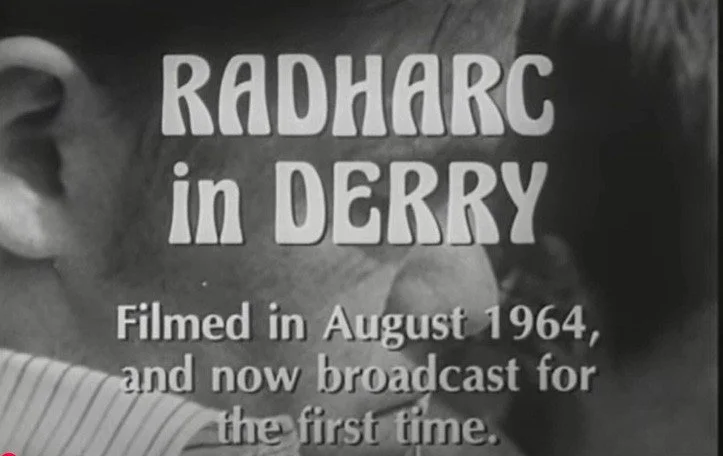
RTÉ’s first film of gerrymandering and discrimination in the north that was shelved after political pressure in 1964
John Breslin, Irish News, May 27th, 2025
How the first ever in-depth RTÉ investigation on what has happening in the north was shelved – most likely for political reasons and not broadcast for another 25 years
Radharc in Derry was broadcast 25 years after its filming in the city in 1964, explaining the gerrymandering for the first time to a southern audience.
IT IS a remarkable piece of film-making that would have starkly detailed discrimination and gerrymandering for the first time to an audience in the Republic – if it had been broadcast 60 years ago.
In the summer of 1964, a team from RTÉ, mostly priests trained internationally in broadcasting, travelled north to Derry to investigate and detail the gerrymandering of the political boundaries of the city and discrimination in jobs and housing.
Leading members of the nationalist community in the city were interviewed – wise, measured, older, heads that included then Nationalist Party leader Eddie McAteer and an esteemed local schoolteacher, Paddy Friel, father of the playwright Brian. Unionists declined to be interviewed.
One remarkable element was that this was the first time the fledgling Irish television station had commissioned any in depth piece on the north, says Professor Robert Savage, a leading expert on modern Irish history and the media.
The Radharc programme was due to be broadcast in 1965. It never happened then or in the subsequent years as the north cooked and then reached beyond boiling point.
Unseen for 25 years
It would not be publicly seen for 25 years. It would be 1968, just months before the October civil rights march in Derry, before RTÉ would finally broadcast any in depth programme on the north.
Lance Pettitt, in Screening Ireland, his book on Irish film and television, said the programme was “prescient because it identified the key issues in the civil rights campaign that followed”.
Joe Dunn, one of the producers, later wrote: “The programme was edited and being prepared for transmission by the end of ‘64. But very early in the new year word came from the programme controller to say that he would prefer not to broadcast it.
“The reason given was that it would be inopportune to show it when the taoiseach was meeting the prime minister of Northern Ireland for the first time.”
It is not known whether pressure was quietly placed by the Irish government on the controller, Gunner Rugheimer, but it would not be surprising, added Prof Savage, of Boston College in the US.
In January 1965, Taoiseach Sean Lemass and Prime Minister Terence O’Neill had two meetings, one in Belfast, the next in Dublin. It was a breakthrough at a time when O’Neill was beginning to talk about at least some reform.
But the conversations between Lemass and O’Neill centred almost exclusively around the economy and tourism.
Discrimination and blatant gerrymandering were not on the agenda, or likely on the minds of the majority of people in the Republic.
As Mr McAteer diplomatically told the interviewer: “There is a lack of understanding in the south as to what the problems of living in the north (are).”
“I would not be surprised if Lemass intervened to halt the programme,” argues Prof Savage.
“He had not hesitated in the past to complain about RTÉ programmes critical of his government. But in this case he may have successfully argued that the programme would undermine his efforts to reach out to O’Neill.
“It is a pity because the programme is excellent and would have enabled the Irish public a chance to get a sense of what was wrong north of the border.”
Along with Mr McAteer and Mr Friel, the programme also featured Frank McCauley of the Catholic Registration Association, James Doherty, also of the Nationalist Party, and Dr Jim McCabe of the Hospitals Appointments Board.
The film, shot during the marching season, is interspersed with footage of the marchers and bands in the city centre and on the walls overlooking the Bogside.
In clear language, it details how most of the city’s majority nationalist population was squeezed into a single ward, returning eight seats to the then Corporation, while the two others with unionist majorities returned 12.
80% of the corporation jobs went to those from a Protestant background, with not a single Catholic allowed to be employed within the walls of the Guildhall.
The story is told of a young married couple from the politically dominant community immediately being granted a house, while more than 2,000 Catholics were on the waiting list.
Nationalist Party leader Eddie McAteer
Nationalist Party leader Eddie McAteer featured in the shelved documentary list, some for multiple years.
Interviewees talk of both hope for the future, but also express deep scepticism unionists will move to change the status quo.
“It is a pity because the programme explained in simple accessible language not only the history of Derry but how gerrymandering worked in the city,” says Prof Savage.
He adds: “People in the Republic had ignored Northern Ireland and one could argue were not well informed about the discrimination that was embedded in its culture.
“This ignorance inhibited an understanding of the problems that challenged the Catholic community.”
Radharc was one of the most watched programmes and with “extraordinarily high production quality and very well written”, says Prof Savage, who to the present day shows this film to his history and media students.
He says that “RTÉ ignored Northern Ireland until 7 Days travelled north in July 1968”, only months before the October march that is often cited as the start of the Troubles.
“What is really extraordinary is the total lack of coverage done by news and current affairs,” Prof Savage adds
The film almost certainly would have been seen by British representatives, most definitely by the then ambassador to Ireland, Geofroy Troy.
It will never be known what impact the film might have had, potentially a catalyst for conversation among the people in the south, possibly leading to more pressure on politicians to become more involved in what was happening over the border.
Before it all went south, so violently.
Saoradh raps Derry businessman for Irvine reference
Allison Morris, Belfast Telegraph, Sunday 27th, 2025
A Derry businessman who provided a court reference to loyalist gunrunner Winston Irvine has been criticised by dissident republicans.
In a joint character reference with the Rev Harold Good submitted to a judge before Irvine's recent sentencing on firearms charges, Derry city centre manager Jim Roddy described him as “honest” and “trustworthy”.
Mr Roddy and Rev Good stated the reference was “based on our experience and the work that we have carried out with him over the last six years”.
Irvine, jailed last week for possession of guns and ammo, was believed to have been employed to help negotiate in the city after a loyalist flute band wore Parachute Regiment insignia on their uniforms during an Apprentice Boys parade in 2019.
Mr Roddy is known for his work as a facilitator in community and peace-building issues.
As part of this he has been involved in various processes with dissident groups.
However, that work now seems to be jeopardy after the release of a statement by Saoradh, widely believed to be the political wing of the New IRA. It described Mr Roddy's letter as “shameful”, as Irvine “represents the very forces that have for decades inflicted terror and intimidation upon Nationalist and Republican communities”.
“These actions further expose the collaborative nature of political policing in the Occupied Six Counties and the continued normalisation of loyalist criminality under the guise of so-called 'community engagement',” it said.
Irvine (49), from Ballysillan Road, Belfast, was given a two-and-a-half-year sentence last week.
Co-accused Robin Workman (54), of Shore Road, Larne, was sentenced to five years.
During sentencing Judge Gordon Kerr KC said despite Irvine's guilty plea, he had declined to give any explanation.
However, the judge said he did not consider the crimes to be connected to terrorism.
He also said he did not consider it proper to impose the statutory minimum sentence for five years due to Irvine's circumstances.
The judge said he considered previous references which described Irvine's “character and long-term commitment to peace building in Northern Ireland”.
Several referees sought anonymity
Mr Roddy was among a number of referees who sought anonymity.
This request was declined by Mr Justice Kerr, who released the documents to the Belfast Telegraph following sentencing.
The glowing reference submitted by Mr Roddy and Rev Good read: “In light of our roles and because of threats that have been issued in the past, we would ask the court to grant us anonymity.
“We are both known as trusted facilitators within the peace-building community and beyond.
“We have worked very closely with Winston Irvine and many others over the past six years on problems relating to intercommunal disputes and issues relating to the legacy of the conflict in Northern Ireland.
“In our work we have always found Winston to be honest, trustworthy and someone who is prepared, along with the rest of us, to take risks to secure peaceful outcomes to some very difficult disputes between the different traditions within our community.
Taking risks
“Such is the nature of this work these risks that we have taken range from reputational risk to personal physical risk.
“The contentious issues that we have been working on include parading, bonfires, street violence, flags/emblems, community identity and legacy. We only engage in such work by invitation and with those who have demonstrated that they are committed to building a peaceful, non-violent society for all of our citizens.
“Winston has always subscribed to these principles, and indeed encouraged others to compromise, where this may have seemed unlikely.
“Our engagement over the past six years has been continual and we would have cooperated regularly and without break with each other during this period.”
In a statement to the Belfast Telegraph, Mr Roddy said the reference was provided prior to Irvine's guilty plea last December.
“In June 2022 I was asked by Mr Irvine's solicitor if I would provide a testimonial to attest to the work that I had been involved in, over a number of years, with Winston Irvine.
“This was for the purpose of a bail application before the High Court in relation to the firearms and ammunitions charges that he faced.
“The reference was written at a time when Mr Irvine had pleaded his innocence in respect of the charges and was presumed innocent.
“The contents of the reference related to a summary of the work we had been involved in which included issues such as parading, bonfires, street violence, flags and emblems, and legacy.
“I will continue to work with people from every part of our community in the spirit of cooperation and reconciliation, and with a view to making our city and the wider region a more receptive place for all its inhabitants.”
Pollsters told health is a priority but nobody votes Sinn Fein or DUP because they reduce waiting lists
Malachi O’Doherty, Belfast Telegraph, May 27th, 2025
The primary concern of most people in Northern Ireland is that the health service here should be fixed.
Logically therefore, you'd think, if a political party emerged which made that its number one objective, that party would win a massive majority.
But it doesn't work that way here.
Every party says that it wants to fix the health service — but when it comes to allocating ministerial seats in the Executive, health is the parcel that everyone wants to pass.
This is evidence enough that the political system we have does not deliver for the wishes of the people and that it can't.
It's very easy to see what people here want.
The LucidTalk poll published in yesterday's Belfast Telegraph makes it plain.
All groups — nationalist, unionist and others — say healthcare and the NHS comes first.
They disagree a little on how they rank in importance the economy, the cost of living and education, but plainly all say that general health and wellbeing, the home-comfort issues, are more important to them than the constitution, the flag issues.
This is what you'd expect — that the practical concerns of daily life would take precedence over identity and constitutional questions.
There is a hierarchy of needs in everyone's life, and usually the flag you can't eat comes after the bread that you can.
Getting a doctor's appointment, or getting seen to in A&E without having to wait for hours, is more important for most of us than what is, for some, the pre-eminent concern of their whole lives — preserving the Union or uniting Ireland.
If you are stressed out waiting for a hip operation or a place in a nursing home, the only way anyone is going to stimulate your immediate interest in the constitutional question is by showing you how one position or the other will solve your problems.
So why do so many vote, as they do, on traditional lines, for parties that prioritise the constitution?
Interestingly, unionists are more concerned about the constitution than nationalists are, with 46% of them prioritising the Union while 32% of nationalists prioritise a united Ireland.
Perhaps they believe that preserving the Union amounts to preserving the health service. The NHS is a British national service, after all.
Yet it is in serious decline and the way to save it might not be to put your energies into shoring up a Union which is under no immediate threat.
The British have worked out that most people here are more concerned with health and the economy and they can therefore disregard unionist angst about an Irish Sea border.
A third of the nationalist population say that the unification of Ireland is more important to them than healthcare or the economy. And you have to wonder why.
Some might reply that unification would solve the problems with healthcare and the economy. Maybe it would. I don't see how.
What this poll tells us is that there are people in Northern Ireland who wake up every day wishing they were in a united Ireland or fretting about the Union, for whom the constitutional status of the region is more important than getting a doctor's appointment or a job. Maybe they don't have those problems. But they are in a minority.
What comes out of this poll, as out of every poll of its kind, is that the concerns of the people do not map onto the spread of the political parties they vote for.
Fantasy politics
Logically, if we had a political system and a range of parties that represented our concerns in proportion, the Healthcare Party would lead.
But this is all fantasy because our political system is structured on the assumption that we are all more concerned about national identity and the constitution than about healthcare and the cost of living. And this poll says that is not so.
Nobody votes for Sinn Fein or the DUP because they think they are better able to fix healthcare and get waiting lists down.
We know this because both, when offered the chance to take the health portfolio, pass it on to the Ulster Unionists, a party they can bully and blame.
We vote on communal lines for identity parties even as we tell pollsters about our waning interest in them.
So that system has to change.
It presents us with a democratic deficit, a blockage against the concerns of the voters being translated into political action that can meet those demands.
We are putting parties into power which represent minority concerns even within the communities they claim to represent. This is bonkers.
If we were starting from scratch, we would not be devising a system of rivalrous power-sharing around nationalist and unionist identity concerns.
We would see that simple majority rule would serve us better.
Lawmakers should give every pupil right to wear trousers - Claire Sugden
‘No child should feel unsafe because of what they have to wear to school’
Paul Ainsworth, Irish News, May 27th, 2025
NEW legislation aiming to reduce the cost of school uniforms should also guarantee the right of all pupils to wear trousers in the classroom, says Independent unionist Claire Sugden, who has tabled an amendment to the School Uniforms Bill that would see trousers allowed to be worn by all pupils, while those partaking in PE would also be allowed to wear shorts instead of skirts.
The amendment comes in the wake of the ‘skorts’ row that recently engulfed the Camogie Association, ending in a ruling this month that players will be allowed to wear regular shorts instead of shorts designed to appear as a short skirt.
The Bill introduced in the Assembly by Education Minister Paul Givan earlier this year will force schools to follow departmental guidelines and address “unfair costs aspects” regarding uniform requirements.
Former justice minister Ms Sugden said her amendment followed a conversation with a seven-year-old girl who raised concerns about being made to wear a skirt and shared fears around ‘upskirting’ – the unwanted taking of pictures under clothing, which was made illegal in Northern Ireland in 2022.
“This young girl’s courage in raising such a serious issue really stayed with me,” she said.
Giving girls a choice
“No child should feel uncomfortable or unsafe because of what they’re required to wear to school. This change is about giving girls a choice they always should have had.”
Some schools in the north already allow female pupils the choice of wearing trousers instead of skirts as part of their uniform.
The amendment would require all schools in the north to offer trousers and shorts as part of standard and sports uniform options.
Ms Sugden said the amendment would be a “practical, immediate response” to the problem of upskirting and associated offending, but said the issue must be addressed in school through methods including comprehensive Relationships and Sexuality Education.
“Uniform policy may seem like a small detail, but it reflects bigger values around dignity, safety and respect,” the East Derry MLA said.
“Children, especially young girls, should never be made to feel vulnerable at school. This is one way we can respond to those concerns now.”
A campaign to offer all female pupils in the north the choice to wear trousers was launched earlier this year by two Enniskillen Integrated Primary School pupils, Rhea Flood and Astrid Knox, who have received the backing of the NI Commissioner for Children and Young People.
False PSNI sectarianism allegation 'impacts on confidence in police' says TUV
By Adam Kula, Belfast News Letter, May 27th, 2025
The TUV aims to raise the issue of false sectarian claims against the police in the Assembly, saying the saga “directly impacts public confidence in the PSNI” and accusing the police leadership of “mishandling” the affair.
It has tabled two attempts to bring the issue to the floor tomorrow – one in the form of a question to the justice minister Naomi Long, the other in the form of a call for a general debate.
It will likely not be known until later this morning whether either attempt has succeeded.
It is also understood the DUP plans to raise the issue this week too.
The News Letter has been following the case of the accusations since they were made 11 weeks ago.
They stem from a former Tactical Support Group officer called Sean (not his real name) who alleged he had heard other officers talking about "fenian b******s", heard personnel swearing at "green" politicians when they came on TV, heard them mocking him for wearing ash on Ash Wednesday, and heard them whistling The Sash around the Twelfth.
He has since come out publicly and admitted to making the whole thing up.
His written retraction of his claims was the front page story of the News Letter's weekend edition.
In his confession, Sean also asked for forgiveness from his former colleagues for inventing the accusations (though he gave no clear explanation as to why he had done so, other than saying he was unwell and vulnerable).
The TUV MLA Timothy Gaston has submitted the following to be raised at Stormont tomorrow: "To ask the Minister of Justice, in light of the public retraction by the former PSNI officer known as 'Sean' of his allegations of sectarianism within the Tactical Support Group, what steps will the minister take to restore public confidence in the impartiality and integrity of policing in Northern Ireland?"
He said the police's handling of the whole affair "raises immediate concerns about the judgement, impartiality, and decision-making processes of senior leadership within the PSNI," adding: "Given the serious reputational damage caused, and the potential erosion of public trust in policing oversight, it is urgent that the Minister of Justice addresses these matters without delay…
"This development has direct implications for the operational accountability of the PSNI and for the role of the Department of Justice in ensuring public confidence in the impartial administration of policing.
"The minister must now be given the opportunity to respond to these concerns in the Assembly and outline what steps will be taken to restore trust and address the mishandling of this issue by PSNI leadership."
He has also asked for the issue to be debated as a "matter of the day", adding: "This issue directly impacts public confidence in the PSNI, an institution central to law, order, and community relations.
"The initial allegations risked deepening community tensions and undermining faith in policing.
"Their retraction affects not only those falsely implicated but also the broader public, whose trust in justice and truth has been placed at stake."
In his confession, Sean had said: “The allegations I made are all untrue. I am unequivocal about that.
"Nobody subjected me to sectarian abuse for wearing ash on my forehead. Not once did I hear Catholic colleagues being referred to as ‘fenian b******s’. I never heard colleagues whistling The Sash in corridors. I never heard or saw colleagues referring to nationalist politicians on TV as ‘fenians’.
"I am deeply sorry that I claimed I had experienced sectarian abuse or witnessed sectarianism in the PSNI. I am also sorry that I alleged to the Chief Constable that I had ever experienced nuanced sectarianism in the PSNI.
"The TSG I served in was a diverse group of men and women and I never saw or heard a single one of them speak in a sectarian way or engage in any bullying or unprofessional behaviour. I am proud to say that I served in a team that treated colleagues and the public professionally, fairly and with humanity.”
The former PSNI head of discipline Jon Burrows, who has been acting as a spokesman for many of Sean’s maligned former officers, has said: “We extend grace to Sean. Get well brother.”
The PSNI is continuing its refusal to comment on the ‘Sean’ case to the News Letter.
Saying Nothing
When Timothy Gaston’s comments above were put to the PSNI, it said “we have nothing to add to the Chief Constable’s statement issued on Saturday”.
This echoed its stance earlier in the month, long before Sean’s retraction at the weekend, when the force was asked repeatedly to comment on the story.
Its response had been that it had nothing further to say beyond what the chief constable had told the Policing Board on May 8.
Though Sean’s allegations of sectarianism originated in a Belfast Telegraph article on March 8, the story began to gather pace earlier this month after the chief constable Jon Boutcher addressed the issue at the Policing Board.
He told members that whilst he was “absolutely satisfied” that Sean did not in fact suffer any sectarianism, he stressed that Sean was a “thoroughly decent” man.
This led to confusion about how both things could be true at once, though the chief constable refused to elaborate on the issue further.
He told the Policing Board “I'm not going to discuss it any further than I already have in public, and I'm going to draw a line under it”, and likewise rebuffed the News Letter’s efforts to elicit more comment in the weeks that followed.
On Saturday, after the News Letter broke the story of Sean recanting his accusations, the chief constable issued a statement saying: “I was aware that Sean may provide a retraction but have deliberately waited for him to take this step before commenting. I have said publicly and very clearly to the Policing Board and reiterate again now, there was no sectarianism in this case.”
Among the questions posed to him by the News Letter at the weekend were why Mr Boutcher had said he was “neutral” on the claims of Sean back in April, when dozens of former officers had come forwards to dispute them;
Why he described Sean as “thoroughly decent” when it was becoming clear his accusations were untrue;
Whether the false claims influenced his decision to launch an internal staff survey into sectarianism / racism / sexism / homophobia this autumn – and whether this will still be going ahead.