Independent Commission for Reconciliation and Information Recovery has faced multiple issues since inception
MARK HENNESSY, Ireland and Britain Editor, Irish Times, April 16th, 2026
A formal inquiry has been ordered into Northern Ireland’s legacy body following an earlier investigation that highlighted major governance and cultural failings.
The Independent Commission for Reconciliation and Information Recovery (ICRIR) has been dogged by problems since it was created as part of controversial legacy legislation passed by the Conservatives before they lost power in 2024.
To date, it has already spent £70 million (€80.5 million) and is seeking “hundreds of millions” more to complete hundreds of investigations into killings committed by the IRA and other paramilitaries, the British army and the Royal Ulster Constabulary, among others.
Currently, however, the ICRIR has approximately 150 people involved in investigations – far too few in the eyes of those who want the body to be an organisation more driven by its core task.
It has approximately 120 administrative staff, including 16 full-time lawyers, which Police Service of Northern Ireland (PSNI) Chief Constable Jon Boutcher has pointed to, saying that the Operation Kenova he led did not have a single lawyer on staff.
Last year, Northern Secretary Hilary Benn ordered an inquiry headed by Peter May, who found serious internal governance weaknesses and cultural problems at senior level within the ICRIR that pointed to “systemic leadership and organisational failings”.
Over 100 investigations but shortage of investigators
In a statement to the House of Commons on Wednesday, Benn said the ICRIR headed by former judge Declan Morgan has “worked hard to build trust so that it can start delivering answers for victims and families”.
Despite criticisms from Sinn Féin and others that the body has no credibility, more than 270 families of Troubles’ victims have already brought their cases to the body, with more than 100 active investigations under way.
The body is facing a number of problems resulting, in Peter May’s view, “from a combination of the 2023 Legacy Act itself, internal governance shortcomings and the culture of the organisation at senior levels.”
Since then, he has met each of the body’s commissioners and has established a joint ICRIR-NIO oversight committee to ensure that the May review’s recommendations are addressed.
The Section 36 inquiry that has now been ordered, however, is far more powerful, with legal powers to make recommendations to Westminster for wholesale reforms to the legacy body.
“It is vital that the Commission’s important work continues on behalf of victims, survivors and their families, as they seek to find answers after so many years,” Benn told MPs.
“The internal challenges faced by ICRIR as a new public organisation tasked with a complex statutory role must not detract from this,” he said, adding that he would “do everything” to ensure reforms are delivered.
The “significant” new inquiry ordered by Benn will focus heavily on whether the ICRIR has been financially well-run since its creation, where complaints have been heard about its administrative competence.
In the eyes of some experts, the ICRIR has little more than third of the investigators it needs if it is to fulfil its mandate. Currently, An Garda Síochána does not deal with it because it does not regard it as a policing-led body.
Some civil service quarters are accused of trying to limit the number of investigations to ensure that it does not become “another Operation Kenova” investigation, informed sources have told The Irish Times.
So far, the ICRIR has spent nearly a third of the budget it was originally allocated by London, yet it has so far failed to produce a single report on an individual murder committed during the Troubles.
This failure is blamed by informed quarters not on the ICRIR’s head, Declan Morgan, or other senior figures, but, rather, because it has just “35 per cent to 40 per cent of the investigators needed”, The Irish Times has been told.
Review of Troubles legacy body reveals ‘problems’ with culture and governance
CONNLA YOUNG CRIME and SECURITY CORRESPONDENT, Irish News, April 16th, 2026
A REVIEW of a controversial legacy body by ex-senior civil servant Peter May has found “problems” with the “culture of the organisation at senior levels” and “internal governance shortcomings”.
Secretary of State Hilary Benn revealed the critical assessment of the Independent Commission for Reconciliation and Information Recovery (ICRIR) on Tuesday.
It followed a review carried out by former Stormont health department permanent secretary Peter May.
Mr Benn now plans to commission a ‘Section 36’ performance review of the ICRIR.
The body was established under the Conservative Party’s Legacy Act in 2023 and is now set to be rebranded the Legacy Commission.
The Court of Appeal has previously found that a British government veto over sensitive material that can be disclosed by the commission to relatives of the dead is not compatible with human rights laws.
In a written statement, Mr Benn said his government is “committed to fundamental reform of the ICRIR”.
While the report has yet to be published, Mr Benn set out some of the conclusions reached by Mr May.
“Following a number of concerns about corporate effectiveness and culture raised directly with the Northern Ireland Office, Peter May was jointly commissioned by the NIO and the ICRIR board to deliver a review of the corporate effectiveness and cultural health of the ICRIR,” he said.
“His findings, submitted to me at the end of February, identified that the organisation is facing a number of problems resulting, in his view, from a combination of the 2023 Legacy Act itself, internal governance shortcomings and the culture of the organisation at senior levels.”
Mr Benn said he has now “established a joint ICRIR-NIO oversight committee to ensure that the review’s recommendations are addressed” and “provided additional dedicated sponsorship resource to support the organisation”.
Daniel Holder, of the Committee on the Administration of Justice, said “whilst we await the detail of the re-port it appears from today’s ministerial statement to be quite damning.”
Mark Thompson of Relatives for Justice said the “ICRIR is incapable of functioning in the real interests of families impacted by the conflict”.
A spokeswoman for the ICRIR said the “review recognises real strengths, however, as with any newly established organisation growing at pace, the review also identifies areas where change is needed”.
Justice Minister meets Belfast Victims Campaigner in Dublin today
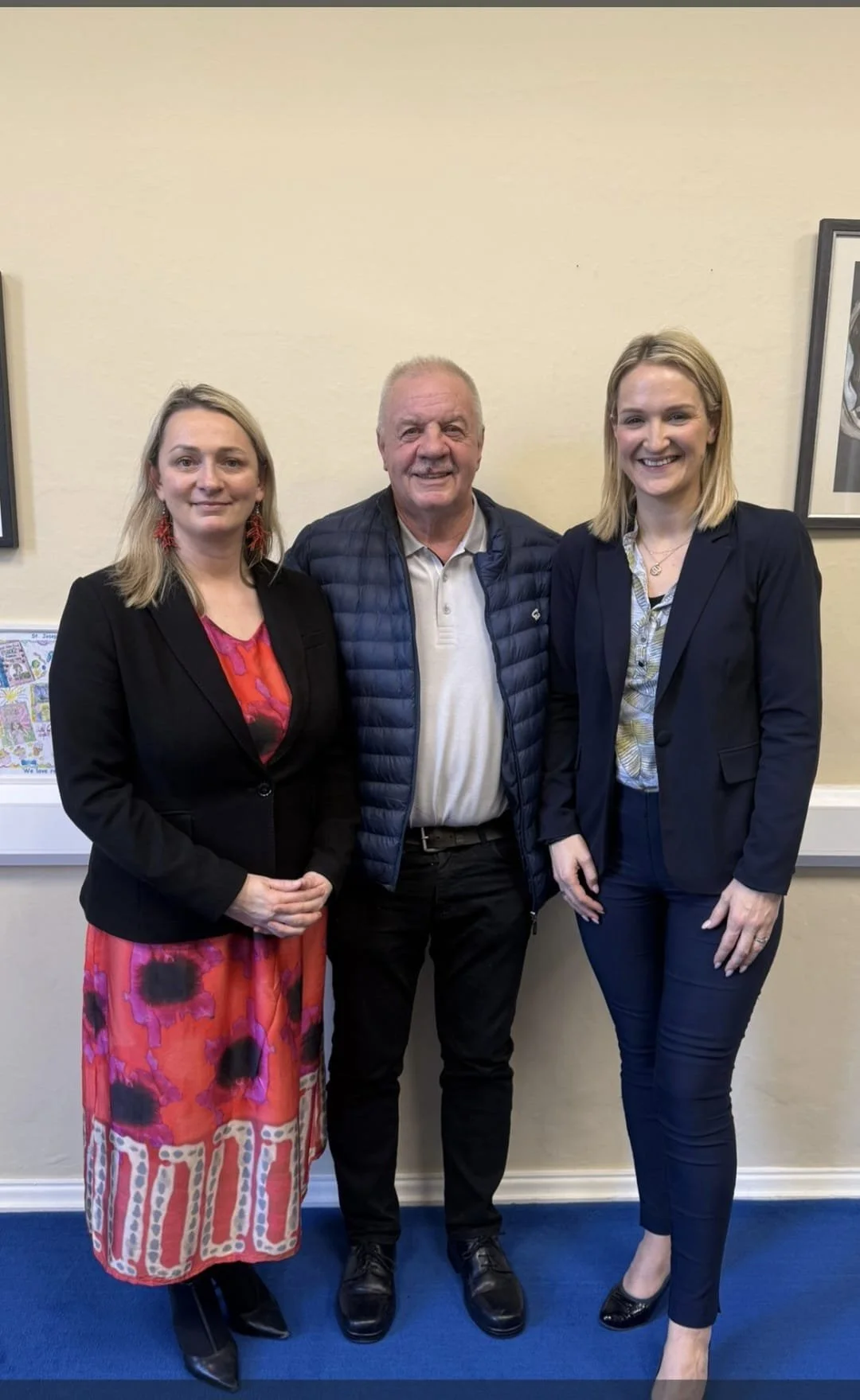
Yesterday's meeting in Leinster House with Minister for Foreign Affairs Helen McIntee, Emer Currie and a senior official was very positive and productive.
Discussing victims issues including the murder of my son Raymond Jr by the UVF with politicians from Dublin is nothing new now and I thank them for it.
Other matters were discussed and the Minister and her department are supporting me in bringing victims events to the ROI.
Again this is much appreciated.
It shows how badly our dysfunctional government at Stormont is when I have to go to Dublin to meet people from a foreign yet so friendly government to push for truth and justice for my murdered son and others, while the circus continues with a point scoring self serving narrative presented to the people instead of reconciliation ,respect and progressive politics.
Bryson urges unionist students to wear sashes and join 'culture war' on campus
SUZANNE BREEN, Belfast Telegraph, April 16th, 2026
LOYALIST CALLS FOR A 'TIT-FOR-TAT RESPONSE' TO PRESENCE OF GAA TOPS AT UNIVERSITIES
Jamie Bryson is calling on unionist students at Queen's and Ulster University to “join the culture war against nationalism” and promote their politics aggressively on campus.
Addressing Ulster University's Orange societies, the loyalist urged young unionists to attend lectures wearing Orange Order T-shirts and sweaters, and to parade around campus in their sashes.
“There are many simple and strategic battles to be fought,” he told the gathering in south Belfast.
“Let us begin with the whole visual atmosphere. Have you ever seen so many GAA tops as you do at your university? You will see more GAA tops at Queen's University than you will at Croke Park.
“Universities are visually nationalist in terms of the people who are willing to manifest — proudly — their cultural and political aspirations and identity.
“I've no idea what the policy is, but if GAA tops are acceptable, then so should you all be attending your classes wearing Orange Order merchandise — Orange Order T-shirts and fleeces.
“Proudly show who and what you are. There can be no policy difference made by the university because there is no rational basis for doing so.”
Mr Bryson said unionist students must take a “retaliatory” approach.
“I am not sure if you see many Celtic shirts, but if you do, make sure you've got your Rangers shirt on.
“If they want to have Irish language gatherings and protests, then get the sash on and organise a parade around the university. This may sound 'tit-for-tat', and that is exactly what it is.
“In class when you hear those subtle biases, when you hear the rewriting of history, or events churning out legacy propaganda and purported legal academic 'analysis' supporting nationalism's latest cause, challenge it.
Cultural aggression
“Speak out. Risk being sneered at in class. Wear that as a badge of honour — you are striking a blow for your own people. We must build a generation, a student-led movement, which aggressively is on the cultural offensive.
“A generation of unionists who break the mould of the current eco-system and change the direction of travel: where the flow into the professional class is not for a pro-nationalist dispensation, but rather a pro-Union one.”
Mr Bryson, who is doing a masters in law part-time at UU, described universities as “the incubator of future soldiers in the culture war — a battlefield, and a key one”. He said: “A small number of unionists in both Queen's and Ulster have tried to fight back. We all owe them a debt of gratitude, but it is not enough. They are vastly outnumbered, and aren't receiving the kind of political support, media propaganda and credentialing of their ideas and cause by civic infrastructure as that available to nationalists.
“Every unionist in university must join the fight. It is a battle for control of ideas and the eco-system which ultimately feeds the professional class. That eco-system is strongly pro-nationalist and hyper liberal.”
He claimed the Good Friday Agreement had “energised a generation of nationalists” and “demobilised and demoralised a generation of unionists”.
The “energised nationalists” using “education as their new weapon” had “flooded media, academia and the legal profession with activists”. A “nationalist 'counter-state' infrastructure existed of law firms, journalists, and lobbying and community groups”.
“At times such persons are shamelessly pro-nationalist; at others, subtly so. Indeed, the subtle activists are more dangerous than the wolves who come as wolves,” the loyalist added.
He claimed that for too long unionists had been “passive victims. The tendency was to placate, to pander, to appease”.
“Unionist culture and traditions was something to apologise for, to be — if we are lucky — contained, controlled and managed towards eradication. Forever on the defensive; forever fighting just to be tolerated or acknowledged; always playing second-fiddle to nationalism's insatiable demands.
“We are told we must embrace Irishness, but of course no one ever tells nationalists they must embrace Britishness. We must cherish the Irish Language. We must discuss a 'New Ireland'. We must embrace the GAA.
“The Orange Order cannot walk for three minutes up the Crumlin Road or down Drumcree because the majority of residents in areas within the vicinity, apparently, object. But 15% of residents in any street is enough to impose divisive Irish language signage.”
He claimed unionists' position was symbolised by the Irish Sea border.
“Nationalism couldn't tolerate so much as a CCTV camera on the land border. So unionism — eating constitutional excrement with a smile — had to accept a sea border down the middle of our own country,” he said.
“Political unionism has been weak both culturally and constitutionally. You don't negotiate with a crocodile in the hope it's going to eat you last.”
Move to axe up to 450 jobs at Ulster University 'shocking' and 'alarming'
GARRETT HARGAN, Belfast Telegraph, April 16th, 2026
Ulster University staff are said to be in “shock” after it was announced that 450 jobs are to be cut.
Ulster University, which educates more than 30,000 students, employs 3,100 staff across its campuses in Belfast, Jordanstown, Coleraine and Londonderry.
It is understood that Vice Chancellor Prof Paul Bartholomew informed staff about the potential 450 job cuts, in what has been described as a 'voluntary' severance scheme, in a meeting yesterday.
Sources told this newspaper that the announcement was made over Teams calls, in which the chat option was disabled, meaning staff were unable to express their views.
It is understood the briefing forms part of a wider consultation process, with full details of the proposed scheme not yet finalised.
Norman Hagan, chair of the Ulster University branch of the University and College Union (UCU), said the “shocking” announcement is “unprecedented”.
He added that the move “represents a direct threat to the quality of education, respect for staff, desires and ambitions of students” and the long-term future of the university.
“Staff already work under sustained pressure, with rising workloads and impossible demands. Imposing redundancies on this scale is deeply alarming and unsustainable.
“Removing hundreds of staff will fundamentally damage the student experience and weaken academic provision.
“Our members deserve full transparency, genuine consultation, in line with legal obligations, as well as the opportunity to challenge the assumptions underpinning these decisions.
“Any process that falls short of this will be robustly contested, and our members will not be afraid to take action to challenge these decisions.
“We are also clear: compulsory redundancies will be strongly resisted.”
Integrity of higher education
He added: “This is not just about jobs; it is about protecting the integrity of higher education in Northern Ireland. Ulster University plays a critical civic role, and decisions of this magnitude, if forced through, would have far-reaching detrimental consequences for students, local communities, and the wider regional economy.
Shaun Harkin, People Before Profit councillor in Derry, said the news that 450 jobs could be affected is “devastating”.
He added: “It has come as a shock for long-serving staff. The justification for this is to make savings. It is unclear why this is necessary.
“It is not acceptable in this climate for these jobs to be put at risk.”
DUP economy spokesman Phillip Brett said universities have been warning that the current funding model imposed by the Department for the Economy is unsustainable.
“Yet Sinn Féin ministers have failed to bring forward a credible plan to support higher education, leaving institutions like Ulster University facing impossible financial pressures,” the MLA added.
“Today's announcement shows the scale of this failure. Behind every one of these potential job losses is a family facing uncertainty and a student experience that will inevitably be impacted.
“This is not just a financial issue; it is a failure of leadership. Promises around expansion, including at Magee, now ring hollow when basic funding cannot be secured to sustain existing provision.”
East Londonderry MLA Claire Sugden said this will be “deeply worrying news for staff and students”.
She added: “There have already been concerns about the long-term future of the Coleraine campus, and announcements like this will only add to that uncertainty.
“For many people locally, this raises real questions about what the future looks like, not just for staff but also for the wider community.”
Alliance economy spokesperson Kate Nicholl MLA said she was concerned but not surprised by the announcement, citing ongoing financial pressures in higher education.
She confirmed Alliance has sought meetings with university leadership and raised urgent questions with the Economy Minister.
SDLP economy spokesperson Sinéad McLaughlin further warned the cuts would impact families, local communities and the wider economy, and could undermine ambitions to expand Magee.
In a statement to the BBC, a spokesperson for the university has said: “Ulster University has sought to hold off on making redundancies while continuing to work with the Department for the Economy, through their reviews, on possible changes to the HE funding model in Northern Ireland.”
It added: “It has recently been made clear to us that a sustainable funding model is not going to be forthcoming and, regretfully, we must now act to reduce our costs.”
A spokesperson for the Department for the Economy said finances are “extremely challenging”, as they urged the government in Westminster to deliver a “sustainable funding model” which “allows for investment in transformation while delivering quality public services”.
“This announcement by Ulster University is another example of the real world consequences of those warnings not being heeded,” they added.
Ulster University and Sinn Féin have been contacted for comment.
Sinn Féin opposes two-year lockout for failed Irish street sign bids
Belfast City Council has now deferred the decision
By Michael Kenwood and Conor Sheils, Irish News, April 15th, 2026
Sinn Féin has opposed a proposal by Belfast City Council officials that would bar streets from reapplying for Irish language signage for two years if they fail to meet the required support threshold.
At a Belfast City Council committee meeting this week, officials put forward a plan to address a gap in policy covering streets that fall short of the 15 percent approval needed for dual language signage.
Despite Sinn Féin’s opposition, parties agreed to defer pending further information, including a report on demographic change.
Council officers recommended a two-year bar on streets reapplying in the same language after a failed application, while allowing applications for a different language to proceed under current policy.
Since the introduction of the new street sign policy, 33 streets have failed to meet the 15 percent threshold — all of them Irish language applications. Of those, 13 streets subsequently submitted further applications in either the same or a different language, mostly Irish but with some in Ulster Scots.
922 signage applications pending
There are currently 922 streets waiting to be processed for dual language signage, with the council clearing an average of eight streets a month — a rate that would take more than nine years to clear the existing backlog.
Sinn Féin councillor Matt Garrett said his party could not support streets being locked out of reapplying.
“There will obviously be changes in a street — people will move in and people will move out. They should have the ability to apply and have the street resurveyed,” he said.
“If we are being honest, there is a backlog around Irish street signs. What we are saying is that if we were to put them back on the list, and it is three, four, five, seven years before they would be resurveyed, I don’t think it is fair we are asking anybody that they can’t have the ability to reapply.”
Green Party councillor Anthony Flynn questioned the practical impact of the proposal given the scale of the backlog.
“If we were to refuse an application today, and someone puts in a new application tomorrow, it’s going to take years for us to get to the application anyway,” he said. “So I don’t think it makes a huge amount of difference.”
DUP councillor Sarah Bunting backed the officials’ recommendations, saying some structure was needed to prevent repeated applications.
“If we don’t respect that threshold, as low as it is, then we are left with applications that just keep coming back again and again in the hope of a different result,” she said. “That is not a robust or fair system to have.”
Councillor Bunting also raised the question of whether the policy should allow for signs to be removed where demographics had shifted in the other direction.
“We don’t have anything in this policy to provide for a demographic change that wants to see a dual language sign, that has already been put up, be taken down. That is something we need to look at,” she said.
The dual language street sign policy was agreed by councillors in 2022, supported by Sinn Féin, Alliance, the SDLP, the Green Party and People Before Profit, and opposed by the DUP, UUP and PUP.
Under the policy, a single resident or councillor can trigger a consultation, with 15 percent support sufficient to erect a sign.
Strength of evidence against man charged with murdering Lyra McKee questioned
REBECCA BLACK, Irish News, April 16th, 2026
THE strength of evidence against a man jointly charged with the murder of journalist Lyra McKee has been questioned by his defence barrister.
The 29-year-old author died after being hit by a bullet as she stood close to police vehicles while observing disturbances in the Creggan area of Derry on April 18 2019.
It came as TV presenter Reggie Yates and an MTV crew were filming in the area for a documentary.
Several petrol bombs had been directed at police and a car was set on fire during chaotic scenes which culminated in four shots being fired towards officers, which the prosecution contend were aimed and deliberate. The New IRA claimed responsibility for the death of Ms McKee.
Paul McIntyre, 58, of Kells Walk in Derry, Peter Cavanagh, 37, of Mary Street, and Jordan Gareth Devine, 25, of Bishop Street, are facing a joint enterprise murder charge.
They are also facing other charges connected to the shooting and the rioting.
Six other Derry men are facing charges including rioting and throwing petrol bombs in the non-jury trial.
Another man accused of rioting and throwing petrol bombs on the night of the murder died during trial proceedings last year.
It is the prosecution’s case that the three men accused of murder had accompanied a lone gunman to the firing point on the night and encouraged or assisted him.
They have all denied the charges and refused to give evidence.
In closing submissions made across two days in March before the Easter break, the prosecution said the three have been linked to the scene by clothing and physical features.
The court has been hearing closing submissions from barristers representing the defendants this week.
Yesterday afternoon, Mark Mulholland KC took issue with the quality of footage used in the prosecution case.
The prosecution, which contends McIntyre played a “leading role”, linked him with Person D seen in the footage.
Mr Mulholland told Judge Patricia Smyth the prosecution’s closing had “not properly reflected the state of the evidence”, and said mobile phone footage of the shooting had been taken from social media and the quality was “degraded”.
“This arises due to compression, it’s the loss of pixels, the detail in the footage, and that is the type of compromised image that this court is being invited as the grounding evidential foundation to come to a conclusion beyond reasonable doubt as the evidence for a murder charge,” he said.
“The footage simply does not pass muster, and if the court accepts that then in terms of the murder charge, it goes no further. There is no other supporting evidence that can salvage the wholly degraded and therefore unreliable imagery being relied upon.”
Mr Mulholland’s submission on behalf of McIntyre is expected to resume this morning.
Court delays could see release of alleged dissident gunman
ALAN ERWIN, Irish News, April 16th, 2026
A PAINTER AND DECORATOR accused of murdering one man and trying to kill a second as part of a dissident republican feud in Belfast must remain in custody, a judge has ruled.
Hugh Black (51) was refused bail amid claims he was the gunman in the assassination of Danny McClean and involved in a separate bid to shoot dead taxi driver Sean O’Reilly four years later.
But a judge warned he could be released in future if there are delays in completing the investigation.
Black, of Rosehead in the city, faces charges of murder, attempted murder and possessing a firearm with intent to endanger life.
Detectives believe both attacks were carried out by Oglaigh na hEireann (ONH) during a conflict within the dissident republican faction.
Mr McClean, 54, was shot at least four times in the head and body as he sat in a car parked on the Cliftonville Road, north Belfast in February 2021.
CCTV footage from the area showed a figure with a distinctive walking style emerge from a Vauxhall Vectra, jog across to the victim’s Audi Q2 and open fire, previous courts heard.
Expert gait analysis provides some support for claims that Black was the gunman, according to the prosecution.
A partial vehicle registration plate match with a Vectra car registered to the defendant also forms part of the case against him.
Black was initially arrested in the aftermath of the shooting, but then released unconditionally at that stage.
Police have also now linked him to the separate attempt on the life of Mr O’Reilly.
Two gunmen targeted the 49-year-old at a cab firm on Bell Steel Manor, west Belfast, in February 2025.
One of the pair opened fire while he was in his Skoda Octavia taxi, leaving him seriously injured from bullet wounds to his shoulder blade and collar bone.
Hugh Blackfaces charges of murder, attempted murder and possessing a firearm with intent to endanger life; below, murder victim Danny McClean.
Gun of accomplice jammed
An accomplice is believed to have brandished a faulty second weapon, which jammed without firing.
The two pistols were discovered stashed in nearby hedges following the attack.
Ballistic examinations confirmed one of the guns had been used to murder Mr McClean four years earlier.
Based on disputed CCTV evidence, police claim the defendant was collected and acted as a look-out in the bid to kill Mr O’Reilly.
With Black denying any involvement in either shooting, he mounted a renewed application for bail at Belfast Magistrates’ Court based on alleged delays in the probe.
Defence solicitor Michael Brentnall argued: “This man has been in custody for a year.
“Both cases are circumstantial, neither of which have forensic or ballistic evidence linking my client to the murder or attempted murder.”
According to an investigating detective, however, releasing him could create “a real and present risk to the public”.
She stressed how both shootings were carried out in open areas.
“The fact Mr Black is charged with offences spanning a period of four years displays a commitment and involvement in dissident republican violent activity,” the detective added.
Deputy District Judge Gerard Trainor refused to grant bail at this stage.
Adjourning proceedings until April 29, he directed that a timeline must be provided for completion of the investigation.
“This case is now getting to the stage where a court is going to grant bail on the grounds of delay,” Mr Trainor said.
Councillor slams Invest NI head for 'disturbing' arms industry comment
GARRETT HARGAN, Belfast Telegraph, April 16th, 2026
The chief executive of Invest NI has been told by a councillor he should resign after suggesting there is an “opportunity” for the arms industry to develop in the north west.
It comes after Invest NI appeared at a business and culture committee meeting in Strabane to provide an update to councillors.
UUP Councillor Derek Hussey raised the potential of arms industry investment in the council area, saying it is a sector of “major growth” at present.
In response, Invest NI chief executive Kieran Donoghue said there was an “opportunity” for defence industry expansion in Northern Ireland, and “potentially for the northwest”.
Mr Donoghue spoke of NI only having one “pure-play” defence company, while others are “dual use”, meaning their products and services “can be sold in either civilian markets or adapted and applied in a defence and security context”.
He added that the Government recently announced a defence growth deal and that NI was identified as a node that will participate in it. Mr Donoghue said he will next week meet with Government representatives to discuss how opportunities can be developed in NI.
Going back to Mr Hussey's question, Mr Donoghue concluded: “So, 'yes' is the short answer.”
That attracted a sharp response from People Before Profit Councillor Shaun Harkin, who said the answer “disturbed” him and that “most people in Derry would be shocked”.
He added: “We have, over the last few years, witnessed absolute barbarism being carried out by the American Government and Israelis in Gaza, where they slaughtered children.
“They've now moved that on to Iran, Lebanon and elsewhere. And the idea that we would be profiting from this, and this would be called an area of opportunity, it's absolutely disgusting, to be quite honest.”
He suggested that Mr Donoghue research what happened to arms company Raytheon in Derry. Its plant was closed in 2010 after sustained protests.
Mr Harkin said that if Mr Donoghue thinks the defence industry allows for opportunity in Derry, he “should actually resign”.
SDLP Councillor Catherine McDaid said that if there was investment in the arms industry in Derry, “that will inevitably contribute to the war machine that is complicit in a genocide and continues to build totally unneeded wars across the Middle East and right across the world”.
Anti-war movement
She spoke of a “clear anti-war movement” in Derry and said the focus should be renewable energy and health science.
Independent Councillor Gary Donnelly said that, although he is not a member of the committee, he was listening and was prepared to give Invest NI “the benefit of the doubt, following years and years of discrimination against this part of Ireland.”
He described Mr Donoghue's comments as “absolutely disgraceful” as he referenced a US missile attack in Iran that killed 170 people, most of whom were schoolgirls.
Defending himself, Mr Donoghue then said he was answering a question: he believes there is an opportunity for the broad defence sector.
He explained: “My response was yes, for the simple reason that countries all over the world — and I don't welcome this, so I'm not making a moral judgment — governments everywhere, right across Europe, are nervous. Their people are scared because of the instability in the world and perceived threats, real or imagined.
“Governments all over the world, regrettably, from their perspective, some of them have said this to me privately, are having to divert more money into defence.
“The question I was asked is 'Does that mean that there is an opportunity for NI?' And I said yes, for the simple reason that Northern Ireland has some capabilities, not related to manufacturing guns or weapons or bombs or bullets, but NI has the capability to develop some technology that might have an application in the defence sector. I specifically then used the phrase 'dual use'.
“But there is a global opportunity out there, and I have no doubt that at some point in the next 12 months or two years, a client will come to us and say: we have a potential opportunity to supply products that we've been supplying into civilian sectors for many, many years to provide some of those technologies to the defence sector, broadly defined.”
Sinn Féin accused Mr Hussey of being “deliberately provocative” when raising the issue, believing the focus should have been on a “positive” presentation by Invest NI.
Mr Hussey hit back, saying the council area is “more than Londonderry or Derry City” and that he'd welcome the investment in Castlederg.
UUP Councillor Darren Guy backed his colleague and said it is “a minority” who oppose these jobs.
Spin-off companies from the arms industry have “blacklisted” the city because of what happened to Raytheon, he stated.
He said people will criticise Invest NI for non-delivery, but then “cry” and “moan” about “the jobs that might come here”.
MLA's concern as 794 people die while on housing waiting list in last two years
ANDREW MADDEN, Belfast Telegraph, April 16th, 2026
Almost 800 people have died in the last two years while languishing on the housing waiting list, new figures have revealed.
Northern Ireland is in the midst of a housing crisis, with the demand far outstripping supply and almost 50,000 applicants on the waiting list for a social home. Many applicants have been on the housing waiting list for years. Northern Ireland is also building fewer homes — both private and social — than it was a decade ago.
Back in 2016, construction on 7,457 housing units started, compared to 6,624 in the last year.
New figures have revealed how thousands of applicants have been removed from the housing waiting list in the last two years by the Northern Ireland Housing Executive (NIHE).
In 2025/26, some 7,877 applicants were removed from the list, compared to 8,893 in 2024/25, for a combined total of 16,770.
By far the most common reason for removal was a failure to reply to reminder letters asking the applicant if they still required a home, accounting for 8,798 removals over this period. The figures also reveal that 794 applicants have been removed from the waiting list since the beginning of the 2024/25 financial year because they had died.
Ulster Unionist Party communities spokesperson Andy Allen said the figures are “deeply concerning” and should “give us all pause for thought”.
“Behind every number is a person, and no one should be dying while waiting for a place to call home,” the East Belfast MLA said.
Mr Allen said he has consistently raised concerns about the number of applicants being removed from the housing waiting list each year.
“Thousands are being taken off due to no response to reminder letters, while at the same time, many others are waiting far too long for housing or suitable alternatives. There is no denying that Northern Ireland is in the midst of a serious housing and homelessness crisis, which isn't helped by the challenging budget landscape.
“The reality is that too many people are being left in limbo for far too long, and these figures only reinforce the need for urgent, Executive-wide coordinated action to fix a system that is clearly under strain.”
Regarding the deceased housing applicants, the NIHE was asked if it carries out any work to investigate if their deaths were in any way related to their homelessness status.
“While we hold information on the number of applicants removed from the waiting list due to the death of the head of a household, we do not routinely collect information on the causes or circumstances of the death of applicants,” a spokesperson said.
“Once an application has been made, our role is limited to assessing housing need and managing access to social housing.
“We are not routinely informed of the cause of death of applicants and it would not be appropriate nor lawful for us to seek such information without a clear statutory basis.”
The NIHE said it is working with Administrative Data Research Northern Ireland (ADR NI) on a research project that will help in understanding the health needs of homeless people and assist them in working with public health bodies to address these needs.
Unionists ask whether Dublin is paying UK to defend Irish seas and skies
By David Thompson, Belfast New Letter, April 16th, 2026
Increasing hostility from Vladimir Putin's Russia in British and Irish seas and skies was a major factor in a recent defence deal between Dublin and London.
Labour ministers have dodged questions from unionist politicians in Westminster over whether the Republic of Ireland has paid the UK for defence and security guarantees London gave Dublin in a recent deal between the two countries.
At the weekend, the News Letter reported that our understanding was that no money has changed hands.
The Ministry of Defence (MoD) has declined to comment, but said the deal “will boost cooperation on areas critical to both our nations’ security”.
The issue has now been raised in both houses of parliament, but government ministers have declined to comment on the matter.
Last week the government said that Russian submarines conducted a covert operation over cables and pipelines in waters north of the UK. Concerns about the safety of such infrastructure in Irish waters are believed to have been a major factor in the UK-Ireland deal.
Potential for future sale of defence material to Republic
Ireland’s naval fleet currently consists of eight vessels, with the Royal Navy operating over 60 ships in its surface fleet, and nine submarines.
In the House of Commons this week, TUV leader Jim Allister questioned MoD minister Alistair Cairns about why only five Royal Navy personnel based are in Northern Ireland.
“Last month, there was a memorandum of understanding between the United Kingdom and the Republic of Ireland on providing sea and naval cover for the entire British Isles. That is particularly important to the Republic, given that its cyber-economy relies on those cables. It has been reported in the press that that cover is being provided free of charge to the Republic of Ireland. Is that correct? Surely not,” the North Antrim MP asked.
Mr Cairns said Northern Ireland’s “essential role in our transatlantic relationship, and in the security of our great isle, is not lost on me – nor indeed is the essential role that Northern Ireland played in World War Two”.
He said he would write back to Mr Allister “with the details on the numbers in Northern Ireland” – and said any diplomatic deals with other countries “usually involve bilateral benefits”.
The UK government believes that there is potential in the deal for future sales of defence equipment to Ireland.
In the House of Lords on Tuesday, Baroness Arlene Foster commended the work of the armed forces in the seas surrounding the UK and Ireland and asked MoD minister Lord Coaker if the Irish government are “contributing to the cost to our Royal Navy”.
The Labour minister did not comment on whether Ireland is paying for British defence support, but said the deal with Dublin “focused on enhancing maritime cooperation, cyber defence, air domain information sharing and increased joint procurement”.
He said the deal will “help not only Ireland to meet some of the challenges and threats that it perceives itself facing now… but also ensures that we deal, as far as we can, working with Ireland, to deter the threats that we also face from that part of the Atlantic as well”.
At the weekend, UUP MLA Steve Aiken, a former nuclear submarine commander in the Royal Navy, questioned why the government is continuing “to pander to the Irish” given its legal action against the UK on the legacy of the Troubles.
He has also questioned the wisdom of the deal, given rumours in defence circles that Ireland is hoping to secure an exclusive defence sales agreement with its EU partner France.