Terminally ill man makes appeal to British Govt and Loyalist killers
‘It’s been really difficult… it’s like you are fighting all these people who are so much more powerful than you’
Connla Young, Irish News, June 7th, 2025
THE seriously ill brother of a Catholic man murdered by loyalists has pleaded with the British government to reveal the truth about the sectarian killing.
Eugene Thompson, who has terminal cancer and was admitted to hospital in recent days, made the impassioned appeal about the murder of his younger brother Paul ‘Topper’ Thompson more than 30 years ago.
The 57-year-old has campaigned tirelessly for more than three decades to establish the circumstances of his only brother’s callous murder.
Paul Thompson (25) was shot dead as he sat in a taxi in April 1994 after a UDA murder squad cut a hole in a Belfast peace line fence to gain entry to a nationalist district close to a British army base.
Hours earlier, a neighbour reported a hole in the fence at Springfield Park in west Belfast to the RUC and the Northern Ireland Office (NIO), but no action was taken.
Strong concerns about the police murder investigation were later raised by members of the community and Paul’s mother Margaret, who died in 2004.
Mr Thompson’s inquest was one of several involving a Public Interest Immunity (PII) process that were halted last year. Tory former Secretary of State Chris Heaton Harris and PSNI Chief Constable Jon Boutcher took legal action to stop a coroner producing a gist, or summary of facts, in the case.
Lawyers claimed any summary of information breached the British government’s Neither Confirm Nor Deny (NCND) policy.
Over 25 other cases
A similar gist issued during the inquest of GAA official Sean Brown last year revealed that more than 25 people were linked by intelligence to the murder, including several state agents.
The PSNI later accepted a court ruling in the Thompson case after the legal challenge was dismissed. However, the NIO referred the case to the Court of Appeal, which was also thrown out.
The British government later lodged the case with the Supreme Court in London, which is due to sit next week.
Despite being gravely ill, Mr Thompson has now made Eugene Thompson a direct appeal for the British government to come clean about his brother’s murder.
“ They have kept me waiting this long and I think about things now, and I think they thought I would be dead before this and that this wouldn’t still be here – that this case still wouldn’t have been going on
“I just don’t want it to go on any longer,” he said.
“I want it to be over with and get justice for my brother.”
Mr Thompson spoke of the challenges he has faced.
“It’s been really difficult because I was doing it on my own and it’s like you are fighting all these people who are so much more powerful than you and so much more adept,” he said.
“They know what they are doing, I had to learn as I went along.”
Mr Thompson spoke of his frustration over the long delays in his brother’s case.
“It’s like you can see the finishing line but you just can’t get there,” he said.
“They keep moving it further and further away.”
While the British government claims it intends to repeal and replace the controversial Legacy Act, it has continues to launch legal challenges in some Troubles cases.
Mr Thompson has “no doubt” there was collusion in his brother’s case.
“Too many things happened that goes beyond coincidence,” he said.
Feels Benn ‘went back on his word’
He has previously met with Labour Secretary of State Hilary Benn, who has pressed ahead with controversial legacy legal action.
“He seemed like he wanted to move forward and get it over with,” Mr Thompson said.
“But he didn’t. I think he went back on his word.”
Mr Thompson was recently diagnosed with cancer.
“It’s terminal but I’m fighting it, I’m trying to stay as long as I can,” he said.
He said having to pursue his brother’s case while facing his own illness has been challenging.
“It’s been difficult because I am not well and my strength isn’t up to it,” he said
He revealed how he suffers guilt over his brother’s murder and was later diagnosed with Post Traumatic Stress Disorder (PTSD).
“You feel guilt over what you could have done,” he said.
“People say, ‘there’s nothing you could have done’, but it’s still there.”
The courageous campaigner believes delays by the British in progressing his brother’s case are calculated.
“They have kept me waiting this long and I think about things now, and I think they thought I would be dead before this and that this wouldn’t still be here – that this case still wouldn’t have been going on,” he said.
Mr Thompson said he remains angry and frustrated despite his recent victories through the courts.
“They keep hitting me back because this case should be over,” he said.
Another week would have completed inquest
“The coroner only had a week to go and that would have been the inquest over. That would have been the start of something different for me.”
The brave west Belfast man has no fear of what the future holds for him.
“I don’t fear death, I don’t want to suffer, but I don’t fear it because most of the people that I love are gone anyway,” he said.
“A lot of people, and I know they will be waiting on me. But justice for Paul would be a big thing, I’d be happy with that.”
He urged the British government to deliver the truth.
“I would say stop doing this on people, look at what you are doing to people,” he said.
“Please give them their justice.”
At times emotional, Mr Thompson told how being a truth campaigner can have a massive personal impact.
“I have thought a lot about this, 31 years I have had, and I have all these things going around in my head,” he said.
“I don’t want credit for it, I just want justice for Paul, for whoever else out there who is suffering the same as me.
“Because I know what it’s like, it’s not nice and it takes over your life,” he said.
Daniel Holder, from the Committee on the Administration of Justice, said Mr Thompson “has shown remarkable resilience for years battling for truth and justice over Paul’s murder in the face of repeated delay and obstruction”.
“His quest for truth and major legal victories to date have exposed how a whole system has worked to conceal information from families,” he said.
“The court rulings here last year have wide implications and set important precedents that British government ministers cannot just play a ‘national security’ card to overrule coroners and cover up wrongdoing.”
A spokesman for the Northern Ireland Office said: “The Secretary of State has the deepest sympathy for the family of Liam Thompson (sic) for the pain they have endured since his murder.
“As this case remains subject to ongoing legal proceedings, it would be inappropriate to comment further.”
Bloomfield a titanic figure helped reshape Northern Ireland in ways unthinkable today
Sam McBride, Northern Ireland Editor, Belfast Telegraph, June 7th, 2025
A SECRET MEETING KENNETH BLOOMFIELD HAD WITH A FUTURE MI5 CHIEF IN 1971 REMAINS CONTROVERSIAL TO SOME FORMER COLLEAGUES, BUT THERE WAS NEVER ANY QUESTION ABOUT HIS INTEGRITY AND ABILITY COMMENT
In Northern Ireland's 104-year history, no bureaucrat had so much influence for so long. It's unlikely that anyone will ever exert such enduring authority again.
Sir Ken Bloomfield, whose long life came to an end last week, was a bureaucratic titan whose death draws renewed focus on the lamentable state of the once-august institution he led.
Bloomfield was only head of the Northern Ireland Civil Service from 1984 to 1991, but that belies his centrality to government from the early 1960s.
Bloomfield's Wikipedia entry is a mere 466 words — a quarter of the length of this column. TV presenter Christine Lampard's entry is more than 2,000 words. Such are the priorities of our celebrity-obsessed culture.
The man who first entered the civil service in 1952 once observed that “neither I nor my parents knew anything at all about the civil service.” By the time he retired, few people knew more.
Prime Minister Harold Wilson described him as “the quickest drafter of good statements I have seen”. Wilson's successor, James Callaghan, described him as “the brains of the outfit”.
The IRA branded this technocratic whiz “the key administrator of British colonial policy”. When they tried to murder him with his wife and young child as they slept, it was strategic.
IRA knew he was no bigot
The IRA knew that this broadminded man was no bigot. But they also knew that he'd been central to defying their wish to make Northern Ireland ungovernable.
He personified the quiet defiance of most people amid the carnage. They didn't support it, didn't want to be part of it, and had contempt for those who thought they had the right to slaughter civilians.
Bloomfield described the role of government here as “the civilised management of diversity”. That willingness to compromise represented the only basis on which Northern Ireland was ultimately sustainable. No wonder the IRA wanted him dead.
Despite that attack, in 2012 after Martin McGuinness's historic handshake with Queen Elizabeth II he wrote warmly: “I try to understand even when I cannot condone. I , too, have shaken the hand of Martin McGuinness. He never enjoyed the privilege of a higher education, but is powerfully articulate and penetrating.
“We need to appreciate what it must have been like for a person of these unexploited gifts to be excluded from opportunities open to others.
“I would like to think that, had it been I who had been so disadvantaged, my reaction would not have extended to the support of violence. But I can be no more sure of this than I can be sure what my reaction would have been if the attack on our home had caused death or injury to loved ones.”
A Sticky Wicket
Just before his retirement, Bloomfield told the Belfast Telegraph: “One thing you can't determine are the times in which we are living. It is a bit like cricket. If you get a good wicket, you can play on it. Some of us do not get such a good wicket and you just have to stick to it.”
There's pathos in that statement. This brilliant mind spent most of his career managing incessant crises; what if he'd been able to turn his intellect to making Northern Ireland flourish?
I only interviewed and corresponded with Bloomfield late in life, long after he'd left power's beating heart. Even then, his pen was lively, his wit sharp and his analysis perceptive.
But in covering two decades of declassified government files, I've read countless Bloomfield memos. Even in an era of eloquent bureaucratic wordsmiths, he was in a different league.
The most memorable was his confidential final despatch 12 April 1991. The valedictory message went to just 11 people and lay buried in the archives for decades.
Referring euphemistically to the “dispiriting circumstances” of the Troubles, he spoke with pride about the civil service as “one of the principal forces working for stability in this community”.
He went on: “Nevertheless, I leave with a real sense of sadness. I've lost too many friends and seen the wreckage of too many familiar places to be content with the state of affairs in which violence persisted for over 20 years and is continuing.”
Emphasising his respect for politicians despite their disputatious ways, he said: “I want to make it clear that I see the way of the local politicians as hard. Someone who helped draft the resignation statements of all the last three Prime Ministers of Northern Ireland is not likely to underestimate the difficulties which democratic leaders face in hard and confused times.”
He identified critical errors in Northern Ireland's governance, acknowledging his involvement in some of them.
Refomist rhetoric outran political will
During the premiership of Terence O'Neill, he said that “reformist rhetoric outran the will and particularly the capacity to deliver…thereafter, while the unionist establishment increasingly perceived a need to reform, the reluctance of its political machine to deliver without prolonged and agonising debate meant that, in an inflating market, they found themselves always trying to buy stability at the previous year's prices.”
He said direct rule “should certainly not have been held back until 1972”, but introduced with troops in 1969, noting that “the intervening years were eaten by the locusts of confusion and ambiguity”.
In the Sunningdale Agreement — which he'd helped negotiate and operate — he said that executive functions for the Council of Ireland were “a bridge too far” for unionists.
He also said that “the distinction between a 'legal' Provisional Sinn Féin and a proscribed PIRA…has been seen to be farcical”.
The 1985 Anglo-Irish Agreement was “from the outset seriously flawed”, he said, and that while he understood London's desire to avoid the need for “tediously-obtained consent” from “prickly and contentious parties”, going over local heads wasn't a durable solution. He said the Agreement's recognition of the Republic as nationalists' advocate was “the antithesis of that which will begin to reconcile the unionist community to the rest of Ireland” and added: “Finally, I would wish to express the view that the curse of Northern Ireland has been the concentration on symbolism and ultimate constitutional destination alongside the comparative neglect of substantive issues”.
It was an eloquent lament about the realities of this place, founded in an appreciation of history.
A moderniser in a ‘Mediaeval Court’
Bloomfield had been at the heart of O'Neill's coterie of trusted officials which The Observer described in 1965 as something which “sometimes resembles a medieval court”.
After O'Neill's demise and Sunningdale's collapse, Bloomfield was devastated.
Brian Faulkner recalled: “We were climbing the marble staircase towards my office when Ken's proverbial restraint snapped and he broke down. I had not until this moment quite understood the depth of his individual commitment to a better future for Northern Ireland.”
Almost three years earlier, on 17 December 1971, Bloomfield took a drastic step when he secretly met London's representative in Belfast, future MI5 head Howard Smith.
Bloomfield bluntly told Smith that Stormont was incapable of devising reforms which would satisfy Catholics and direct rule was necessary. Smith said Bloomfield “thought such an initiative might lead in the end to the final question of unification”.
Smith noted the significance of a man “of such high ability, who had been at the centre of things for so long” at Stormont judging this enormous risk worth taking.
In the words of historian Huw Bennett, “this was a momentous occasion” where for the first time someone at the heart of Stormont suggested radical constitutional change.
Robert Ramsay, another brilliant official of that era who went on to be a senior EU figure, said that when this was first reported in 2003, he phoned Bloomfield who tearfully told him he'd done what he thought best.
Ramsay said he didn't doubt Bloomfield's truthfulness, saying: “He is neither a malicious person nor a cynical careerist”.
Nevertheless, Ramsay said witheringly that “while I accept the purity of his motives, I condemn utterly his lack of professional ethical integrity” but advocating “a counter-policy to that of his government”, something he said was “administrative hubris on a grand scale”.
Ramsay said Bloomfield could have argued to change policy, sought a transfer, or resigned.
Fear of full blown civil war
We all have feet of clay. In Bloomfield's defence, this was a crisis involving fear of full-blown civil war. As someone who served in that period, Ramsay has more right than most to criticise Bloomfield, but if such irregular actions were ever appropriate, they were at a point where he believed that human lives depended on an urgent policy shift.
Fourteen years later, Bloomfield again had serious misgivings about government policy.
Despite having been cut out of negotiations which led to the Anglo-Irish Agreement, he was furious at a report that there may be mutiny among senior civil servants and made clear that his colleagues would put aside their personal views and act professionally.
Former Secretary of State Tom King later acknowledged it as wrong to cut out Belfast officials, saying that “somebody as wise as Ken Bloomfield could have played, I think, a very useful role at an earlier stage”
Terence O'Neill later wrote of Bloomfield that “as history was his subject, he could better understand the problems with which we were faced than many civil servants”.
Likewise, the historian Alvin Jackson saw Bloomfield as “a good example of a civil servant who, as an Oxford history graduate, has been aware of the significance of the past”.
This is a rejoinder to those who now dismiss humanities degrees in favour of purely practical subjects.
North’s T K Whitaker
Bloomfield was, in many ways, Northern Ireland's answer to TK Whitaker, the brilliant bureaucrat central to reshaping Ireland away from de Valera's inward protectionism.
Whitaker — who with Bloomfield jointly planned Taoiseach Sean Lemass's seminal Stormont visit in 1965 — was born in Rostrevor. That he went south demonstrated the stupidity as well as the injustice of sectarian discrimination; a small country cannot afford to cast off its brightest minds.
One senior Catholic official who Bloomfield brought into Stormont's heart was Maurice Hayes, another top intellect. This GAA enthusiast's memos set out for British ministers how government initiatives would be received by nationalists, ensuring the views of the governed were communicated to the governors.
Bloomfield was inherently pragmatic. Despite — or perhaps because of — his close work with victims, he said: “I don't believe there's such a thing [as reconciliation in this generation]; I believe there's movement in the right direction and one shouldn't be overambitious.”
One of Bloomfield's successors as head of the civil service, Sir Nigel Hamilton, told me that Bloomfield was “as much a part of the architecture of power-sharing as some of the leading politicians claimed to be”.
He knew Bloomfield from the 1970s, working “as his batman, effectively” from 1985 to 1991.
“To me, he was the pre-eminent public servant. He was a great believer in Northern Ireland as a place and in delivering the best possible public services,” he said.
Commissioner for victims and disappeared
“I think it's very interesting that after he retired he took on a number of public service jobs — governor of the BBC for Northern Ireland, the first victims' commissioner, and then the commission for the disappeared and so on. He didn't go off to a bank or elsewhere to make lots of money.”
In 2011, Bloomfield told me that while he supported bringing in outsiders as permanent secretaries — who he described as “the cardinals of the bureaucratic mandinarate” — he believed the top post should be restricted to civil servants,
With Bloomfieldian eloquence, he said: “I think it's one thing to come in as an instrumentalist in the orchestra; it's another thing to come in as the conductor of the whole orchestra.”
When Bloomfield escaped death in 1988, he had a statement out within an hour; within two hours, he was back in the office.
Epigone
This week, it took more than three days from when the news of Bloomfield's death began to emerge for the current head of the civil service, Jayne Brady, to release a brief and inadequate statement on his death.
The 131-word missive demonstrated no real appreciation of Bloomfield's stature. By contrast, a statement from her office about a visit by Joe Kennedy was more than three times longer.
If this was Brady's only sin, it would be but a minor blemish. Rather, it follows basic blunder upon basic blunder.
The civil service's shortcomings were brutally exposed by RHI. Brady was brought in as an outsider to reform but has managed to double her personal staff while presiding over continued decline.
Just this week, it was revealed that Brady took a chauffeur-driven car in Washington while ministers walked or used public transport. When I asked how much this had cost, her office refused to reply. When I asked the question again, it sent a response which ignored the question. When I asked a third time, there was silence.
On Thursday, Brady couldn't say whether she would walk in Belfast Pride, which this year is protesting against Executive policy and has banned Executive parties from participation.
Bloomfield's life and achievements demonstrate what public service can achieve and why it matters.
They're also a reproach to a bureaucracy which in bloody violence showed its mettle but which in peace has lost its way.
Risk concern over bonfire material stored feet away from hospital clinic
By Paul Ainsworth, Irish News, June 7th, 2025
Dozens of wooden pallets have been piled at the end of an alleyway in the Hopewell Avenue area off the Crumlin Road in the north of the city.
The stack is close to where pallets had recently been piling up at Hopewell Square, yards from a row of homes that suffered extensive damage during an Eleventh Night bonfire in 2016.
Although separated by a wall and wire fence, the pallets in the alley are directly behind the Belfast Trust’s Fairview building, which houses the Mater Hospital’s Macular Clinic.
The Fairview Building, beside which bonfire material is being stacked, is part of Belfast's Mater Hospital.
Several homes are also located directly beside the pallet stash, which although several feet away, is not on Belfast Trust land.
It is expected the pallets will be moved to a bonfire site ahead of the Eleventh Night, when hundreds of pyres will be lit across the north to signal the start of the Twelfth of July Orange Order marches commemorating the Battle of the Boyne.
However, with bonfire materials occasionally set alight early, there are concerns the proximity of the pallets could pose a risk to the Belfast Trust property, where patients are treated for conditions including eyesight deterioration.
‘Putting life, property and environment at risk’
North Belfast Sinn Féin MLA Carán Ní Chuilín said: “Those organising bonfires should not be putting life, property or the environment at risk.
“If material for bonfires is a potential hazard to public services they should be moved immediately.”
A spokesperson for the Belfast Trust told the Irish News it has “a responsibility to safely dispose of any waste materials only within the boundaries of its premises across all of our sites”.
“This includes any hazardous or flammable material,” they said.
“We do not have responsibility for the disposal of such materials outside those boundaries.
“Trust staff are aware of this issue and if necessary will assess the situation and any impact on staff and service users.”
Up until 2017, a bonfire yards from Belfast City Hospital caused annual concern before the site was transformed into a community garden.
That bonfire, which was directly beside the Donegall Road entrance to the hospital was set alight early in 2010.
A spokesperson for the NI Fire and Rescue Service said it has no “statutory duty or legislative powers” to risk assess bonfire material or sites.
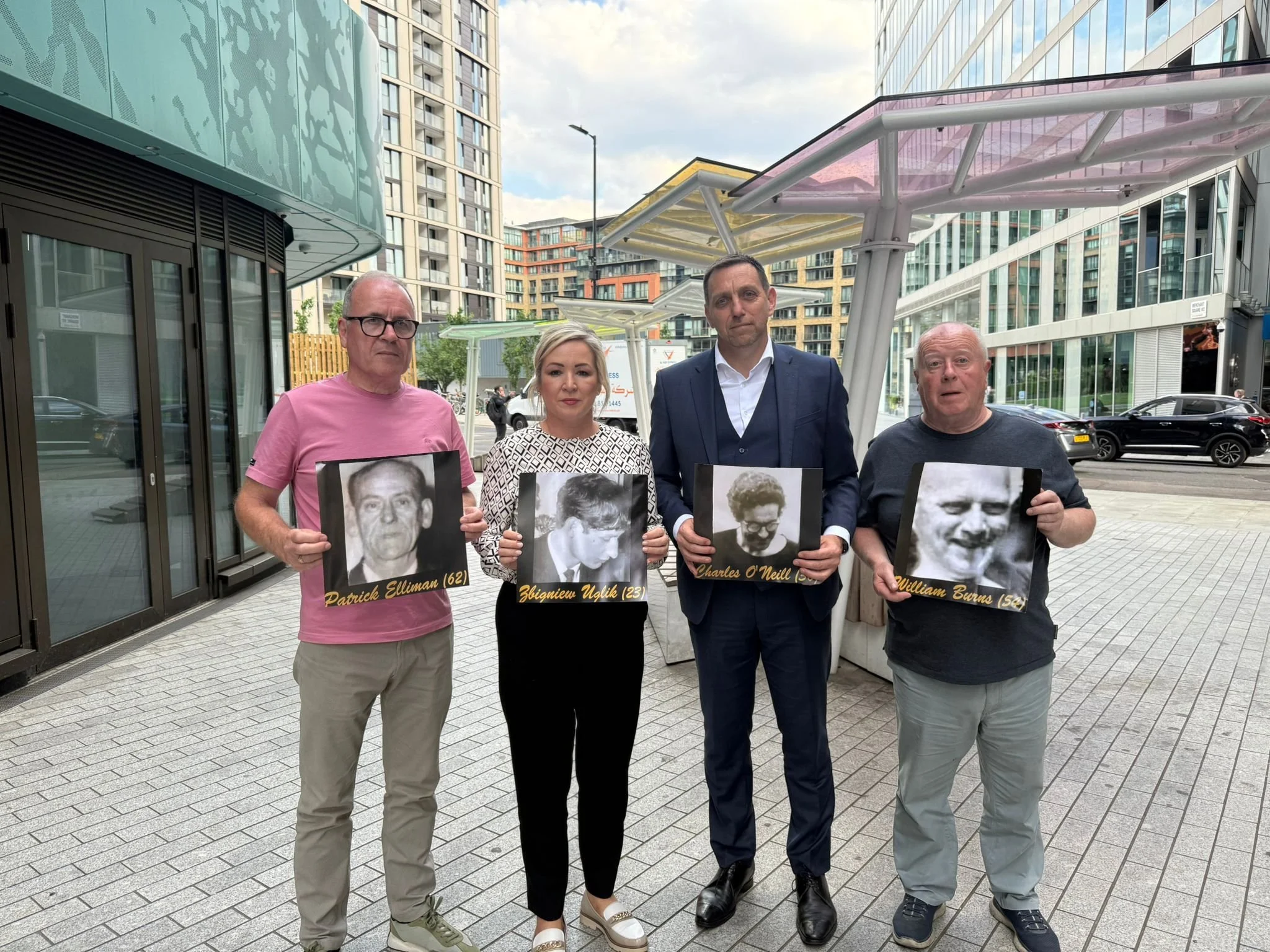
SUPPORT: Pól Wilson, Pádraig Ó Muirigh and Robert McClenaghan with First Minister Michelle O\'Neill SUPPORT: Pól Wilson, Pádraig Ó Muirigh and Robert McClenaghan with First Minister Michelle O'Neill
Fundraising drive begins to support a people's inquiry into the Falls Curfew killings
Conor McParland, Belfast Media, June 7th, 2025
A FUNDRAISING drive is underway to support a people's inquiry into the Falls Curfew – 55 years on.
Between July 3 and 5 1970, the British Army imposed a 36-hour curfew on the Falls Road during which four civilians were killed. The victims were Zbigniew Uglik (21), William Burns (54), Patrick Elliman (62) and Charles O’Neill (36).
During the operation British soldiers ransacked homes and injured a further 78 people. Three hundred and thirty-seven people were arrested.
More than five decades later, the families of those who died continue to seek answers and accountability for the loss of their loved ones.
In pursuit of truth and justice, the relatives are working to establish an Independent Panel of Inquiry to be chaired by Michael Mansfield KC, a distinguished barrister known for his commitment to human rights and social justice. To achieve this, they are appealing for financial support. All funds raised will be used exclusively to cover the administrative expenses associated with forming the Independent Panel of Inquiry and the publication of its findings. It is hoped the inquiry will be held in St Comgall's later this year.
Robert McClenaghan from Falls Residents' Association says time is running out for the families in their quest for the truth.
"We have started a fundraiser in a bid to raise £10,000 to fund our people's inquiry into the Falls Curfew," he said. "The families realised they are never going to get a public inquiry. They realise that time is running out. Family members and witnesses cannot live forever.
"After 55 years, it is time to bring this to a close and let the truth be told."
Robert said that Michael Mansfield will be coming over in Belfast to launch the inquiry.
Last week, Robert travelled to London with Pól Wilson, a relative of victim Patrick Elliman, along with solicitor Pádraig Ó Muirigh to visit the grave of victim Zbigniew Uglik. Zbigniew was an amateur photographer and had been taking photographs of the riots after travelling over to Belfast from London.
After checking into the Wellington Park Hotel in South Belfast, he made his way to the Falls Road with his camera, unaware that the community was being placed under curfew.
In the chaos Zbigniew was given shelter by a local man William Gray in Albert Street. William later reported that Zbigniew had left to get fresh film from his hotel room. While climbing a wall at the rear of the property, Zbigniew was shot dead by the British Army, who later made false claims that he was a sniper.
During the London visit a wreath was placed on Zbigniew's grave, in the first of a number of key events to mark the 55th anniversary this year.
The relatives have also met with First Minister Michelle O'Neill, who pledged her support for a people's inquiry into the Falls Curfew.
Robert said the visit was very emotional.
"We said prayers and laid a wreath at the grave of Zbigniew," he said. "It was very poignant and emotional. It took 55 years to track down relatives of Zbigniew.
"I spoke about him at every commemoration ever since but it always felt incomplete to me until we tracked down his family. His niece is now in contact with Pádraig Ó Muirigh solicitors.
"We also met First Minister Michelle O’Neill in London who pledged her full support to holding an independent panel to investigate the events of the Falls Curfew."
You can donate to the fundraising page for a Falls Curfew people's inquiry here.
Anyone with information about the killings or arrests during the Falls Curfew is asked to contact Pádraig Ó Muirigh solicitors on 028 9023 0222.
Former Tanaiste Simon Coveney talks about Brexit, Unionists and life after politics
Coveney speaks to Irish News Political Correspondent John Manley, June 7th, 2025
SIMON COVENEY RECALLS LIFE BEFORE AND AFTER MARCH 14th, 1998.
He was 25 at the time and skippering the family yacht Golden Apple, as he and four of his six siblings sailed around the world, raising funds for children affected by the Chernobyl disaster 12 years previously.
They were in the Galápagos Islands when an email arrived via satellite with an instruction to phone home.
Coveney found a pay phone and reversed the charges, only to learn of the death of his father Hugh, a former Fine Gael minister and serving TD, who had fallen from a cliff at Cork Harbour as he attempted to rescue one of his dogs during a walk.
A former mayor of Cork city, who served as a minister in John Bruton’s cabinet, Coveney snr was from affluent, merchant stock but also regarded as a successful businessman in his own right before he entered politics.
His son says Hugh Coveney taught his children to “make something of ourselves and be a success somewhere else before bringing that skill set into politics”.
However, circumstances would mean politics came first for his third eldest child, who stood in the subsequent Dáil by-election and topped the poll.
It’s said that it transformed the newly-elected TD for Cork South-Central from boy to man almost overnight.
Overnight Transition
“There are sometimes moments in your life when you remember things on the basis of what happened before that moment and then what happened after that,” he told a recent Manufacturing NI event in Belfast, attending and speaking in his new guise as a businessman, having announced his intention to quit politics two years ago.
“It is such a fundamental change in direction, in terms of your thought process, the responsibility that you have in life, the direction that you choose to travel in.”
After a relatively low-key start to his political career, Coveney was promoted to the Fine Gael opposition front bench under Enda Kenny.
He then served three years as an MEP between 2004, before returning to the Dáil.
His first ministerial position came in 2011 as part of a Fine Gael-Labour Party coalition, where he was minister for agriculture, food and the marine, taking on the additional role of minister for defence in 2014 following the resignation of Eamon Gilmore as tánaiste.
Most popular candidate
He held the housing portfolio for little over a year up until June 2017, where in the aftermath of Kenny’s resignation he contested the Fine Gael leadership election, losing out to Leo Varadkar, despite being the most popular candidate among party members.
It was in June 2017, in the aftermath of the UK vote to leave the EU, that the newly-elected Fine Gael deputy leader came to prominence north of the border, as minister for foreign affairs with special responsibility for Brexit. A matter of months later, he was appointed Tánaiste.
His role in the Brexit negotiations, and the Dublin government’s EU-backed insistence that there would be no hard border in Ireland, led to some vilification from unionists of the then tánaiste and taoiseach Leo Varadkar.
An advocate of the ‘backstop’ that would’ve seen the UK as a whole remain in the EU’s customs union until an alternative arrangement was agreed, he was left frustrated by Tory Brexiteers’ persistent efforts to undermine the then prime minister Theresa May, at one point describing their arguments against a deal as “farcical”.
Even after May’s successor Boris Johnson agreed the protocol, the criticism from unionists continued. In 2002, then DUP leader Arlene Foster said Coveney was “tone deaf to the concerns of unionism”.
“Throughout that process, I’d like to think that I was consistent in terms of what I was trying to do,” he told The Irish News during a recent visit to Belfast.
Foreign Affairs priorities
“From the day I became foreign minister to four to five years later, I was trying to protect the all-island economy, a functioning peace process, and ensuring Ireland’s place in the EU was not being undermined.
“It was also important to keep Ireland’s trading relationship with the UK as functional as possible, because it’s a hugely important part of the Irish economy – all of those things were achieved in the end.”
He says the period prior to Brexit being finalised was characterised by “lots of tension, lots of debate and at times frustration – and some violence and protest”.
He points out that from the time when he became foreign affairs minister up to the signing of the Windsor Framework in February 2023, there were “four British prime ministers, five foreign secretaries, six secretaries of state for Northern Ireland and seven Brexit negotiators for the British government”.
“It wasn’t easy in terms of trying to build relationships and trust, to try to guess outcomes that we can all live with.
“I’d be the first to say that this was a very uncomfortable and difficult period for unionism but it was also very uncomfortable period for many nationalists in Northern Ireland too, who felt that actually we weren’t going to be able to avoid physical border infrastructure on the island of Ireland, and that they were going to be separated even more from what they regard as their own country in terms of trade barriers and so on. Everybody was anxious.”
Coveney says his role was “to keep a cool head and to be respectful in terms of the language I was using – even if some people didn’t want to hear what I had to say”.
Tried to be frank, honest and respectful
“I tried to be as frank and as honest and respectful as I could to all sides and I think in the end, we got a result that isn’t perfect but it was probably the best outcome to those negotiations we could’ve got from an Irish perspective, north and south – though it took a bit longer than I would’ve liked.”
In terms of the criticism levelled at him by unionists, he argues that it was unjustified.
“I do regret the fact that many in the unionist community saw me as someone who was trying to force something on them they didn’t want, but that wasn’t the case. I didn’t deal the cards here: the situation was forced on us by the decision of the UK as a whole to leave the European Union.
“I’m sure there are some people who still believe that the outcome wasn’t fair or didn’t respect their identity or whatever, but nobody was entirely happy and people have learned to live with it.
“I do wonder if most people even notice that there are checks between GB and Northern Ireland. I know ideologically people have a big problem with that – I get that, and I understand it – but the alternatives were worse, and that’s the bottom line.”
Hoax bomb
The most sinister manifestation of unionist backlash against the then foreign affairs minister came in March 2022, when a peace-building event he was addressing at the Houben centre in north Belfast was abruptly interrupted by a bomb scare, which later turned out to be a hoax.
A funeral at the adjacent Holy Cross Church was also disrupted, while a number of houses in the area were evacuated.
Coveney recalls that “it all happened so quickly”.
“I was whipped off the stage and taken away in a PSNI Land Rover.”
He returned six months later to complete the speech.
The person he most feels for is the electrician whose van was hijacked and loaded with what the driver believed was an explosive device.
“Honestly, the person I was and still am most upset about in relation to that event was the poor individual who was essentially stopped on the street, his van was hijacked, before he was held at gunpoint.
“They put a barrel into the back of his van and told him it was a bomb. He was forced to drive right up to the front door of the event that I was speaking at… his life has been shattered by that incident; he’s had to leave Northern Ireland; he no longer has the business that he’d been building.
“ I do regret the fact that many in the unionist community saw me as someone who was trying to force something on them they didn’t want, but that wasn’t the case
“I feel terrible for him and his family and I can’t change that. He would never have been stopped if I hadn’t been in Belfast that day and I’m very conscious of that.”
The former Tánaiste is keen to stress his continued fondness for the north and welcomes the fact that on his latest trip across the border he’s “not accompanied by two burly PSNI officers”.
“I love Northern Ireland. I love coming up here. I love the people here, though the feeling isn’t always mutual.
“There are some in the unionist community who believe that I had agendas that I was trying to force an outcome on Brexit that was about undermining the union – nothing could be further from the truth: I was a pragmatic politician trying to find an intelligent way of solving a very real problem.”
Coveney bowed out of politics, arguably prematurely, in 2024 in the aftermath of Leo Varadkar’s sudden resignation.
These days, at 52 and after a career in politics spanning more than a quarter of a century, he has a range of business roles, including his own Cork-based consultancy and as a non-executive director with engineering and robotics firm Reliance.
One week of each month is spent in the UAE advising global businesses on geopolitical issues.
“If I’m honest, even when I was in my thirties and forties, in my own mind, I knew that once I hit my fifties that I wanted to potentially look at a new direction; to challenge myself in new areas.
“I was always curious about the private sector. I wanted to be part of building something, in terms of a commercial business, and now I have the chance to do it.
Feels ‘very lucky’
He believes he’s “very lucky” to have left politics with his reputation intact.
“Hopefully I’m respected as someone who was pretty straight,” he says.
As expected, the former Fine Gael deputy leader welcomes the recent outline agreement between the EU and British government that will lead to the latter aligning more with the former.
Coveney says criticism of the deal in what he terms the “Conservative press” is “outdated”.
“I really hope this is the start of a new direction of cooperation and better relations between the UK and EU.”
He maintains that, despite the deal, the north’s dual market access still offers unprecedented opportunities but argues that its status is undersold.
“I know it doesn’t suit everybody’s political narrative but, certainly from a trading opportunity, it’s undoubtedly a potentially hugely positive marketing tool, and not just marketing tool, it’s a very positive reality for exporting-based manufacturing in Northern Ireland.”
Natural centrist
On Leo Varadkar becoming a cheerleader for Irish unity, having arguably done little to advance the cause while in office, the former taoiseach’s one-time deputy says criticism is “unfair”.
“Leo’s a straight talker. He had lots of responsibilities as Taoiseach and I think the setting up of the Shared Island unit was a very positive contribution, and continues to be.
“Leo did a lot more than a lot of other taoisigh in the context of Northern Ireland but you shouldn’t forget some of the other pressures that he was under at the time and he would have had to have balanced those.”
On the ongoing humanitarian situation in Gaza, Coveney describes the October 7 attacks by Hamas as “despicable and unforgivable”.
He says Hamas “effectively sacrificed their own people in some ways”, as the Israeli military response could have been predicted.
“That’s not to say that what Israel is doing and continues to do is in any way justifiable – it’s heartbreaking.”
The former foreign affairs minister says Ireland is “arguably the most vocal” but contests that “if you move too far from the centre ground position on the Middle East conflict, then you actually lose credibility”.
“So the job of Irish diplomacy is to actually bring the centre ground of European politics towards our perspective around the application of international humanitarian law to protect Palestinian children in the same way that it needs to protect Israeli children.”
Eames - 'I had difficult times trying to bring comfort to victims of violence'
Alf McCreary, Belfast Telegraph, June 7th, 2025
FORMER PRIMATE TO CELEBRATE 50 YEARS SINCE BECOMING THE BISHOP OF DERRY
Lord Eames, the former Church of Ireland Primate, has paid a warm tribute to the people of Derry who taught him about the realities of bridge-building which stood him in good stead during his long career as one of the best-known senior clerics in the worldwide Anglican Communion.
Speaking exclusively to the Belfast Telegraph ahead of a service in St Columb's Cathedral on Monday to mark the 50th anniversary of his consecration as Bishop of Derry and Raphoe in 1975, he said: “This is one of the most touching invitations of my career and it has brought back so many memories of the vast changes in church life and politics during the last half-century.”
Robin Eames, now in his 89th year, came to Derry as bishop when he was only 37. At his Consecration in St Patrick's Cathedral, Armagh he invited the Catholic Bishop of Derry Edward Daly to walk with him down the aisle.
“I believe that this was the first time it happened. I wanted to show that he and I were friends, and that I was holding out the hand of friendship to the whole Catholic community in Derry.”
Lord Eames also made a point of visiting the homes of people in the Bogside.
“This was to let them know that I was not their enemy and that I wanted to understand their feelings. During one of the first meetings a man opened the door, shook my hand and said 'Welcome to Derry, my name is John Hume'. We met frequently afterwards and he always impressed me greatly.”
After five years in Derry, Eames became Bishop of Down and Dromore.
Belfast community divisions ran deeper than Derry
“The divisions in Belfast were deeper than in Derry, and the attitudes had hardened. These were some of the worst years of the Troubles,” he said.
“My experience in Derry had taught me much about bridge-building and I received great warmth and support from all sides in that city. In Belfast I got on well with the Roman Catholic Bishop of Down and Connor Cahal Daly, and the relationships between all the main Churches improved greatly.”
In 1986 Eames became Archbishop of Armagh and Primate of All-Ireland, a post which he held until his retirement in 2006. He worked closely with Catholic Primates Tomas O'Fiach, Cahal Daly, and Sean Brady.
“I always related to them as human beings and not only as senior Church figures. I asked them to take me as I am, and they did the same for me. Our friendships helped us through some very testing situations. It was a privilege to work with them.”
Drumcree
One of the most difficult challenges he faced as Archbishop was the prolonged stand-off at Drumcree between residents and members of the Orange Order which led to widespread violence.
“I received many demands, particularly from the Irish Republic, to close the Drumcree parish church, but I could not shut a building where people from all backgrounds came to worship. I was severely criticized, which was personally hurtful, but closing the church was something I could not do in all conscience. I deeply regret that the Drumcree dispute lasted so long and showed the world the deep divisions in our community. However, I believe it was the right decision to keep the church open.”
In 2009 Lord Eames and the former Catholic priest Denis Bradley produced their report for the Consultative Group on the Past which was shelved amid controversy over its recommendations.
“Obviously I was disappointed but if people look at the small print it still has the seeds of a solution to our divisions. A former Northern Ireland Secretary told me if he had accepted the report it would have prevented what took place later on.”
Robin Eames also travelled the world as a clerical trouble-shooter dealing with major issues facing the Anglican Communion. “I was sent by Archbishop Robert Runcie, and my experience in Derry helped me build bridges that would last. I became friends with Archbishop Desmond Tutu, who once stayed in our home in Armagh. We shared many of the same problems in Northern Ireland and South Africa as prisoners of our past.”
Tribute to Major and Reynolds
Lord Eames also played a key role behind the scenes in the creation of the 1993 Downing Street Declaration which, he believes, formed the path towards the Good Friday Agreement. “I had the highest regard for Sir John Major and Albert Reynolds who played such a major part in producing the Declaration.”
He has also been a cross-bencher in the Lords since his retirement as Archbishop, something he says has taught him that basic understanding of 'Englishness' and 'Irishness' has been “one of the root causes of a great many problems between the two parts of the UK”.
Lord Eames has served as chairman of some of the Anglican Communion's most important Commissions.
Order of Merit
He has received numerous awards, and is a member of the Order of Merit — a very special honour bestowed on him personally by the late Queen Elizabeth .
It is confined to a maximum of 24 people, and the current members include Sir David Attenborough and the artist David Hockney
Badly injured in a fall last year, Lord Eames is making a steady recovery, and reflected on the past and present.
“There have been so many changes in all the churches but for me the basic message and challenge of Christianity remain the same.”
“I had very difficult times in my ministry trying to comfort victims of violence and their families, and sometimes I am still overwhelmed when I recall how bad it all was. Yet I also remember those who impressed us with their courage and faith from the depths of adversity.
“I was with Gordon and Joan Wilson on the day their daughter Marie was killed in the Enniskillen bomb. Their Christianity and example in dealing with that immense personal tragedy was an inspiration to all of us, and they were not the only ones.
“I look back on my life and praise God for giving me strength to minister to all sorts of people. I also pay tribute to my wife Christine who has been a tower of strength to me throughout my ministry. I have so much for which to be thankful.”
Tiocfaidh ár gondola
Patrick Murphy, Irish News, June 7th, 2025
“TIOCFAIDH ár gondola.” That’s the theme of an apparent agreement between officials of Newry, Mourne and Down District Council (NMDC) and Sinn Féin, in a madcap idea to build a gondola (cable car) halfway up a Co Down hillside at a cost of up to £44 million.
The proposed cable car would go to Cloughmore (Big Stone) near Rostrevor.
Following the council’s announcement, Sinn Féin’s South Down MLA, Sinead Ennis, instantly welcomed the idea.
In a public relations duet, the council said the cable car’s pylons would “not pass through the ancient woodland”.
SF claimed they would “not cross the ancient oak woodland”.
The proposal comes less than a month after the National Trust refused permission for a similar project at Slieve Donard.
Instead of a different idea, officials opted for the same proposal in a different location, with SF support.
Cloughmore sits on a shelf of land just over halfway up Slieve Martin in an undulating area covered in wild blueberry bushes.
Enhancing environment with pylons, cable cars and buildings
A gondola would require flattening the area, including filling in a small ravine just behind the Big Stone, which would then be concreted to accommodate pylons, electric motors and a terminal building.
Perhaps Sinead Ennis would visit Cloughmore to show us where these structures will be located and how replacing blueberry bushes with concrete will fit with her claim of protecting the environment.
The site is just a 15-minute walk from a forest car park, along a pathway accessible by prams and wheelchairs – although the path could be extended by about 50 yards to make access easier at the top.
NMDC recently sent the wrong application for permission to build an unnecessary second council headquarters in Newry.
It is a planning authority which does not understand the planning process.
As this paper reported, councillors were denied sight of legal advice which enabled the council to retrospectively amend the controversial planning application.
NMDC is beginning to look worthy of a public inquiry into its operation.
Confession
Time to declare an interest: in 1976 I was part of an informal group lobbying the council to buy the Meadow (now Kilbroney Park, the starting point for the gondola) for recreational use, rather than private housing.
“Local government in 1976 was based on reforms which I had marched for with thousands of others in the civil rights campaign. It was a fair system and the councillors were decent men and women who made decisions openly and fairly. Today we have a gerrymandered system…”
Those involved included Kevin Hanna, Sean Tinnelly and Robert Linden, with support from William Haughton-Crowe and the Church of Ireland’s Canon Graham.
At the same time I was beginning research into public sector decision-making for a PhD, attending and analysing the local council’s meetings.
I observed that, out of courtesy, councillors did not involve themselves in specific issues outside their own electoral area.
Only Rostrevor’s Independent Councillor Anthony Williamson spoke against the housing proposal, so the council as a whole did not regard the issue as significant. Despite public meetings and petitions for months, the campaign effectively died. Recognising this, a developer sought planning permission for housing.
I had noticed that before the main agenda at meetings many councillors raised issues based on popular news items in the previous week’s Newry Reporter.
‘Storm of protest’
So I wrote a piece for the Reporter claiming “a storm of protest” was brewing in Rostrevor against the planning application. I told no one else. I would take responsibility for the report and colleagues could honestly claim they knew nothing about it.
It made the paper’s front-page lead. There was little truth in it, but it worked.
At the next meeting councillors and officials were keen to support what they believed was a populist revolt in Rostrevor, helped by Anthony Williamson having shown the site to highly respected council clerk, Paddy O’Hagan.
The decision was essentially made at that meeting to oppose planning permission, buy the Meadow and (wrongly) rename it Kilbroney Park.
Kevin Hanna and Sean Tinnelly had won.
Nearly 50 years later, I am writing another article, this time under my own name, accurately reporting the indignation of Rostrevor people at the council’s proposed vandalism.
Local government in 1976 was based on reforms which I had marched for with thousands of others in the civil rights campaign. It was a fair system and the councillors were decent men and women who made decisions openly and fairly.
Today we have a gerrymandered system of local government, created in a sectarian carve-up between SF and the DUP. It operates mainly behind closed doors. (There is a PhD today for someone to analyse the level of secrecy in local government decision-making.)
Times have changed, but the council must recognise that we did not fight for Rostrevor’s Meadow so it could be used to give political cover to bureaucratic incompetence.
Irish unity and unionist gap ‘halves in one year’
John Manley, Irish News, June 7th, 2025
THE gap between those advocating Irish unity and those who believe in maintaining the union has halved in the space of a year, according to the latest Northern Ireland Life and Times Survey.
The proportion supporting the constitutional status quo dropped by five percentage points year-on-year to 42%, while the number in favour of Irish unification increased by a single point to 36% – a difference of six percentage points.
In the previous 2023 survey, the difference between the two opposing groups was 12 percentage points, and two years before that it stood at 23 percentage points.
Elsewhere, the research conducted annually by Queen’s University and Ulster University shows a greater number in the youngest cohort supporting unity for the first time.
Of the 18-24 year-olds questioned, 48% back unification, compared to 30% who are opposed to constitutional change and 12% who don’t know.
The research also indicates that a majority of people – some 61% – are convinced Ireland will be united at some point in the next 20 years, with just 16% believing the region’s constitutional status won’t change.
Brexit a key driver
Brexit appears to be one of the key drivers in growing support for Irish unity.
Some 37% said the UK leaving the European Union made them feel more in favour of a united Ireland, compared to 9% who said it meant they were less in favour. However, 45% who said Brexit made no difference.
Colum Eastwood, former SDLP leader and chair of the party’s New Ireland Commission, described the survey results as “really positive and heartening”.
The Foyle MP said there was a “small health warning with all polling” but that the overall trend pointed to “consistent levels of support for a new Ireland”.
He said the campaign for unity had yet to truly begin but already there was evidence of a “growing group of persuadables – especially younger people who are hungry for change”.
“The work that the New Ireland Commission is doing is aimed at people who recognise that what we have right now isn’t as good as it gets and that constitutional change could deliver better,” he said.
“We’re exploring the issues that matter to them and the kind of new society they want to be a part of. We’re very optimistic about the prospectus for change.”
‘Irresponsible’ to ignore future trends
Historian and Irish News columnist Brian Feeney said the narrowing of the gap between supporters of unity and advocates of the union since 2020 was “really remarkable”.
“A lot of the figures indicate changes in political sentiment but they also demonstrate rapidly changing demography with the unionist population on a down escalator which is accelerat ing,” he said.
Colum Eastwood said the overall trend pointed to ‘consistent levels of support for a new Ireland’
“This statistical trend has been seen in recent elections. The nationalist majority in universities is obvious and there’s an even greater majority in Catholic schools whose pupils will soon join the electoral register – all of which should impress on the Irish government the need to begin urgent preparations for an inevitable referendum.”
The Ireland’s Future board member said it was “irresponsible to ignore what the figures clearly foretell”.
Two men jailed over ‘industrial scale’ dumping in Derry
TWO men were jailed at Derry Crown Court yesterday for their part in what a judge described as “a systemic pattern of established behaviour to facilitate industrial level environmental crime” in relation to illegal dumping.
Paul Doherty (66), of Culmore Road and Gérard Farmer (58) of Westlake both in Derry had pleaded guilty to a series of waste management offences on the Mobuoy Road that occurred on dates between January 1 2011 and July 4 2013 in Doherty’s case and July 1 2007 and August 5 2013 in Farmer’s case.
The court was told that while the exact tonnage of waste was disputed it ran to hundreds of thousands of tonnes and the value would be somewhere around £30 million in ‘relevant landfill charges and taxes’.
It was said that much of the illegal dumping took place on land owned by Farmer and on adjacent land owned by Doherty.
Judge Neil Rafferty KC said Doherty received “financial reward largely in the form of cash payments”.
The bulk of the waste was household waste which the court heard is “highly polluting”.
The judge said that the remedial costs to put right the dumping were also disputed ‘it is quite clear that significant public expenditure has been incurred and will continue to be incurred”.
Judge Rafferty said that emails showed Farmer had “full knowledge of what he was doing and was actively engaged in covering up the criminality at the site”.
The court heard that the emails also “leave little doubt about the nature of the financial arrangement” involving Doherty.
The judge said that while there was dispute over the exact tonnage “it is clear that the quantity of waste across both sites is very significant”.
A report on Doherty said he was ‘remorseful ‘ and denied any financial gain but Judge Rafferty rejected this.
The report on Farmer noted he believed he should have paid more attention to what was going on but again the judge said the emails contradicted that.
The court heard monitoring and remedial measures costing £6.5 million had already been undertaken but this figure would increase. Passing sentence Judge Rafferty said this was “a purely economically motivated environmental crime on an industrial scale” and he sentenced Doherty to 12 months immediate custody and Farmer to 21 months.
The judge concluded: “The time has long since passed where those who commit environmental crime motivated by greed can expect to walk free from the consequences of their actions.”
Judge rejects attempt to stop media reporting Frank Cushnahan's NAMA trial
Sam McBride, Belfast Telegraph, June 7th, 2025
JUDGE RULED IN OUR FAVOUR EARLIER THIS WEEK, BUT WE CAN ONLY NOW REPORT OUTCOME RELATED TO CASE IN WHICH DEFENCE LAWYER SAYS IS OF 'MONUMENTAL INTEREST' TO JOURNALISTS AND THE PUBLIC
The Belfast Telegraph and other media organisations have successfully resisted an attempt to prevent us reporting on the trial of a prominent figure for alleged offences including fraud.
More than a decade after the Republic's 'bad bank' — the National Asset Management Agency (Nama) — sold its Northern Ireland loans for more than a billion pounds, the trial of two men has faced repeated delays but is finally due to begin in the autumn.
The massive trial is expected to involve a host of witnesses and evidence from the heart of the Northern Ireland establishment .
After an investigation by the National Crime Agency, two men involved in the transaction were charged in August 2020.
Former banker Frank Cushnahan (82), of Alexandra Gate in Holywood, is charged with fraud and making a false representation.
Mr Cushnahan was a prominent figure, serving on Nama's Northern Ireland advisory board as well as having been a board member of the Office of the First and Deputy First Minister, and a well-known Belfast businessman.
Former solicitor Ian Coulter (52), of Templepatrick Road in Ballyclare, is charged with making an article in connection with a fraud and making a false representation. He had been the head of major Belfast law firm Tughans and was also head of the CBI in Northern Ireland.
Both men have pleaded not guilty to all charges.
Drastic reporting restrictions sought
An application from Mr Cushnahan's barrister, Frank O'Donoghue KC, asked Belfast Crown Court to impose drastic reporting restrictions which would have postponed any media reporting of his client's involvement in the trial for several years.
Mr Coulter was not party to the application.
The detailed basis for Mr Cushnahan's application cannot currently be reported for legal reasons, but the application centred on a contention of substantial risk of prejudice to the administration of justice.
The Belfast Telegraph, supported by the BBC, RTE and the Irish Times, resisted the application and Mr Justice Huddleston heard arguments about the matter on Tuesday.
Mr O'Donoghue made clear that he had no criticism of the accuracy or fairness of how the media has covered the case to date but argued that there were legitimate legal reasons why it would be right to ask the media to delay reporting of the trial.
The Belfast Telegraph argued that the practical effect of this would be to prevent coverage of the trial because by the time the reporting restrictions were lifted far into the future it would no longer be newsworthy to publish detailed accounts of a trial which happened years ago.
Mr O'Donoghue stressed that what his client was seeking wasn't about protecting an individual, but the administration of justice.
He said that the trial would be “subject to intensive daily reporting” across the entire island of Ireland, adding: “This case is of monumental interest to journalists on this island and to the general public.”
He added: “The only other trial that will come close to this trial in modern times is the rugby rape trial… this is a trial of unique proportions, to be compared only to the rugby trial.”
Richard Coghlin KC for the media drew to the judge's attention that there are already extensive media reports available online about the issue all the way back to 2016.
Speaking of the allegations, he said “They are all already out there.”
He said fair and accurate reporting of a public trial was of crucial importance, as was the right of the public to receive those facts.
He said there was an “extremely heavy” public interest in the case being reported, adding: “What is being proposed here is the removal of an authoritative account and an open invitation for conspiracy theories…with all of the deleterious effects that will have on the rule of law… My lord, what is being proposed is the total destruction of the right to freedom of expression.
“It is broadly recognised that news is a perishable commodity… the incentive for new organisations to send journalists to report on trials which they cannot report is so small that's it's unlikely to be done at all.”
Jonathan Kinnear KC for the Crown said the prosecution supported the media's arguments.
Open justice ‘far outweighs’ special interests
Mr Justice Huddleston ruled in favour of the media on Wednesday, saying that the principle of open justice “far outweighs” the arguments advanced in favour of the restriction.
That judgment could not be reported until now because the media had to make a separate application to report on the judgment itself.
Acceding to the media organisations' application, the judge ruled that it can be reported. Mr Justice Huddleston said that the request for restrictions was “fatally flawed”.
He said: “The application, in my view, falls at the first hurdle,” adding that arguments for the restrictions, “are based in large part in conjecture as to what might happen”.
He went on: “There is nothing exceptional to this trial other than it will attract substantial public interest.”
The judge said that “the public interest in fair and accurate reporting of criminal trials generally, and the promotion of public confidence in the administration of justice and the rule of law, is something which very much tends to the dismissal of the application”.
Solicitor Fergal McGoldrick of Carson McDowell, who represented the media, said: “Today's ruling from Mr Justice Huddleston is a timely restatement of the importance of the open justice principle in the criminal justice system, particularly where matters of the most significant public interest are at play.”
Just how do Sinn Féin, DUP and UUP plan to save Lough Neagh?
Newton Emerson, Irish News, June 7th, 2025
OBJECTORS TO NEW POLUTION CONTROLS RESORT TO WHATABOUTERY
Farming produces over 60 per cent of the nitrates poisoning Northern Ireland’s waterways, with a large fraction of that due to illegal spreading or dumping of slurry.
Farmers, food processors, industry groups and their political supporters, who include the DUP, UUP and Sinn Féin, all realise this is indefensible.
So they are asking ‘what about the other polluters?’
It is a question that should be put straight back to those three executive parties.
NI Water is causing around 20 per cent of the problem thanks to under-investment in the sewage system.
This can only be fixed by putting up rates, introducing water charges or making large cuts elsewhere in Stormont’s budget.
Almost all the remaining pollution comes from domestic septic tanks, which are used by nearly a fifth of households.
This can only be addressed by further investment in sewers, or by setting requirements and deadlines for households to update their equipment, as Muir is proposing for farmers.
Septic tank technology has improved and Stormont could provide grants to help install it.
Which of these options do Sinn Féin, the DUP and the UUP prefer?
They must have answers, unless they are just trying to change the subject.
A British and Irish Broadcasting Corporation
FOLLOWING his libel victory against the BBC, Gerry Adams said “the British Broadcasting Corporation upholds the ethos of the British state in Ireland”.
Well, of course it does. What other ethos would the UK’s national broadcaster have?
The former Sinn Féin president added that this was “out of sync” with the Good Friday Agreement.
There is a confused view across nationalism that the agreement created a hybrid state that must be reflected in all public institutions.
In reality, it recognised full British sovereignty over Northern Ireland, unless or until there is a united Ireland.
There must be impartial administration, but within the lawful framework of the British state.
Even if the BBC were subject to the agreement, this would not require it to become the British and Irish Broadcasting Corporation. It must only be British and impartial, as required already.
The real problem is that the BBC cringes to declare its Britishness, ironically due to its ethos of apologetic middle-class Britishness.
To paraphrase Adams, these are the manners it puts on itself.
Over promising and under delivering
STORMONT only has enough money for 1,000 social housing starts this year, half the level promised in the programme for government.
In January, Sinn Féin’s then finance minister, Caoimhe Archibald, announced £100 million for social housing “in addition” to the Department for Community’s social housing budget.
However, this has ended up “within” the budget, according to a statement this month from the DUP-controlled department.
Social housing starts are up 8 per cent on last year, thanks to some good work by Sinn Féin and DUP ministers.
Instead of being praised for that success, over-promising means they are being condemned for under-delivering.
Former Guerillas planning a property killing?
IN 2020, Sinn Féin called for the closure of Belfast Zoo via a council motion that denounced keeping animals in captivity as “outdated, unethical and wrong”.
Nobody else supported the motion, despite some sympathy with its sentiment, because other parties suspected Sinn Féin was eyeing up the site for development.
Such suspicions were apparently confirmed later that year when Sinn Féin demanded Dublin Zoo be saved to “protect conservation”.
“Some animals really are more equal than others,” quipped SDLP MLA Mark H Durkan.
Sinn Féin is now coming after Belfast Zoo again, this time on grounds of cost, complaining it lost almost £2 million last year.
Such touching concern for the ratepayer must be set against the almost £6m Belfast City Council hands out every year in community funding, most of it carved up by Sinn Féin and the DUP.
DUP and Alliance block Irish language signs in east Belfast
Michael Kenwood, Irish News, June 7th, 2025
THE DUP and Alliance Party are blocking the erection of Irish signs on an east Belfast street where almost half of residents said they did not want it.
The application had been made for Shandon Park, off Knock Road, with 41 residents in favour (16.8%), compared to 121 (49.5%) against.
Seven said they had no preference.
Residents were surveyed under Belfast City Council’s policy on bilingual signs, which allows for signage to be erected if just 15% of residents agree.
Under a pre-2022 policy, a new bilingual sign required the backing of 66.6% of a street’s residents.
Just one resident or councillor is now required to trigger a street survey, compared to 33.3% of residents under the old policy, but each application is subject to an equality assessment.
A bilingual street sign at Shandon Park has been rejected.
At a meeting of the council’s People and Communities Committee, a report stated some residents had raised concerns over costs and said “the money would be better spent on other public services”.
DUP councillor Sarah Bunting proposed the council reject the application for Shandon Park, despite it meeting the required threshold under the new policy.
Alliance councillor Jenna Maghie said: “I can’t remember quite as high a number against. I appreciate those in favour have reached that 15% threshold that is in the policy, but I think it is important we remember that discretion is also in the policy.
“When 50% of the street is against it, that is a very clear example of when we should exercise that discretion.”
Sinn Féin’s Róis-Máire Donnelly said: “I completely understand what people are saying. My issue again with this is that we are talking about a minority language, and we are asking that a minority language supporter becomes the majority. It wouldn’t be required anywhere else, where we would ask a minority to prove they have a majority.”
Green councillor Anthony Flynn said: “We see this as a minority rights issue, it is very clear, and black and white, for us. It is quite disappointing that the Alliance Party particularly continues to go against a minority rights issue.”
What’s in a name?
SDLP councillor Gary McKeown said: “Shandon is a translation from Irish, so we would essentially be going back to the original term it was taken from. In this case it should be less controversial frankly because we are just going back to what it was.”
At the meeting, 10 other streets were approved for Irish dual language signage.
Sinn Féin proposed erecting the signs on all 11 streets, and in a vote, 10 committee members were in favour, and 10 were against.
The chair, DUP councillor Ruth Brooks, voted against it with her casting vote.
A DUP amendment proposed all applications but the Shandon Park sign be passed.
This also saw 10 for and 10 against, but passed with Cllr Brooks’ deciding vote. A vote to ratify the decision will take place at the next full council meeting.
DUP grassroots revolt sees Lyons fail to become party secretary
Suzanne Breen, Belfast Telegraph, June 7th, 2025.
MLA FREW GAINS 'CONVINCING' VICTORY OVER MINISTER AT AGM
DUP Communities Minister Gordon Lyons was beaten by Stormont backbencher Paul Frew in an internal contest to become party secretary.
Sources told this newspaper that the North Antrim MLA “won convincingly” when delegates voted at the party's annual general meeting in Antrim on Thursday night.
They said Mr Lyons had been supported in his bid for the position by Deputy First Minister Emma Little-Pengelly. The DUP has been contacted for comment.
Insiders said Mr Frew's election was a “mini-rebellion” against the party establishment by councillors who feel they are “disrespected” by the leadership.
“Paul is very independent-minded and conscientious,” one said. “He isn't a yes man. He listens to the party grassroots. Gordon Lyons wouldn't be popular with some councillors.”
Another source said the Communities Minister hadn't “really impressed” in his role in Stormont. “He is seen by the leadership as a safe pair of hands who doesn't drop the ball, and that is true,” they said.
“But it's hard to remember anything he says or does. There's a feeling that he's listening too much to the civil servants.
“He's not radical enough in terms of achieving what is possible in his brief.”
There had been previous speculation that Lord Morrow might retire, but he has stayed on as party chair.
Education Minister Paul Givan is the new vice-chair with South Down MLA Diane Forsythe continuing in the role of assistant secretary. East Londonderry MP Gregory Campbell is treasurer.
Ms Little-Pengelly and Upper Bann MP Carla Lockhart were the personal selections to the party officer team of DUP leader Gavin Robinson.
He has also appointed Lagan Valley MLA Jonny Buckley as director of elections and Mid-Ulster MLA Keith Buchanan as director of party development.
Fewer divisions in DUP
Mr Buckley's promotion is seen as a reward for stepping forward to run in the Westminster election in Lagan Valley in difficult circumstances following Jeffrey Donaldson's resignation, and for the hard work he put into the campaign. Despite Mr Lyons' defeat by Mr Frew, there are fewer divisions among the party's MLAs and MPs than there have been in many years.
Mr Robinson said he wanted to see the DUP's “campaigning spirit” renewed and restored.
“It's a mindset and a philosophy that must drive everything we do,” he said. “There is no substitute for being out on the ground talking to people, but we know that our campaigning needs to be on all fronts.
“We are focused on making Northern Ireland work within the Union. Securing and strengthening our place within the UK is what we exist to do and it is the foundational principle of everything we do.”
The next Assembly election was “only 23 months away”, the DUP leader warned.
“We are planning to win. We must work to deliver for the people we serve and connect with more people in every constituency. We must work with fellow unionists for the greater good. The price of division and disunity is defeat and weaker representation.”