Inaugural Speech of President Catherine Connolly
Dublin Castle, 11 November 2025
A Thaoisigh, A Phríomhbhreithimh, Airí, Baill Chomhairle an Stáit, Baill an Oireachtais, Ambasadóirí, Ceannairí Eaglaise, agus dhaoine uaisle ar fad, chomh maith le an Chéad Aire an Tuaiscirt, Michelle O’Neill, agus ceannairí eile ó gach cairn den Tuaisceart.
Ba mhaith liom céad mile fáilte a chur roimh mo chlann freisin, atá anseo. Mo bheirt mhac, mo fhearchéile, mo dheirfiúracha, mo dheartháireacha, thaisteal siad ó cheann ceann an domhain ó Atlanta, Georgia, ó Ceanada, ó Toronto, agus míle buíochas go chuir siad an dua sin orthu féin.
I stand before you humbly and proudly as the 10th President of this beautiful country.
The people have spoken and have given their President a powerful mandate to articulate their vision for a new Republic.
A Republic worthy of its name where everyone is valued and diversity is cherished, where sustainable solutions are urgently implemented and where a home is a fundamental human right.
The change that led to this joyful day began with a small group of elected representatives and volunteers facing what appeared to be insurmountable challenges.
We were led to believe that it was too great a leap, that our ideas were too far out, too left, at odds with the prevailing narrative.
In shared conversations all over the country, however, it became evident that the dominant narrative did not reflect or represent people’s values and concerns.
Time and time again, people spoke of how it served to silence, to other, to label, to exclude and to stifle critical thinking.
Along with that however, along with meaningful engagement, we saw the emergence of hope, we saw the emergence of joy, along with the courage and determination of people to use their voices to shape a country that we can be proud of.
As President of Ireland, I will ensure that all voices are represented, heard and valued, and promote a public discourse that nourishes inclusivity, tolerance and active citizenship.
Previous Presidents faced different challenges reflecting the dominant issues of the day.
In 1990, when Mary Robinson – and I want to welcome Mary Robinson and her husband Nick – when Mary was elected, the parameters of geopolitics were shifting following the fall of the Berlin Wall the previous year and the dissolution of the Soviet Union, while at home, Ireland was undergoing its own seismic changes laying the foundation for a modern and inclusive society.
In 1997, one year before the Good Friday Agreement, the former President Mary McAleese – and again I want to welcome the former President and husband Martin – was elected in the midst of the ongoing peace process, a landmark event in shaping a shared vision for the future of Ireland.
In 2011, Michael D. Higgins assumed office – and again I want to pay tribute to his courage and his work – Michael D. assumed office as a global financial collapse shook Ireland and the world. The reverberations of that crisis continue to impact upon and shape people’s lives and our economy.
Existential Threats
Now in 2025, as I assume the privilege of office, we face the existential threat of climate change and the threat of ongoing wars, both of course are inextricably linked.
As I speak, I am acutely conscious of the 165 million people currently forcibly displaced from their homes and countries due to war, famine and climate change.
We cannot turn back the clock nor close our eyes to these realities.
These are the challenges of our times, and our actions or inaction will determine the world our children and grandchildren will inherit.
It is both an individual and a collective challenge and one which obliges us to reflect on the way we live and interact with our world and with each other.
It is also the responsibility of those entrusted with public office to come together both nationally and internationally to lead and to create the conditions for a sustainable existence on our planet.
It is significant that today is Remembrance Day, the eleventh of the eleventh 2025. It is significant on so many levels, but it gives us an opportunity to pause and reflect on the horrors of war in a world where unfortunately we have all become witnesses to ongoing wars and genocide.
Given our history, the normalisation of war and genocide has never been and will never be acceptable to us.
As a sovereign independent nation with a long and cherished tradition of neutrality and an uninterrupted record of peacekeeping since 1958, Ireland is particularly well placed to lead and articulate alternative diplomatic solutions to conflict and war.
Indeed, our experience of colonisation and resistance, of a catastrophic man-made Famine and forced emigration gives us a lived understanding of dispossession, hunger and war and a mandate for Ireland to lead.
We can and should take real pride in the success of the Good Friday Agreement, knowing that this is recognised far and wide and is a model for peaceful resolution of conflict.
We also know that this journey of peace and reconciliation was the result of meticulous and methodical work over a long period of time, and this work continues to this day.
I look forward to paying my first official visit to the North and meeting with people from all communities and celebrating the rich heritage and traditions of all who live there.
I am particularly conscious of Article 3 of the Constitution, which sets out in detail the firm wish of the Irish people, the Irish nation to have a united Ireland, albeit in the conditions set out very clearly in the Article on consent.
As President, I will foster an inclusive and open dialogue across the island in a manner that highlights and recognises our similarities and respects our differences.
I want to acknowledge our large and growing diaspora. There is hardly a family on this island that does not have a personal experience of migration. On every continent our emigrants have put their ingenuity and hard work at the service of new homelands. Yet they have kept their love of Ireland and its culture deep in their hearts.
I hope over the next 7 years that there will be many opportunities for me to celebrate with them and share our experiences.
I have never believed more in the spirit of this country. Having travelled the length and breadth of the island, I have witnessed it in every county, in every corner of Ireland. I have heard it in the music, the literature and the dance of our people, in the deep tradition of solidarity and decency that continues to be the dominant force behind our people. I have felt it in the quiet dignity and stoicism of those who simply keep going, despite the very real challenges that they face.
“Tír gan teanga, tír gan anam”
Is sibhse, muintir na tíre, cosmhuintir na tíre, a casadh orm agus mé ar fud na tíre a spreag mé, agus a spreag m’fhoireann le linn an fheachtais. Sibhse a chuaigh agus a théann i ngleic le heaspaí seirbhísí agus riachtanais gach lá beo, easpaí nár cheart a bheith fós ann i dtír atá chomh sabhair. Spreag sibh mé le bhur ndúthracht agus bhur bhfláithiúlacht, ag roinnt bhur scéalta agus taithí liom go fial. Is sibhse a thug agus a thugann misneach dom, misneach a bhainfidh mé úsáid as anois agus a thógfaidh mé air agus mé ag obair ar bhur son mar Uachtarán.
Ar ndóigh, tá tábhacht na teanga chun anam agus spioraid na tíre a thabhairt chun cinn tuigthe agam le blianta fada anois; anam agus spioraid a bhí curtha faoi chois le blianta, bíodh sin d’aon ghnó, de bharr smacht na dtíoránach nó de bharr neamhaird, neamhchúram nó easpa tuisceanaí. Tír gan teanga, tír gan anam, agus is fíor sin, mar nuair atá a teanga múchta, ní féidir leis an tír, nó aon tír, a mianta, a luachanna nó a spioraid a chur in iúl.
Cuireadh ár dteanga, teanga ársa ár sinsir, teanga ina bhfuil spioraid ár sinsir agus nádúr ár dtíre le mothú i gchuile fhocal, sa dara háit, gan meas nó ómós tugtha di. Plúchadh croí ár muintir nuair a cuireadh stop leo úsáid a bhaint as a dteanga féin, teanga a chuireann mothúchain agus croí in iúl le chuile fhocal. Ach scaoilimis le chéile anois leis an bhfaitíos sin. Ligfimis don Ghaeilge bláthú. Éistimis leo siúd ar fad nach bhfuil uathu ach aitheantas a bheith tugtha dóibh mar Ghaeilgeoirí ina dtír féin agus in ómós dóibh agus dúinne.
Gaeilgeoirí, Gael, agus lucht foghlama na Gaeilge, ní sa gcúinne á labhairt go híseal a bhéas an Ghaeilge san Áras ach sa chéad áit mar theanga oibre agus beidh sí á labhairt ar fud na tíre go misniúil, go fileata, go ceolmhar, faoi mar atá cloiste agam agus mé ar fud na tíre, agus dár ndóigh, déanfar í a labhairt go húdarásach agus gan aon drogall nuair is gá.
Mar fhocal scoir, to conclude, I believe that the President should be a unifying presence—a steady hand yes, but also a catalyst for change reflecting our desire for a Republic that lives up to its name.
I will embrace the role of the President with dignity, determination and courage.
Go raibh míle maith agaibh.
Connolly pledges to be ‘catalyst for change’
ELLEN COYNE, Political Correspondent, Irish Times, November 12th, 2025
President Catherine Connolly will use her seven years as Ireland’s 10th president to be a “catalyst for change”.
Ms Connolly was formally inaugurated in the historic setting of St Patrick’s Hall in Dublin Castle yesterday, in front of the Taoiseach, Tánaiste, former presidents, judges, politicians and her friends and family.
Shortly after 12.30pm, she was declared President of Ireland after repeating the declaration of office which was read to her by Chief Justice Donal O’Donnell. Ms Connolly signed the declaration, becoming the 10th President of Ireland.
In her inauguration speech, the President referenced a number of social issues which had defined her successful campaign. In her opening remarks, she said she had been given a “powerful mandate” by the public to “articulate their vision for a new republic, a republic worthy of its name”.
Ms Connolly mentioned diversity, climate justice and the housing crisis, telling those gathered that “a home is a fundamental human right”. She was critical of a “prevailing narrative” which had suggested her left-wing unity campaign was “too far out, too left”.
“However, it became evident that the dominant narrative did not reflect or represent people’s values and concerns,” she said.
‘Tradition of neutrality’
Ms Connolly, who made neutrality a central part of her successful campaign, said it was “significant” that her inauguration was November 11th, Remembrance Day. She said that Ireland had “a long and cherished tradition of neutrality and an uninterrupted record of peacekeeping since 1958”, which made Ireland “particularly well placed” to articulate alternative solutions to war.
“Indeed, our experience of colonisation and resistance of a catastrophic man-made famine and forced emigration gives us a lived understanding of dispossession, hunger and war and a mandate for Ireland to lead,” the President said.
In front of former presidents Mary Robinson and Mary McAleese and outgoing president Michael D Higgins, Ms Connolly cited the backdrops against which each of them had become president: the fall of the Berlin Wall and the dissolution of the Soviet Union in 1990, the peace process leading to the Belfast Agreement in 1997 and the fallout from the financial crash in 2011.
Diaspora
She cited the diaspora, and said she hoped to use her seven years to celebrate them and their experiences. Ms Connolly described how she has “never believed more in the spirit of this country” which she witnessed over the course of her campaign.
The President also dedicated a section of her speech to the Irish language, saying in Irish that the language “has such importance in projecting the soul and spirit of the country. I understand that for many years that soul and spirit were repressed. It was done deliberately in some cases, or because of neglect, a lack of care or a lack of understanding.”
“Tír gan teanga, tír gan anam,” she said. (A country without a language, a country with a soul.) Ms Connolly said that Irish will “not be spoken in a low voice in the Áras, it will have first place as a working language”.
The President’s inauguration featured a religious ceremony including the leaders of all main faiths in Ireland. The musical performers at the inauguration included the Army Number 1 Band conducted by Comdt Fergal Carroll.
Síle Denvir, a native Irish speaker from Connemara in Ms Connolly’s home county of Galway, sang a sean-nós rendition of Ár nAthair and played the harp. Dublin-born mezzo-soprano Gemma Ní Bhriain performed Amhrán na bhFiann and the uilleann pipes were played by Eugene Lambe.
After her speech, Ms Connolly walked in to the courtyard of Dublin Castle where she conducted her first guard of honour inspection. The Air Corps carried out a fly-past while the band performed the presidential salute. Ms Connolly greeted children from third and fourth class at Francis Street School before she departed for Áras an Uachtaráin.
The DUP's days of gesture politics are over... its only focus is stopping Allister
SUZANNE BREEN, Belfast Telegraph, November 12th, 2025
ANALYSIS
There are more than 150 DUP elected representatives in Northern Ireland, but apparently not one of them was free to attend the Irish president's inauguration.
Emma Little-Pengelly has said she couldn't go due to Remembrance Day commitments. Gavin Robinson cited a similar reason, and stressed “the significance of the 11th day of the 11th month” for his community.
Yet Peter Robinson managed to join Martin McGuinness for the inauguration of Michael D Higgins on November 11, 2011.
While the date of the Irish president's swearing in hasn't changed, DUP attitudes to gestures of reconciliation clearly have. The 'calendar clash' excuse is an attempt to spin a snub.
Catherine Connolly has pledged that her first official visit will be to Northern Ireland. Robinson said his party would be “pleased” to meet her in a formal capacity when she comes here.
That doesn't involve stretching itself in the way that leaving its home turf and travelling to Dublin would have done.
In February, Michelle O'Neill joined Little-Pengelly, the Prime Minister and the leaders of the Scottish and Welsh devolved administrations for a private dinner with King Charles at Windsor Castle.
O'Neill has attended two Remembrance Sunday services, the Queen's funeral and the King's coronation. She stood for 'God Save the King' at Windsor Park last year during a Northern Ireland women's football match against Montenegro.
It is impossible to imagine any DUP figure standing for Amhrán na bhFiann here. The party is in retreat mode on the gesture front.
North a different place
It's in a very different place compared to when devolution was restored in February 2024. The days of ceili dancing and camogie playing are gone.
In the first Assembly meeting after power-sharing returned, newly appointed Education Minister Paul Givan branded Jim Allister “a dead-end unionist”.
“He is an angry man, and I can understand why,” Givan said. “He has achieved absolutely nothing. I understand why he is angry and shouting at me because his political career has been one marked with failure.”
Five months later Allister was elected North Antrim MP. In LucidTalk's last opinion poll for the Belfast Telegraph last month, the TUV was in third place on 13% — just five points behind the DUP.
Robinson's party has moved significantly to the right in an attempt to win back support. TUV had already warned its bigger rival that “there should be no question” of Little-Pengelly attending the inauguration.
Allister said: “For a unionist to meekly troop down to Dublin to attend such an inauguration would send entirely the wrong message.
“Unionists should be standing firm for the Union — not lending legitimacy to those who would see it destroyed and show no respect for our constitutional place as part of the United Kingdom.”
Tweeting from Dublin Castle, O'Neill said it was a “a great privilege to represent you all as First Minister at the inauguration of our new President, Catherine Connolly”.
She described Connolly as “a leader of compassion and courage who will represent everyone who calls this island home, with integrity and sincerity”.
The First Minister added: “I look forward to working alongside Catherine in this time of change and massive potential on our island, as we continue our journey towards a fairer, stronger, and united Ireland.”
Connolly pledged to ensure “all voices are represented, heard and valued” as she became the 10th president of Ireland.
She said: “The people have spoken and have given their president a powerful mandate to articulate their vision for a new republic, a republic worthy of its name where everyone is valued and diversity is cherished, where sustainable solutions are urgently implemented, and where a home is a fundamental human right.”
The president added: “The change that led to this joyful day began with the small group of elected representatives and volunteers facing what appeared to be insurmountable challenges.
“We were led to believe that it was too great a leap, that our ideas were too far out, too left — at odds with the prevailing narrative.”
She stated that Ireland's history meant “the normalisation of war and genocide has never been and will never be acceptable to us”.
The president said: “As a sovereign independent nation with the long and cherished tradition of neutrality and an uninterrupted record of peacekeeping since 1958, Ireland is particularly well-placed to lead and articulate alternative diplomatic solutions to conflict and war.
“Indeed, our experience of colonisation and resistance of a catastrophic man-made famine and forced immigration gives us a lived understanding of dispossession, hunger and war and a mandate for Ireland to lead.”
Connolly said Ireland could take “real pride in the success” of the Good Friday Agreement as a “model for the peaceful resolution of conflict”.
She looked forward to her “first official visit to the north”, and referenced Article 3 of the constitution which sets out the firm wish of the Irish people for a united Ireland by consent.
Gardaí manpower and budget ‘will be stretched’ during EU Presidency
CILLIAN SHERLOCK, Irish News, November 12th, 2025
GARDAÍ are going to be “stretched” as Ireland holds the EU Presidency next year as senior figures indicated concerns over manpower and the overtime budget.
The presidency of the Council of the European Union rotates among the member states in turn every six months.
Ireland will assume the presidency between July 1 and December 31 2026, and will therefore have to host various formal and informal meetings of different Council bodies throughout that period.
The Oireachtas Justice Committee was told yesterday that gardai have asked Government to ensure that EU Presidency events do not clash with other major events around the country.
New Garda Commissioner Justin Kelly told the committee: “The biggest concern for us is around providing manpower.” He also said that there will be “pressures around resources, equipment and capability” relating to the EU Presidency.
“What I can say is we have already made significant procurement purchases around equipment, vehicles, very technical specialist things that we need, for example, counter drone (technology) – we’ve done a lot of work in that area.”
Mr Kelly said work has been under way for “quite a significant time” around training for motorcycle escorts, close protection officers, and increasing firearm capability.
“Obviously, one of the big things for us will be around overtime.
“We’ve got to keep the lights on all around the country with all the regular policing.”
The Commissioner said there would nee to be a “significant” additional amount of overtime.
Mr Kelly said procured equipment will continue to be used by the service after the EU Presidency.
Deputy Commissioner Shawna Coxon told the committee: “Business as usual is going to be a challenge. I’m not going to sit here and say that it’s not.
“We are working on looking at everything that is available to us.
“We have historically relied on things like bringing in people on their days off, overtime, etc, to support these things.”
She added: “The calendar, as you know, isn’t fully set yet, but I want to assure you that we have been working with Government to try to ensure that there is no conflict in terms of having two large events on (the same date), whether it’s part of the EU calendar or not – for example, the Irish Open, we’re not quite sure what that’s going to look like next year.
“And we’re working with Government to try to ensure that there’s not two major events across the country at the same time, because we are going to be stretched, and we are aware of that.
“So certainly, as those plans crystallise into in terms of what is needed, where what the threat level is, where the locations are, and what’s required, we’ll be working those through.”
Ms Coxon said she did not know the full garda budget for the EU presidency, but key items such as motorcade capability had been procured through the Department of Foreign Affair as the lead agency.
“It’s not as dire as it may seem. So most of the budget that we’ll be looking out will be in relation to overtime, etc.”
An Garda Siochana’s chief corporate officer, Siobhan Toale, said that it the organisation had made submissions on a “very clear work plan”.
“We have sought funding to meet our needs. That process is under way, and we’re expecting a response in terms of those needs by the end of November.”
Coxon said An Garda Siochána has also learned from agencies in other EU member states that have hosted the presidency about the challenges that arose.
100 arrests made since serious summer rioting in Ballymena
Senior PSNI officer said investigations continuing into ‘racist thuggery’
JONATHAN McCAMBRIDGE, Irish News, January 12th, 2025
POLICE in Northern Ireland have made 100 arrests since serious rioting erupted in Ballymena in the summer.
A senior officer said an investigation into the violence which began in the Co Antrim town and spread to other areas was continuing and this was providing “reassurance to local communities” that were impacted.
Violence erupted in Ballymena in June after an alleged sexual assault of a girl in the town.
Two 14-year-old boys, who spoke to a court through a Romanian interpreter, were charged with attempted rape.
A peaceful protest in the Co Antrim town over the alleged assault was followed by attacks on police and properties housing ethnic minorities, described by police at the time as “racist thuggery”.
The disturbances lasted for several nights and spread to other areas of Northern Ireland including Portadown, Larne, Belfast, Carrickfergus, Derry and Coleraine.
Providing an update, the PSNI said their investigation has now resulted in 100 arrests with 91 people subsequently being charged for offences including riot, arson with intent to endanger life and burglary with intent to cause arson.
The PSNI said cases are currently being prosecuted before the courts.
Throughout the course of the team’s investigation, photographs of 60 potential suspects were issued to the public and this led to 49 arrests.
Detective Chief Inspector Michael O’Loan said: “On June 9 hate motivated, serious public disorder unfolded in Ballymena which saw the homes of ethnic minority families destroyed and violent crowds attack police officers.
“Consecutive nights of sustained disorder in Ballymena and other parts of Northern Ireland followed until calm was restored.
Dedicated investigation team
“A dedicated investigation team was established to carry out a focused investigation into what happened and we brought together specialist resources to ensure a thorough and swift review was conducted.”
Police responded after violence erupted in Ballymena and other parts of Northern Ireland in the summer
The senior officer said the investigation team had worked through over 1,000 hours of CCTV, evidence gathering and body worn video footage, as well as a large volume of online material.
He added: “This team’s work has been vital in restoring calm and providing reassurance to local communities in Ballymena and across Northern Ireland by identifying, and holding those responsible accountable for their actions.
“A number of suspects remain unidentified and their images have been published on our website and social media platforms.
“I would appeal to these individuals to come forward and hand themselves into the police or if you know who they are please tell us.”
Mr O’Loan said: “The police service remains committed to maintaining public order, and we would strongly encourage anyone with information about what happened or who was involved to make contact with us.
“Photos and footage, including CCTV, mobile phone or dash cam footage that could help our investigation, can continued to be shared with us through the Major Incident Public Portal at https://mipp.police. uk/operation/PSNI25U11-PO1.
“Alternatively, a report can be submitted online using the non-emergency reporting form at www.psni. police.uk/makeareport/.
“Should you wish to make a report anonymously, you can do so by contacting Crimestoppers on 0800 555 111 or online at www.crimestoppers-uk.org.
“The Police Service of Northern Ireland will do everything we can to prevent hate crime and bring those responsible to justice.
“We do not underestimate the impact hate crimes have on victims, their families and wider communities.
“It is totally unacceptable that anyone is targeted because of their race.
“No one should feel intimated or threatened due to their ethnicity and officers will continue to pursue justice for the victims of hate-related crime.”
Funding to combat race hate tensions given to flute bands
CONOR COYLE, Irish News, November 12th, 2025
A GROUP representing flute bands in Belfast has received £40,000 in funding earmarked for addressing anti-Muslim tensions following racially motivated disorder in the city last year.
The Belfast Bands Forum has been awarded the South Belfast tranche of funding for the Community Recovery Fund.
It was introduced by the British government in response to race riots which began in Southport and spread to other parts of the UK in August 2024.
A £600,000 fund was announced for Northern Ireland by UK Deputy Prime Minister Angela Rayner following the racist violence last August, which saw rioting following anti-immigration protests in Belfast, with migrant-owned businesses and homes attacked by protestors.
The funding was distributed by Belfast City Council, including one section which provided £160,000 to community groups in four parts of Belfast – Greater Falls (west), Woodvale (north), Connswater (east) and Sandy Row/Donegall Road in the south of the city.
The worst violence seen in Belfast during the riots was centred in the south Belfast area.
Delay in funding and Riots
While the projects for the three other areas of the city had funding awarded and commenced in March 2025, there was a months-long delay in awarding the south Belfast tranche.
However, Belfast City Council has now confirmed to The Irish News that the £40,000 funding will be released to the Belfast Bands Forum.
A council spokesperson said the group “will be working with local schools and community partners through a range of cultural integration projects and programmes.”
Project aims to ‘promote inclusion and rebuild trust’
A submission by Belfast Bands Forum to the council said its project aims to “strengthen community leadership, promote inclusion and rebuild trust between communities following the events of August 2024”.
The project includes three aspects, including “giving 24 local leaders the skills to de-escalate emerging issues and promote inclusion”.
It also includes “community outreach and tuition projects… using music, storytelling and shared cultural traditions”.
The project will also deliver “a shared event which will showcase Belfast’s diverse cultures, through music, dance and food.
An open call for funding from the Community Recovery Fund earlier this year from the council said it was “seeking proposals to tackle hate and intolerance, focusing on reducing race hate crime and hate speech”.
According to a council action plan, the expected outcomes from groups applying for the cash was “a reduction in anti-Muslim hate”, “increased integration” and to “rebuild social trust and promote cohesion between communities”.
Belfast Bands Forum has been contacted for comment.
The group was set up earlier this year “to promote marching bands within the Belfast area and show the positive aspects as well as the community and personal impact those bands create”.
The forum is represented on the Executive and subcommittees for the 2026 Fleadh Ceoil, which is to be held in Belfast next year.
Emmet McDonough-Brown, Alliance Party councillor for the Botanic area, welcomed the clarity on how the funding was to be used.
Cllr McDonough-Brown said: “The dreadful scenes we’ve seen play out on the streets of our city these two previous summers have made clear the serious need for robust interventions to tackle racial and xenophobic prejudice and to foster community cohesion, particularly in South Belfast, one of the most culturally diverse areas in all of Northern Ireland.
“With that in mind, we’re glad to finally see clarity around where this funding has gone.
“There must now be a focus on ensuring all resources are invested effectively in programmes and initiatives that promote education, understanding, inclusion and togetherness, wholly and unequivocally.”
Sectarian graffiti attack on premises is ‘sickening’ says Catholic businessman
CONNLA YOUNG CRIME and SECURITY CORRESPONDENT, Irish News, November 12th, 2025
A CATHOLIC businessman has branded a sectarian graffiti attack on his Glengormley premises as “sickening”.
Aaron Ferguson hit out after KAT ‘Kill All Taigs’ and other graffiti was scrawled on the roadway outside a planned new day nursery in the Glebe Road West area overnight on Monday.
Other graffiti includes the letters NMH, which is believed locally to be a reference to a local gang called New Mossley Hoods, and QPT, the signature of another loyalist mob known as Queen’s Park Tartan.
Police branded the attack a sectarian hate crime adding that “patrols will be focused on the area over the coming evenings”.
Details of the attack emerged just days after UVF and KAT was sprayed on an Alliance Party office in Glengormley.
Mr Ferguson, who has been a businessman in the area for 25 years, had been planning to open his new business in January.
“I have been working on it for six months,” he said.
“That’s brand new windows and doors that have been graffitied.”
He described the attack as “a major setback” and “a very worrying one”.
“I don’t think or feel it was a personal attack and I would be quite devastated if it was,” he said.
“I have been serving people from those communities… and have done for many years.
“It’s a sickening attack, I think it was more to do with it being an easy target, because it’s quite a quiet area.”
Mr Ferguson said the attack was a “blow”.
‘Not a very nice place to be’
“Obviously, we were going to open in January, it has caused major setbacks, it has also given me and my wife pause, it’s just not a very nice place to be or to wake up in the morning,” he said.
Mr Ferguson said he has become aware that there were indications that something might happen in the area.
“I now know there was an indication because of certain social media groups that are apparently known to the police, but there doesn’t seem to be any action being taken against these groups.”
The businessman said he has seen footage that shows “it was an adult orchestrated sectarian attack on the area to erect flags and damage property”.
Mr Ferguson said other threats have been made to paint kerbs and target more property.
A spokeswoman for the PSNI said they received a report that graffiti had been sprayed across the front of a building in the Glebe Road West area at around 9.20pm on Monday.
“There were also reports of a large group of males nearby wearing dark clothing, with their faces covered,” the spokeswoman said.
“Officers responding to the re-port also observed that the footpath and some properties in the vicinity had also been spray-painted.
“These incidents are being treated as sectarian hate crimes.”
Police added that “patrols will be focused on the area over the coming evenings but seek support from the community to ensure this situation doesn’t escalate further”.
Ulster boxing warned funding 'could be cut' as Lyons goes on the front foot
NIAMH CAMPBELL, Belfast Telegraph, November 12th, 2025
MINISTER CONFIRMS HE WILL TAKE 'DIRECT CONTROL' OF EQUALITY REFORMS PROCESS
Gordon Lyons (DUP) has confirmed he will have “direct control” over a new oversight process to ensure the full implementation of equality reforms in Ulster boxing.
It comes as he warned that public funding to the sport's bodies will be cut if the appropriate changes aren't made.
The Communities Minister addressed the Assembly yesterday following the publication of a recent report from the Equality Commission.
The report was commissioned after a Protestant boxer took legal action against the Ulster Boxing Council (UBC) and Irish Athletic Boxing Association (IABA).
Daryl Clarke, who fought for Monkstown Boxing Club, brought proceedings after claiming he was excluded from the 2022 Commonwealth Games due to his religious and cultural identity.
UBC paid the community youth worker a five-figure sum without admission of liability last year.
Part of the settlement included the Ulster Boxing Council agreeing to work with the Equality Commission to conduct a comprehensive review of its governance and practices to ensure compliance with equality laws and codes of practice.
Key recommendations from that report include the implementation of a code of conduct, which will govern the display of flags, emblems, and identity symbols, to ensure safe and neutral venues.
Protestants under-represented
Mr Lyons also noted that an under-representation of Protestants on boards and committees must be addressed through co-option and capacity building.
He said: “Today I am announcing a new oversight panel for this process. This panel will be established under my direct control and will be complete within 18 months.
“I will ensure that it properly holds the IABA and UBC to account with public progress reports. Let me remind this house again, these organisations receive public funding through arm's length bodies of my department.”
The DUP politician apologised to Daryl Clarke and others who have faced discrimination.
“My hope is that if fully implemented as the commission intends, these measures will have the effect of increasing confidence in boxing as an inclusive sport for all communities across Northern Ireland,” he continued.
“Let me send a message to all of our young sporting hopefuls — I want you to fulfil your aspirations. I want you to be able to compete and not have to worry about the impact that your faith or community background will have on your ability to progress.
“Merit, not identity must be the determining factor. I will do all in my power to ensure that the recommendations are implemented and if not, those who are responsible will be held to account.
“There must be no going back. There must be no acceptance of the status quo. Change is needed, change must be delivered and I will ensure that happens.
“To Daryl and others like him. I'm sorry for the barriers that you have faced and the opportunities that have been lost.”
The minister also criticised the failure to implement many of the 2013 Duncan Morrow Independent Working Group recommendations on boxing governance. Those recommendations were made in the wake of previous concerns about sectarianism, a lack of transparency, and imbalance in representation within the sport — particularly between Protestant and Catholic communities.
That report was instigated by the IABA, following allegations from the mainly Protestant Sandy Row Club in south Belfast, who in 2012 said that its members had suffered a decade of “chronic sectarianism” while boxing in nationalist areas.
Mr Lyons was later asked questions in the Assembly about his statement.
When asked by Alliance's Sian Mulholland why he believed these recommendations had not been implemented back in 2013, Mr Lyons said it was due to “reluctance on the part of those involved to take them forward because it upset the status quo”.
“But there can be no room for the status quo whenever it is not leading to fair and equitable outcomes for everyone,” he continued.
“People are long past fed up at how long it has taken for some of these issues to be resolved and the same will apply in terms of social media and other policies that need to be put in place.”
Kellie Armstrong further stated that it was an “unusual step for a minister to take” and asked why he felt he had to take control of the new panel instead of delegating it to one of his arm's length bodies.
In his answer, My Lyons said that “sometimes things move slowly and sometimes you need to get in there and be prepared to put your shoulder to the wheel and do the work yourself”.
“What happened in 2013 — this was left, and recommendations weren't implemented so I hope I can bring the weight of the ministerial office to this process and make sure we get on with it and get it done.”
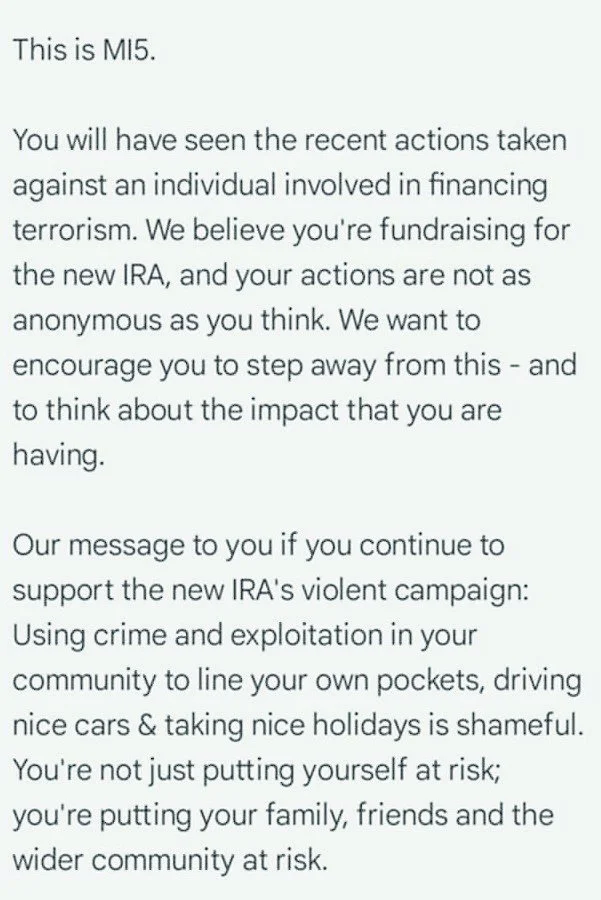
Message sent to Republican dissidents
MI5 texts ‘to help’ dissident republicans after suspect had assets frozen
Prisoner welfare group says seven people in Derry, Belfast and Scotland received similar correspondence
CONNLA YOUNG CRIME AND SECURITY CORRESPONDENT, Irish News, November 12th, 2025
MI5 has contacted several republicans by text offering to ‘help’ them, days after a Derry man was hit with severe financial sanctions by the British government.
A republican prisoner welfare group said seven people in Derry, Belfast and Scotland received text messages from the British intelligence agency in recent days.
It is understood those targeted, who are linked to the Irish Republican Prisoners Welfare Association (IRPWA), all received similar messages.
The messages were received in the days after Derry man Kieran Gallagher (48) was the subject of an assets freeze by British treasury officials saying there were “reasonable grounds” to suspect he is involved in activity linked to the New IRA.
MI5 headquarters at Holywood, Co Down. The Irish Republican Prisoners Welfare Association has said attempts by the British intelligence agency to ‘financially isolate our activists will not deter us’
The text message said: “This is MI5. You will have seen the recent actions taken against an individual involved in financing terrorism.
“We believe you’re fundraising for the New IRA and your actions are not as anonymous as you think.
“We want to encourage you to step away from this – and to think about the impact you are having.”
The message goes on to tell those targeted they “are not alone and there are people who care about you and want to help”.
“You can leave this criminal organisation behind and start a new chapter in your life,” it said.
“If you are willing to disengage then we are willing to help you achieve that.
“However, there will be financial and legal repercussions for those who continue to support the New IRA.”
Yesterday, two of those contacted received a second message, which appeared to express MI5’s disappointment after the earlier communication was ignored.
The IRPWA claimed a bank account belonging to Mr Gallagher contained “just £38”.
IRPWA spokesman Paddy Gallagher said: “Attempts to intimidate or financially isolate our activists will not deter us.
“The IRPWA will continue to provide vital support to republican prisoners and their families, ensuring that no family is left without assistance due to political repression.”
The text message received by several republicans:
Stormont is accused of 'starving' poorer councils of rates support
GARRETT HARGAN, Belfast Telegraph, November 12th, 2025
JUDGE BACKS LOCAL AUTHORITIES OVER JUDICIAL REVIEW OF CUTS TO VITAL GRANTS
Councils are considering their next steps after a judge ruled in favour of their judicial review against a Stormont department over cuts to the rates support grant.
The grant (RSG), devised to help the most deprived and rural councils provide services that are on par with more wealthy councils, has been slashed from £20.5m in 2008/09 to £3.124m — an 85% cut.
Mid Ulster Council challenged the Department for Communities (DfC) on four central grounds, with their legal action supported by Derry City and Strabane Council.
A judge concluded the applicant's claim for judicial review “succeeds on the ground of failure to have due regard to rural needs”.
But the elements relating to irrationality, good relations under section 75 of the Northern Ireland Act and the lack of consultation were dismissed.
As well as the court decision, a review of the RSG was instigated by DfC and the conclusions and recommendations from the report along with the department's responses have been published.
Impacted councils have now reacted to that review, saying it is “disappointing” as it is focused on process rather than the amount of funding given.
Derry City and Strabane Council chief executive John Kelpie said although there was a favourable outcome in court, it doesn't mean any additional funds will be restored.
The council's solicitor Philip Kingston was in court when the judgment was handed down and said the judge found budgets had been allocated and already spent and was not minded to make any formal order “compelling the reinstatement of the rates support grant”.
At the same meeting, People Before Profit councillor Shaun Harkin said the indication there will be no increase to the grant is “very, very disappointing”.
He added: “I wouldn't say that I'm surprised given that the rates support grant has been cut year on year. And we've talked about ministers starving this district and Derry of funding.
“I think that cutting the rates support grant is a way to do that, it starves this district of desperately needed funding.
“And that's why people in this district pay disproportionately higher rates compared to wealthier council areas across the North.”
A detailed report will be brought to the council's December meeting to allow representatives to consider and agree on the next course of action.
In terms of Section 75 of the Northern Ireland Act 1998, that involves a requirement by public authorities to promote equality of opportunity and good relations between various groups, including between persons of different religious belief. Mid Ulster Council submitted evidence suggesting the adverse impact of the reduction in the RSG budget would be disproportionately felt by councils having a majority Catholic population.
Four out of the seven councils in receipt of RSG have an outright majority of Catholic residents in their district and in a further two of the councils in receipt of RSG Catholics form the largest group in the area population.
Box ticking exercise
Furthermore, it said, 51% of the population in all councils in receipt of RSG are Catholic as opposed to 17% for the next highest denomination.
The judge made clear the section 75 complaint was a matter for the Equality Commission NI (ECNI) to consider.
But, in remarks critical of the department, the judgment states: “The completion of the equality screening form before the Permanent Secretary's final approval was given was treated as a formal requirement — in effect a box-ticking exercise — before the agreed position was finalised.
“This is not what section 75 NIA requires, nor indeed the respondent's Equality Scheme — which indicates that screening is to be completed 'at the earliest opportunity in the policy development/review process'.” The judge added that “had it been appropriate to determine this issue, I would have considered there to be force in the (council's) submission that the consideration of equality impacts in this case was post hoc and therefore insufficient to discharge the (department's) obligations”.
Mid Ulster District Council said it was successful in arguing that the Department for Communities erred in reducing the Rates Support Grant 23/24 budget without having due regard to rural needs under the Act.
“Mid Ulster District Council is a council with a large rural population, meaning that a cut to the Rates Support Grant will have a greater negative effect on the rural population compared to urban populations,” a statement added.
Mid Ulster Council added: “The recommendations fail to address the importance and the quantum of the Rates Support Grant for the less wealthy and more rural and deprived councils.
“The council will review the published information in detail and will consider the position further.”
A spokesperson for the Department for Communities said: “No changes are proposed to the current RSG methodology. Key lessons learned from the judicial review have been shared with staff across the department.”
Minister to intervene in support of DfI's appeal on A5 ruling
ALAN ERWIN, Belfast Telegraph, November 12th, 2025
Agriculture and Environment Minister Andrew Muir (Alliance) has secured permission to intervene in support of Liz Kimmins' appeal against a ruling that halted the £1.7bn A5 road upgrade.
Ms Kimmins (Sinn Fein), the Infrastructure Minister, is seeking to overturn a finding that the dual carriageway scheme did not comply with climate change targets.
Senior judges confirmed yesterday that Mr Muir's department can participate at next month's hearing in the Court of Appeal.
Intervenor status was also granted to environmental campaigners Friends of the Earth.
The legal battle centres on the decision to approve the 58-mile development between Derry and Aughnacloy in October last year. According to official figures, 57 people have been killed on the road since 2006.
The project, which forms part of a proposed cross-border business route linking Dublin and the north west, has already been held up by previous legal actions.
A fresh challenge against the decision to authorise construction work was mounted by an umbrella group of local residents and landowners, the Alternative A5 Alliance. One ground of challenge involved claims that approval breached a goal in the Climate Change (Northern Ireland) Act 2022 to get to net-zero greenhouse gas emissions by 2050.
In June, the High Court quashed the Department for Infrastructure's decision to give the scheme the go-ahead.
A judge held that the decision was irrational based on a lack of evidence it would not prevent Northern Ireland meeting the climate change targets.
With Ms Kimmins and her department preparing to appeal his verdict, formal requests were made by both Daera and Friends of the Earth for intervenor status.
At a review hearing yesterday, any objection to both applications was withdrawn. Counsel representing both new participants stressed their involvement in the case will be limited.
Tony McGleenan KC, for Daera, said: “We will be addressing the climate change legislation only.”
Meanwhile, the campaign group A5 Enough is Enough will continue to have similar participation status at the legal battle in support of the upgrade.
The group has expressed frustrations at the repeated delays in improving what their lawyers branded “a deathtrap of a road”.
Lady Chief Justice Dame Siobhan Keegan, sitting with Lord Justice Treacy, confirmed the appeal hearing is to begin on December 10.
‘Extreme pressures’ at Altnagelvin as patients lie on floor awaiting surgery
CONOR COYLE, Irish News, November 12th, 2025
THE Western Health and Social Care Trust has warned of “extreme pressures” at its hospitals after patients waiting for surgery were forced to lie on the floor at Altnagelvin in recent days.
The Irish News has seen images of an unwell patient at the Derry hospital who was provided with a blanket and pillows to lie on the floor next to a toilet cubicle, while connected to an IV drip.
The patient did not wish to be named but is understood to have been waiting more than 24 hours on an operation.
A statement from the Western Trust said it could not comment on individual cases, but cited acute pressures at Altnagelvin adding that it is currently operating more than 40 beds above its funded capacity at the hospital.
“We are acutely aware of the continuing challenges and extreme pressures not just in our Emergency Departments but across both of our acute hospital sites and community services, with full escalation of beds on all wards and departments and additional beds in place in the community,” a trust spokesperson said.
“Both our acute hospital sites are over capacity with 41 escalated beds over and above the 370 funded beds at Altnagelvin Hospital and 31 escalated beds at South West Acute hospital over and above the 202 funded beds.
“Pressures are not unique to the Western Trust area and are being experienced across Northern Ireland. We are working alongside the Regional Control Centre daily to manage pressures.”
The Trust apologised for long waits and moved to reassure the public it was doing everything possible “under difficult circumstances”.
“Unfortunately due to these extreme pressures, patients waiting for admission to a ward are having to wait longer in our Emergency Departments than we would like and we apologise for this.
“We want to reassure the public that we are doing the best that we can and wish to thank our staff for the excellent care they provide to our patients under difficult circumstances.”
MLAs united in opposition to Starmer’s digital ID scheme
ANDREW MADDEN, Belfast Telegraph, November 12th, 2025
FEARS VOICED OVER PRIVACY, IDENTITY AND COST DURING STORMONT DEBATE
Stormont MLAs have united in opposition to the Government's controversial plans for a digital ID.
It comes after Prime Minister Keir Starmer announced plans in September to make digital IDs compulsory for all those working in the UK.
The Government has said it is part of efforts to deter illegal immigrants from travelling to the UK, as it will make it harder for people to work without the right to do so.
Stormont's main political parties are all against the scheme.
Sinn Fein tabled a motion in opposition to the plans, which noted concern that “this flawed proposal could result in the squandering of millions of pounds of public money at a time when public services are increasingly stretched”.
The motion called for an “exemption to be put in place so that citizens here are not included, if the British Government proceeds with its ill-considered digital ID scheme”.
An amendment was tabled by the DUP, calling for the scheme to be scrapped right across the UK.
Speaking in the chamber yesterday, Sinn Fein's Colm Gildernew referred to the digital ID as a 'Britcard', as it has been branded by many.
Mr Gildernew said the scheme isn't wanted by the majority of people here and the Government needs to “reflect on this hare-brained scheme”.
‘Attack on Good Friday Agreement’ that is ‘most British thing to do’
“First and foremost, this is an attack on the Good Friday Agreement,” he said.
“The Good Friday Agreement makes it explicitly clear that citizens here in the North have the right to identify as Irish or British, or indeed, both, as they so choose.
“The idea that Irish nationalists living in the North who carry Irish passports as a proud birthright would accept a mandatory form of ID that forces them to identify as British is absolutely ludicrous.”
The DUP's Paul Frew accused Sinn Fein of being “wrong-headed” on the subject.
“The reason why they're so wrong-headed on this, the reason why they're hung up on a nickname, 'Britcard', is because if this was brought in in the Republic of Ireland, if this was brought in in the EU, which there are plans for it to be, they would lap it up,” he said. “They would all sign up for their digital ID cards.”
He added: “It's the most British thing to do to oppose digital ID. It is the most British thing to do to oppose ID, mandatory ID of any form, because the British people have never suffered it.”
Backing the DUP amendment, Alliance's Paula Bradshaw said it “acknowledges the broader risks, not just to Northern Ireland, to our unique circumstances, but to personal privacy and public trust across the UK”.
The SDLP also backed the amendment, with MLA Cara Hunter stating the scheme is a “violation of privacy”.
“I welcome that essentially every party across this house, despite their belief, background or view on London, is standing together to reject what is such a violation of privacy for our citizens here,” she said.
Ms Hunter added: “Today it is digital ID, but what's tomorrow can be a lot more sinister,” she said. “Facial recognition, databases, movement scoring, or potentially technologically driven profiling. To that, we say no.”
UUP deputy leader Robbie Butler said the scheme would “open the door to the misuse of data” and “once that door is opened, it's rarely closed again.”
People Before Profit MLA Gerry Carroll said the scheme is “based entirely on exclusion and discrimination”.
“It is designed to assess who may have access to our public services and who may not,” he added.
Following the debate, the motion was passed, as amended by the DUP, without a vote.
Ongoing lawfare risks everything say retired Generals
The Times, London, November 10 2025,
LETTER
Having held the honour of leading the United Kingdom’s armed forces, we do not speak out lightly. Yet on Armistice Day we feel bound to warn that the government’s Northern Ireland Troubles Bill, and the legal activism surrounding it, risk weakening the moral foundations and operational effectiveness of the forces on which this nation depends. Presented as a route to justice and closure, the bill achieves neither. It will not bring terrorists to account; it will not heal division in Northern Ireland; and it undermines the confidence of those who volunteer to serve this country at its request and under its authority. This lawfare is a direct threat to national security.
No member of the armed forces received a “letter of comfort” after the Good Friday Agreement. What they relied upon was far stronger: the belief that if they acted within the law, under proper orders and in good faith, the nation would stand by them. This bill tears up that compact. Be clear, those who served in Northern Ireland do not seek immunity, they simply seek fairness — the recognition that there is a fundamental difference between legitimate authority and illegitimate violence. To erase that distinction weakens the moral authority of the state.
By extending the same protections to those who enforced the law and those who defied it, the bill becomes morally incoherent. It treats those who upheld the peace and those who bombed and murdered in pursuit of political ends as equivalent actors in a shared tragedy. That is not reconciliation; it is abdication of responsibility. Trust between the state and the individual who serves it is the cornerstone of military effectiveness. If servicemen and women begin to doubt, when they believe that lawful actions taken in the service of the crown will one day be re-examined in the misplaced light of hindsight, then recruitment, retention and morale will suffer.
Contrary to recent ministerial assurances, highly trained members of special forces are already leaving the service. These are the men and women who quietly neutralise threats and protect lives every week. Their loss is significant; it is a direct consequence of legal uncertainty and the erosion of trust. This is a corrosive form of “lawfare” — the use of legal processes to fight political or ideological battles — which now extends far beyond Northern Ireland. Today every deployed member of the British Armed Forces must consider not only the enemy in front but the lawyer behind. The fear that lawful actions may later be judged unlawful will paralyse decision-making, distort rules of engagement and deter initiative. We will lose our fighting edge at exactly the moment it is most needed. And make no mistake, our closest allies are watching uneasily, and our enemies will be rubbing their hands.
The prime minister and attorney-general must recognise that an ever-broadening interpretation of the European Convention on Human Rights is being used against those who act under lawful authority of the crown. The state owes its servants more than political reassurance it must ensure that those who apply necessary force on behalf of the nation are not left to face the consequences alone.
The government must restore legal clarity, reaffirm the law of armed conflict, deviate from the application of the ECHR, the Human Rights Act and relevant international conventions and ensure those who act under lawful authority are protected. A new, honest framework is required. The Troubles Bill achieves nothing — and ongoing lawfare risks everything.
General Sir Peter Wall, CGS 2010-14
General Sir Mark Carleton-Smith, CGS 2018-22
General Sir Patrick Sanders, CGS 2022-24
General Sir Richard Barrons, Comd JFC 2013-16
General Sir Chris Deverell, Comd JFC 2016-2019
General Sir Richard Shirreff, DSACEUR 2011-2014
General Sir Tim Radford, DSACEUR 2020-23
General Sir Nick Parker, CinC 2010-2012
Air Chief Marshal Sir Andrew Pulford, CAS 2013-2016
Careers ended, broken marriage and bereavements: Nama allegations destroyed defendants
SAM MCBRIDE, Belfast Telegraph, November 12th, 2025
DEVELOPER WHO ONCE OWED NAMA £0.5BN INSISTS BOTH ACCUSED ARE HONOURABLE MEN
One of Northern Ireland's biggest property developers has told a jury that the two defendants in the Nama trial are honourable people who have “had their lives destroyed both professionally and personally”.
Andrew Creighton told Belfast Crown Court that Frank Cushnahan's wife died six years ago, having “never recovered from the headlines” about the allegations around his Nama deal role, while Ian Coulter lost his job, his marriage and his parents over recent years.
Mr Creighton — who once owed Nama more than half a billion pounds — asked a jury “and for what?”, saying that the deal to sell Nama's loans had been good for him personally and good for Northern Ireland's economy.
Frank Hugh Cushnahan (83), of Alexandra Gate in Holywood, is charged with fraud by failing to disclose information and fraud by false representation.
His co-accused, former solicitor and Tughans' managing partner Ian George Coulter (54), of Templepatrick Road in Ballyclare, faces two charges of fraud by false representation, and charges of making or supplying articles for use in fraud, removing criminal property, and transferring criminal property.
Both men deny all the charges.
Yesterday the court heard from Nama's single biggest debtor, whose debts were among those sold by the Republic's 'bad bank' to US vulture fund Cerberus in 2014 for £1.2bn in what the Crown alleges was a deal involving corruption.
David Andrew Creighton said he'd been in the property business for about four decades with a “big interest in the centre of Belfast”.
Listing some of the properties he either owns or owned, he referred to the Anderson McAuley building, the Robinson Cleaver building, the US Consulate, three big shopping centres in central London, and “one of the biggest” shopping centres in Edinburgh.
Asked by Jonathan Kinnear KC for the Crown how he first met Cushnahan, he said it was probably around 2007. “I was keen to get to know him because he was a mover and shaker and a deal-maker about town,” he said.
The developer said he was keen to “form a relationship to see where that would take me to”.
He said that on a Sunday in February 2014 he met Cushnahan in the library of Tughans' solicitors after getting a call from someone to say that Cushnahan wanted to talk to him because he was “working on a project that could possibly see the Nama loan book sold”.
He said Cushnahan confirmed that to him in person and asked if he could help with “details of my portfolio”. At that point, he said his rental income was about £50m a year, £30m of which involved properties controlled by Nama.
He said Cushnahan wouldn't tell him who the potential buyer was but “I wasn't surprised at that because Mr Cushnahan would have been quite private in his dealings”.
He gave Cushnahan detailed information about his companies, he said, but then for weeks there were “more and more questions”.
Saying he was annoyed at this as some of them could have been answered by reading what he'd already handed over, the developer said he asked Cushnahan: “Am I gonna get paid for doing this work?”
Mr Creighton said Cushnahan responded by saying that “if there was a successful bid and he was going to pay a fee he would see if he could get me paid”.
However, the developer said his request was “more to put [Cushnahan] off” and he never really expected payment because “this was about saving my family business”.
Mr Creighton said he met Coulter through Cushnahan, who was keen to “put some of my business in Tughans' direction”. He said Tughans now do some work for him.
The developer said he had “lots of meetings” with Cushnahan in Tughans' office and in one of those meetings Coulter entered the room, “grabbing the chance to say no fees could be paid”.
He thought that related to whether he'd be paid for his work which “was no big deal”.
He said Cushnahan later handed him a letter in Tughans' library “along the lines that I wouldn't be making any claim against Tughans for any payment” but “as far as I was concerned the matter was closed” so he tore it up without even reading it.
Under cross-examination by Frank O'Donoghue KC for Cushnahan, the witness said he'd had a very positive view of Cushnahan to this day.
Explaining the scale of his operations, he said that “every property around the Waterfront Hall, my company built”.
The Belfast developer said that the Nama Act was “law that was written in another jurisdiction and should never have applied to me”.
When asked if he would have trusted Cushnahan, he said: “Yes, and still do”.
Under cross-examination by Patrick Taggart for Coulter, the witness said he met Cerberus after the deal and “dug in hard”, telling them they needed him to help them out.
He said that he ended up paying the US fund “many millions to get out of my [personal] guarantees” for loans which was “very successful for [it] and very successful for me”. Asked how he got on with Nama, he said the relationship was fine. However, he added: “You can get on well with your jailer, but you don't particularly like him”.
He said he didn't know what Tughans wanted him to sign to say he wasn't expecting a fee. Mr Taggart asked if it might have been because the firm wanted to keep the millions of pounds for itself. The witness said that might have been so but he didn't know.
Mr Creighton said he'd known Coulter since about 2011 or 2012 and he is “still working with Ian Coulter as we speak”.
He told the court that several years ago “Glentoran FC was served with a tax demand for £500,000 and — don't ask me how — but Mr Cushnahan went in to fix this and asked me to assist and I assisted. I think Ian was involved at the start of that.”
He said of the defendants: “Their lives have been destroyed, both professionally and personally. Mr Cushnahan hasn't been right since.”
He said Cushnahan's wife died in 2019, having “never recovered from the headlines about this whole thing” and Coulter “is no longer — he was a top corporate lawyer… his marriage has broken down, as far as I know, and his proud parents passed away”.
He went on: “For what? For a deal that Nama say is a good deal, that Cerberus say was a good deal, I'm certainly saying it's a good deal and both our governments in Belfast and Dublin say is a good deal.”
The trial continues.
A wise and balanced examination of Irish unity by two of Ireland’s finest journalists
Posted on Wednesday, November 12th, 2025, Andy Pollak, https://2irelands2gether.com/
Fintan O’Toole is the nearest thing Ireland gets to a public intellectual: a writer of erudition and intellect who tackles the political and cultural issues of the day and of the nation through a widely read column in a prestigious newspaper, in his case the Irish Times. Similarly, for my money, Sam McBride of the Belfast Telegraph is the finest journalist currently working in Northern Ireland. Neither of them can be easily pigeon-holed into the two traditional viewpoints of commentators, politicians and so many ordinary citizens on this island: nationalist or unionist.
They have recently come together to publish a fascinating and imaginatively crafted examination of the strengths and weaknesses of the arguments for and against Irish unity, entitled simply For and Against a United Ireland. In this short 177 page paperback book, commissioned by the ARINS project, O’Toole and McBride each take on and explore the arguments from each camp. I would make this balanced and scrupulous treatment of the great existential issue of this island required reading for every Irish and Northern Irish sixth year school student and first year undergraduate (and their parents). This book, say the authors in their introduction, is “especially for the undecideds.”
In a jointly written postscript the authors come to their conclusions. These are:
1) a border poll is not imminent, “nor would it be wise to hold a referendum for a considerable period because even nationalist politicians are for now mostly engaging with the issue rhetorically.”
2) “Irish unity could work to create a settled, pluralist and prosperous island that is moving decisively beyond the bloody enmity of the past. That would require years of hard slog before a referendum and decades of difficult and for the most part terribly dull work after a vote for unity.”
3) Preparing the ground for a Border poll isn’t simply opening the way to Irish unity, as many unionists fear. “Much of what can be done to make a referendum meaningful – for example, sharing resources to create better health services on both sides of the border or boosting investment in public transport, education and green infrastructure – is well worth doing anyway. It makes life better for everyone, regardless of whether Northern Ireland ultimately opts to remain in the UK or join a united Ireland.”
4) The outcome of a Border poll “will be determined by the growing number of people who are open to persuasion. The open-minded will not be swayed by slogans or appeals to tribal solidarity. They will want good answers to hard questions. Both sides will have to be prepared to make arguments grounded on facts about the present and realistic projections about the future.” They point out that many of those who will go to the polls – including the 20% of people in the Republic and 10% of people in Northern Ireland who were born outside Ireland or the UK respectively – “will have identities that do not align themselves with traditional Green/Orange, Protestant/Catholic or British/Irish binaries. They will be looking not for historic vindication or vengeance, but for better futures for themselves and their children.”
On the way to these joint conclusions the two authors separately tackle the ‘for’ and ‘against’ positions. The arguments here are dense and this short blog can only give a flavour of them. Fintan O’Toole argues the case against unity by saying “unknown change” is currently what is on offer. He quotes the 2022 ARINS/Irish Times opinion survey that people in the Republic identified as their biggest concern “whether a united Ireland would be peaceful”.
“The threat of serious violence could be diminished if the shape of a unified Ireland were made clear in advance of a poll and, critically, if that shape were one in which those who wish to retain a British allegiance were reassured by generous concessions to their sense of identity. But there is no great reason to believe that people in the Republic are in general prepared to make those concessions.”
O’Toole says “there is an irreconcilable contradiction between between the way Southerners see a united Ireland – essentially a Greater 26 Counties – and the way it would have to function on the levels of both institutions and symbols.”
The economic cost of unity
He quotes the economists John Fitzgerald and Edgar Morgenroth claiming that the cost of Ireland supporting the North after unity, when the costs of increased public sector wages and welfare rates are included, would rise to almost 10% of national income. This would require a dramatic increase in taxation and/or a major reduction in government expenditure. However a 2021 Irish Independent poll found that 54% of people said they would be unwilling to pay more taxes to fund a united Ireland.
He says the evidence suggests that one thing voters would expect before any border poll is a detailed health care plan for the whole island. However “if the Republic has been unable over many decades to integrate its own health service, how can we imagine it would be capable of amalgamating it with a service north of the border founded on very different ideological and organisational principles?” For example, before creating an all-island National Health Service – which is what people seem to want – the South would have to nationalise 10 powerful private hospital groups, some of them owned by Catholic religious orders.
He concludes by saying that it is “simply fanciful” to imagine that the South’s “creaking system” of housing, healthcare, childcare, public transport and infrastructure is “capable of managing, in addition, all the immense practical problems that unification would bring.” In this sense, “there is simply no evidence that most people in the South have given any real thought to what unification would mean.”
“Bluntly, unification – if it is not to be chaotic, costly and potentially violent – demands a much more robust and effective Southern state than the one that currently exists. When there is a more settled North and a stronger South, unification may become feasible. Before then, it must remain in the realm of vague possibilities.”
In his arguments in favour of unity, O’Toole says that “Northern Ireland was a product of the fusion of three forces: demographic, economic and political. It was made possible by the existence of a secure Protestant majority in the north-east of the island; the radical superiority of the Northern economy over its Southern counterpart; and the firm alliance between Ulster unionism and British conservatism. But the stark reality is that each of these three pillars has now crumbled.”
On demography, he says that in 1926 33.5% of the population of Northern Ireland were Catholic. By 2021, when religion and ‘upbringing’ are combined, 45.7% of the population were ‘Catholic’, compared to 43.5% who were ‘Protestant, Other Christian or Christian-related.’ So “the demographic ground has shifted irrevocably.”
On the economy, over the past century Northern Ireland has lost much of its industrial base, with manufacturing employment having fallen from 169,000 in 1970 to 89,000 in 2024. Conversely the South is now more industrial than the North. “By far the biggest part of its economy is in services, but industry nonetheless accounts for 19% of its workforce, compared with 11% in the North.”
In politics, he quotes the conservative Northern Ireland Secretary Peter Brooke’s carefully-crafted and mould-breaking 1990 speech indicating that “the British government has no selfish strategic or economic interest in Northern Ireland.”
A process or an event?
O’Toole concludes that “the case for a united Ireland is highly problematic – but only if we think of unification as an event rather than a process.” He says Northern Ireland’s separation from the United Kingdom would be “a consensual process of transferring sovereignty from one friendly state to another.” The UK would remain “centrally involved in a process it is pledged to facilitate. There would be a range of governmental actors – Dublin, London, Brussels and perhaps (depending on the long-term effects of the second Trump administration) Washington – working together to ease the process.”
He believes that “the great advantage of planning seriously for the possibility of a united Ireland is that most of what needs to be done to prepare for is is good for everyone whether unification happens or not”: strengthening cross-border trade; creating a fair and efficient health service, north and south; making the two welfare systems more effective at lifting people out of poverty, and ending the disproportionate religious control of education in both jurisdictions. “This is what will make a united Ireland attractive not just as an idea or aspiration, but as a process of tangible improvement in the daily lives of all who share the island.”
Citing opinion polls showing that unity is low on Southern voters’ list of priorities, and the comparable case of German unification, O’Toole makes the valid point that “most citizens in democracies do not spend a great deal of time thinking about abstract propositions…It is only when the proposition becomes real that most people will start to turn a general aspiration into a concrete decision. It is at that point that the ‘terms and conditions’ will come into play.”
Sam McBride’s arguments are not quite so forensic and statistic-driven as O’Toole’s. Arguing in favour of unity, he says that in 2025, “with Ireland economically prosperous and with the Catholic Church more powerless than at any time since the Act of Union, there is evidence of tangible change of the sort that means sharing this piece of earth without bloodshed [a favourite phrase of John Hume’s] is more possible than at any point since partition.”
He says that “a wise nationalist leadership would kill unionists with kindness…financial investment in unionist areas, gestures by nationalist leaders, and changing national symbols to show the seriousness of the commitment to a truly new dispensation.” He points out that “not only is Ireland a nation with a high regard for individual freedom, democracy and the rule of law, it is brimming with wealth. Whereas in 1974 amalgamation with the South would have meant poverty, now it means prosperity.”
He believes the threat of a violent loyalist backlash can be handled. UK intelligence agencies are known to have heavily infiltrated the loyalist paramilitaries. “If it is in Britain’s strategic interest to ensure a peaceful transfer of sovereignty, it should have a significant influence on how these organisations behave or at the very least have good intelligence on what they’re up to.”He also points out that any loyalist insurrection “would immediately transgress one of the prerequisites of a just war: it would have no chance of success.”
McBride’s arguments against unity are again based partly on the serious risk of violence and upheaval if a unity referendum is bungled:”a slim majority either way could be disastrous.””A united Ireland would not mean bolting Northern Ireland onto the Republic. It would mean dismantling both states and creating an entirely new country. To remake any state would be a major risk. But on an island whose soil is saturated with centuries of bloodshed and where hundreds of thousands of Northerners do not want such an outcome, it would be a gargantuan risk.”
Uncertainty gives militants leverage
He quotes the historian John Whyte observing that “for civil war to break out, it is not necessary for a majority of inhabitants to desire it. Quite small numbers of extremists on both sides can force a situation where, by reprisal and counter-reprisal, the peacefully inclined majority are obliged to seek protection from, and then give support to, the paramilitaries of their own community. This is how civil war began in Lebanon in 1975”. He also points out that the Republic’s defence forces are “farcically ill-equipped” to deal with any major outbreak of violence in the North.
Whereas nationalists continuously reassure unionists that their identities would be fully respected in a united Ireland, they ignore “the depth of anti-British sentiment that remains in Irish society”. McBride gives as examples of this the vandalisation and eventual abandonment of the wall in Glasnevin cemetery commemorating all those who died in the 1916 Rising, including British soldiers; and the abandonment by the Irish government of an event to mark the Royal Irish Constabulary and Dublin Metropolitan Police. [I would add the sectarian vitriol faced by Fine Gael’s Presbyterian candidate, Heather Humphreys, in the recent presidential election].
McBride also notes that the often suggested solution of inverting the Good Friday Agreement by maintaining Northern Ireland on a devolved basis while Dublin takes over the powers currently exercised by London, “would almost certainly be a mirage. It would mean keeping most of the bad bits of Northern Ireland [‘devolution has been shambolic’] while losing the key benefit – being part of a much larger UK.”
Much better for now, he argues, would be to “unite around making both parts of the island work, making the two parts of the island understand each other better, and leaving it to the wisdom of our descendants at some long-distant juncture to decade if a near-invisible border should be removed.”
“Once [in NI], unity was the only way to get rid of the worst excesses of unionist dominance. Now there is no dominance. It’s possible to have the best of both worlds: full access to the UK economically, professionally and practically, while being every bit as Irish as someone in Cork or Kerry.”
The authors’ final joint thought is a telling one. “The ultimate question in relation to unity will be whether, in a turbulent world, more people prefer the comforts of the familiar or believe that the challenges of the future can best be met in a transformed Ireland. While much of what will happen in the meantime is currently hard to imagine, this is one choice that we can control. We have been given the benefits of peace and time in which to consider this decision carefully. History trends to be sparing with those gifts.”
P.S. In a follow-up column in the Irish Times, Fintan O’Toole writes of the extraordinary 238-page Department of Finance document called ‘Future Forty’, which maps the challenges the Irish State is likely to face between now and 2065. Extraordinary because it assumes that during that 40 year period “in all scenarios no change occurs to the current constitutional and political arrangements in both jurisdictions.”1
1 ‘The State is unified on not wanting to talk about unity’, Irish Times, 11 November
Alliance MLA's 'ex-combatant' language is 'straight out of the Sinn Féin handbook' - Burrows
By David Thompson, Belfast News Letter, November 12th, 2025
An Alliance MLA used language “straight out of the Sinn Fein handbook” when she referred to memorials for ‘ex-combatants’ rather than terrorists, an Ulster Unionist MLA has said.
Paula Bradshaw used the term when discussing a proposal from her party to “reimage” memorials on public land across Northern Ireland – in a bid to stop the marking of territory and the glorification of terrorism.
The South Belfast MLA told the BBC that “the vast majority of the memorials that are in place at the minute are dedicated to ex-combatants – very few of them are actually about innocent civilians”.
UUP MLA Jon Burrows said he “was appalled but not surprised” to hear Ms Bradshaw use the term ‘ex-combatants’ to describe former terrorists.
“This language is straight out of the Sinn Féin handbook. The people who maimed and murdered our citizens, loyalist and republican alike, were not ex-combatants, they were terrorists.
Moral certainty
“Language is important, it sends to both innocent victims and perpetrators a signal that there is a moral certainty that terrorism is wrong and was wrong. Alliance have claimed foul when it’s been pointed out their language on perpetrators and victims is morally confused, but they continue to provide evidence that it is.”
Ms Bradshaw has been clear in her condemnation of all paramilitary violence, and previously questioned the First Minister on the current status of the IRA in her role as chair of Stormont’s Executive Office committee. Michelle O’Neill claimed that she couldn’t answer questions about the influence of the IRA on Sinn Fein and the Stormont Executive because “party political issues” were not matters for Ms Bradshaw’s committee.
The Alliance motion on memorials – which was debated at Stormont on Tuesday – seeks to remove “paramilitary imagery and emblems and references to acts of violence or events that caused pain and misery”. It called on the Executive Office to develop guidance to ensure that future memorials “expressly require planning permission and are displayed in accordance with agreed standards”.
Ms Bradshaw told the BBC on Sunday that her party would not “inflict or enforce this on any community at all” – but said there have been successful schemes to rebrand murals.
Dangers in diluting Belfast Agreement's cross-community protections
By David Thompson, Belfast News Letter, November 12th, 2025
UUP MLA John Stewart says any attempt to dilute cross-community protections at Stormont should be of concern to Unionists.
A vote by nationalists and Alliance to reform the system by which Stormont ministers can be removed from office “sets a dangerous precedent and undermines the very protections that underpin power sharing”, the UUP has warned.
In the wake of a failed bid to oust the DUP education minister over a trip to Israel, the SDLP proposed reform of the current system which requires cross-community support for a motion to remove a minister from office.
It was passed with the backing of Sinn Fein and Alliance. Unionists have argued that the attempt to remove Mr Givan was purely political – and voted against the SDLP proposal.
Accountability Crisis
Leader of the Opposition Matthew O’Toole claimed the issue over Paul Givan had shown a “crisis in accountability” and in trust which he said threatened the future of the institutions.
The SDLP MLA said that even when there is “a clear and frankly overwhelming argument for censuring and holding to account an individual minister” – they were “effectively immune” under the current rules. He accepted that there had been no finding of any breach of the ministerial code against Mr Givan – but said when there had been in the past, the cross-community voting provisions had prevented “any meaningful censure”.
Mr O’Toole said the Assembly was “not ready” for removing other cross-community protections at the moment – but said they needed reform.
Ulster Unionist John Stewart, a member of the Assembly and Executive Review Committee told the News Letter his party “remains firmly committed to the principles of the Belfast Agreement, particularly the cross-community protections that ensure fairness and mutual respect in our institutions”.
The East Antrim MLA said: “These safeguards were designed to prevent one community from imposing its will on another, and any attempt to dilute them, especially in the face of a pan nationalist front should be something of concern for Unionists.
“The SDLP’s support for excluding a unionist minister without any breach of the Ministerial Code or the law sets a dangerous precedent and undermines the very protections that underpin power sharing. It is precisely this kind of behaviour that erodes public confidence and fuels instability.
“Calls for reform must not be used as a vehicle to advance partisan agendas. As I said in the Assembly, even the authors of the Agreement expected it to evolve but evolution must come through cross-party consensus, not nationalist dominance.
Destabilising Belfast Good Friday Agreement
“Reforming institutions without unionist input is not only irresponsible, it risks destabilising the delicate balance that has sustained peace for over 25 years. In fact, you need see what has happened in the past. On the three occasions when fundamental changes were made to the Belfast Agreement, whether at St Andrews, at Stormont House or in New Decade, New Approach, not everyone was involved.
“In those times of crisis, changes were often made to the Agreement to appease those causing the disruption, rather than to strengthen our institutions. I will also say this that there is no appetite from either the British or Irish Governments for further changes, and rightly so.”
During Monday’s debate, the DUP rejected the proposals – saying that the power to appoint or dismiss ministers must rest solely with party leaders and their nominating officers.
“The SDLP motion implies that a grouping of parties should be able to dictate the appointment or dismissal of ministers from parties they oppose – that directly contradicts the motion’s own language about stability”, Pam Cameron MLA said.
TUV MLA Timothy Gaston said accountability was not a principle for nationalists and Alliance but a “political weapon”.
He pointed to the DUP’s decision not to support a TUV motion of no confidence in the First Minister over her handling of the Michael McMonagle paedophile scandal. “The DUP were nowhere to be seen. Tellingly, as they found out today, the favour was not returned by their coalition partners.
“One rule for Sinn Fein, another rule for unionist ministers. So-called accountability here is not a principle, but a political weapon”, the North Antrim MLA said.
Sinn Fein said there must be “serious reform”, but West Belfast MLA Pat Sheehan said there is “always a potential that if you pull at a thread somewhere, it will unravel other parts of the [Belfast] Agreement”. Mr O’Toole argued that the spirit of the 1998 deal could be maintained while changing how Stormont works. The official opposition’s motion was passed by 42 votes to 30.