Victims campaigner who lost wife in Shankill bomb retires from Wave Trauma Centre
Ivan Little, Sunday Life, August 24th, 2025
ACTIVIST SLAMS 'PAINFULLY SLOW' PACE OF POLITICAL PROGRESS VICTIMS CAMPAIGNER WHO LOST WIFE IN SHANKILL BOMB RETIRES FROM WAVE TRAUMA CENTRE 'WITH A HEAVY HEART' TO LOOK AFTER OWN WELLBEING
Victims campaigner and peacebuilder Alan McBride has retired from the Wave Trauma Centre he joined soon after losing his wife Sharon in the 1993 Shankill bombing.
Mr McBride, who has been with the organisation for 30 years, helping to run it for the last 26, cited his mental health as the main reason for stepping away but said working for the group had been “the absolute honour of my life”.
The 60-year-old, from north Belfast, became one of the island's most articulate advocates for peace in his time with Wave.
Even before joining the group, he was involved in peace work with the 174 Trust.
“I like to think I have done my bit for peace, but it has come at a very heavy price,” Mr McBride told Sunday Life.
He is known for repeatedly confronting Gerry Adams in the wake of the IRA bombing which claimed the life of his 29-year-old wife and her father Desmond Frizzell at the family fish shop on the Shankill Road in October 1993.
Mr McBride has “lived and breathed” Wave ever since joining its management committee.
He said: “(Wave) was in my DNA, but it's been really tough for me over the last two years. It hit me like a steam train that my daughter Zoe was actually older than her mother was at the time of the bombing.
“It made me realise how young Sharon was when she was killed, and it made me think of all the things she missed out on, as well as what was robbed from me.
“My mental health deteriorated, there were sleepless nights, nightmares, flashbacks, sweats, shakes and I was sometimes finding it hard to get out of bed.
“Everything was creating anger with me, and I didn't know what to do with that anger, because who was I angry at?
“Society had moved on and we had the peace process that I played my part in.
Counselling
“But I realised I needed to get well so I decided, with a very heavy heart, to take early retirement from Wave.
“I knew that I had to take care of myself and get better, prioritising my own mental health and wellbeing. I'm walking a lot and journalling a lot, getting how I'm feeling down on paper.”
Mr McBride, who has a three-year-old granddaughter Lyla, said Wave had been very good to him and had provided him with the sort of counselling he would have recommended for others.
He added: “Trauma comes and goes. I don't know if you are ever healed from it.
“I've thought sometimes in my life that I was healed, then something happened and you were right back down again.”
While Mr McBride doesn't envisage returning to Wave, he is ready to give talks to concerned groups to “let them see what trauma does to a person and try to (help them) get out the other side of trauma”.
Seeing the impact of wars around the world, along with the political situation at home, often made him angry.
“Here in Northern Ireland, we are not where we ought to be, and it's only now that our Assembly is up and running, with no danger collapsing,” Mr McBride said.
“But the stop-start nature of it upset me because I think I gave up a lot to progress the Good Friday Agreement.
“I saw Sean Kelly, one of the bombers who murdered my wife, freed from prison after seven years.
“The politicians who lost precious little played silly buggers, instead of just getting on and making this place work for everyone in this society.
“I hope Sinn Fein and the DUP are working better now.”
Mr McBride works in a Belfast city centre pub. He takes comfort from seeing Protestants and Catholics socialising happily together, and is appalled that some elements in Northern Ireland are turning their hate on migrants.
He said: “I choose to believe that love drives out hate. I have tried to be a person that has demonstrated love, tolerance and acceptance.
“I still believe we are on a journey and are not going back, even if that journey is painfully slow.”
Unsurprisingly, his harrowing memories of the Shankill bombing have not faded at all.
He was working in a butcher's business, not far from his father-in-law's fish shop, and could easily have been visiting his wife when the device exploded.
“I was on a day off and was on the Lagan Towpath with my daughter Zoe, who had only just turned two,” he recalled.
“After I got home, a friend told me there'd been a bomb on the Shankill.
“When I called the shop, the phone was ringing, and I took that as a good sign.
“But when I arrived on that horrible scene and saw people digging with their bare hands for bodies, I feared Sharon was under the rubble — and she was.”
Watching the footage of flattened buildings and people scrambling to find survivors in Gaza brought the horrific memories rushing back.
In 1993, Mr McBride became involved with the Families Against Intimidation and Terror, and staged a campaign of protest against Gerry Adams, who had carried the coffin of Shankill bomber Thomas Begley.
However, he eventually resolved it was time for him to “end chasing him around the country with placards”.
Forgiveness
“I really wanted to sit down and start to develop dialogues and communications with people, but I don't really go down the road of forgiveness,” Mr McBride told Sunday Life.
“I don't know that I've forgiven the people behind the Shankill bomb, but I've found a way of trying to let go of the hurt of that atrocity, even though it comes back to haunt me sometimes.”
Alan McBride's courage after Shankill despair is an example to everyone
Suzanne Breen, Sunday Life, August 24th, 2025
Alan McBride has always been brutally honest, even if at times it has made for an uncomfortable personal and political journey.
On the morning of October 23, 1993, he dropped his wife off to work in her father's fish shop on the Shankill.
Hours later Sharon was blown up when two IRA men carried a bomb into the premises.
Alan's recollection of his last words with her isn't rose-tinted. “As she was getting out of the car, I asked, 'Did you remember to tape the football?' She had forgotten,” he said.
“I wasn't happy. I closed the door and sped off — revved the engine up to let her know I wasn't happy. Crazy, like, looking back now, that that was the last exchange I had with her.”
Other less moral men may have chosen not to publicly disclose that chat. And now, over three decades after he lost his wife, Alan is once again scrupulously candid.
For 26 years he has helped to run Wave Trauma Centre. He has been a shining light in terms of peace-building: not in a phoney, cliched way, but in a manner which has involved stretching himself.
But the man who has addressed conferences on post-traumatic stress today comes clean in this newspaper about his own struggles in recent years.
‘Like a steam train’
His daughter Zoe was a toddler when her mother was killed. Zoe reaching 29 — the age Sharon was when she died — hit Alan “like a steam train”.
He has been haunted by thoughts of how much his wife has missed out on and what he's been robbed of.
“My mental health deteriorated. There were sleepless nights or nightmares, flashbacks, sweats, shakes. I was sometimes finding it hard to get out of bed,” he said.
“Everything was creating anger with me and I didn't know what to do with that anger because who was I angry at? Society had moved on and we had the peace process that I played my part in.”
Alan reveals he has left Wave to work in a city centre pub as he focuses on his mental health.
That Saturday afternoon almost 32 years ago, hospital staff showed Alan the wedding and engagement rings that had been removed from Sharon.
He chose not to identify her body because he wanted to remember her as the beautiful young woman she had been, and not as the IRA left her.
The “hardest thing” was putting two-year-old Zoe on his knee and explaining that her mother was not coming home.
Alan spent “a long time hounding Gerry Adams”, who had carried the coffin of the dead bomber Thomas Begley.
“I followed him to Dublin and Washington,” he recalled. “I'd be there to meet him when he arrived at airports, holding a placard that read: 'My wife was murdered by the IRA'.”
Then, Alan started thinking about his own childhood. He'd grown up a “tearaway” in the loyalist Westland estate. He'd rioted regularly after school. His father had been a UDA member.
Abnormal society
He told the Holywell Trust Forward Together podcast in 2020 he hadn't forgiven the IRA “or gone soft on them”, but he recognised Northern Ireland was an abnormal society.
“When I'm thinking about peace and reconciliation and pointing the finger — the net has to be cast much wider than just those who planted bombs and shot and killed people,” he said.
“As a young boy I went to church and heard some very sectarian sermons from the pulpit… I remember politicians who didn't give us any sort of leadership… they were compounding our sense of sectarianism.”
Alan challenged anyone who would put his wife, an innocent victim, “on the same page” as Thomas Begley. Yet he stressed that the dead bomber's family “suffered just as much” as he had.
As Alan says today, “trauma comes and goes. I don't know if you're ever healed”. Through his work in Wave he has helped thousands of victims.
Whether angry or reflective, his has always been a voice of credibility and courage. Let's wish him well as he begins the next part of his journey.
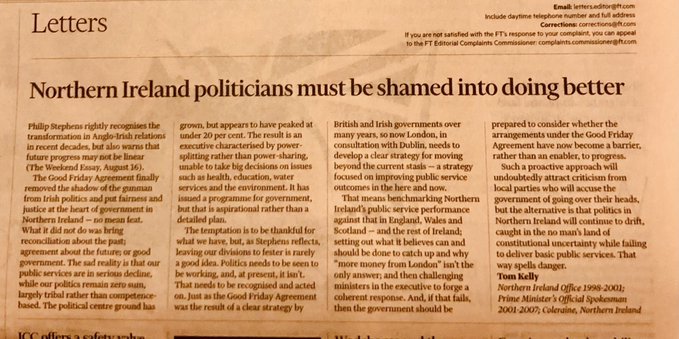
Letter by Tom Kelly, Former Official Spokesman, Prime Minister, 2001-2007, Financial Times. One of the best summaries of why it’s time to move on from Belfast Good Friday carve up to facilitate sectarian politics.
Queen's graduate who stored gun for the UVF says terror gang ruined his life
Ciaran Barnes, Sunday Life, August 24th, 2025
MIXED MARRIAGE LOYALIST BANDSMAN PREYED UPON BY CRIMINALS, CLAIM PALS
A university graduate forced to store a gun and ammo for the East Belfast UVF says his life has been ruined by the terror gang.
Gareth Rice was studying for a PhD at Queen's University when he was ordered to stash the sawn-off shotgun and 24 cartridges by loyalist paramilitaries.
The weapons had only been in his home in the Gilnahirk area of Belfast for a short time when the property was raided by the Paramilitary Crime Task Force in an operation targeting the East Belfast UVF.
Rice was hauled off to court, charged with possessing the cache and remanded in custody at Maghaberry Prison.
He was eventually freed on bail, and last week pleaded guilty to having the sawn-off, double-barrelled, 12-bore shotgun and cartridges.
A judge told Rice he would be sentenced at Belfast Crown Court on September 3, with pre-sentence reports being key to deciding whether he is jailed.
Loyalists who know the university graduate insist he was never a member of the East Belfast UVF and was preyed upon because he was in the loyalist Pride of the Raven flute band.
“Gareth was given a bag by a UVF member and told to hide it in his home. He was afraid for both himself and his family if he refused, so he put it an old coal bunker in the back garden. He didn't even look inside,” a pal told Sunday Life.
A short time later, Rice's home was raided by the Paramilitary Crime Task Force in an intelligence-led operation targeting East Belfast UVF criminality.
“The police searched the coal bunker and found the bag with the shotgun and cartridges inside,” added our source.
'Duress'
“It was clear that Gareth had been set up by an informant. His life has been ruined, and for what purpose? So that some £10 tout could impress his handlers.”
When Rice appeared in court two days after the February 2023 shotgun find, his solicitor said he had been preyed upon and had been in “extreme fear” and put under duress to keep the haul.
Giving evidence, a detective argued that the defendant was a member of a loyalist flute band which has alleged links to the East Belfast UVF. However, it was stressed there was no suggestion Rice was a member of any paramilitary organisation.
“He appears to be an intelligent individual. He's studying for a PhD, so he would know right from wrong,” said the detective.
A solicitor for Rice said his client had been targeted because of his clear record, and while he knew about the bag, he had never looked inside it and had been too frightened to contact the authorities.
“He was very upset in his interviews and indicated to police that he was in extreme fear,” revealed the solicitor who, referring to Rice's involvement with a loyalist flute band, added: “It provides the opportunity for a person like this to have been preyed upon and targeted as a candidate able to be put under duress to store these items.”
While Rice was on bail on the weapons possession charges, a second individual whose fingerprints were discovered on the shotgun was prosecuted.
Loyalist sources believe the shotgun was used in two attacks by the East Belfast UVF, one at Tower Court in November 2021, and another on Belvoir Street the following January.
In both instances, shots were fired at the properties late at night in an attempt to intimidate the occupants.
Because shotguns leave little ballistic evidence — that is why they are favoured by criminals — the PSNI has been unable to definitively link the gun Gareth Rice was hiding to the shootings.
Friends of Rice, who is in a religiously mixed marriage and has lived with his young family in a nationalist area of Belfast, say he is trying to get on with his life.
One added: “He wants to put all this behind him and move on. Gareth's just another victim of the East Belfast UVF.”
Nine months after Rice's arrest in February 2023, the Shankill Road leadership 'stood down' the bosses of its East Belfast brigade.
This was in response to rampant drug dealing and criminality by members of the gang.
Innocent schoolgirl Julie deserved better from me
Ivan Little, Sunday Life, August 24th, 2025
I've made plenty of mistakes in my reporting career but one that annoys me more than most is one that I had to confront as I watched a play in Derry/Londonderry last weekend.
The production in the sold-out Playhouse was a one-woman show, Julie, about the death of a 14-year-old girl Julie Livingstone, who was hit by a plastic bullet fired by soldiers in Lenadoon in May 1981 as she returned from the shops.
The play was written and performed by Julie's niece, Charlotte McCurry, and while it did quite properly highlight concerns about the use of plastic bullets — which were shared by both sides of the community — it wasn't an overtly political piece and concentrated more on the devastation caused on a very personal level to the Livingstone family.
I reported on Julie's death for UTV not long after it happened and just before my report went on air, I received a phone call from a source within the RUC.
He told me that two of Julie's brothers were in the Maze, one of them for a brutal sectarian murder, a charge which was later quashed on appeal.
The RUC tip-off was clearly an attempt to blacken Julie's name, and I fell for it.
I led my lunchtime report with the revelations about her brothers. Which I hadn't taken the time to think had nothing to do with Julie who was later found by a long-delayed inquest to have been a totally innocent victim who was doing absolutely nothing wrong.
Indefensible
Not long after my lunchtime report went out, I was contacted by angry friends of Julie who wanted to know why I brought her brothers into the equation, especially at the start of the piece.
As I tried to give them an answer, I realised there was no answer. And then it dawned on me that I had let the journalistic desire to be first with new information rule my head. Yes, I could have mentioned her siblings later in the report, but it was indefensible to begin it with the disclosure.
I changed the construction of my report for the teatime news, but the damage had been done. The slur had been cast.
In the play based on the memories of Julie's sister Bernadette, it was said that the family had protested to the Belfast Telegraph for downplaying like me the nature of the killing and instead highlighting the fact that Julie's brothers were in prison.
Julie's family have long campaigned for the truth about her death but the files on the shooting have mysteriously been sealed until 2064.
Julie was one of at least 16 people including one Protestant who were killed by plastic or rubber bullets during the Troubles. It's estimated that more than 120,000 of them were fired before their use stopped.
Inspirational
In Derry I remembered how the inspirational Richard Moore, who was blinded at the age of 10 by a soldier's rubber bullet in 1972, has shown remarkable forgiveness and has become a prominent peacebuilder.
And just how many people were impacted by plastic or rubber bullets was underlined by the fact that my taxi driver in Derry had been hit in the face by one of them back in the day.
Anyone who's ever faced police or soldiers firing plastic bullets will know that the security forces didn't always play by the rules
I've seen colleagues deliberately targeted, and it was during one particularly vicious riot at a bonfire in the Edgarstown area Portadown that I narrowly escaped injury.
My crew and I were filming as loyalists attacked the police in the nationalist Obins Street area who responded with plastic bullets, hitting the rioters in the face, arms and legs.
Later Billy Wright had staff waken me in my Portadown hotel and he insisted that I should go with him to Craigavon Area Hospital to do a Mother Teresa-style meet and greet with 'wounded' loyalists who proudly showed me their battle scars.
How no one was killed or more seriously injured amazed me.
Back with the Julie Livingstone play, the director of the Kabosh Theatre Company, Paula McFetridge, told me the production had done amazing business on its first tour of Northern Ireland.
I said that I hoped that the play would be back for more performances in even bigger stages but Paula said that any return wouldn't be for a while.
For the very simple reason that Charlotte McCurry is pregnant.
If Sinn Féin wants a president to further the cause, Humphreys is their woman
Siobhán Fenton, Sunday Independent, August 24th, 2025
A border poll could take place during the next president's term, and a Presbyterian in Áras would be powerful symbol of reconciliation
Following a slew of nominations that left Seán Kelly scrambling to catch up, Heather Humphreys has emerged as the front-runner to be Fine Gael's candidate in the presidential election.
Despite this early momentum, if selected she will still face an uphill battle to succeed Michael D Higgins. The Áras has eluded Fine Gael's grasp and the party has a well-worn habit of derailing itself with self-inflicted gaffes during campaigns.
With Fianna Fáil and Sinn Féin both holding their cards close to their chests regarding which candidate they will run — or indeed if they will run a candidate at all — the dynamic of the election and its outcome are impossible to predict at this stage.
Yet the prospect of Humphreys becoming Fine Gael's candidate, and eventually president, would carry a symbolic significance that could shape politics across Ireland — not least how the debate about a united Ireland is viewed by northern Protestant voters. Those who advocate a united Ireland, including those in Sinn Féin, will be conscious that the president elected this autumn has a realistic chance of being in office for the next 14 years. As momentum towards a border poll grows, it is possible that a vote on Irish unity could take place in the latter stages of the next president's time in office.
Given Humphreys' background — as a Presbyterian from a border county, daughter of an Orange Order member and granddaughter of a signatory to the 1912 Ulster Covenant opposing Home Rule — the prospect of her becoming first citizen has the potential to be a potent symbol of reconciliation on the island.
In debates and discussions about a united Ireland, unionists often express concerns that the north's Protestant/unionist community could face discrimination similar to that inflicted on the Catholic/nationalist community after the creation of Northern Ireland.
‘Extremely fearful’
In an Ipsos poll taken earlier this year, 24pc of northern Protestants reported they would feel "very or extremely fearful” if a referendum on unity succeeded.
In the 2019 report 'Unionist Concerns and Fears of a United Ireland' undertaken by Fianna Fáil senator Mark Daly, a range of members of the Protestant, unionist and loyalist community — including politicians, religious ministers and loyalist band members — were interviewed about their concerns. Their anxieties included the prospect that "revenge” or "retribution” would be inflicted on them, including a Zimbabwe-style land grab confiscating farms from Protestant farmers. Some feared becoming "second-class citizens” subjected to forced assimilation in the new state.
In the report, then MLA and current Ulster Unionist Party leader and Stormont minister Mike Nesbitt elaborated on this.
"Over the near 100 years of Northern Ireland's existence, unionists have struggled to make the majority of nationalists feel comfortable,” he said.
"No one could argue objectively that unionism succeeded in that challenge and the fear is that replacing one majority with another opens the door to repeating past mistakes, or expressed simply, putting the shoe on the other foot.”
Former DUP leader and first minister Arlene Foster has also said that she would consider leaving the country if a united Ireland materialised.
"If it were to happen, then I am not sure if I would be able to continue to live here. I would feel so strongly about it,” she told Patrick Kielty, in a documentary marking the 20th anniversary of the Good Friday Agreement in 2018.
Polling suggests that momentum towards a united Ireland is growing, with research, including the Arins project (Analysing and Researching Ireland North and South), indicating that the percentage of people in the North who would vote Yes in a border poll has increased from 27pc in 2022 to 34pc this year. While this represents a steady rise, polling has yet to show the overwhelming support that would probably be considered a precursor to a referendum being called.
Pro-unity campaigners will be keen to assuage fears held by moderate unionists and undecided voters, by persuading them that the Protestant community would not merely be tolerated or accommodated, but actively included and embraced.
Reshaping unity debate
In this context, the prospect of Humphreys being elected to the highest office in the land by popular vote would attract keen interest within the North and shape the unity debate considerably.
Undoubtedly, there is little love lost between Sinn Féin and Humphreys. Sinn Féin supporters would view the former Cavan-Monaghan TD as being complicit in an out-of-touch government that has overseen a housing crisis that is causing misery and hardship for generations. They would baulk at the prospect of a Fine Gael president, regarding it as another sign of establishment politics continuing to reign.
As Sinn Féin considers whether to run their own candidate or back left-wing independent candidate Catherine Connolly, the leadership will be conscious that a poor showing by a Sinn Féin candidate would be another blow to a party already mired by a run of recent poor electoral performances. They will be keen to chalk up a success to boost morale and regain momentum.
However, much more so than other parties, Sinn Féin is above all a movement organised around the ultimate goal of achieving a united Ireland.
Unlike Fianna Fáil and Fine Gael, they are not only planning for the party's own electoral successes, but constantly thinking ahead as to how a referendum could be fought and won.
As a result, the party faces an unusual situation — whereby although a Sinn Féin candidate losing would be undoubtedly disappointing, a Humphreys presidency could suit the party's long-term strategic objectives.
She could prove a real asset to republicans, once a referendum on a united Ireland is under way.
Siobhán Fenton is a writer living in Belfast. She was SF deputy head of press in the Oireachtas, 2022-2024
Ahern might find peace process cannot cloak all of his flaws
Máiría Cahill, Sunday Independent, August 24th, 2025
Bertie Ahern has some great friends. The type of friends who would help in a time of need. The type of friends who stay loyal in the face of adversity. The type who can overlook the unfortunate points (such as the Mahon Tribunal findings), and who only see his positive attributes. The type of friends who want him as our next president.
There are those in Fianna Fáil, and indeed the country, who are not so enthusiastic — the type who could probably find 165,000 reasons for him not to run for the Áras.
Given the fact that he has consistently refused to rule out entering the race, we can presume he was considering it. There was only one obstacle. Like a snake slithering out of a decayed layer of skin, he needed to lose his shredded reputation and regrow a shiny new one. And so, when he rejoined Fianna Fáil just two years ago, coinciding with the 25th anniversary of the Good Friday Agreement, people were rightly curious. Was this a springboard back to public life?
Expecting those with Mahon memories to wipe the scales from their eyes in favour of Good Friday Agreement misting, though — even for a man with the gift of the gab and a talent for talking his way out of sticky wickets — is like crossing your fingers in Knock and hoping for an apparition.
You can sell it, and you may even convert some doubters, but there's always a cloud in the sky blocking those radiant rays.
Political miracles may happen. More likely, on hearing the news that most of the Fianna Fáil parliamentary party would back Ahern, is the scenario that those who are not amnesiacs will exclaim loudly while beating their breasts: "Jesus, Mary, and St Joseph. Have they learned nothing?”
You would have to feel sorry for Micheál Martin, given a poisoned-chalice ultimatum through the media by anonymous sources. Either he runs or Ahern does, they say. The Taoiseach would make an excellent president, but he doesn't want it.
Does Fianna Fáil need the negativity that running Ahern would bring? Let's remember what a wide-eyed and sincere Ahern told RTÉ's Bryan Dobson in 2006 shortly after the Irish Times had broken a story stating that he had received €50,000 from businessmen: "It is ridiculous that wherever I've gone for the last week, there have been 50 journalists running around behind me, like pied pipers.
I gave this information to the tribunal. I'm not blaming anyone who leaked it, I don't want to be taking anyone's character. But somebody took mine.”
Peace at a price
We nearly had the violins out. Then the tribunal interrogated the issues. We know the rest. Do we care, though?
Perhaps, like others who have cloaked themselves in the Good Friday Agreement, Ahern could argue that the pursuit of peace takes precedence over other reputational difficulties.
It's an interesting notion, and one that arose not in relation to him, but Martin McGuinness, on Friday, when IRA victim Brian Stack's son Austin and former Northern Ireland secretary Shaun Woodward were questioned on BBC radio about former Scotland first minister Nicola Sturgeon's description of McGuinness as "really kind” with "the twinkliest eyes”.
People have often written about Ahern's lovely eyes, too. Still, except for their peepers and the need for supporters to validate their strides for peace, there the similarity ends between him and McGuinness. Whatever you might say about Ahern, he is a peaceful, constitutional politician. McGuinness was, well, McGuinness. Stack called McGuinness "an evil person”, conceding that while he eventually compromised with unionism, he "never sought to reconcile himself with the victims”.
Woodward, while not disagreeing, was more sanguine about the former IRA commander. "There were many sides to Martin McGuinness, and they happened in different timescales… without McGuinness and Ian Paisley, I am not sure that we would have the enduring political institutions today or the peace process today,” he said.
Paisley, of course, vehemently opposed the Good Friday Agreement, but embraced power sharing during the Chuckle Brothers' era. Despite this, he never quite managed to move his reputation from his fire-and-brimstone days. McGuinness, on the other hand, had statesmen such as Bill Clinton delivering eulogies at his funeral.
Just before that funeral, Ahern told RTÉ radio: "I think it's fitting that Martin gets a good send-off. He was a good guy, he had a life that moved from being an IRA commander leading the Northern brigade right through to a time when he managed to convince the IRA to stop.”
Relatives of McGuinness's victims would disagree. One of them, Patsy Gillespie, was identified by a piece of his flesh attached to a zip after the IRA used him as a proxy bomb. Another, Frank Hegarty, was lured back to his death from England after "good guy” McGuinness assured his mother Rose that he would be safe.
When I went public in 2014 about child abuse, McGuinness told the media: "I regret that she wasn't able to go into a court and confront the person that she alleged raped her in the same fashion that republicans are being confronted now.”
That piece of inverted victimhood from the recent past is at odds with Ahern's "good-guy” perception of McGuinness, but it is undeniable that he worked toward peace.
Politicians should beware of dining out on their role in peace negotiations while the fact remains that more walls are segregating the two main communities in the North than there were at the time of the Good Friday Agreement. It is inaccurate to state that it brought peace, though it reduced the rates of killing substantially. None of us wants that to return.
One suspects that Ahern's friends would like to spin peace to obtain power. Those pushing for "Ahern for the Áras” might find that the public don't want the former taoiseach to return to public life either.
But, if he runs, at least Ahern is in a better place than most to find friends to donate to his campaign.
