‘Nobody knew things were going to get so bad’
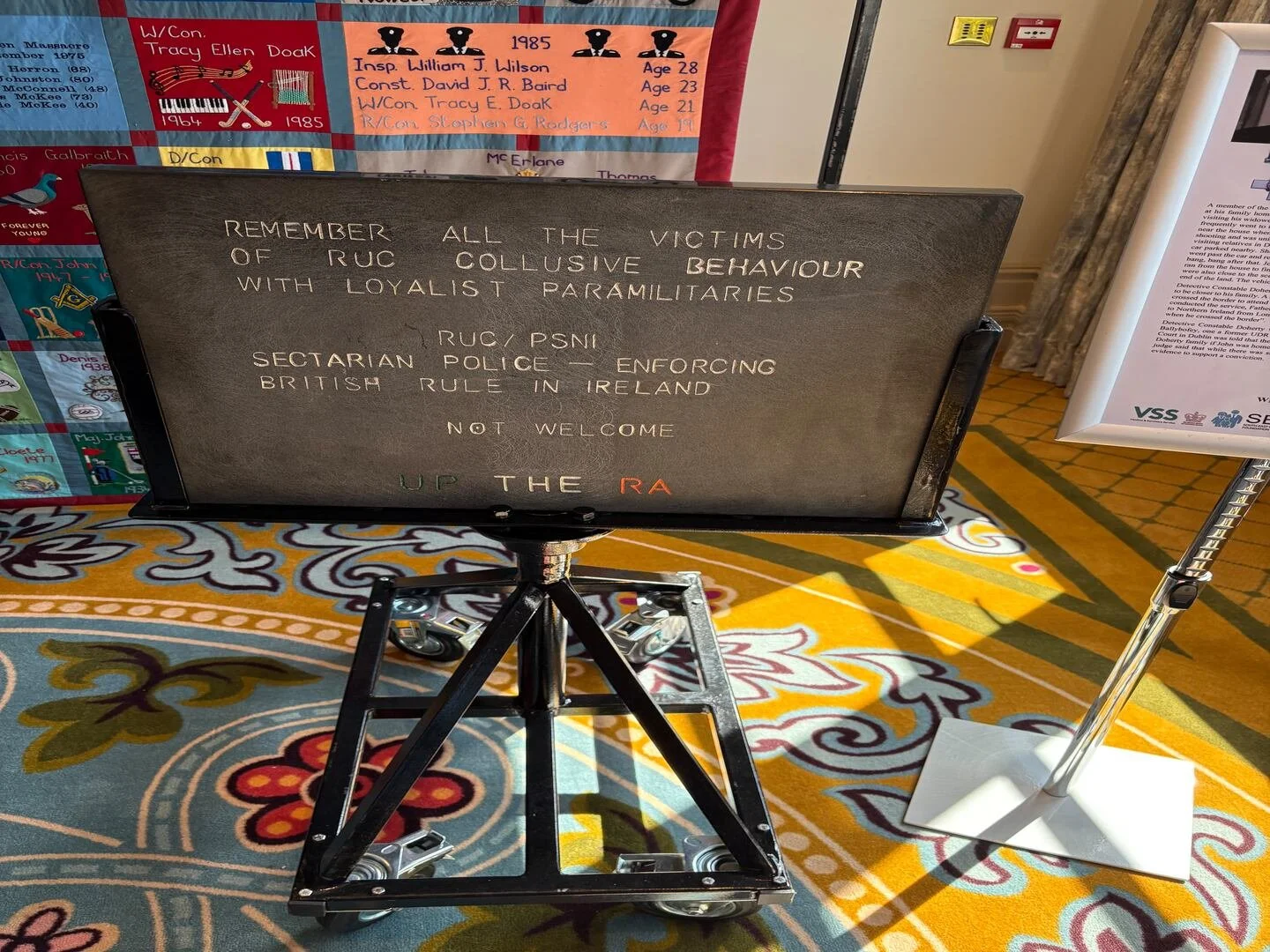
The reverse face of defaced memorial stone to Donegal-born RUC officer John Doherty now at centre of Troubles exhibition
Exhibition is to help people on both sides of the Border suffering from Troubles related trauma
Mark Hennessy, Irish Times, Sunday, May 11th, 2025
A graveyard memorial erected to honour a Co Donegal-born RUC officer that was vandalised within weeks is now the centrepiece of an exhibition recalling the Troubles.
The deep gashes left by the angle grinder used to deface John Doherty’s marble headstone took time to inflict, but those who stole it from his grave at Castlefin St Mary’s Church in Co Donegal in 2023 had plenty of that.
The damaged headstone, along with a memorial quilt commemorating some of the Troubles’ dead, formed part of an exhibition at the Church of Ireland‘s Synod in Naas, Co Kildare, which finished on Saturday.
The headstone was erected on October 28th, 2023 to mark the 50th anniversary of the killing by the IRA of Mr Doherty, a Catholic Royal Ulster Constabulary officer, as he came home to visit his mother at their home near Lifford.
Within days of being erected, it was stolen under cover of darkness. A month later, similarly in darkness, it reappeared with the inscription defaced, with the harp and shamrock symbol of the RUC bearing cut marks.
On the back, a text had been carefully chiselled: “Remember All The Victims of RUC Collusive Behaviour and loyalist Paramilitaries. RUC/PSNI Sectarian Police – Enforcing British Rule in Ireland. Not Welcome”.
The final line of the text on the back of the stone, which had been unveiled just weeks before in front of senior Garda and PSNI officers, had been filled in with the colours of the Irish Tricolour, with “Up The ‘Ra” written in green, white and orange.
“There’s a casual cruelty about that that, isn’t there? It’s dark. Death is always supposed to be sacrosanct in Ireland,” says the exhibition’s organiser, Kenny Donaldson, director of the South East Fermanagh Foundation (SEFF).
Returned home
Mr Doherty had joined the Metropolitan Police in London a few years before the Troubles erupted, but transferred to the RUC in late 1969 to be closer to his five brothers, six sisters and parents at their Ardnasool home.
His brother Terry, who served for more than 25 years in the Irish Army, said: “Nobody knew when he decided to come back that things were going to get so bad.”
He told of how the family’s home came under surveillance for nearly 18 months before his brother was killed, and his girlfriend wounded, as he turned his car on the narrow laneway on a Sunday evening. His mother rushed out to find him.
A man with no obvious reason to be in Ardnasool had travelled the quiet country road so often in the months beforehand that he was given a nickname – the name of a country music singer – by Mr Doherty’s siblings.
“John was a target for the IRA, but he loved getting home to see our mother. We always feared for him, but you always hope that trouble won’t come to your door,” Terry said.
His Catholic background had condemned him: “By killing him, the IRA frightened a lot of other Catholics from joining the RUC, or frightened those who were already in it to quit,” Terry added.
Nobody has been held responsible for the desecration. “The guards did their best, but there was no CCTV and these spineless individuals operated in darkness, as they always do,” Terry said.
SEFF Exhibition
The headstone and the memorial quilt were exhibited by the SEFF, which helps people on both sides of the Border who are suffering due to traumatic experiences caused by terrorism.
The quilt, the eighth completed so far, honours, among others, the Quinn children killed by a loyalist paramilitary firebomb in 1998, along with Ross and Ann Hearst, a father and daughter who served in the RUC and were killed by the IRA three years apart.
The quilts are brought by SEFF before schools and groups to tell the stories of those who were lost and who were left behind, including places where people “may have perceived that we would have had difficulty, but that wasn’t the reality”, said Mr Donaldson.
Last year, the organisation went to Latton GAA club in Co Monaghan, the home club of the late Fine Gael senator Billy Fox, who was murdered by PIRA in March 1974 when some of its members raided his girlfriend’s house in Tircooney.
One of the earliest exhibitions took place in St Mary’s College in west Belfast a decade ago, where some of those who visited “struggled” when faced with emblems of Orange Lodges, GAA clubs, the RUC and the Irish Army on one quilt.
Mr Donaldson recalled one young woman’s initially negative reaction. “I said nothing and let her continue to look. Then, she worked it out. She said to me, ‘It’s because they’re all innocent, isn’t it?’.”
The quilts never knowingly commemorate anyone involved in the IRA, or other republican groups, or loyalist paramilitaries.
“And they won’t be,” Mr Donaldson added. “Those individuals signed up to a code which enabled them and empowered them to go out and to murder their neighbours. That’s the difference. There’s human choice.”
The checks are, he said, “easier to make in some cases than others”.
“Sometimes there is a challenge to doing so, but we have built an organisation on the basis of its safe space that it offers to victims and survivors.
“If we overnight were to introduce a perpetrator into that, it totally changes the dynamic of everything. Do I have, on a human level, sympathy for everyone killed? Absolutely, yes, I do,” he went on.
“These were young men or young women who were misguided, who were ideologically used by others. Often, they were the cannon fodder who went out and did what they did. But they are not innocents and cannot be classified as such.”
'I don't subscribe to the belief these victims will not be found’
Kurtis Reid, Belfast Telegraph, May 12th, 2025
NEWLY-APPOINTED LOCATION OF VICTIMS' REMAINS LEADING INVESTIGATOR EAMONN HENRY CONTINUES THE SEARCH FOR THE DISAPPEARED OF THE TROUBLES
In his first days as the new lead investigator into the Disappeared, Eamonn Henry is careful with promises — but he's not without conviction.
The former Garda inspector (61) has been appointed to one of the most difficult — and open-ended — jobs on the island.
As head of the Independent Commission for the Location of Victims' Remains (ICLVR), he's leading the search for those abducted, murdered and secretly buried by republicans during the Troubles.
To date, the remains of 13 Disappeared have been recovered. Four remain — Joe Lynskey, Robert Nairac, Seamus Maguire and Columba McVeigh.
Mr Henry takes the reins from Jon Hill, who announced last month that he would step down — weeks after remains exhumed from a grave in Annyalla cemetery in Co Monaghan were confirmed not to belong to former monk and IRA member Lynskey, despite great hope that the search for his body was over.
“I don't subscribe to the belief these victims will not be found — I wouldn't have taken this job if that was the case,” the softly-spoken former Garda officer said, speaking to the Belfast Telegraph while in Northern Ireland just days after taking up the post.
Believes bodies of remaining four people will be found
“I do believe the remaining Disappeared will be found. I will do this job until these four people are recovered.
“I believe in the goodwill of humanity. People mellow over time and may have a 'Road to Damascus' moment and come forward with information.
“It's been a long time, and I just hope people who have this information look at the length of time it's been and think, yes, now it's time to bring these people home.”
Born in Roscommon into a farming family, Mr Henry — who is married and a father of three sons — was raised in Kildare and now lives in Dublin.
A keen GAA player, alongside rugby and golf, he said he was initially adamant he would join the family trade, but was discouraged by a warning from his mother that there was “no money in farming”.
He then saw a local advertisement appealing for people to join An Garda Síochána.
“I applied, joined in 1986 and rose to the rank of Detective Inspector, later joining the National Bureau for Criminal Investigation, where I served for 11 years,” he explains.
“It was part of that role that involved being the liaison to the Commission, but also cold case reviews, and serious investigations into murders and manslaughters.
“So I was well versed for this role due to my work with the Commission.
“In murder cases, you have the victim, and it's about getting justice for the family. That investigative process can be tedious and long — you're walking a tight line.
‘It’s all about working on behalf of victims’
“It was stressful but rewarding if we got a conviction. But again, it's all about working on behalf of the victims and their families, so it's similar to the Commission for the Disappeared. It's about the families, and that is my motivation.”
Mr Henry points to his vast experience during his time with the Gardaí on cold cases — the term used to describe investigations ongoing for years with no leads — and the comparison to his new role.
“I've worked on cases that remained unsolved for many years, and saw how one piece of tiny information led to convictions and brought people justice. So there is always an opportunity, there is always a chance,” he said.
“One case in particular I remember involved testing the DNA of hair from a hairbrush, which led to the identification of remains from a missing person in Cumbria. It's little things like that.”
He will never give up on trying to bring these murdered and secretly buried home to their families.
“I hear people say all the time, 'There is little hope' and 'There is no chance', particularly with the Disappeared. I don't see it that way at all,” he adds.
“There is always hope — and there are people out there with information. Whether they are being suppressed or not, or simply don't want to come forward, I am directly appealing to those people.”
Probed on his comment about the suppression of people who may hold information — an accusation often levelled at those in republican communities — Mr Henry won't be drawn on specific groups.
“I won't be naming any organisation or whatever, but there are people out there — and they know who they are —who have information. I am not interested in their political views or secrets, except for finding the location of these four victims,” he added.
“That's all I want — just four locations.
“Every organisation has its dynamics, its own methods of working, and its politics. You never fully understand the deep motivations of some people, but there are possibilities that people are being constrained.”
General goodwill
He doesn't believe republican or nationalist groups have been outwardly supporting the Commission's efforts to locate the remaining Disappeared while denouncing it in private.
“There is general goodwill towards the Commission, and support, and it's based on that,” he said.
During an interview with the Belfast Telegraph in March, Joe Lynskey's niece, Maria, said she was devastated that remains found in a grave in Co Monaghan were not his.
She said: “I'll be negative the next time going into it. I definitely won't let myself get to where I was with this one again. Definitely not.”
Mr Henry empathises with Ms Lynskey's viewpoint, given the failings to find her uncle's remains from more than 50 years ago.
“In relation to searching for Joe, I am sure she will get her hopes up, but we have to manage those expectations. If I were in her shoes, I'd be the same,” he said.
“We stress that it's a possibility, not a certainty. We still have a number of lines of enquiry into the Joe Lynskey case — but no one case gets priority.
“In a way, it's run like any police investigation,” he said about the day-to-day work of the Commission, which has four members.
“It's like a road map — we try to identify sources of information.”
Global platform
The stories of the Disappeared received a global platform — and a spotlight boost — through the Disney and FX series Say Nothing.
Based on the acclaimed non-fiction book Say Nothing: A True Story of Murder and Memory in Northern Ireland by Patrick Radden Keefe, the series, which aired last November, focused on IRA members Dolours Price and Marian Price.
It featured depictions of the 'disappearing' of Joe Lynskey, Kevin McKee, and Seamus Wright — against the backdrop of the abduction and murder of mother-of-10 Jean McConville, who was missing until her remains were located in 2003.
The Commission worked closely with Mr Radden Keefe during the writing of his book, and its close relationship with the acclaimed writer resulted in the organisation's details being included in the end credits of the series, which listed a confidential telephone number for information to be provided on the Disappeared.
Mr Henry has watched the series —and enjoyed it. He also said the Commission did “receive some responses” on the back of the appeal.
“I thought it was immense — and encouraged my family and friends to watch it. I felt it gave a good view of the political scene in Northern Ireland at the time,” he said.
“Obviously there were some creative liberties taken — and it's based on certain people's recollections — but I thought it was good.
“I know it aired a good few months ago, but I do hope it encourages people to come forward with some information.
“It did generate a response to us, but I can't go into specific details. Still, it gave us publicity.”
As he prepares to now lead the investigation into the four outstanding Disappeared victims, Mr Henry said he wants to ensure one thing is crystal clear: confidentiality.
“The information given to us cannot and will not be passed on to law enforcement or any other government services. It doesn't go past us,” he said.
“This is why I appeal to people to come to us directly. We will ensure their identity is not known to anyone.”
There is, nonetheless, a perception — however unfounded — that Mr Henry's direct appeal may be met with scepticism, given his background as a former police officer.
“I see that — I see how people could think you'd go to the back door and pass something on. That is not the case,” he insists.
“In the history of the Commission, there has not been a single leak, or breach of information provided to us.
“But time is our enemy — people have passed, memory fades, and the ecology of an area changes. That is why we need to find these people now. Not in four, five, six, 10 years' time. Now.”
Victims of Libyan-backed atrocities deserve a lot more than they got
PLATFORM: Jason McCue, Belfast Telegraph, May 12th, 2025
Recently the UK passed into law, in conjunction with European and G7 allies, authority to utilise extraordinary revenues from frozen Russian state assets to facilitate a loan to Ukraine for its military, budget and reconstruction needs.
It was the right thing to do in terms of morality, international law compliance and policy.
In short, the principal sum of frozen assets remains sacrosanct, but the extraordinary revenues, such as interest, generated on those assets can be utilised to compensate relevant just causes.
Now that the UK has crossed the Rubicon — putting itself closer towards long-established US and EU policies of confiscating sanctioned assets for satisfying relevant legal claims — the question arises around what the Government will do with the frozen assets of other malignant regimes, and in particular those relating to Libya.
Following the start of the Libyan revolution in 2011, and a subsequent UN resolution condemning the violence against civilians, £10 billion of Gaddafi regime assets were frozen in the UK alone.
Though our Government's released figures are opaque, such assets have increased by a staggering £3 billion in interest. That £3 billion should have the same legal and political status (and potential) as the extraordinary revenues on Russian assets being used to provide a non-recourse loan to Ukraine.
After pursuing a decade of litigation on behalf of victims seeking justice and compensation from Libya, for enabling Provisional IRA bombings — such as Enniskillen and Warrington — through their supply of Semtex for Gaddafi's infamous demand for 'rivers of blood' in the UK, in 2011 I travelled to Libya and concluded the Benghazi Agreement with the Transitional Libyan Government.
The Agreement confirmed that the Libyans and successor governments would pay set compensation to UK victims — approximately £450million — in parity with an earlier agreement between the predecessor regime and the US government. That agreement had only provided compensation to each US victim in our case because the UK Government had failed to similarly negotiate the same for UK victims.
In addition, the Benghazi Agreement also acknowledged and secured a promise to pay compensation for a wider group of UK victims — to those in our case — through a 'reconciliation fund'.
To date, successive Libyan governments have failed to live up to the Agreement, shamefully ignored the victims, and so far relented on their word of honour.
In 2015, the Northern Ireland Affairs Committee carried out a two-year inquiry into this matter. They concluded, in 2017, that our Government should use all its powers to make Libya pay (as per the terms of the Benghazi Agreement), failing which it should leverage the frozen assets to force Libya to pay.
UK Govt obligations to victims
Should that also fail, then the Government should pay the victims and seek to recoup the funds from Libya — rather prescient of the later loan structure put in place for Ukraine.
Successive UK governments have failed to implement those recommendations; despite claiming they have worked 'tirelessly' to make it happen.
Putting aside that a decade of trying (which many victims disbelieve) has demonstrably been an abstract failure, one wonders how, when holding all the cards for negotiation (including the Agreement and the frozen assets), the Government has played their hand so badly.
Perhaps the answer lies in their will. Of the last seven prime ministers who were asked (including Sir Keir Starmer) while in opposition, all had supported the victims' cause, agreeing to get justice done when in power. However, when in power, their public line has repeatedly been 'we would if we could, but we can't'; on the basis that it would offend international law and treaty commitments.
That position changed slightly a few years ago, when the Government began suggesting that international law was not the barrier — confirming what we had maintained from the start — but that it was simply Government policy not to do so.
The behind closed doors policy concerns were always said to be security, diplomatic relations and oil.
But now, Gaddafi's alleged chemical weapons are no more. What relations exist to be damaged when members of the Libyan government are openly complicit in orchestrating illegal migration into the EU and UK? And who in their right mind would invest in, as UK Government put it, a Tripoli government controlled by sporadic militias prone to despotic violence, when oil is at only $62 dollars a barrel?
Our government's admirable stance on using Russian frozen assets for Ukraine clarifies that they — alongside other leading nations participating in the Ukraine Loan Cooperation Mechanism — agree that actions of this type are in line with international law.
But it also demonstrates a U-turn on Government policy. It is no wonder Baroness Hoey, after supporting our victims' two decades long campaign, called a debate recently in the House of Lords to emphasise the glaring inconsistencies between the goose and the gander.
I declare an interest in supporting and devoting the last three years to promoting justice in Ukraine. But why is the Government putting itself in the ridiculous position of placing UK victims below those of Ukrainian victims rather than on a par?
Whether the UK's sanction was instigated off the back of an EU, a coalition of the willing or a UN call to action makes no difference to the legitimacy of this policy.
A UN resolution requiring member states to sanction Russian assets was only not forthcoming because of Russia's veto powers; so the sanctioning of Putin's assets never had a UN basis and thus neither did the UK's recent utilisation of extraordinary revenues for Ukrainian purposes.
It is simply now a question of having a consistent policy towards utilising frozen assets to satisfy relevant legitimate claims against it.
The victims have law and precedent on their side. They can enforce this.
The Government — after its promises and being recommended by Parliament to resolve this issue — should not, without shame and condemnation, put UK victims through another court case.
Whatever happens, the Government must not again be allowed to throw away its hand in this card game with Libya nor again be allowed to play our civilian victims as second fiddle within Northern Ireland legacy issues.
Dr Jason McCue is senior partner of McCue Jury & Partners LLP and an international justice campaigner.
Never felt attached to VE Day, despite family military history
Allison Morris, Belfast Telegraph, May 12th, 2025
I've never felt attached to VE Day, with its sea of red, white and blue bunting, despite my family's military history
There are acts of remembrance that shouldn't be controversial but for various reasons — some understandable, others manufactured — continue to make headlines.
Events took place over the last week to mark VE Day, the date in 1945 when Germany's unconditional surrender was accepted, thus ending the Second World War in Europe.
It would be several months later, on August 15 1945, before the war in the Pacific ended.
Japan surrendered after the United States detonated two atomic bombs over the cities of Hiroshima and Nagasaki.
The bombings killed more than 200,000 people, most of them civilians. It remains the only use of nuclear weapons in an armed conflict.
Despite these events taking place 80 years ago and 10,000 miles away, they have particular significance to my own family.
My grandfather Tommy Morris was held in a Japanese prisoner of war camp. He was captured, presumed dead, in 1942.
War records show that Tommy was in two camps — one in Java, the other Hiroshima.
Born in August 1908, Tommy was married with children when the war broke out. While the family story was that he had joined the army to fight Hitler, the truth was that he had joined as a teenager, had already travelled the world and was a member of the Territorial Army when conflict started.
Liberated in September 1945
He was captured on March 8, 1942. He is listed as a gunner with the Royal Artillery in his war records and wasn't liberated until September 1945. His family thought he was dead when they were contacted to say he'd been found, in poor health but alive, in Japan.
The family lived in Albert Street, in the lower Falls area of Belfast.
Tommy died in his 60s, his heart weakened by the years of starvation. His remarkable journey and ability to withstand the torture of the POW camp was rarely spoken about.
He gave his war medals to his children to play with, such was the value he placed upon them.
Tommy was named after his father, Thomas Morris, who came from Bruce in Co Cavan, but was residing in 15 Cinnamond Street in Belfast when he joined the Royal Irish Rifles in 1915.
Along with his wife Rose, he would have been one of hundreds of people who, pre-partition, moved from rural counties seeking work in Belfast.
Cinnamond Street was more or less where the Westlink is now situated. It was low standard housing for the mill and factory workers and their children.
If I ever went on Who Do You Think You Are, there would be no landed gentry or lost fortunes in my ancestry. Research through various census records shows only poverty, hard work and servitude. Thomas died on May 9, 1915. War records have his death as Killed in Action. He was Rifleman, Service Number 7276.
His location is listed as France And Flanders as a member of the 1st Battalion of the Royal Irish Rifles.
VE Day, with its sea of red, white and blue bunting, has never been something I have felt even remotely attached to despite the almost forgotten military history of my relatives.
Respecting other traditions
Michelle O'Neill as First Minister attended an event at St Anne's Cathedral to mark VE Day last weekend. It is right that she did so, given her role.
When she took that job she knew it would involve attending events that republicans might have shunned in the past.
Earlier in the day she attended the unveiling of a statue to Bobby Sands, something that has since been condemned by unionists.
The demand for a sackcloth and ashes attitude from unionists when it comes to re remembrance for figures like Sands is hypocritical. You don't need to agree with the ideology, or acknowledge that Sands is considered a republican martyr to many, to accept that Ms O'Neill is entitled to remember him.
In fact you can deeply disagree with all he represents while still accepting others do not share your views.
My family's association with the British army doesn't end with those two men called Thomas. My aunt named her son Thomas after her father and grandfather.
In August 1983, Thomas Reilly was shot in the back by a British soldier who made history as the first soldier convicted of murder while on duty in Northern Ireland.
Thomas was a roadie for a number of 80s pop bands. Bananarama attended his funeral, Gary Kemp later said during an interview that his murder was the inspiration behind his most famous hit Through the Barricades. Thomas had been on tour with Spandau Ballet shortly before his death.
And so our history is not binary, it isn't black and white. One thing or another, despite what some people would like to believe, there are blurred lines.
Accepting that there is no one dominant version of the past, that we are complex people with lots of facets to our characters, would go a long way to helping us heal and move forward with a mutual respect for our differences.
Kingsmills Massacre families press ICRIR to name deceased IRA terrorists in case
By Philip Bradfield, Belfast News Letter, May 12th, 2025
Relatives of those slain in the Kingsmills Massacre are asking the Independent Commission for Reconciliation and Information to name deceased terrorists who were prime suspects in the atrocity.
Using a cover name, IRA gunmen stopped a minibus of textile workers as they travelled home from work near Kingsmills in south Armagh in 1976.
The attack came during tit-for-tat sectarian murders, but the Historical Enquiries Team and legacy inquest both found it was a purely sectarian attack that had been planned months in advance.
Ulster Human Rights Watch (UHRW), which is supporting some of the families said, it is "real progress and a significant advance for relatives" that ICRIR has agreed to take on the case.
UHRW says two families have asked ICRIR to investigate.
They are pressing the ICRIR to name the deceased suspected terrorists involved in the attack – something the Kingsmill legacy inquest coroner refused to do.
They have submitted 57, including one about why so many Public Interest Immunity Certificates were used in the inquest.
Also of major concern to the families are the actions of the Gardaí.
Gardai respond to Kingsmill relatives in closed hearing
During the legacy inquest families submitted 77 questions to the Gardai about the attack. Finally after nine years of pressure the Gardai responded to the questions - but in a closed court hearing in Dublin which the families were not allowed to attend. Irish authorities have refused to publish the answers.
Kenneth Worton said: “We have an opportunity here to get answers to events that surrounded the massacre. Forty-nine years on from these brutal slayings, we have been given some hope by this decision by the ICRIR to launch an investigation.
“Families can only expect limited closure but naming those who gunned down our relatives would be a positive step.”
UHRW Advocacy Worker, Jonathan Larner, said: “The Irish Government has been dragging its heels on Kingsmill as with all cross-border cases. Families want to see Dublin become fully engaged with the ICRIR and agree to open their files. The role of the Gardaí deserves close scrutiny if we are to get to the truth and if suspicions of collusion are to be addressed.”
“This decision by the ICRIR is real progress and a significant advance for relatives.
“Kingsmill families have waited long enough for answers which merely served to retraumatise them and cause pain and anguish. They hope to learn why, for example, Public Interest Immunity Certificates were issued and what they were attempting to conceal.
“Also concerning are the reasons for the Irish ‘closed court’. Why and what purpose did that serve? We’re trying to shine a light into a dark corner and the hope has to be that the ICRIR unearths information that gives the families some closure and peace.”
“UHRW calls on the Republic of Ireland Government to effectively commit itself to cooperating fully and unreservedly with the ICRIR providing unfettered access to the information it holds in relation to this barbaric atrocity”.
The 10 men who were murdered were Robert Chambers, 18, John Bryans, 46, Reginald Chapman, 29, Walter Chapman, 35, Robert Freeburn, 50, Joseph Lemmon, 46, John McConville, 20, James McWhirter, 58, Robert Walker, 46, and Kenneth Worton, 24.
The ICRIR and Irish Department of Justice have both been invited to comment.
Petition to protect military veterans of Troubles from prosecution gets 30,000 signatures in three days
By Adam Kula, Belfast News Letter, May 12th, 2025.
An online petition calling on the government to protect Operation Banner veterans from prosecution has garnered around 30,000 signatures in three days.
If it reaches 100,000, then that triggers a debate on it in parliament.
The Veterans' Commissioner is among those encouraging the public to sign it.
It was started by former soldier Ian Robert Liles, and reads: "We think that the Government should not make any changes to legislation that would allow Northern Ireland veterans to be prosecuted for doing their duty in combating terrorism as part of 'Operation Banner' (1969-2007)."
At time of writing at 5pm on Monday, it had 28,349 signatures.
Commissioner David Johnstone told the News Letter that “it’s important people who are exercised by this use these means to highlight the issue of legacy and the demonisation and ongoing targeting of those that served by the republican movement”.
He added: “Anything that puts a spotlight on this injustice I think is important… terrorists were let out of jail. Terrorists had their record reduced effectively to two years. Terrorists were given on-the-run [letters] and royal pardons.
"And yet here we are 27 years on trying to put soldiers in the dock. It’s immoral.”
He said the re-instating the process of inquests into Troubles deaths would mean the actions of scores of formers soldiers would be put under scrutiny, with the likely result that files would be sent to the PPS to consider prosecuting them.
Treatment of Veterans ‘fundamentally flawed’
It comes after the commissioner and other witnesses appeared in front of the NI Affairs Committee of the House of Commons last week to give evidence on the treatment of veterans.
The commissioner (a former Royal Irish Regiment officer who took up the post in January) had told MPs there is a "poignant" comparison between the recent praise heaped on WWII veterans for VE Day's 80th anniversary and "how veterans in Northern Ireland are treated".
"I think there's a huge contrast there, and a stark, marked difference" he said.
He recalled the case of Dennis Hutchings who died in 2021 while being prosecuted over the fatal shooting of an unarmed Catholic man with learning difficulties.
"I think there's something fundamentally flawed in terms of how we've approached legacy," said Mr Johnstone.
"I think there is a feeling that, irrespective of the views of veterans, the government has a line of trajectory that it's going down…
"I'm pretty confident the vast, vast majority of veterans in Northern Ireland would be totally opposed to the re-introduction of [Troubles] inquests.
"I do think what's very, very important for the committee to understand is that the reason for the opposition is not based around any fear of past actions. It's not based on any fear of justice, or the natural pursuit of justice where rules of engagement have been broken.
"The issue is around the fundamental unfairness of the inquest process. And that is absolutely key.
Loughgall Inquest request
"If I can give one very quick tangible example: the Secretary of State recently met the sister of Patrick Kelly, who was the OC of the East Tyrone Brigade of the IRA.
"And the press reports indicated that the Secretarty of State assured Patrick Kelly's sister that there would be an inquest into Loughgall, where Patrick Kelly lost his life as he committed [an act] of terrorism…
"When it comes to the activities of the East Tyrone Brigade, where are the inquests into that?"
He added: "There's around 33 inquests that will reopen if the current government policy plays out. Of that, only two are for republican actions. And the rest are either state forces – around about 17, where a member of the security forces pulled a trigger in an incident - and the rest are by loyalists."
Family of murdered GAA official Sean Brown meet Simon Harris
GAA members urged to attend ‘Walk for Truth’ this week
By Connla Young, Crime and Security Correspondent, Irish News, May 12th, 2025
The family of GAA official Sean Brown has met Tánaiste Simon Harris on the 28th anniversary of his murder.
The Bellaghy Wolfe Tones chairman was attacked and beaten as he locked the gates at his club before being abducted and later shot dead near Randalstown, Co Antrim, on May 12 1997.
More than 25 people have been linked by intelligence to the murder, including several state agents.
On Monday the Brown family, including his 87-year-old widow Bridie, marked his anniversary by attending Mass in his home village before travelling to Dublin for their meeting with Mr Harris.
The Sean Brown 'Walk for Truth' will take place on Friday (Bellaghy GAC)
The meeting, which was also attended by GAA president Jarlath Burns and the family’s solicitor Niall Murphy, comes as the British government continues to stall on a public inquiry into Mr Brown’s murder.
An abandoned inquest last year revealed that a suspect in the murder was believed to be a serving member of the Royal Irish Regiment.
Another held a personal protection weapon and was regularly visited by a police officer at his home.
It is now known that an RUC surveillance operation on Mark ‘Swinger’ Fulton, a notorious Mid Ulster LVF member, was halted the night before the murder and picked up again the following morning.
Sean Brown’s widow Bridie Brownand Family speak the media as The family of Sean Brown return to the High Court in Belfast. The Court of Appeal had ruled it unlawful for the UK government's not to hold a public inquiry into the murder of GAA official Sean Brown.
Secretary of State Hilary Benn has refused to grant a public inquiry.
To date five high court judges, including one acting as a coroner, have backed a public inquiry.
The British government has sought leave to take the case to the Supreme Court despite an impassioned plea to Mr Benn from Bridie Brown to “do the right thing and please don’t have me going to London”.
Speaking after Monday’s meeting, daughter Siobhan Brown said the family was deeply obliged to the Tánaiste for his time and understanding.
“Our meeting was in depth and extensive and we were able to bring him through the clear and explicit evidence which compels the British Government to convene a public inquiry,” she said.
Public Inquiry is only acceptable way forward
“The tánaiste understands that the only mechanism which can discharge the state’s international legal obligations is a public inquiry. This is the irreducible minimum which we will accept.
“We are grateful that the Irish Government will continue to advocate and apply political pressure on our behalf, on the British Government to do the right thing and abide by the order of the court.”
Mr Harris said the Brown family had waited far too long for truth and accountability.
“I reiterated this point, as I have previously, to the Secretary of State for Northern Ireland in a phone call with him last Friday. I say it again today and I will continue to use every channel available to me to pursue this matter,” he said.
“In the absence of an effective investigation into his death – which the UK government agrees has not yet taken place – the passage of time makes this increasingly pressing.
“Bridie Brown and her family have shown enormous strength in pursuing this case and I will continue to use my influence and that of the Irish government to bring about a resolution that is acceptable to the Brown family. They have waited too long.”
The meeting with Mr Harris came as GAA members were urged to take part in a ‘Walk for Truth’ in support of a public inquiry.
The event is being organised by Bellaghy Wolfe Tones.
“Twenty eight years we have been waiting to find out why, why he was singled out on the night of the May 12, 1997?” Ms Brown said.
“We are still waiting for answers in relation to that.”
Ms Brown said the planned walk is intended to “bring the community together”.
“Daddy was the chairman of Bellaghy Wolfe Tones GAA and it was in the grounds of the clubhouse that he was abducted from,” she said.
“It’s very poignant that the GAA want to mark, first of all his anniversary, but demonstrate the fact we are still waiting 28 years later for answers for why he has been murdered.
“And the only meaningful way forward is to call for a public inquiry into his murder.”
Ms Brown said the organisers are “calling on all Gaels across Ireland to support us in that call for a public inquiry”.
Gaelic clubs in Derry and further afield have been asked to join the “act of solidarity” - with those attending urged to wear their club colours.
The Walk for Truth will start from the carpark of St Mary’s Church to the grounds of Bellaghy Wolfe Tones, Páirc Seán de Brún, which are named after their former chairman, at 7pm on Friday.
Danny Morrison Interview: Part Two
John Manley, Political Correspondent, Irish News, May 12th, 2025
TAOISEACH’S STANCE ON IRISH UNITY REFERENDUM ‘DANGEROUS’
In the second part of an interview with Danny Morrison, Sinn Féin’s former director of publicity talks to political correspondent John Manley about Freddie Scappaticci and how the north has transformed – but unionism hasn’t changed
DANNY Morrison has witnessed dramatic changes in his 72 years.
A teenager at the beginning of the conflict, he has lived to enjoy the fruits of the electoral seeds he and others sowed in the 1980s, with Sinn Féin now topping the polls in Westminster, Stormont and council elections.
But electoral success doesn’t automatically deliver political solutions.
“The objective is to improve people’s lives, to move resources from the rich towards the poor, but obviously they [the Sinn Féin-led Stormont executive] are constrained by being connected to Westminster and the British exchequer,” he says.
“But I have never viewed Stormont as a permanent institution. To me, this is an experiment and it’s an experiment that unionists continually undermine.”
He argues that rather than “quote unquote making Northern Ireland work, unionists do the exact opposite”.
He accuses unionist politicians of a failure to reciprocate gestures by republicans, such as Michelle O’Neill laying a wreath at the Belfast cenotaph or attending King Charles’s coronation.
But despite intransigence, Morrison says he has seen northern society transform.
“Nationalists are very confident people, they are in every profession now,” he says.
“If you look at the judiciary, the arts, though they always were in the arts, but all around the situation has dramatically changed but without being resolved.”
Unity is direction of travel
He believes the “direction of travel is towards Irish unity” but sees resistance and not only from unionists.
The British government should publish the criteria for triggering a border poll, he argues, but most of all the Micheál Martin-led government in Dublin needs to change tack.
“Imagine any other country in the world where the independence of your country was within peaceful constitutional reach, and you have somebody who’s allegedly the leader of the ‘Republican Party’ saying there’ll be no constitutional referendum on my watch; insisting there has to be reconciliation before there can be a chance of unity,” he says.
“That is so tempting to loyalist paramilitaries, it’s actually dangerous and could lead to violence.
“If there’s talk of a referendum in six years’ time, they [loyalist paramilitaries] can turn around and start bombing, shooting and causing mayhem to try and stop it. They did it before when they planted bombs in Dublin and Monaghan during the power-sharing executive in May ‘74.
“It’s also given loyalists an incentive not to be involved in reconciliation.”
He is similarly dismissive of the late Seamus Mallon’s suggestion of parallel consent in a referendum, believing it’s “shifting the goalposts”.
“You can’t tell the people to lay down their arms based on an agreement that includes criteria and then think 20 years later: ‘Ah f*** that there, rip that up.
“It’s really dangerous stuff, you want to tell people they were sold a pup? But aside from that, we’re in an agreement here – the ground rules were set.”
In 2016, Morrison is reported to have received a “six-figure sum” as a settlement for his wrongful conviction on charges relating to the 1990 abduction of IRA informer Alexander ‘Sandy’ Lynch.
According to the then Sinn Féin director of publicity, he had gone to a house in Lenadoon in west Belfast to speak to Lynch, who it’s claimed had agreed to out himself as an informer at a press conference.
Morrison, who says he’d previously organised similar press conferences, wanted to establish whether Lynch, who had been interrogated at the house over a number of days by Freddie Scappaticci and others on behalf of the IRA’s internal security unit, “was for real or a Walter Mitty character”.
Soon after arriving, the house was raided and Morrison arrested, in what he believes was a set-up with the aim of discrediting him and Sinn Féin by demonstrating a direct link to the IRA.
It’s now widely acknowledged that the British army and RUC personnel were directed to the house by Scappaticci, who 13 years later would be unmasked as Stakeknife, the highest ranking agent in the IRA.
While Morrison maintains that “everyone in that house was a suspect”, the episode that led to his conviction aroused suspicion in the IRA and marked the end of Scappaticci’s involvement with the organisation’s so-called nutting squad.
Scappaticci was Stakeknife
The former Sinn Féin director of publicity accepts Scappaticci is Stakeknife but describes as “nonsense” the suggestion that he or any British agent’s actions were instrumental in bringing an end to the IRA’s campaign.
He suggests that as well as the British and unionists, who wish to downplay the efficacy of the IRA campaign, there are a number of authors and commentators, including former comrades, whose work is designed to discredit mainstream republicanism.
He says the argument that the IRA was widely infiltrated “suits their agenda”.
“Their agenda is that the peace process was manipulated by British intelligence and that the republicans really didn’t know what they were doing,” he says.
“It’s such a nonsense because it disregards the rest of us. What about the prison population? What about the activist population? Are we so stupid?
“When it comes from the Brits it’s a very racist, Paddy Irishman approach, suggesting republicans couldn’t independently come to this view themselves.”
He says he’s read claims that Freddie Scappaticci “vetted everybody that was joining the IRA” and dismisses them as “total, absolute b***s”.
“How could that be? How is it even possible?
“Scap didn’t catch informers. It was the IRA on the ground, who identified suspects and then went to the leadership.”
He rhymes off past IRA operations, many of which were carried out in England, including the Brighton bomb, 10 Downing Street mortar bomb attack, Deal Barracks, and the 1990 killing of Conservative MP Ian Gow TD by a car bomb planted outside his East Sussex home.
“So where’s all the agents if the IRA’s so heavily infiltrated? How come all these operations took place?
“They even go as far as to claim that the British government let those people die to cover up for Scap.
“The worst thing about it is, and I have no love for informers because two times out of the four that I was put in jail, it’s been a result of informers, but people who became informers for whatever reason, their handlers had a duty of care towards them,” he says.
He argues that on many occasions when Freddie Scappaticci let his handlers know that the IRA had identified and interrogated an informer, the response of the authorities was to let them die.
“The effect of the death all played out within the nationalist community. The family would obviously deny that their son was an informer, all of their relatives, if there were sympathisers of the republican movement, would shun it. It’s very demoralising within the own community, seen as a betrayal.
“So they were killing people who were working for them. Where’s the morality in that?
“These people were just expendable because it would produce a problem for the nationalist community. It was all about the propaganda value.”
‘Trust is a huge issue’ says British Army veteran turned author
Jonathan Trigg says it has been slow work getting former IRA members to open up to him, but some have done so, sharing their experiences and thoughts - and asking about British army training
Mark Hennessy, Irish Times, May 11th, 2025
More than three decades on, the former British army officer, and now author of two books on the IRA, Jonathan Trigg still remembers the foot patrol in Tyrone, the farmyard and the suppressed rage.
Then a 23-year-old lieutenant in the Royal Anglian Regiment, Trigg and his platoon had been dropped by helicopter – the roads deemed too dangerous for them to travel on because of IRA roadside bombs. The British Army was deployed in the North from 1969 until 2007.
“We’d gone about two kilometres from the drop-off point. We were walking through a farmyard and ran into the farmer. A long-serving IRA volunteer. A bombmaker, that was his speciality,” says Trigg.
“He was loading the back of one of his wagons, farm stuff. He saw us come through. He just stopped and stood absolutely stock-still while staring at me. His hands were down by sides, fists clenched.
“I got closer. He was actually shaking. I realised straight away that he was not shaking with fear. That’s for sure. He was shaking with suppressed rage. It wasn’t anger, it was rage. His jaw was clenched.
“The muscles in his neck were standing out. I’ve no doubt whatsoever that if he could get away with it he would have killed me with his bare hands there and then,” Trigg tells The Irish Times from his Essex home.
Later in his six-month tour in Tyrone from November 1993, based in Dungannon, Trigg came closer to the work of IRA bombmakers when he and his platoon found a bomb hidden by a road near Cappagh.
Having raised the alarm and called in bomb disposal teams, Trigg and his soldiers continued the search. Trigg looked over a waist-high wall near a derelict house. Partially hidden, he saw another seven explosive-filled beer kegs.
Trigg ordered his soldiers to halt. It was, he puts it drily, a “victim-operated” improvised explosive device. In a follow-up search, the soldiers found that a pressure pad had been hidden in the field covered by a door and sods.
“The idea was that the soldiers would walk over the covered door. That would create the circuit. The guys in the field were within feet of walking on it. The first bomb had been ‘the come on’,” he says.
Trigg, who served in the British army until 1998 and retired as a captain, says he has in recent years met many former IRA members in very different circumstances since he began to write the history of their times.
Slow work
Getting people to talk has been slow work – perhaps unsurprisingly given Trigg’s background – helped significantly by Irish Academic Press publisher Conor Graham, who has published scores of books on Ireland over decades.
In 2023, Trigg’s book Death in the Fields: The IRA in East Tyrone, told the story of the IRA in that county. Now, he has written Death in Derry: Martin McGuinness and the Derry IRA’s War Against the British.
Trigg’s first encounter with a former member of the IRA as a writer, not as a soldier, came, he says, in 2021 in a Monaghan hotel: “He came in. He gave me the same look as the bomb-making farmer, that suppressed rage.
“I put out my hand. He made no effort to take it. I thought, ‘I’m not going to withdraw it. I’m just going to leave it, because we have to start somewhere.’ In the end, he gave it a very brief shake,” Trigg recalls.
Tyrone was very difficult to engage with. Trust is a huge issue. They don’t want books written
The former IRA man insisted repeatedly that he would give 30 minutes “and not a minute more”. In the beginning, the answers were monosyllabic: “It was ‘Yes, No, I don’t want to talk about that’.”
In a while, however, the mood eased. By the end, they had talked for three hours, finishing only because Trigg had to leave for a long-arranged appointment.
“He had a raft of questions for me. I have seen this since. They are massively interested in how the British army were trained, what we thought of them, how we worked. Because they had always only seen it from their angle.”
Trigg has had many such moments since. For Death In Derry, he says he met last year with former IRA members in the Bogside, in Creggan, inside the city’s walls.
He had arranged to meet a man he identifies only as “Eamonn” in a lay-by in a small blue car. After he got in, “Eamonn” drove Trigg to a house nearby, parking by the side door.
“He left the keys in the ignition. The house was open. No one in it. In the kitchen, there was a table, a couple of chairs, a kettle, tea-making stuff. Nothing else. No photographs, little furniture,” Trigg says.
“The house is clean,” Trigg says “Eamon” told him, “We can talk without interruptions and without worrying about being overheard.” With the tea made, they sat down to talk. “We drank tea until it was coming out of our ears.”
Former Volunteer believed Derry PIRA deeply infiltrated
“Eamonn” had clear opinions on deeply controversial issues. Firstly, he argued, according to Trigg, that the IRA in Derry was infiltrated from “top to bottom” by British intelligence and the RUC special branch for years before the 1994 ceasefire.
But he went further.
The brutal killing by the IRA of Patsy Gillespie in 1990, forced to drive a car filled with explosives into a British army checkpoint, and the Enniskillen bombing in 1987, were orchestrated by people within the organisation to “turn our support base against us”, he claimed.
Trigg writes in his book: “In the kitchen of an old IRA safe house in the Bogside, with not a whisper of sound in the place, it was obvious that Eamonn wanted to say something more. The years weighed on his face.
“He was clearly desperately uncomfortable at what he was thinking of telling me, but it was also obvious it was what he had really brought me there to say, and it was about Martin McGuinness.”
A former senior IRA member in the city, and one involved in many attacks, “Eamonn” finally said what he had brought Trigg to hear: “I strongly believe Martin was an agent, or at the very least he was compromised.”
McGuinness himself strongly dismissed claims he was a British agent in 2006, and his supporters and others continue to dispute such allegations. The Sinn Féin politician, who died in 2017, became the North’s deputy first minister in 2007.
Decades on, Trigg argues, some former IRA members remain confused or feel betrayed by their leadership’s decision not to fully deploy arms supplied in the 1980s by Libyan leader Col Muammar Gadafy, although many in the North and elsewhere were killed or maimed with such weaponry.
Four shipments were landed, stored, mostly, in Munster arms dumps, before the Eksund was intercepted in 1987 carrying 120 tons of armaments, including three dozen RPG-7 rocket launchers and some 20 Soviet-made surface-to-air missiles and a 1,000 mortars.
Very little of the weaponry that did get through, bar some AK 47s, ammunition and some Semtex, was ever taken across the Border after the late 1980s, and much of the heavier weaponry was defective when it left Libyan arms stores. Trigg says: “To be honest, that still flummoxes me. And not just me.
Libyan arms
“The majority of volunteers in Derry just scratch their heads. ‘Why didn’t we get any of it?’ they said,” says Trigg, who believes “a decision was taken at the highest levels” of the Provisionals not to use the deadliest equipment.
Instead, he argues, McGuinness and others decided to “use it as a bargaining chip” because secret talks would have “evaporated” if they had hit British army bases from across the Border with mortars accurate up to 4km.
“They decided they needed to supply the IRA’s active service units in the North with just enough to keep going so that they had a military threat in the field, but not enough to swamp them,” he argues.
Life after the Troubles for former IRA members, Trigg argues, has offered different endings for many of those involved. Some people – some prominent, some not – have done very well.
In Belfast, he observes, some are living on the minimum wage: “They have no savings to fall back on. They’ll work until they get the State pension. Relationships have broken down, they’re estranged from their kids. Some are loners.”
In Derry, few, no matter the level of their unhappiness with McGuinness or Gerry Adams in the years before, and after, the 1994 ceasefire have drifted towards republican dissidents.
“They’ve opted out, if anything. They do their own thing. They’re taxi drivers or delivery drivers or whatever, plasterers. Their community knows who they are, but they’re not involved, any more.”
Most former Derry IRA members have more settled lives than those in Belfast, Trigg contends: “They got married later in life, often. The families know of their involvement, but not the detail. They keep that separate.”
The cultural differences between different elements of the IRA have struck Trigg vividly: “Tyrone was very difficult to engage with. Trust is a huge issue. They don’t want books written.
“By their nature, they’re quiet people. They’ve got a close family network, a network of friends. They don’t go shooting their mouth off,” says Trigg.
“When I said to the Tyrone guys that my next one’s ‘going to be on Derry’, they were going, ‘Oh, you’ll get people ‘speechy’ there because city folk are gobby. Same with Belfast.’”, he says, with a laugh.
“The Derry guys weren’t shouting off from the rooftops, either, but they were far more willing to talk, far more open about it, to be honest,” Trigg goes on. Already, his work on a history of the Belfast IRA is under way.
Death in Derry: Martin McGuinness and the Derry IRA’s War Against the British by Jonathan Trigg is published by Irish Academic Press at €18.99