15 people killed in loyalist blast
Connla Young, Crime and Security Correspondent, Irish News, February 05, 2025
The PSNI has been ordered to hand over previously withheld material about the McGurk’s Bar Massacre after a four-year legal battle.
Fifteen people were killed when the UVF detonated a bomb at the north Belfast bar in December 1971.
At the time security forces blamed the IRA for the North Queen Street blast but this was later shown not to be true.
Campaigners believe there was collusion in the murders and that attempts were subsequently made to mislead the public.
Campaigners say the Information Rights Tribunal has now ordered PSNI chief constable Jon Boutcher to disclose the blocked information.
Ciaran MacAirt, from the research charity Paper Trail, has carried out groundbreaking research into the attack.
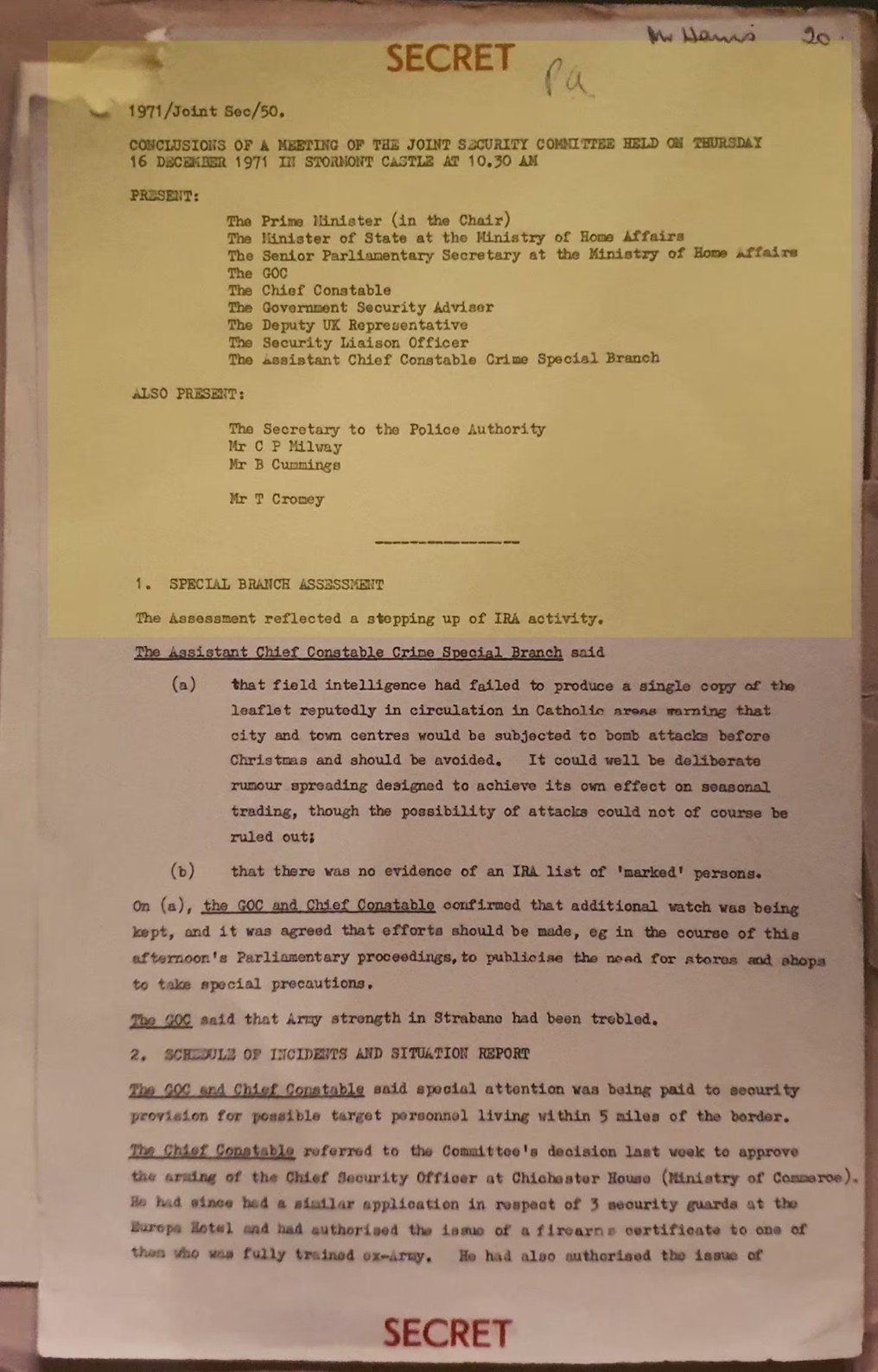
In December 2020 Mr MacAirt, whose grandmother Kitty Irvine, was killed in the explosion, requested information under the Freedom of Information Act about “the provenance and source of police” information provided to a Joint Security Committee meeting which took place after the attack.
Those present at the 1971 meeting included then Chief Constable, Graham Shillington and the head of Special Branch.
John Taylor
They presented an assessment to Stormont Prime Minister Brian Faulkner, the General Officer Commanding the British Army Harry Tuzo, and minister John Taylor, also known as Lord Kilclooney.
Mr Taylor recently came in for criticism after appearing to question the innocence of those killed.
The police briefing included the false claim that “circumstantial evidence indicates that this was a premature detonation and two of those killed were known IRA members at least one of whom had been associated with bombing activities.
“Intelligence indicates that the bomb was destined for use elsewhere in the city,” the briefing added.
Mr MacAirt later traced the “disinformation” to what he describes as a “secret agreement” between Brigadier Frank Kitson and the RUC, reached within hours of the explosion.
The British army’s Belfast commander, Frank Kitson, who died last year, is believed to have set up the shadowy Military Reaction Force (MRF), which is linked to the murder of several Catholic civilians in the early years of the Troubles.
Extract from British army log
An entry in the Commander’s Diary for 39 Brigade found by Mr MacAirt shows that Mr Kitson told his staff four hours after the bomb blast that the “RUC have a line that the bomb in the pub was a bomb designed to be used elsewhere, left in the pub to be picked up by the Provisional IRA.
“Bomb went off and was a mistake,” it states.
“RUC press office have a line on it – NI should deal with them.”
The PSNI later refused a request “for the provenance and source of this false intelligence”.
The tribunal has now told police to hand over the requested information.
Mr MacAirt was critical of the PSNI.
“This important win also proves that PSNI not only withheld significant information from the historic investigations, courts and families, but also continues to withhold critical evidence in the mass murder of our loved ones,” he said.
Christopher Stanley, of KRW Law, said: “The Chief Constable has demonstrated sense and courage previously on legacy issues.
“He should read this judgment and reflect upon it.”
The PSNI was contacted.
Childhood Trauma still affecting 60 per cent of adults
And three out of ten attributed their trauma to the Troubles
By Iain Gray, Belfast News Letter, February 6th, 2025
Study says 14 out of every 100 adults in Northern Ireland were traumatised as kids by witnessing violence during the Troubles - and 60% of people suffered some form of childhood trauma.
A study has suggested 14 out of every 100 of adults in Northern Ireland were traumatised as children by seeing violence during the Troubles.
The study showed that 60% of adults who took part reported at least one traumatic event in their childhood – and three out of 10 said their trauma stemmed from the Troubles.
Of the latter group, almost half said they’d witnessed violence.
And 12.2% of them said they’d been threatened by paramilitaries when they were kids. That’s equivalent to three out of every 100 people in the study.
Meanwhile 8.7% of those traumatised by the Troubles as children said they’d been bereaved by the conflict.
For first time Adverse Childhood Experiences documented
Justice Minister Naomi Long said the results of the study of Adverse Childhood Experiences in the province’s adult population are evidence of a major public health challenge facing Northern Ireland, as kids who suffer trauma are more likely to have mental and physical health problems.
Ms Long said: “For the first time, the true extent of childhood trauma and its impact has been documented and measured for all to see.”
Adding that the study shows “significant levels of trauma continue to impact all communities and across generations”, the Minister said: “The findings from this research are both striking and sobering.
Justice Minister Naomi Long says the study highlights the public health impact of trauma in Northern Ireland.
“We now have crucial evidence of how childhood trauma shapes life outcomes in Northern Ireland.
“The findings show clear correlations between higher exposure to trauma in childhood and many negative outcomes, including poorer educational achievement, chronic health conditions like rheumatoid arthritis and chronic pain, increased exposure to domestic violence, addiction, poor mental health and health-harming behaviours.”
The study’s findings, she stated, will be used to drive policies at Stormont.
Said Ms Long: “That 60% of our adult population reports at least one traumatic childhood event, with nearly one in five experiencing four or more, represents a major public health challenge.
“Perhaps most concerning is the evidence that, despite being almost 27 years past the Good Friday Agreement, our younger generation continues to experience trauma linked to paramilitary activity.”
The study, commissioned by the Executive Programme on Paramilitarism and Organised Crime, was led by a team from Queen’s University Belfast. Researchers surveyed 1,200 participants from Northern Ireland.
Paramiltary violence and domestic abuse still affecting many today.
Allan Preston, Irish News, February 6th, 2025
CHILDHOOD trauma is still impacting around 60% of Northern Ireland’s adult population, a new report has found.
Researchers from Queen’s University heard from around 1,200 participants about how Adverse Childhood Experiences (ACEs) like paramiltary violence and domestic abuse still affected them today.
Justice Minister Naomi Long called the results “striking and sobering.”
“The findings show clear correlations between higher exposure to trauma in childhood and many negative outcomes, including poorer educational achievement, chronic health conditions like rheumatoid arthritis and chronic pain, increased exposure to domestic violence, addiction, poor mental health and health-harming behaviours,” she said.
With 60% of respondents reporting at least one traumatic childhood, 30% also reported conflict-specific adversities.
“Perhaps most concerning is the evidence that, despite being almost 27 years past the Good Friday Agreement, our younger generation continues to experience trauma linked to paramilitary activity,” Ms Long said.
Dr Colm Walsh from Queen’s University led the study: “What we see here is the long arm of early adversities, the impact of which extends beyond childhood, affecting a number of key outcomes, ranging from educational attainment, physical and mental health, substance use, and offending,” he said.
He added that those with four or more ACEs were nine times as likely to be expelled from school, eight times more likely to have been arrested and three times more likely to have used drugs in the last year as an adult.
ACEs and Troubles-related trauma were also more concentrated in deprived areas, creating further challenges for some areas.
The research was initiated after high trauma levels were noticed in those taking part in the Executive Programme on Paramilitarism and Organised Crime.
Programme Director Adele Brown commented: “27 years on from a historical peace agreement, our young people deserve a level playing field where inter-generational and domestic trauma doesn’t hold them back.
“They have the right not just to peace but a quality of peace. That means making sure that we all question the impact trauma could be having on our friends, family and colleagues and public services and learn how to respond effectively to it. This is much wider than specialist responses, this is about everyday interactions, too.
“We very much hope that the study’s findings will inform policy development and service provision across health, education, justice, and social services sectors in Northern Ireland.”
Omagh Public Inquiry
'I new she was gone’ said Mother injured by blast who looked for her daughter
Liam Tunney, Belfast Telegraph, February 6th, 2025
The death of a talented teenage GAA player in the Omagh bombing caused “irreversible” damage to her family, the inquiry into the blast was told.
Brenda Logue (17) was among 29 people, including a mother carrying unborn twins, who were murdered in the Real IRA atrocity.
Her former school, her old club Loughmacrory GAC, and her county all have tournaments named in her honour.
As the inquiry continued yesterday, Brenda's brothers gave evidence at Strule Arts Centre.
Cathal read an emotional statement compiled by his mother Mary shortly before she passed away last November.
It described the final memory she had of her daughter leaving a shop when the 500lb bomb exploded.
“The last thing I remember of Brenda was her ponytail swishing as she walked out the door,” Mary recalled.
“The blast would throw me back into a wall and I would be knocked unconscious. When I came round, I knew in my heart she was gone, but I got up and went to look for her.
Like a scene from disaster movie
“It was like a scene from a disaster movie. The things I saw that day are the things that haunt my dreams - the sounds, the screams. It would be five days before her body was brought home and she was buried on the Friday.”
The statement described how her daughter's death impacted the family.
“I bagged and put away everything, even the rubbish on the floor. Everything she had ever owned or touched is still in the attic,” she said.
“Karl [her brother] would take to sleeping in her bed because it smelled of her. He wouldn't let me change the sheets and I didn't want to either.
“My first grandchild was born less than a month after the bomb. Her arrival should have been one of the happiest times, but was tainted by the loss of her aunt.
“August 15 has defined my family's existence — we are, and will forever be, known as that family. The shockwaves ripped through my family and friends. Those around me who had to watch from the outside as our world fell apart.”
Mary revealed how medical consultants were “baffled” at her response to being told she had cancer at the beginning of last year.
“I said it wasn't the worst news I have ever received,” the statement read.
Every parents worst nightmare
“Losing a child is every parent's worst nightmare and I have lived that nightmare every day for the last 26 years.”
Mary also paid tribute to her strong-minded and talented daughter, who represented her local GAA club, school and county.
“She loved the craic, being surrounded by people. She was a leader in the local youth club, leaving a lasting impression,” her mum said.
“She would later fight and win the right for girls to wear trousers to her school. Her argument was that it was unfair for them to be cold in a skirt.
“Brenda's love for football stemmed from her older brothers. This would lead her down the path to start her short but very talented Gaelic football career.
“She was a natural goalkeeper who was tall, strong and most importantly, had no fear. She would go on to be selected for the Tyrone minor panel and eventually the senior panel.
“Tyrone ladies went on to win the All-Ireland in 2018. Would she have been part of that set-up? Would she have walked the Hogan Stand steps to lift the trophy?”
The Tyrone county board named the junior championship cup after Brenda and Mary proudly presented the trophy to one of her daughter's former team-mates when Loughmacrory ladies went on to win it.
“Loughmacrory GAA also runs an annual tournament in her memory,” she said. “This year we had the honour of my granddaughter and her namesake, Brenda Marie Logue, lifting that cup as captain.
“Her father got to present her with the trophy. The team then took the cup to her graveside. I wasn't able to attend due to chemotherapy.”
Mary's testimony outlined the devastating consequences of the bomb.
“I have been robbed of so many things; seeing her grow up and become a woman,” she said.
“I have missed the chance to see her meet that special someone, fall in love, see her walk down the aisle, go wedding dress shopping with my only daughter.
“My sons have lived their lives trying to cope with the murder of their sister. It caused irreversible emotional damage to each of them and to me.”
'We feared Jolene leaving Omagh for Belfast in case conflict flared up... little did we know'
Cillian Sherlock, Irish Independent, February 6th, 2025
Teenagers denied future potential, as man (54) never met grandchildren
The Omagh bombing denied its victims the opportunity to fulfil their potential and meet new generations of their families, an inquiry has been told.
The assertion came during the second week of commemorative hearings for the victims at the Omagh Bombing Inquiry.
Twenty-nine people, including a woman pregnant with twins, died in the Real IRA attack on August 15, 1998.
The inquiry is examining whether the bombing could reasonably have been prevented by the security forces.
Commemorative and personal statement hearings will continue over the next two weeks.
The inquiry heard statements from the families of Brenda Logue and Jolene Marlow, both 17-year-old girls were killed in the attack, together with 54-year-old Brian McCrory.
In a statement read out on behalf of Jolene's mother Bridie, the inquiry was told of the teenager's strong academic and sporting abilities.
Jolene had a younger sister and three younger brothers and had begun driving lessons shortly before her death. She was described as a "very popular member of staff” in her summer job, and an "exemplary student”.
Her mother's statement said: "I can remember feeling so emotional on the evening of her leaving mass, I couldn't help but think our eldest child was now ready to start the next chapter in her education and life, only now she would be doing it in Belfast.
"We always secretly dreaded the thought of Jolene being in Belfast in case the Troubles would flare up.
"Little did we know then that our hometown of Omagh, where Jolene had attended school, had a part-time job, was learning to drive, socialised and shopped, would be the actual place where she would be denied all of her hopes and dreams, of her bright future.”
Brilliant Potential
Brenda Logue's unfulfilled potential as a strong leader and natural Gaelic football goalkeeper was also spoken about during the commemorative statements.
Reading a statement on behalf of his mother, Brenda's brother Cathal Logue said the bombing caused "irreversible emotional damage” to the family.
Mary Logue, who had relayed her words to her sons while being treated for cancer before her death last November, said Brenda "would know what to do, what to say, how to comfort my boys”.
"She could be their mother figure when I go,” she said.
"We tried to make it through the motions of the shock, the sheer darkness of depression, the rage and anger, the consistent grief.
"It would come in waves. Some days you could keep your head above water, other days you were drowning.
"Each of my boys fell apart in different ways, struggling to cope, and I was no help, because I was falling apart myself.”
A Gentle Giant
Mr McCrory, a former fireman, was remembered as a "gentle giant”, "loving husband” and "amazing” father-of-three.
In a statement read out on behalf of his daughter Louise, the inquiry heard that Mr McCrory was a "good, decent and hardworking” man.
"He had a strong faith and was dedicated to his family.
"He had a kindness and a gentle spirit that anyone who knew him experienced, and a beautiful, warm, open smile that made you feel comfortable and safe,” the statement read.
"We are so very lucky to have had the chance to share our lives with someone so very special, and we should have been given much longer to experience and share our lives with this unassuming, good-natured, quiet and much-loved man.”
Mr McCrory's daughter said she and her siblings had missed out on the opportunity of a growing relationship with their father as they became adults, adding that he never got to meet their partners.
She said they had each visited their father's graveside on their wedding days.
"As a family, instead, our family events are overshadowed by an immeasurable loss and always a constant awareness of our missing husband, father and friend - our gentle giant,” she said.
She added that it was "heartbreaking” he had never had the chance to enjoy life with his own grandchildren.
The inquiry continues today
Father was in town to have photos developed
Liam Tunney, Belfast Telegraph, February 6th, 2025
A father killed in the Omagh bombing was in town to drop off photos he had taken that morning to be developed, his family told the inquiry.
Brian McCrory (54) was among 29 people - including a mother pregnant with unborn twins - murdered when the Real IRA detonated a 500lb bomb in the town.
The inquiry heard yesterday how Brian was a keen amateur photographer, often being called to take photos at family events.
A statement from his daughter Louise was read by solicitor Emma Fox.
“He had taken photos that morning at granny's and had dropped them into the chemist to get developed while collecting his prescription,” she said.
“This was the reason he had been in Omagh town that day.
“He loved taking photos and was generally called in for christenings, communions, confirmations and everything in between as the designated photographer.
“I think there are very few family members or friends who do not possess a photo he had lovingly taken over the years.”
Deeply Affected
Louise said Brian's family had been deeply affected by the events of that day when they lost a “loving husband, an amazing father, brother, uncle, colleague, neighbour and a good friend to many”.
“The feeling of fear and panic from that day that never really leaves,” she said.
“He had a kindness and a gentle spirit that anyone who knew him experienced and a beautiful, warm, open smile that made you feel comfortable and safe.
“We are so very lucky to have had the chance to share our lives with someone so very special and we should have been given so much longer to experience and share our lives with this unassuming, good-natured, quiet and much-loved man.
“My mum lost her one-in-a-million husband, best friend, confidant and father of her children and all her future life plans with her life companion.
“My brothers, Colin, Brian and I lost our father and friend, an amazing man who we all looked up to.”
Inquiry chair Lord Alan Turnbull said it was a “cruel tragedy” that it was the photography hobby enjoyed by so many of his relatives that took Brian into Omagh on the day he died.
“As a consequence of the Omagh bomb, his own children have now been left with a feeling of great loss,” he added.
“The statement sets out with real warmth and depth of feeling just how close her family had been and the strength of the love and guidance her father brought to his wife and his children.”