The bloody legacy of Scap demands the whole truth
Pro Fide, Pro Patria, Irish News, August 4th, 2025
“ THE dark history of Freddie Scappaticci, also known as Stakeknife and the most prized agent of British intelligence within the IRA, has been slowly emerging over the last quarter of a century.
Every single aspect of it is appalling, involving dozens of terrible murders by the IRA in circumstances which were known in advance by the forces of the state and could clearly have been prevented.
The extent of the cover-up designed to protect Scappaticci’s activities was so enormous that many people were not immediately prepared to accept the authenticity of the official announcement of his death in the south of England in 2023.
More than 20 years ago, the then Labour MP Kevin McNamara, a former shadow secretary of state, said at Westminster that Scappaticci had been paid £80,000 a year
We can now be as satisfied as is possible at this stage that the person who changed his name to Frank Cowley really is dead, but we still need to establish all the facts behind his blood-stained legacy.
Operation Kenova, which was established in 2016, has closely examined his role, and, after producing its interim findings last year, distributed 25 bespoke statements to the relatives of those impacted by Stakeknife.
The Kenova team’s full verdict is due to be published on an unspecified future date, but public concern can only grow over developments linked to Scappaticci in recent days.
Cabinet Minister’s salary and assets as protected as Royal Family’s
There are firm indications that he left a sum of over £500,000 in his will, which is believed to have been accumulated through the payments he received from the British Army’s notorious Force Research Unit (FRU).
More than 20 years ago, the then Labour MP Kevin McNamara, a former shadow secretary of state, said at Westminster that Scappaticci had been paid £80,000 a year – an equivalent salary to a cabinet minister at the time – with the cash deposited into a Gibraltar bank account.
The London-based National Crime Agency (NCA) was asked to seize or freeze Scappaticci’s assets almost seven years ago, but last week, during a closed High Court hearing, in an extremely unusual ruling previously restricted to members of the British royal family, a judge ordered that his will should be sealed for 70 years.
As legal applications get under way to access the details of the will, there will also be huge sympathy for the family of Thomas Emmanuel Wilson (35), a member of the Workers’ Party and an entirely innocent figure, who is believed to have been assassinated by Scappaticci in west Belfast in 1987.
They want to see a full public inquiry into his murder, as set out by coverage in this newspaper last week, and, unless the final Kenova report resolves all the remaining mysteries surrounding Stakeknife, it is difficult to see how else the full truth can ever be told.
Sealing Stakeknife’s will weakens faith in security services
Why has a senior judge afforded killer the same post-mortem secrecy given to Prince Philip and the Queen Mother?
Sean O’Neill, The Times, August 4th, 2025
In a remarkable judgment last week, details of the will of a Belfast builder were sealed for 70 years — a provision previously made only for members of the royal family. The step was taken to keep secret the estate of Freddie Scappaticci who was the agent Stakeknife, British intelligence’s top spy inside the IRA during the Troubles.
While spying on republican leaders, Scappaticci was also chief interrogator, torturer and executioner for the IRA’s internal security unit, which hunted and killed suspected informants. He was exposed in 2003 and was spirited away by MI5 to live under false names at comfortable addresses in Surrey until his death in hospital in March 2023.
When he died Scappaticci was the chief suspect in a police investigation, Operation Kenova, which linked him to at least 14 murders. Detectives concluded that many of those killings could have been prevented by his handlers.
Just why is this killer entitled to state protection after his death? Why has a senior judge afforded him the same post-mortem secrecy given to Prince Philip and the Queen Mother? After a closed-door hearing, Sir Julian Flaux found there could be a threat to the safety of his beneficiaries. Those are most likely to be his six children; yet no evidence has been cited of any threat to them since their father disappeared from Belfast.
The judge also insisted that there was nothing remotely interesting to the press or the public in Scappaticci’s will. How he knows that without asking to hear submissions from interested parties is a mystery.
Did the judge think to ask for the views of the survivors of IRA interrogations or the families of those killed by Scappaticci who have lodged 30 civil claims against him? The contents of his estate (which presumably include the proceeds of a £443,000 house sale in 2019) are a matter of legitimate interest in those cases.
I fear the courts have once again been hoodwinked by the application of the security services’ doctrine of NCND (neither confirm nor deny). Created by the CIA in the 1970s, NCND is enthusiastically applied by Whitehall to cloak its more embarrassing secrets. NCND is a necessary tool to protect sensitive operations and information.
But in the Stakeknife case it is used to bury uncomfortable truths and thwart justice. A report into the scandal last year was prevented under NCND from formally identifying Scappaticci as Stakeknife.
The continued adherence to NCND in the Stakeknife scandal is ridiculous. It undermines public trust in the security services. To restore even a semblance of faith, NCND and its limits must be properly codified, not continually stretched.
PIRA decommissioning - ‘We’ll just have to trust them’
Sam McBride, Belfast Telegraph, August 4th, 2025
GENERAL IN CHARGE OF PROCESS SAID IRA WERE DISREGARDING SAFETY AND WOULDN'T LET EXPERTS TAKE PART IN WEAPONS' DESTRUCTION
A key Downing Street figure in the peace process advised Tony Blair that as the IRA could never account for all its weapons, the Government should accept a few “big symbolic acts of decommissioning” and then declare the process complete, declassified files in London have revealed.
Downing Street documents opened at The National Archives also show that the Canadian general brought in to oversee decommissioning almost walked away in 2003 because the IRA was refusing to allow experts to be involved in decommissioning, wouldn't accept the methods the experts wanted to ensure safety, and wouldn't allow the commission to say what arms were destroyed.
Five years after the Good Friday Agreement, and long after Sinn Féin had been admitted to government, the IRA was still holding most of its weapons and explosives — something which critically undermined unionist confidence in David Trimble, who had initially campaigned on a pledge of 'no guns, no government'.
The IRA eventually began destroying weapons in late 2001, just weeks after the September 11 atrocity saw intense hostility from erstwhile US supporters.
But by 2003, the prospects of full IRA decommissioning were still far from clear, with Gerry Adams and Martin McGuinness giving mixed signals to the British and Irish Governments.
Confidential Memo
In a confidential memo to Tony Blair on January 17, 2003, the Prime Minister's chief of staff, Jonathan Powell, said of decommissioning: “The IRA will never be able to account for all their weapons or retrieve them.
“What we should perhaps aim for is a few more big symbolic acts of decommissioning and then declare that the process is complete… our approach should be that we will take the IRA at its word about ceasing all the activities listed and will monitor it through the verification process we are setting up.”
Years later, after the IRA murder of a man in Belfast in 2015, a joint PSNI-MI5 assessment accepted that not all IRA weapons had been decommissioned.
The month after Powell's memo, Mary Madden in the NIO relayed details of a conversation with Church of Ireland Archbishop of Armagh Robin Eames.
The Anglican primate had privately met Adams and McGuinness in Clonard Monastery and although they hadn't asked him outright to witness IRA decommissioning alongside his Catholic counterpart, Cardinal Sean Brady, that had been suggested by others.
The NIO official said that both clerics had “concerns” about the idea. She said: “Eames remains concerned about his involvement and how it might be perceived, not only in the wider community but also among his flock.
“He feels ill-equipped to make any judgment on the quality or type of the material he may be shown. But Eames has indicated to me recently that, within certain parameters, he might be prepared to become involved if both Governments asked him to do so.”
Ultimately, it would be two other more junior clerics — the Rev Harold Good and Fr Alec Reid — who would act as witnesses of IRA decommissioning. After the publication of his memoir recently, the Rev Good made clear that he will never disclose even basic details about the process such as whether the weapons were cut up or encased in concrete.
De Chastelain’s concerns
On May 6, 2003, the NIO's political director, Jonathan Phillips, confidentially informed the Secretary of State about a conversation with General de Chastelain.
He said that the general had phoned him to ask for a meeting in which it was clear he was “beginning to think seriously about his long-term commitment to the process”.
“He told me that he was clear that PIRA would not undertake a decommissioning exercise on a basis that he considers acceptable this side of the election.
“During the recent political negotiations he said that it had been made clear to him that PIRA would not allow: experts to participate in a decommissioning exercise; the methods proposed by experts to be used to ensure safety; the commission to state what arms were put beyond use, but PIRA would want the commission to say simply that a large quantity had been put beyond use.
“On top of this, they would not give a commitment to all arms being put beyond use according to a schedule. De Chastelain said that he could not himself agree to proceed on this basis. I said that he'd had the Government's full support in taking a strong stand of this kind.”
Two documents around this time have been withheld. The two communications — both with the classification 'secret' — were entitled 'Provisional rank and file reaction' and 'Where now?'.
By November 2003, Adams told Powell — according to the latter's note to Blair — that “the IRA are not now prepared to say that a certain percentage of their weaponry has been destroyed. And even if they were, we do not believe De Chastelain would confirm it.”
'My mum's illness has made it a very tough year to do the job of First Minister'
Suzanne Breen, Belfast Telegraph, August 4th, 2025
O'NEILL REVEALS HOW CHALLENGING PERIOD IMPACTED ROLE AMID FAMILY EMERGENCY
Michelle O'Neill has revealed she faced the biggest challenge of her political career this year in trying to fulfil her First Ministerial duties while her mother was seriously ill.
The Sinn Fein vice-president attended fewer events and cut back on media interviews, leading to speculation in Stormont that she herself was unwell.
In the run-up to St Patrick's Day, there had even been doubts about whether she'd lead a trade delegation of local businesses to the US.
Ms O'Neill quashed the rumours that she'd been sick. “I'm perfectly fine,” she told the Belfast Telegraph. “I've had a right tough year because my mother became very ill at the end of last year. For three months we were at her bedside.
“So that was difficult given the challenge of doing this job. It's a hugely busy job, and it's very hard to be everywhere all of the time.”
The First Minister explained that her mother Kathleen is “thankfully much better than she was”, although she has a “chronic condition which makes her life quality very, very poor”.
O'Neill said: “All of us in politics are human. We all have families behind us. I'm a mummy, a granny, a daughter, a sister and a partner. These are the other parts to my life.
“There will be tough days when you have to brave it out and put your best face on even though you're not feeling it. Family always comes first. Who is always going to be with you? Who is always going to be by your side?”
The First Minister said her best downtime was spent with her four grandchildren — her daughter Saoirse's daughter Tuathla, and her partner's grandsons Lorcan, Daire and Cahir.
“They mean the world to me. Politics is tough and when you get the chance to switch off and be with children who are a different lens to the world, it's so special,” she added.
Guns N Roses and Kneecap
O'Neill said she also relaxed by walking, gardening — she grows her own vegetables — and cooking. She has an eclectic taste in music ranging from “Guns N' Roses to American country”. She admires how Kneecap have “lifted their voice for the people of Palestine”.
Sinn Fein hasn't yet announced whether it will contest the Irish presidential election. There's speculation about Mary Lou McDonald, O'Neill or North Belfast MP John Finucane running.
The Sinn Fein vice-president refused to be drawn on her party's plans, which are still fluid. She said it likely won't reveal its hand for another month.
“We're not there yet. There's lots of things we need to work out. There's also a bit of time to go because the election itself probably won't be called until September and not held until October. We're still working through all the options,” she added.
If Ms McDonald ran and was returned to Áras an Uachtaráin would O'Neill like to become Sinn Fein president? “There's no point in speculating, but I've plenty to be doing as First Minister,” she said.
Former Taoiseach Leo Varadkar has become a leading advocate for Irish unity. Some left-wing republicans argue that his economic policies when in office should mean there is no place for him in the campaign.
Varadkar’s support for unity campaign very welcome
The First Minister said Varadkar was “very welcome, as is every other voice”.
She added Micheal Martin's suggestion that reconciliation was needed before Irish unity “nearly strayed into the territory of trying to rewrite the Good Friday Agreement by moving the goalposts”.
O'Neill defended the Executive's performance since devolution was restored, and denied that it had delivered nothing but photo opportunities.
“I still feel as hopeful as I did whenever I walked through the door and became First Minister 18 months ago,” she said.
“Have we got to the end of all the things we want to achieve? No, we're not at that juncture yet, but we have made really strong strides forward.”
The positives included advances in “childcare and the Lough Neagh Action Plan”.
O'Neill said there was a strong will to deliver around the ministerial table “particularly in relation to the health service”. She welcomed the appointment of senior surgeon Professor Mark Taylor to tackle waiting lists.
“Fixing the health service is like turning a tanker — you can't do it overnight. We've made advances but there is much more to do,” she added.
Bunfire regulation
Asked who she gets on with best in Stormont outside her own party, she cited Alliance Agriculture Minister Andrew Muir. She works with him and Naomi Long to “try to navigate blockages where they occur and advance more progressive politics” in the Executive.
O'Neill called for bonfire regulation in the wake of several controversial pyres last month. She branded an effigy of migrants in a boat on top of the Moygashel bonfire as “disgusting”.
She said: “There can't be effigies on these bonfires. There can't be displays of racism or sectarianism. Yes, have the space to celebrate your culture but don't do so with these displays of hate.”
She said there had been a lack of leadership in unionism on the bonfire issue.
“These things should be called out. If you lead in your community, you should be discouraging and actively working to ensure these things don't happen,” she added.
Sub-par or superb solution to the north’s waiting list crisis?
Deirdre Hennan, Irish News, August 4th, 2025
THE appointment of Professor Mark Taylor as the first regional clinical director for elective care with a focus on tackling the appalling waiting lists has been broadly welcomed.
Mark Taylor is not only a respected surgeon but, significantly, someone who has taken an active role in highlighting the systemic issues that continue to bedevil the north’s health and social care system.
He is very well aware that this is a Herculean task and one that will require courage and leadership.
Countless articles have been written about the unacceptable length of time people are on a waiting list for elective care treatment in Northern Ireland.
This benighted region has the longest waiting times in the United Kingdom and amongst the worst in Europe. The latest figures suggest that one in four people here are on a waiting list for a first hospital consultation or procedure.
Behind these figures are people, families and communities affected by this appalling state of affairs. Long waits for access to healthcare impinge on every aspect of life, leading to feelings of helplessness, hopelessness and lives placed on hold.
Recent studies show that waiting lists are associated with increased mortality rates, worse quality of life, and significant emotional trauma.
Patients losing hope in public health provision
An increasing number of people have opted to self-fund private care as they have lost all hope of ever making it to the top of the list. This in turn leads to deepening health inequalities and a two-tier system.
Consecutive health ministers have watched as the north’s patient population are in a position where some can afford treatment and others cannot.
Additionally, the diabolical waiting lists mean that some people may see no point in seeking out a crucial diagnosis as they feel they will never be able to access treatment.
Currently, the longest outpatient list is for general surgery, followed by ears, nose and throat (ENT) and gynaecology. The numbers waiting remains stubbornly high and rising.
To set this in some context, in England less than 1% of the population wait over two years. The equivalent here is almost 40%. Waits of over five years are not uncommon.
Many people have given up, and believe they will never be treated. Some die before they reach the top of the list.
Following news of his appointment, Prof Taylor referred to the spiralling waiting lists as national shame. Indeed. It is nothing short of a national scandal.
Over 18 months into this administration and very little by way of action. Can this appointment make a meaningful difference?
Can Prof Taylor make a difference?
What power and authority comes with this role? To what extent can Prof Taylor direct the department and the trusts to do things differently?
The fact that there is now a focal point for this issue is to be welcomed – someone who can be identified as leading this crucial programme of change and reform.
Key questions though remain unanswered. What power and authority comes with this role? To what extent can Prof Taylor direct the department and the trusts to do things differently?
Is his role advisory? Will he have control of the allocation of the £215 million set aside for this initiative?
Mr Taylor requires the full support of the health minister and a speedy resolution to current dispute with GPs. If properly resourced and empowered, GPs can provide care in the right place and can avoid thousands of people heading to hospital for unnecessary appointments.
Care closer to home such as scans, women’s health hubs, ENT clinics and community physiotherapy diverts people from waiting lists.
Investing in primary and community care is a prerequisite to providing cost-effective, timely support.
We desperately need this introduction of a “waiting list tzar” to make a real difference to how this issue is dealt within both the long and short term. A number of steps could help to ensure that this is not yet another false dawn.
Firstly, no-one would seriously suggest that one person alone could deliver change in this complex and dynamic landscape. Prof Taylor must build a small team of people from across health and social care who are up for the challenge and understand how the system works.
Waiting lists a symptom of long term malaise
Throwing money at this is the not the answer. Waiting lists are not simply a backlog to be cleared but rather a symptom of a system that is not fit for purpose. They are a complex and dynamic interplay between demand and supply.
Secondly, a rapid audit of the waiting lists is required to ensure that there is a clear, reliable picture of the task ahead. That means communicating with everyone on the list and collecting up to date information on their conditions and needs.
Waiting lists can then be divided into specialisms which provides a more accurate assessment of the challenge. A regional waiting list system could address the postcode lottery that currently exits.
Harnessing the benefits of technology such as AI can tackle inefficiencies and waste. For example, predictions using AI have helped to save millions on missed appointments in England.
Thirdly, a systems-wide approach is required to understand the myriad of factors that contributed to these long waits in the first place. This includes supply-side factors such as availability of funding, capacity of the workforce, productivity, performance management, number of beds, use of technology and equipment. Demand-side factors include the health of the general population and criteria for referrals.
Finally, the development of a strategic approach with the independent sector. The dichotomy that public sector is good and private sector is bad is too simplistic and ignores the complex interplay between the two.
There are no quick fixes to the waiting list issue, but the health service can recover with a long-term plan that combines the right mix of policy change, radical innovation, incentives for positive change, performance oversight and long-term investment.
Tackling waiting lists is an essential step in building a health and social care system fit for the future. This initiative will be judged by its results.
Similar violence to race riots could reoccur warns watchdog
Irish News, August 4th, 2025
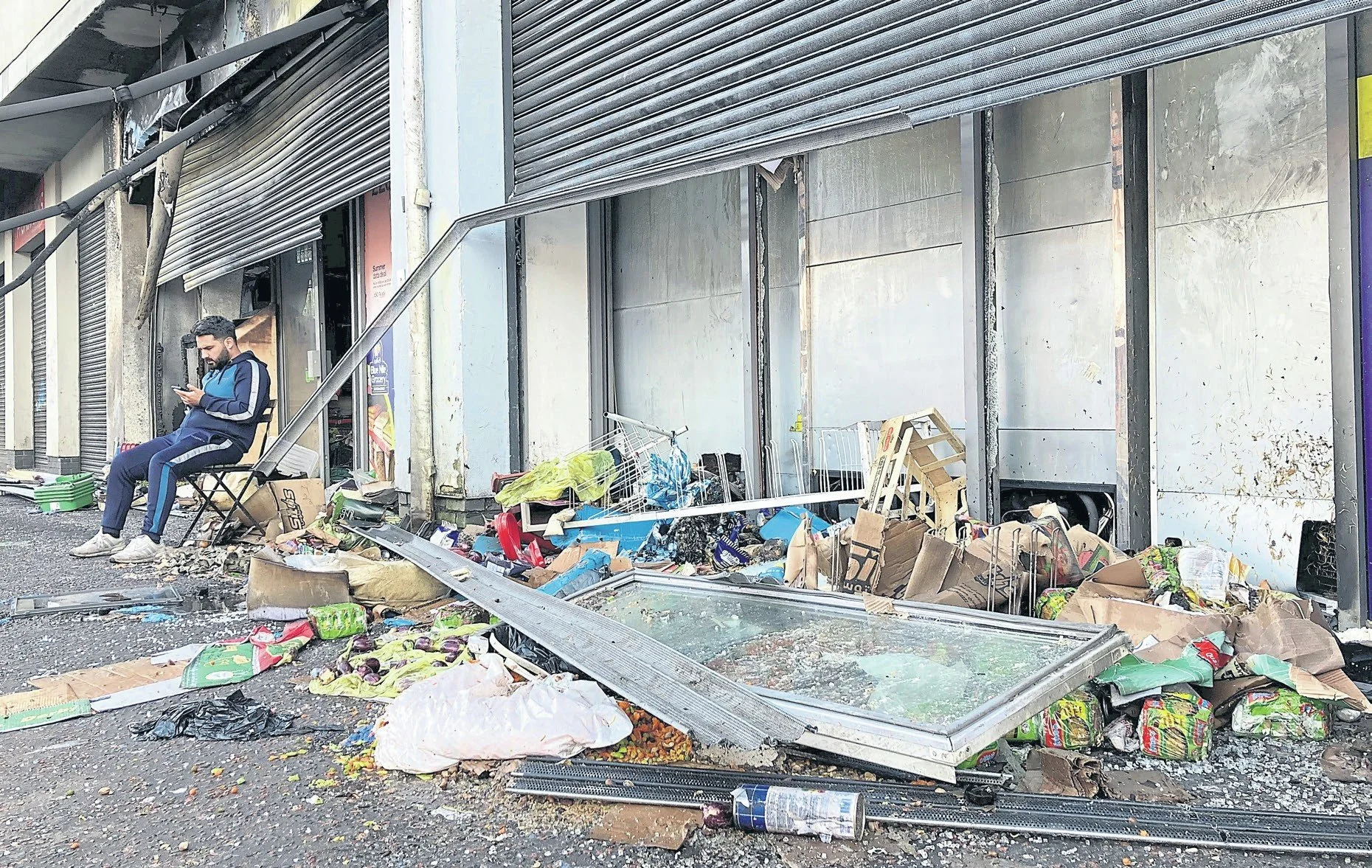
Abdelkader Mohamad Al Alloush, owner of the Sham Supermarket on Belfast’s Donegall Road. The shop was damaged last year during disorder following an anti-immigration protest
THERE is “every possibility” that similar violence to the Southport riots of summer 2024 could reoccur, a watchdog chief has said.
The police service “should not be caught off-guard again”, His Majesty’s Chief Inspector of Constabulary and Fire and Rescue Services Sir Andy Cooke wrote in the Sunday Telegraph.
Disorder broke out after the murder of three girls at a Taylor Swiftthemed dance class in the town on July 29 last year.
It quickly spread to other areas. Mosques, community centres and libraries were attacked while hotels housing asylum seekers were also targeted.
A year later, Mr Cooke said the “tools that amplified hatred last summer remain largely unchanged and unregulated”.
He said: “The police service should not be caught off-guard again. There is every possibility that similar violence could reoccur.
“Online misinformation continues to spread. Community tensions persist. The tools that amplified hatred last summer remain largely unchanged and unregulated.
“The police service must modernise its understanding of how disorder develops and spreads in the digital age.”
In recent weeks, multiple demonstrations have been held outside the Bell Hotel in Epping after an asylum seeker was charged with allegedly attempting to kiss a 14-year-old girl.
Protests have been held in other areas against the use of hotels to accommodate asylum seekers since.
Several demonstrators were detained by police after rival groups gathered at a protest against the use of a hotel to accommodate asylum seekers on Saturday afternoon.
The Metropolitan Police imposed conditions on a protest and counter-protest outside the Thistle City Barbican Hotel in Islington, north London.
BBC faces criticism over delay in paying court-ordered damages to Gerry Adams
Rebecca Black, Belfast Telegraph and Irish News, August 4th, 2025
The BBC has been criticised for not yet having paid court-ordered damages to former Sinn Fein president Gerry Adams.
The corporation lost a major defamation case earlier this year after Mr Adams took them to court over a 2016 episode of its Spotlight programme and an accompanying online story.
They contained an allegation that Mr Adams sanctioned the killing of former Sinn Fein official Denis Donaldson. Mr Adams denied any involvement.
Mr Donaldson was shot dead in Co Donegal in 2006, months after admitting his role as a police and MI5 agent over 20 years.
In May, a jury at the High Court in Dublin found in his favour and awarded him €100,000 (£84,000) after determining that was the meaning of words included in the programme and article.
The BBC, which was found by the jury not to have acted in good faith nor in a fair and reasonable way, was also ordered to pay the former Sinn Fein leader's legal costs.
Mr Adams' legal team said the verdict of the jury was a “full vindication” for their client while the BBC said it was “disappointed” with the outcome.
Adam Smyth, director of BBC NI, said the corporation believes it supplied extensive evidence to the court of the careful editorial process and journalistic diligence applied to the programme and accompanying online article.
After the decision, the broadcaster's legal team was granted a stay in the payment of the full award as it took time to consider an appeal, subject to paying half the damages (€50,000 or £42,000) and €250,000 (£210,000) towards solicitors' fees.
In June, the BBC confirmed it would not pursue an appeal.
However, it is understood that by August 1 the BBC had not paid the damages.
Mr Adams previously indicated that he planned to donate what he receives to good causes.
He specified that these would include charities that help children in Gaza as well as groups in the Irish language sector and those who are homeless.
A source close to Mr Adams told this newspaper: “The delay by the BBC is deplorable and it should move speedily towards discharging the order of the court.”
A BBC spokesperson said: “Total costs will be finalised and payable in due course.”
Our murals may divide opinion, but as much part of this place as the Giant's Causeway
Alison Morris, Belfast Telegraph, August 4th, 2025
A lot of things bring tourists to Northern Ireland. This summer's numbers have been boosted by Portrush hosting The Open, adding to the annual flow of visitors arriving on cruise ships in Belfast.
Curious tourists will visit the Giant's Causeway, Crumlin Road Gaol, Titanic Belfast and the city's bustling Cathedral Quarter.
But there is one marked difference between this place and other city breaks — our recent political history and the legacy of our troubled past.
For many, the memory of that time is still very raw. But for those who come to this place for a pint in the Duke of York, there is a natural curiosity about what happened here, how it started and how it ended.
The black taxi tours do a roaring trade on both sides of the interface, explaining the history of the artwork and murals which are now a part of this place, just as much as the basalt columns of the Causeway.
On Friday, as part of Feile an Phobail, there was an exhibition of the murals along with a talk involving some of the artists.
It was held in the beautifully restored St Comgall's, an old school at the bottom of the Falls Road that was brought back to life as a visitor centre and community hub. The place was thriving with a range of events.
Mothers Against Genocide
In the central atrium there was an exhibition hosted by the Mothers Against Genocide — linen panels with intricate embroidery featuring the names of 20,000 men, women and children killed in Gaza by Israel.
The names of the children were sewn in green thread. Thousands of them, many just toddlers. It was simple but powerful.
In the room next door, the Vibrant Colours, Violent Past mural exhibition was taking place.
Danny Devenny, the republican artist who started the now famous International Wall, spoke of meeting the then young painters who would become some of Belfast's more accomplished mural artists.
Initially the paintings were crude in their execution, and those responsible would often find themselves arrested.
At the time people were painting political graffiti on walls, but this was to be an elevation of that.
As well as a rolling reel of film showing murals being painted, there were pictures of the art, old and new.
Painting by (house) numbers
On one side were the republican murals, on the other loyalist.
Devenny joked that the colour palate was often decided based on what colour the neighbours had been painting their houses because it was all donated materials — long before government 'reimaging' grants were available.
Many of the murals' themes have moved on now, as we move further away from the Troubles and towards a different future. What were contemporary messages of political protest and expression are now historic markers.
The walls now have a more international theme, and going further back into Irish history with images of mythology.
The artists also spoke of their opinions of the non-political art that is brightening up the more rundown parts of Belfast.
They are decorative and stunning in their own right, but as one panelist asked: would you remember them five minutes later?
They hope the political murals cause tourists to ask questions about this place and even go away and research or read more about what happened here.
Love them or loathe them, murals are a unique part of this place, marking us with what an advertising executive might call a unique selling point.
Derry Girls
The murals in Derry bring thousands of visitors each year.
They pose next to the art in the Bogside one minute, and a painting of the Derry Girls in their distinctive school uniforms the next.
A short distance apart, the past and present blend seamlessly.
The 'peace wall' between the Shankill and Falls is now a blank slate for artists who have adorned it with stunning paintings and messages for the future.
Tourists line up to sign their names on the wall, a physical symbol of division but being used as a canvas of hope.
Some argue the murals are outdated and should be painted over.
But I strongly disagree with a whitewashing of the past.
Art can be provocative, it can be difficult and even offensive. It can draw — literally — on a range of emotions.
But we must also accept that we are not the same as other European cities; we are a place apart and what makes us different is our history.
Murals as a means of political expression are very much a part of that.
Four years on, Centenary Stone yet to be installed at Stormont
Noel McAdam, Belfast Telegraph, August 4th, 2025
The Centenary Stone has yet to be put in place — four years after Northern Ireland entered its second century.
Planning rules are said to have hit the installation of the stone — paid for by the three main unionist parties DUP, UUP and TUV — at Stormont.
But in a rare display of political unity, another commemorative event has been agreed — to mark the scandal of the Mother and Baby Homes and Magdalene Laundries.
A plaque will be erected in the main entrance area to Parliament Buildings — before the official inquiry into the mainly church-run homes gets underway.
The Assembly parties have also secured the agreement of all victims groups after a memorial bench was first suggested.
And now it had been confirmed the ceremony to unveil the plaque will take place this autumn.
The plaque was a recommendation in the report of the Historical Institutional Abuse Inquiry almost eight years ago.
The report in 2017 said the memorial would “remind legislators and others of what many children experienced in residential homes.”
But it was late 2023 before the Executive Office (TEO) wrote to then Speaker Alex Maskey seeking permission from the Assembly Commission which is responsible for Parliament Buildings, for, at that time, a memorial bench.
The current Assembly Speaker, Edwin Poots, worked with the Executive Office on alternatives inside Parliament Buildings and told the Commission that an agreement had been reached with all victim groups for a memorial plaque.
Commission members have asked to see the design of the plaque before it is placed in the main entrance area to the Great Hall.
A spokesperson for TEO said: “Following engagement with victims' and survivors' groups, there is support for fulfilling the Historical Institutional Abuse Inquiry recommendation through a memorial plaque in Parliament Buildings.
“We have received the Assembly Speaker's formal approval, enabling us to proceed and continue engagement with survivors.
“Subject to agreement on wording and completion of logistical arrangements, we are aiming for installation and a formal opening in autumn 2025.”
There has been no indication of an installation date for the Centenary Stone but party sources have insisted progress is being made.