Tom Hadden, Fortnight55, July 15th, 2025
Tom Hadden writes and lectures at Queens on human rights and armed conflict law.
Another way of looking at legacy issues is to ask if searching for truth and justice helps or hinders communal reconciliation.
There is an obvious risk in areas of communal conflict that disputes over responsibility for deaths and injuries may increase feelings of antagonism between affected communities. The search for truth about what actually happened is unlikely to decrease this risk, especially where very different forms of accountability apply to state forces and opposing paramilitaries: state forces are supposed to adhere to strict human rights standards and to reveal all that they know about what happened; paramilitary forces on the other hand are subject to strict criminal law sanctions but are not required to disclose information that might incriminate them.
There is an obvious imbalance in this which puts much greater pressure on the state to reveal and accept liability for unlawful killings. While many IRA and Loyalist killers have been prosecuted and convicted, many more are able to celebrate their exploits and remain free from any obligation to tell the truth about their involvement.
Frequent comparisons with the Truth and Reconciliation Commission in South Africa has perhaps added to the perception that the recovery of truth can help the achievement of communal reconciliation. But this is misleading. In South Africa the TRC was deliberately separated from the criminal justice system – Desmond Tutu reportedly once said ‘justice is too difficult’. Instead it was given the power to grant amnesty to anyone who came forward to tell the truth of their involvement.
The TRC then compiled an overall assessment of the responsibilities of all players in the longstanding conflict between Whites and Blacks. The prosecuting authorities decided soon after not to pursue any further criminal pre-settlement criminal cases. Publishing an overall assessment of responsibilities on all sides during their conflicts was also the practice of the numerous truth commissions in Latin America, though the repeal of previous amnesties and a search for legal justice for victims has continued in many cases.
In addressing the ‘Troubles legacy’ here the idea of combining the two objectives of truth recovery and reconciliation in the ICRIR has not proved to be either popular or successful. There has been widespread opposition to any form of amnesty as an incentive for those responsible for violations in both state and paramilitary forces to come forward and tell their stories. And the task of compiling an objective assessment of overall responsibilities has been divided between a Panel of individual historians and an overlapping ICRIR mandate to report on various unspecified themes.
Different skills needed and people needed
Different skills In reality the two objectives of truth recovery and reconciliation require very different skills and formal powers. The necessary powers for truth recovery are a right to require the production of papers from state bodies and to question individuals, but not to require self-incrimination; perhaps also the power to grant immunity from prosecution for information provided, as for ‘the disappeared’, or an amnesty of some kind. The skills are those of cross-examination and producing evidence to counter what witnesses are claiming.
The necessary skills for reconciliation are an ability to bring opposing sides together and persuade them to talk openly about their memories and underlying feelings and to engage with those on the other side. That is ideally what happens at an individual level in restorative justice programmes. At a communal level it probably requires some form of amnesty; and those involved need to have experience in eliciting the acknowledgements and compromises that are essential to allow different communities to live peacefully together. They may also need the understanding and empathy required for the formulation of a narrative that helps to explain the initial commitment on both or all sides to different and often incompatible goals. In simpler terms truth recovery is usually closely tied to a desire for punishment or compensation for past actions – the work of lawyers. Reconciliation is about finding a way forward to a shared future – the work of peacemakers.
Giving both these tasks to a single agency is not a good idea. As we have seen as the peace process developed it has been gatherings of people from civil society with leaders like Robin Eames, Denis Bradley and Harold Good that have made most progress. It has been legal institutions – inquests, public inquiries and criminal proceedings – that have tied us up in interminable and expensive legislative and procedural wrangling. The two governments would do better by putting resources into wide ranging consultative and public proceedings like those of Desmond Tutu’s TRC and our Opsahl Commission.
This suggests that the policy of combining of truth recovery and reconciliation in a single body needs to be replaced by one that separates them. The investigation of individual incidents can best be left to inquests rather than complex public inquiries that cost so much more and often provide only for one side to complain about their treatment by the other. The choice of the incidents to be the subject of inquiries has been both controversial and arguably discriminatory.
It would be better to focus on producing a more balanced assessment of the actions of all sides, accepting that both state and insurgent forces contributed to the eventual settlement of the Troubles. Both the British |Army and the IRA started with the idea of winning the war by military action. Both eventually realised that this was not going to work. The state security forces shifted from a strategy of ‘shooting to kill’ terrorists to infiltrating the IRA and undermining its belief in possible victory. The IRA was persuaded by back channel negotiations to abandon the armed struggle and to accept the involvement of Sinn Fein in the government of the North.
This involved difficult legal and constitutional compromises on all sides. There are difficult legal distinctions for the security forces between collaboration, infiltration and the protection of informers by effective amnesty which remain unresolved. But the new strategy, despite some obviously unlawful action, undoubtedly worked and helped to enable the peace process.
And for Republicans the acceptance of a ceasefire and disarmament took a long time but did not protect their volunteers from continuing criminal prosecutions. But this narrative and the associated legal complexities needs to be told and acknowledged by both governments in place of their continuing wrangling over human rights violations.
No more kneecappings?
Inside the decline of paramilitary ‘punishment’ attacks
Conor Sheils, Irish News, July 15th, 2025
PARAMILITARY-STYLE ‘punishment’ attacks were once a weekly occurrence across the north, where self-styled vigilantes left children, teenagers and young adults with life-changing injuries under the guise of delivering justice in areas underserved by the police.
The latest statistics from the PSNI show a rapid decline in the number of so called punishment attacks and shootings in recent years – but what has led to such a drastic shift, and how is it impacting the communities that once bore the brunt of these vicious assaults?
Kieran McEvoy, a leading expert on transitional and restorative justice at Queen’s University Belfast, focuses on how restorative justice practices are used to address harm and promote peacebuilding, with an emphasis on republican communities.
He told The Irish News that the reasons for the decline are complex – with no single factor responsible for the shift away from vigilante attacks.
Once a brutal fixture of life in many communities, paramilitary-style ‘punishment’ attacks are in steep decline
“First of all, obviously, the mainstream republican movement, the Provisional IRA, went out of business. But aside from the IRA leaving the stage, the emergence of community-based restorative justice as an alternative to punishment violence has also come about. Plus, we have the establishment of meaningful relationships – not unproblematic by any means – but meaningful relationships between the police and a historically estranged nationalist community,” he said.
‘You can’t have a system where you go around and shoot and beat children’
Restorative justice is an approach that seeks to repair harm by bringing together victims, offenders, and the wider community, promoting accountability and healing rather than retaliation.
“The second thing that happened in the early years is that dissident republican groups stepped into that space previously occupied by the mainstream IRA,” Professor McEvoy said.
“Part of their argument for support in local republican communities was ‘The IRA have abandoned you, your communities will be overrun by criminals and drug dealers, therefore we will step into that space and protect you’. So you had different groups involved in the provision of punishment violence for periods, and it ebbs and flows within these communities.
“But they couldn’t actually sustain the ‘service’ that they were offering. I think part of the reason for that is their own logistics, manpower, and infrastructure – the fact that they’re so heavily infiltrated.
“I also think some dissidents were probably surprised that there was such an appetite for this kind of vigilantism. But for logistical and other reasons, they arguably couldn’t meet that demand. So they also began having parallel discussions to end punishment attacks – the type that the mainstream republican movement was having a generation before.
‘A very fragmented place’
“I’m not saying there have not been good-faith discussions by some dissidents too, on their own path to non-violence. There have been on-off discussions among dissident republicans about it, but it’s a very fragmented space, and you have different groups doing different things. At least some of those groups may have been genuinely wanting to move away from punishment attacks.
“The other reality is that for some of the dissident groups, at least some of them have morphed into criminal gangs. There will be a lot of discussion, for example, around the INLA – that they have now morphed into a criminal gang. The Continuity IRA, arguably, have done the same. So how can you credibly say you are a republican group providing this so-called service to republican communities to protect them from crime, if you’re involved in criminality yourself?
“And the other variable is that there has been a gradual improvement in relations with the police in republican areas. The republican community had no history of proper policing throughout the conflict – arguably since the formation of the state – but certainly during the conflict. Over time, we’ve seen gradually better relations with working-class republican communities, which has helped bring a serious decline to these types of attacks over the years.
“People are also now engaging in restorative justice schemes, where the perpetrators of crime are making amends with their community or their victims, rather than suffering so-called punishment attacks.”
Professor McEvoy paints a multi-layered and complex picture, with no single reason for the drop in brutal attacks that were once so commonplace on the north’s streets.
But the figures are clear and speak for themselves.
Data from the PSNI shows that the number of paramilitary-style punishment shootings and beatings has fallen dramatically in recent years.
According to the latest statistics, there were 23 casualties from paramilitary-style ‘punishment’ attacks during 2024, down from 31 the previous year, while shootings dropped even more dramatically – from 19 to just five casualties.
Belfast saw the greatest reduction, with paramilitary beatings falling from 12 to seven incidents, while the city recorded no shootings at all compared to nine the previous year.
THE figures account for attacks carried out using weapons like iron bars and baseball bats, which usually target victims’ knees, elbows, feet, ankles or thighs, and often leave them with life-changing injuries, though not resulting in death.
Over 4,300 punishment style attacks since 1990
The latest statistics show an undeniable contrast with how things used to be just a few years ago – 4,336 punishment-style attacks and shootings were reported to police from the beginning of 1990 to the end of October 2014, but the trend stretches back much further, to the 1970s and the height of the Troubles.
Attacks were prevalent across both sides of the divide, with both Protestant and Catholic communities blighted – and in many cases supportive of – these types of attacks in the absence of what they saw as effective policing.
As the years have passed, many may have forgotten the sheer brutality of so-called ‘punishment’ attacks. Indeed, many born today may not even know the full extent of these assaults or the fear they instilled within communities.
Paramilitary groups on both sides of the divide inflicted this violence, often on teenagers.
While in the early days of the Troubles, public humiliations such as sign-wearing or tarring and feathering were commonplace, the methods employed by paramilitaries against petty criminals – or anyone who crossed them, regardless of religion or political allegiance – worsened as the years went by.
Symbolic methods of punishment, designed not only to inflict pain but to terrorise communities and enforce their version of “justice,” were dished out freely.
‘Padre Pio’ punishment
Among the most chilling of these is the so-called ‘Padre Pio’ technique, named after the Italian saint famous for bearing the stigmata – wounds on his hands that mirrored those of Christ. Victims of this punishment are forced to spread their arms or press their hands flat against a wall or other surface before being shot through both palms at point-blank range. While this method is less likely to be fatal than traditional kneecapping, it leaves victims with severe nerve damage, permanent disability, and lifelong psychological scars. The religious symbolism embedded in the name underscores the grim nature of this punishment, particularly in Catholic communities.
Another gruesome variation, employed by loyalist paramilitaries, was crucifixion.
In 2015, Paul Harbinson, a 23-year-old from north Belfast, was subjected to a crucifixion-style attack, reportedly carried out by the UDA. Harbinson was nailed by his hands to his own kitchen counter while his one-year old child slept upstairs. The attackers also tried to nail his feet to the floor but abandoned the attempt after he resisted. Firefighters had to use electric saws to cut through the nails hammered deeply into his flesh and kitchen surfaces.
Andrew Kearney was murdered by the IRA in a so-called ‘punishment’ attack after allegedly getting into a fight with an IRA commander
One of the most severe of all punishment shootings was know as the ‘Six-Pack’ – a term that describes a savage shooting in which the victim is hit by six bullets, usually distributed across the knees, ankles, and sometimes the hands.
IRA victim Andrew Kearney received a version of it in 1998.
He was shot seven times by the Provisional IRA, including three bullets in each leg and, critically, a shot to the spine intended to half-paralyse him – a method grimly referred to as a “50-50 job.” Kearney bled to death from a severed artery.
Mr Kearney had allegedly got in a fight with an IRA commander in the days before the attack.
Provisional IRA punishment attacks stopped almost overnight in late 2001 after the US administration made it clear that it would not be tolerated anymore as part of its ‘war on terrorism’ after the 9/11 attacks.
Loyalist punishment squads mirrored Republicans
Conor Shiels, Irish News, July 15th, 2025
PROFESSOR Shirlow on how peace has played its part. ‘Obviously you couldn’t be talking peace as you were maiming children’.
He told The Irish News that despite some support, many saw the attacks as unfair – a two-tier system where the severity of punishment was decided based on whether the youngster in question had family in paramilitary groups.
“I think there were always people in the paramilitary organisations who saw it as counterproductive. And they saw it as counterproductive as it was popular, but also unpopular within communities,” he said.
“The reason it was often unpopular was because it was selective – in the sense that some people who behaved in the same way as others were not targeted because of their family links. People were starting to recognise that their son, who had done something, had been punished, but somebody who was from ‘paramilitary royalty’ had done the same thing and had not received any punishment – or at least not as severe a punishment.”
Professor Shirlow credits the skills learned by loyalist prisoners in jail under rehabilitation schemes with bringing new ideas around community justice back to their communities.
Constructive role of ex-prisoners
“On the loyalist side, especially in the UVF, some of the ex-prisoners, when they came out of prison, took what they’d learnt about criminology, rehabilitation and restorative justice and put it into practice,” he said.
“This meant that under the new ideas, you wouldn’t be punished physically, but you would have to do some sort of community activity – such as meet the victim and explain yourself – or it could mean that you would volunteer for some sort of community work.
“They wanted to try and show young offenders that the anger they had could be directed into a more positive position.”
For its part, the PSNI has welcomed the change on the streets and the shift towards restorative justice and police engagement.
Detective Chief Superintendent Emma Neill, head of the PSNI’s Organised Crime Branch, said the shift was due not just to the police force, but to the communities themselves.
“The reduction in the number of paramilitary-style attacks is certainly welcomed,” she said.
“It’s a signal of the significant and ongoing efforts made by the police service, partners and, in particular, the community towards achieving the kind of society that we all want and deserve.
‘Any attack one too many’
“While there has been progress, we’re certainly not complacent, and I’m keen to stress that any attack is an attack too many. These are cowardly and brutal acts of violence against some of the most vulnerable members of our communities. Paramilitary activity – whether in the form of physical violence or coercion – is appalling and has no place whatsoever in our society.”
However, she admitted there is still a lot to be done when it comes to stamping out the power of paramilitary groups.
“I know that, working in partnership, there is much work still to be done.
“And it’s vital that people continue to tell us about crime when they see or experience it. We can only work to address issues when we know about them. I will take every opportunity to encourage anyone who has been a victim, or has information or concerns, to please speak to us.”
But not everyone is entirely convinced by the efforts of the wider justice system.
“You know, the whole thing is barbaric. You can’t have a system where you go around and shoot and beat children – you shouldn’t be shooting or beating anyone,” Professor Shirlow said.
“I think that one of the problems in communities is people need to react to what’s happened to them.
Legal system still lacks credibility for many
“They believe the system doesn’t do anything.
“There’s still a tension in communities where they’ll see somebody, report something to the police, and then see that person back on the streets two or three days later. People are frustrated because they see individuals committing crimes and anti-social behaviour, and then they’re back out, and they blame that on the police – as opposed to actually looking at the justice system or the courts more broadly.
“If you were to ask me a straight question – ‘Are there people in communities who want this type of activity?’ – the answer is unfortunately yes.”
His views are echoed by Kieran McEvoy, who says the solution lies, at least in part, in improving relations between communities and the police.
“If you do not have a police service that has legitimacy and that has good, organic relationships with local communities, the history of this place suggests that other actors step into that space. History suggests that if you do not have effective relations between the police and the community, other actors step into that space.”
Hundreds of British veterans protest against possible repeal of Legacy Act
Lily Shanagher, Belfast Telegraph, July 15th, 2025
Hundreds of veterans marched outside Parliament yesterday to protest against the possible repeal of the Legacy Act.
MPs including Sir Iain Duncan Smith, Mark Francois and Stuart Anderson joined former soldiers as the Act was debated inside the House of Commons.
They marched to Parliament Square in Westminster and were flanked by a motorbike procession. The debate comes after 165,000 people signed a petition calling for the Government to keep the Legacy Act, which was put in place in 2023 by the former Conservative government to halt all but the most serious allegations involving Troubles-related cases from being investigated any further.
The Labour Government announced it would repeal and replace the Act following criticism over immunity for soldiers by human rights groups.
Veterans and MPs alike said they feared this would open up soldiers to being prosecuted for acts and create a “two-tier” justice system, in which IRA members are given immunity but UK troops are open to prosecution.
James Cartlidge, the shadow defence secretary, said he feared it would dissuade people from joining the Armed Forces because they could be “persecuted” further down the line.
Sir Iain, the former leader of the Conservative Party who served in Northern Ireland, said veterans were angry about the potential changes to the legislation.
He said: “You don't see any of the IRA being pursued. Right now this is a very one-sided arrangement with the British soldiers who didn't ask to go there.”
Northern Ireland Secretary Hilary Benn said: “The Legacy Act has been rejected in Northern Ireland and found by our domestic courts to be unlawful, not least because it would have offered immunity to terrorists.
“Any incoming government would have had to repeal unlawful legislation and it is simply wrong for anyone to suggest otherwise. I and the Defence Secretary are engaging with our veterans community and with all interested parties over future legislation.”
COMMENT: letters@irishnews.com, July 15th, 2025
Perhaps the real question isn’t why we accepted the Twelfth fortnight, but what we do now that we recognise we never had to
I’M 55 years old now. My father – a builder all his life – is approaching 80. He worked hard, retiring only in his early 70s, and like so many of us growing up in Northern Ireland, we rarely questioned the rhythms of life around us.
One of those rhythms was the ‘Twelfth fortnight’. Every summer, everything stopped – building sites, factories, builders’ merchants.
Holidays were booked, tools were downed and it was just understood – this was our break.
We never asked why, not at home, not at work, not even among our friends and family. And here’s the thing – we were a Catholic, nationalist family but still we accepted it. It was just how things were.
It’s only now, in my 50s, that I find myself asking: Why did we go along with this for so long? Why did a community with a distinct identity and cultural calendar simply adopt a tradition that didn’t reflect us? Was it convenience? A shared rhythm of industry? Or was it something more uncomfortable – a legacy of silence, and knowing your place?
I think the answer lies in a combination of all three.
For people like my father, raising a family in a divided society, keeping your head down, was a matter of survival. You didn’t make a fuss. You didn’t ask for Irish classes in school or question who controlled the calendar. You worked, provided and got on with it. If the system didn’t reflect you – well, you adapted to the system.
In truth, the ‘Twelfth fortnight’ was never neutral. It was part of a state that was designed to serve one community above others. The public holidays, the parades, the place names, the flags – they all reinforced a cultural dominance that most of us didn’t have the power to challenge. We absorbed it into our lives because questioning it seemed either impossible or dangerous.
But things have changed. My children are growing up in a different Northern Ireland – imperfect, yes, but more open. They ask questions. They explore identity more freely. They’re more likely to celebrate a GAA final, or St Brigid’s Day, or an Eid celebration at school. And they’re not afraid to ask: Why do we mark this? Who does this tradition belong to?
And that’s the key – moving forward doesn’t mean scrapping traditions or erasing identity. It means recognising that our public life must reflect the plurality of who we are – not just one culture, but all of us.
The Twelfth is important to many in the Protestant and unionist community, and it should be respected. But so too should the cultural expressions of everyone else in this shared space we’re trying to build. Our public holidays, school calendars, and civic celebrations should reflect a new balance – one that recognises not just where we’ve been, but where we’re going.
Accepting the Twelfth? What do we do about Bonfires?
COMMENT letters@irishnews.com
July 15th, 2025
Perhaps the real question isn’t why we accepted the Twelfth fortnight, but what we do now that we recognise we never had to
I’M 55 years old now. My father – a builder all his life – is approaching 80. He worked hard, retiring only in his early 70s, and like so many of us growing up in Northern Ireland, we rarely questioned the rhythms of life around us.
One of those rhythms was the ‘Twelfth fortnight’. Every summer, everything stopped – building sites, factories, builders’ merchants.
Holidays were booked, tools were downed and it was just understood – this was our break.
We never asked why, not at home, not at work, not even among our friends and family. And here’s the thing – we were a Catholic, nationalist family but still we accepted it. It was just how things were.
It’s only now, in my 50s, that I find myself asking: Why did we go along with this for so long? Why did a community with a distinct identity and cultural calendar simply adopt a tradition that didn’t reflect us? Was it convenience? A shared rhythm of industry? Or was it something more uncomfortable – a legacy of silence, and knowing your place?
I think the answer lies in a combination of all three.
For people like my father, raising a family in a divided society, keeping your head down, was a matter of survival. You didn’t make a fuss. You didn’t ask for Irish classes in school or question who controlled the calendar. You worked, provided and got on with it. If the system didn’t reflect you – well, you adapted to the system.
In truth, the ‘Twelfth fortnight’ was never neutral. It was part of a state that was designed to serve one community above others. The public holidays, the parades, the place names, the flags – they all reinforced a cultural dominance that most of us didn’t have the power to challenge. We absorbed it into our lives because questioning it seemed either impossible or dangerous.
But things have changed. My children are growing up in a different Northern Ireland – imperfect, yes, but more open. They ask questions. They explore identity more freely. They’re more likely to celebrate a GAA final, or St Brigid’s Day, or an Eid celebration at school. And they’re not afraid to ask: Why do we mark this? Who does this tradition belong to?
And that’s the key – moving forward doesn’t mean scrapping traditions or erasing identity. It means recognising that our public life must reflect the plurality of who we are – not just one culture, but all of us.
The Twelfth is important to many in the Protestant and unionist community, and it should be respected. But so too should the cultural expressions of everyone else in this shared space we’re trying to build. Our public holidays, school calendars, and civic celebrations should reflect a new balance – one that recognises not just where we’ve been, but where we’re going.
So, perhaps the real question isn’t why we accepted the Twelfth fortnight, but what we do now that we recognise we never had to.
Because silence may have been the price of survival for our parents’ generation – but questioning and fairness must be the currency of ours.
EUGENE REID, BALLYMENA, CO ANTRIM
BONFIRES and PARADES
Silence may have been the price of survival for our parents’ generation, but questioning and fairness must be the currency of ours.
I WAS a young school teacher during the years 1995-98, when riots over the Drumcree parades dispute regularly marred our summers. Deserted streets and decimated tourist locations were common, together with several tragic murders. Each September, I would be appalled to hear teenage pupils talk of their excitement at participating in the sometimes violent protests over the summer.
Because of this I spoke out many times on Radio Ulster (anonymously because I was a school teacher) against the idea of forcing parades through areas where they were unwelcome. When the suggestion of a Parades Commission was floated, I enthusiastically supported it.
The tension and violence over parades gradually eased and the Parades Commission has been an incredible success.
Let’s apply a similar solution to the issue of bonfires – we need a Bonfires Commission to adjudicate on what is reasonable and what is unacceptable. Our unionist politicians do not want to deal with this troublesome issue. William Crawley on Talkback has commented on the difficulty of getting unionist parties to comment on a bonfire that was close to dumped asbestos and to the electricity substation supplying two major hospitals. Let’s delegate the decision to a Bonfires Commission.
A number of commentators online and on radio have sought to attack the PSNI for failing to take action. I am not a legal expert but I am fairly certain that the PSNI has no responsibility to remove bonfires. They have a duty to protect those doing so.
Responsibility for bonfires cuts across local councils, the PSNI, the landowners, the Fire and Rescue Service and the Department of Agriculture, Environment and Rural Affairs. When no single body is responsible for taking difficult decisions, decision-making tends to be avoided and that is what has happened, year after year. We need a single body to be responsible for bonfire rules and it should be a Bonfires Commission.
ARNOLD CARTON Belfast BT6
Omagh inquiry seeks secret transcript from MPs archive
Will Durrant, Irish News, July 15th, 2025
BRITAIN’S parliamentary rules watchdog has three and-a-half months to decide whether to release a secret transcript, amid efforts to establish whether the 1998 Omagh bombing could have been prevented.
Omagh Bombing Inquiry solicitor Tim Suter has asked for information about an allegation “that police investigators into previous attacks in Moira, Portadown, Banbridge and Lisburn did not have access to intelligence materials which may have reasonably enabled them to disrupt the activities of dissident republican terrorists” in the Co Tyrone town.
The allegation is thought to have been made during a private session of the Commons Northern Ireland Affairs Committee almost 16 years ago, on November 11 2009.
Conservative MP Simon Hoare warned there was “no wriggle room” in Parliament’s rules to hand over the information to the inquiry without MPs’ say-so, because it previously went “unreported”.
Commons committees can refrain from reporting evidence in certain circumstances, for example, if it contains information which is prejudicial to the public interest.
MPs tasked the Commons Privileges Committee with looking at the 2009 transcript.
October 30th deadline
This seven-member group has until October 30 to decide whether to report and publish the evidence, which was originally given to the House by former senior police officer Norman Baxter.
“It is very hard for the House to decide whether or not to release evidence it has not seen and cannot see before the decision is made,” Mr Hoare warned.
“It is particularly difficult in this case, as that evidence may contain sensitive information.”
The North Dorset MP added that the Privileges Committee “might simply decide to publish it”.
But the agreed motion will give the committee power to make an alternative recommendation “on the desirability or otherwise of the release of the evidence to the Omagh Bombing Inquiry”.
Privileges Committee chairman Alberto Costa, the Conservative MP for South Leicestershire, told MPs that his organisation “stands ready to deal with this matter”.
The independent inquiry chaired by Lord Turnbull will consider whether the Omagh bombing “could reasonably have been prevented by UK state authorities”.
The dissident republican bomb exploded in the Co Tyrone town on August 15 1998, killing 29 people, including a woman pregnant with twins.
Mr Hoare agreed with DUP MP for Strangford Jim Shannon, who was born in Omagh, after he told the Commons that “justice” should be at the “forefront of all right honourable and honourable members’ minds during this process”.
RUC must be involved in legacy body insists Beattie
Paul Ainsworth, Irish News, July 15th, 2025
FORMER Ulster Unionist leader Doug Beattie has warned that denying ex-RUC officers involvement with the British government’s legacy body would see his party end support for it.
Mr Beattie, the UUP’s justice spokesperson, spoke out following comments made by the Chief Commissioner at the Northern Ireland Human Rights Commission, Alyson Kilpatrick.
In an interview with The Irish News, Ms Kilpatrick raised questions about the Independent Commission for Reconciliation and Information Recovery (ICRIR) in light of this newspaper revealing up to 26 former RUC officers, staff and British soldiers are working for it.
The ICRIR was created by the then-Conservative government under its Northern Ireland Troubles (Legacy and Reconciliation) Act 2023.
The legislation sought to end all inquests and civil cases relating to the Troubles, while offering conditional immunity for those responsible for Troubles-era offences – including murder – as long as they complied with the ICRIR. The Labour government is repealing the legislation but aims to retain the IC-RIR while reforming it, despite some victims’ groups calling for the body to be scrapped.
In her Irish News interview, Ms Kilpatrick questioned the independence of a body that has as a lead investigator former senior RUC officer and ex-PSNI assistant chief constable Peter Sheridan.
Mr Sheridan, who was confirmed as ICRIR commissioner for investigations in 2023, once headed the RUC’s Crime Operations Department, which included Special Branch.
Ms Kilpatrick said Mr Sheridan’s ICRIR position is “untenable” as, given his former senior policing role, it would be “impossible for him to recuse himself from every investigation”. However, Mr Beattie criticised Ms Kilpatrick’s comments as “unhelpful”.
“The comments work on the premise that all former members of the Royal Ulster Constabulary were corrupt, biased or unable to conduct an Article 2 compliant investigation,” the Upper Bann MLA said.
“The Ulster Unionist Party has been clear. Any attempt to remove or deny former RUC officers from serving on the ICRIR would result in the withdrawal of all support for this legacy investigatory body.
“Any open and transparent recruitment process for the ICRIR cannot be fair or promote equality if former RUC or military personnel are excluded.”
Sham Fight attracts 'largest crowd ever' as 100,000 spectators descend on Scarva
Angela Davison, Belfast Telegraph, July 15th, 2025
TWINS STAKE PITCH EARLY TO STEAL A MARCH ON 100,000 AT SHAM FIGHT
Around 100,000 spectators turned out for the annual Sham Fight in Scarva yesterday.
This year's event attracted one of the largest crowds in memory, leading to organisers hailing it as a runaway success.
Among the first to arrive were twins Leanne Moore and Lorraine Cowan.
The sisters unpacked their canopy chairs at 6.50am as they secured the best spot to watch more than 90 Royal Black preceptories in the annual procession.
“The main thing about Scarva is to get a good seat, you don't want to be up in the field as it's too mucky, and you get to see everything and are close to the toilets,” they said
They have refined their set-up over 45 years to keep both the rain and the sun off their faces as they continue the tradition of meeting up with over a dozen relatives and friends.
Organisers were expecting as many as 150,000 people to attend the event, which usually takes place on July 13. But as that fell on a Sunday this year, festivities were put on hold for a day.
50 years of parading
Nicola Simpson travelled from Scotland with her sister Lynsey Willis to watch their dad Neville Poole march through the village to Scarva Demesne with Poyntzpass RBP 24, which was marking 50 years of parading.
His four grandchildren were also there to cheer him on, including six-year-old Arthur.
“It's good fun and I'm carrying a flag this year,” he said.
A total of 91 Royal Black preceptories and 89 bands took part in the pomp and pageantry.
Scarva-based RBP 1000 led the line-up of approximately 7,000 participants, accompanied by Waringsford Pipe Band.
Ten-year-old Ava Frizelle was there to cheer on her uncle in the parade. She described the atmosphere as “brilliant”.
The colourful stream of bands walked to the rhythm of flutes, bagpipes, drums, accordions and silver brass.
Marching with Portadown Defenders were friends Peter Frizelle, Thomas Huniford and Darren Black.
Darren explained that it was important for him to be in Scarva for cultural and historical reasons.
Thomas has been a band member for a quarter-of-a-century, along with his two brothers.
Chairman of Scarva District and Cultural Society Sandy Heak helped organise the event, which he said is “a great day out for everyone”:
“The event is very important to Scarva, it's where people meet every year,” he added.
“This is probably the biggest show of unionism in a single day event in the British Isles.
“The main aim of today is Preceptory RBP 1000 leading the parade to the religious service in the field — it's a family day.
“People can set their deckchair out to the exact inch to where it was last year and everybody just knows their wee spot that they have to go and watch the parade, and it's just brilliant.
Everyone’s welcome
“I've Catholic neighbours who are here today watching the parade and who have done for years.
“It's cross community — everyone's welcome in Scarva.”
The route to the Demesne was lined with burger and chip vans, with other vendors selling crepes, sweets, toys and an abundance of red, white and blue memorabilia.
To the relief of many spectators eagerly anticipating the confrontation between King William III and King James II, there was no shortage of portable toilets too.
Jeanette Abbott and her daughter Lucie-Anne travelled from Maguiresbridge in Co Fermanagh for their first ever Sham Fight.
Jeanette told the Belfast Telegraph her husband “dragged me here today” to watch him parade.
“We weren't going to come, but we're so glad we did,” she added.
“It has been a brilliant day and these ones beside us know everybody. I don't know where everybody's going as we haven't walked the full length yet!
“We'll be back. I'd nearly rather come here than the Twelfth of July — first time but not the last.”
King Billy for 30 years
John Adair, registrar of the Sir Alfred Buller Memorial RBP 1000, which is the organising body, has been playing the role of 'King Billy' for over 30 years.
He said: “I'm very happy with the turnout today, the best turnout ever, with all six counties represented plus Co Donegal.
“Scarva is important as William camped here on his way to the Battle of the Boyne and that's where the Sham Fight comes from.
“It's a family day, we have everything here — funfair, trade stands, toys, you name it. People like to come year after year. The event has certainly grown.”
Veteran actor Colin Cairns, who once again donned King James II's 17th Century garb, was well prepared for the outcome of the battle. He joked: “The odds of me winning are very slight. I've kept turning up for 35 years and never won — I think it's my soldiers!”
After locking swords, which led — rather unsurprisingly — to King William winning again, a religious service took place before the return parade left the Demesne at 3.15pm.
Money talks... and UK audience may wish to listen to Mary Lou's unity call
Mark Bain, Belfast Telegraph, July 15th, 2025
SINN FEIN LEADER TELLS GOOD MORNING BRITAIN VIEWERS THAT 'NI MAKES NO ECONOMIC SENSE'
It was only a matter of time before the case for Irish unity was taken to the hearts and minds of the UK mainland.
It's far from coincidental that Sinn Fein leader Mary Lou McDonald popped up on Good Morning Britain after the Twelfth weekend, appearing on July 14, Bastille Day, which marks the events that began the French Revolution.
After a Twelfth once more blighted with rows over bonfires, just a few weeks after loyalist protests around towns in Northern Ireland spilled over into violence.
Ms McDonald cut a reasoned, gracious figure, quizzed by GMB co-host Richard Madeley.
The word 'friends' was a frequent guest — but against the backdrop of the reminder to “just remember, more than a century ago, Ireland was partitioned down the barrel of a British gun”.
And where once the war for Irish unity was waged with the bombs and the bullets, attention is now being turned to the power that money can wield.
The UK television audience was told, bluntly, that Northern Ireland “makes no economic sense” and it might be that the UK wants to listen.
Browse any bookshop... a decision can be made on whether to buy a book by what it says on the cover. The 'blurb' has to pique interest.
And so any mention of money at a time when so many cutbacks are being made across the UK will inevitably turn heads, and the 'conversations' those in favour of Irish unity are so desperate to have will start to be had.
Unless unionism in Northern Ireland can start providing a coherent, reasoned and, above all, 'united' counter-argument, then the whispers will intensify, the talk will get serious and unionism will be left outside, looking in, as Northern Ireland is painted as too much of a financial drain to maintain.
The pieces are aligning on the board and unionism is still in the changing room debating tactics.
The case for the Union wasn't helped when Madeley asked Ms McDonald: “Why do you want Northern Ireland still so badly? Because, economically, I think it's fair to say it's close to being a basket case at the moment. This country pays it a huge amount in terms of subsidies to Ulster, far more than we get back.”
Cause for alarm
And there were the words that unionists should seriously be alarmed about.
Why does someone based on the mainland believe England should be 'getting something back' from a place that is also part of the UK?
Any notion that English fingers are now being burned by the financial flames of Northern Ireland and the unity brigade will be only too willing to fan them.
There is an open door to march on through. Mary Lou is already at the gates of the UK Parliament while unionism remains fractured, calling again, over the Twelfth, for that 'unity' which always seems beyond grasp.
“We are now 27 years on from the Good Friday Agreement — as we all know, a historic moment, where we settled on the democratic and institutional arrangements to end what was a conflict that ran for centuries,” Ms McDonald told UK viewers.
“We created the space to build peace and reconciliation, build friendships, build relationships across the island of Ireland, but also between Ireland and Britain.
“At the heart of that agreement is the commitment to a referendum to make the decision on partition.
“Now we're at a point where we say: 'What's the next chapter?' For us, logically, in economic terms, social terms, democratic terms, Irish unity makes sense.”
When questioned about recent polling, with a majority in Northern Ireland still against reunification, Ms McDonald said: “Just remember this: any polling that's done now is in a context where there hasn't been an active conversation around preparing for referendums or raising the questions around what will our health service, education system look like? Our first ask is that preparation needs to start.
“I absolutely accept and appreciate that unionism will argue for the Union,” she added, the remark being something that will have come across as a reasoned approach to a UK-wide audience largely oblivious (Madeley's “paying subsidies, far more than we get back” comment a case in point) and, it has to be said, uninterested in the Irish border question.
She continued: “This will be a democratic process where the proposition is put for a reunified Ireland that has all of the economic options and levers and opportunities that will come with this. The maintenance of a border has brought a financial and a social cost.
“I would say to our unionist friends, those for whom the question of identity and being British is at the core of their concerns: you are British in partitioned Ireland; you will be British in a united Ireland. This is not an attempt to, in any way, push back against the identity or the integrity of somebody's sense of self. This is about building a modern, dynamic and peaceful country.
“Why [are] the six counties, the north, consistently in economic difficulties? The answer to that question is because it is not economically viable as a territory.
“The reality is partition is not sustainable. And, by the way, other data matters. Unionism has lost its electoral majority. It's gone. It's been gone for several election cycles.
“My colleague Michelle O'Neill is First Minister in a place that was designed — specifically engineered — to maintain a perpetual unionist majority. That's over.
“I think all of us — unionist, loyalist, republican, nationalist — need to ask the question: how do we now navigate and manage this part of Irish history when change is happening?”
Words and phrases such as 'friends', 'money', 'economic sense', coupled with a little charm on the unity question, are being thrown in at a time when screens are filled with 'loyalist anger' as unionism continues an undignified wrestle with itself, the UK audience now seeing unionists as the ones digging their heels in, unwilling to come to the table for that 'conversation'.
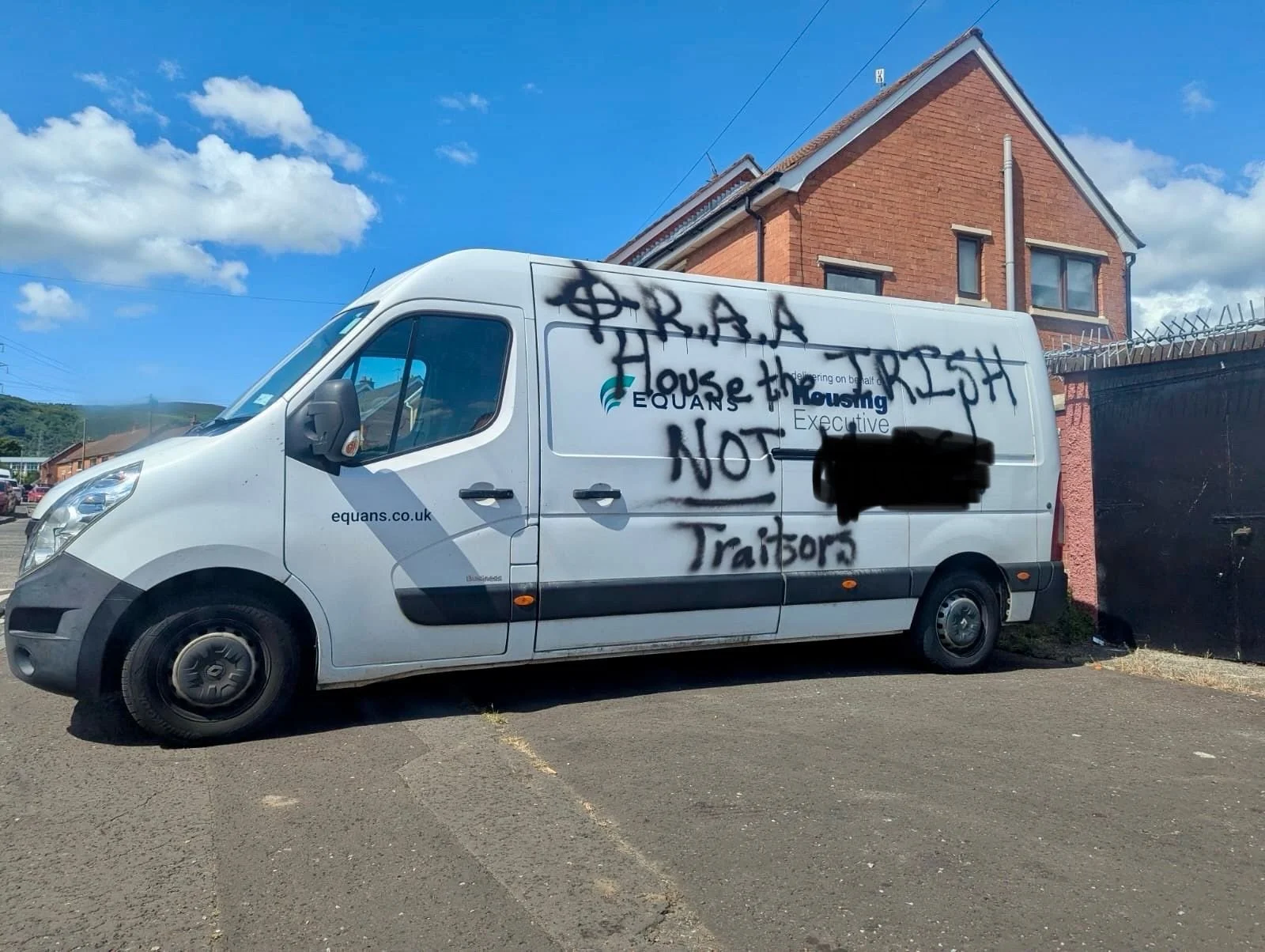
Housing Executive van covered in racist slogans in West Belfast
Racist graffiti daubed on Housing Executive van in Andersonstown
Conor McParland, Belfast Media, July 15th, 2025
CONDEMNATION: The racist graffiti on a Housing Executive van
RACIST graffiti daubed on a Housing Executive van in Andersonstown has been condemned.
The van was daubed with message of hate in the Bearnagh Drive area on Monday afternoon.
'House the Irish not w**s' and 'Traitors' was written on the van as well as a target graphic and the letters RAA – representing a gang which purports to be an anti-left republican group, Republicans Against Antifa.
It has no spokespersons or known structures, though has been reported to have been behind a number of racist graffiti incidents in West Belfast in recent months.
Local SDLP Councillor Paul Doherty said: “The racist graffiti daubed on a Housing Executive vehicle in Bearnagh Drive today was disgraceful and has no place in our society.
"This vile act does not reflect the people of this community, a community built on respect, diversity and solidarity. No family should have to walk past that kind of hatred.
“I’ve flagged this with the police and hope the vehicle can be removed by Housing Executive staff as soon as possible.
"Those responsible should be ashamed. We stand united against racism in all its forms.”
Sinn Féin MP Paul Maskey added: "A company van was sprayed with disgusting xenophobic slurs, designed to spread fear and hatred.
“Our activists were in the area speaking to local residents and the vehicle driver, all of whom are outraged.
“We have reported this to PSNI and I would urge anyone with information to please bring it forward.
“Those involved do not speak for the vast majority of West Belfast. Andersonstown is a welcoming community, one which I am proud to be part of and represent.
“Our resolve is steadfast. Racism will not win.”