Star of the Sea Documentary to be screened at the Foyle Fim Festival
Cultúrlann Uí Chanáin, 37 Great James St, Derry~Londonderry at 7pm on November 25th

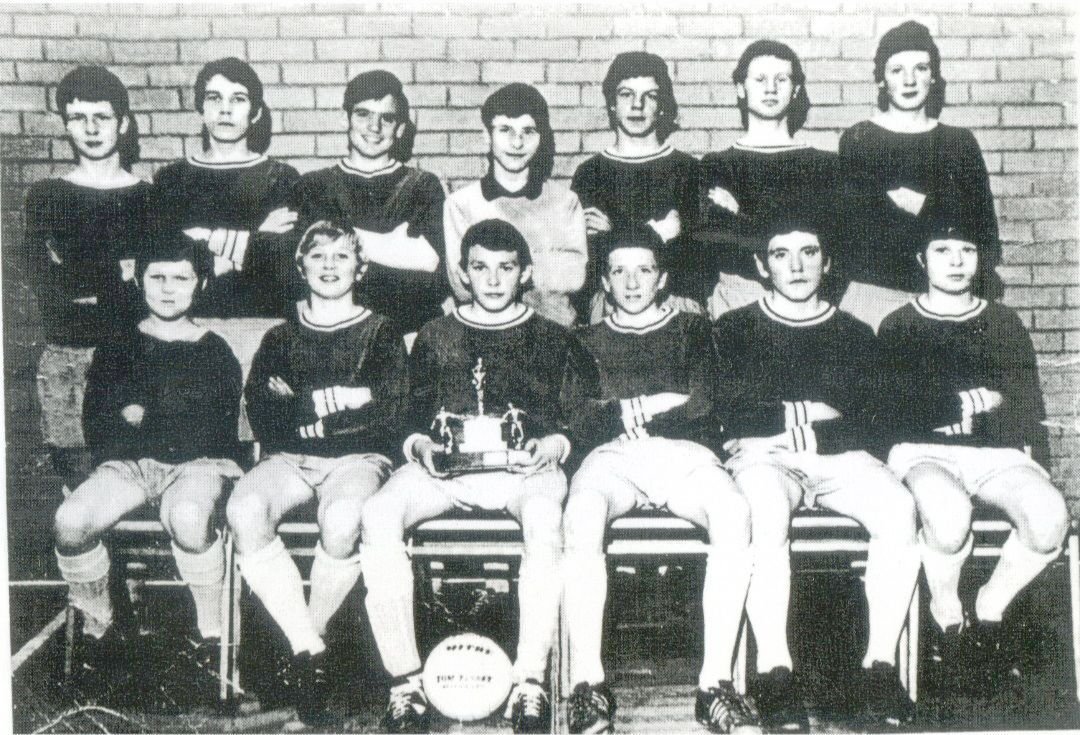
Above, Former members of the Star of the Sea Team from 1969-70: Left to Right, Ciaran Cooke, defender, Debis Sweeney, forward, Brian Short, defender, Brendan Nellis, mid-field, Geordie Hussey, foward, Raymond McCord, centre-half, Jim Russell, goalkeeper.
Below, Star of the Sea Team in 1969-70. Raymond McCord is third from tight. Bobby Sands is stitting immediately in front of him.
Star of the Sea Documentary to be screened at the Foyle Fim Festival
Cultúrlann Uí Chanáin, 37 Great James St, Derry~Londonderry at 7pm on November 25th
'I've never met Bobby Sands the hunger striker': The Belfast football team that put politics to one side
Raymond McCord recalls a Belfast childhood playing football with Star of the Sea, and the fight for justice that has defined his life.
THERE WERE NO lofty ideals at play when the Northern Ireland Housing Trust started construction on the Rathcoole estate in north Belfast, says this superb documentary on the impact the Troubles had on teenagers growing up on a mixed Belfast housing estate by James Wynn.
Part of a post-war building boom, the 366 acres on the slopes of Carnmoney Hill would serve as modern housing for those stuck in deprivation in the inner city areas, allowing the city to be spruced up.
If there was an ambition for the area to be cross-community, nobody was shouting about it, but around one-third of the families moving into Rathcoole were Catholic, populating the local Stella Maris schools.
Liam Conlon, a local doctor and community youth worker founded Star of the Sea, (the history of which still lives on in Super League basketball club Belfast Star) when he gathered an underage team of whoever wished to play soccer. The rule was there was to be no talk of politics and religion.
Invincible
They played together, they won together. Recollections from those who coached them testify that across five years, they weren’t beaten once on their way to winning multiple competitions.
Players were invited to cross-channel trials. Almost half of them played at some level for Northern Ireland at youth level.
The story inspired much media coverage and featured as an Andrew Lloyd Webber musical.
Tomorrow night (Tuesday, November 18th, 2026) it is brought to life once again in a new TG4 documentary by director James Wynne: ‘Réalt na Mara – An Pheil, Na Trioblóidí agus An Iarmhairt’ (Star of the Sea – The Football, The Troubles and the Aftermath).
***
1970s
As the ‘70s hovered into view, things changed. Catholic families were being burned out of their Rathcoole homes. Their places were being taken by Protestants, some of whom had sectarian tendencies.
Within a few years, players had gone to the extreme edges.
Star of the Sea’s left-back, Bobby Sands, helped plant and detonate an IRA bomb that took out the Balmoral Furniture showroom.
Their right-back, Michael Acheson, joined the Ulster Volunteer Force. So too did midfielder Terry Nicholl.
Denis Sweeney narrowly avoided being in a pub bombing, which influenced his decision to become a doctor. Tommy O’Neill was displaced by pogroms and died a young man, severely affected by the surrounding environment.
Sands would achieve worldwide renown, scorn, admiration and pity as the first of 10 Republican prisoners to die on hunger strike in 1981 in Long Kesh prison.
During his fast, he was elected as an MP for Fermanagh and South Tyrone but British PM Margaret Thatcher not concede political status to republican prisoners.
In the early hours of 5 May 1981, Sands lost his life, the first of ten hunger strikers to die.
McCord
The pick of that Star of the Sea team was Raymond McCord.
The son of Hector, an Orange man, and mother Kathleen from the Shankill, Raymond and older sister Jean moved out from York Street to Rathcoole just before he started primary school.
The street he lived in was mixed, and as he said, ‘the happiest’ street in all the estate. His neighbours were Monaghans, Fitzsimmons, Binghams and Reillys.
McCord lived a couple of doors down from Geraldine Noade, who would later marry Sands.
He started playing for Star of the Sea and soon found he loved everything about the team and the culture of the club, with Conlon their coach and youth leader.
His father never tried to talk him into the Orange Order, but he remembers some of the elders trying. The closest he came was being a ‘string boy’, holding the ends of strings flying off a banner on the Twelfth. His suit was bought ‘on tick’ and his shoes were too big for him and cut his feet to ribbons.
The bonfires at that time were harmless affairs; a few bushes cut down and set alight. No pallets, no tyres, certainly no tricolours or effigies of mosques or immigrants on small boats. Two families – one Catholic, one Protestant – would collect a few shillings off the families on the row that would pay for the children’s lemonade and sweets.
Still, McCord could find nothing about it that really appealed to him.
George Best
“I played football like everybody,” he recalls now. “I went to school, I played football and I had a girlfriend…. Why would I want to join something that’s going to take you away from that?”
He was more than good. Manchester United came calling and he went over for two months. His coach was Paddy Crerand. The manager was Frank O’Farrell. George Best was still there, training on an adjoining pitch at The Cliff.
And then, just like Best, he decided he was homesick and went home.
Unlike Best, he didn’t go back.
His boyhood club Crusaders wanted him. He went along and had a look. But again, not for him.
“I was happier at home: my girlfriend, my family there, my friends, at The Star,” he says.
Attitudes were hardening. He was asked what he was doing playing for Star of the Sea, a ‘Fenian’ crowd.
And when the football was over, he would be asked in the pubs about Man United, always couched in terms that surely it was the greatest mistake of his life?
“I said, wait a minute. If I had stayed, I’d have ended up probably married to an English girl. Chances are I wouldn’t have had three great sons.
One of his sons was Raymond Jr. His picture in Royal Air Force uniform hangs on the wall, directly in Raymond’s line of view.
The Shipyard and the UVF
The elder McCord had no truck with loyalist paramilitaries. When he was a teenager, he was asked to join some of the local ‘Tartan Gangs’, a recruiting ground for the Ulster Defence Association and the UVF. He refused.
When a Catholic friend of his was beaten up he exacted revenge.
“I wasn’t being John Wayne. That’s what friends do,” he says.
“You didn’t know until you’re fighting them if they could fight.
“In my experience of them, they were easy to beat, because they couldn’t fight. They were thugs.”
He worked as a welder in Harland and Wolff.
He liked the work and played football for the company team, but he wasn’t crazy about the overall atmosphere.
Over the years he had a few arguments in the yard with paramilitaries.
“To me, I didn’t see them as paramilitary”, he said. “I see them as an individual who could try and cause me a problem.”
Occasionally, he would find himself in fights with them. He had absolutely no fear.
One night, someone followed him into the toilets of a bar and launched a headbutt at him, breaking his nose. McCord hit back severely.
He went back to his company in the pub and carried on his night. The barman told him to slip outside the side door and get home. He wouldn’t. Half an hour later, car tyres squealed outside and a group of men emerged in the pub with iron bars and baseball bats.
Once they had him down, they went to work, breaking his arms and legs. Nobody could help. They were told not to even call for an ambulance as he was left for dead.
But paramilitaries offer some status and money. Not everyone was immune from their appeal and gradually, Raymond Jr found himself drawn into that world during his periods of leave from the RAF.
Raised in Dail
In 1997, a drug deal went wrong and Raymond Jr’s leaders suspected he might have informed in police interviews. He was lured to the disused Ballyduff quarry where he was beaten to death with concrete blocks on 9 November 1997. When Labour Party leader Pat Rabbitte raised Raymond Jr’s case in Dáil Éireann in 2005, using his parliamentary privilege, he said that Raymond Jr had been murdered on the orders of Mark Haddock, the head of the UVF’s Mount Vernon branch.
Raymond Sr was made swear to his family that he would not seek physical retribution.
Instead, he put faith in the police investigation. But it went nowhere for years, and he wasn’t being updated. He made some enquiries himself and spoke to leading figures in loyalist gangs and began forming suspicions.
He took them to the office of Northern Ireland’s Police Ombudsman, Nuala O’Loan. In January 2007, O’Loan’s report confirmed that Haddock – identified in the report as Informant #1 – had indeed been a protected species and safe from arrest; he was a British state agent, a paid informer.
Raymond Sr is a tough man, but how he and his family were treated comes out in torrents.
No clerical support
“No church minister condemned Raymond’s murder. No church minister came near my wife’s house. Not one brought even a sympathy card.
“Not one even came to speak to us or say a prayer. This is no joke, not one to this day, not one has ever come here.
“I’m not going to ask the stupid question why? Is it because of fear of paramilitaries? I know there was nothing in it for them.
“Our own so-called Unionist politicians, (Ian) Paisley, David Trimble and them, not one came near the house. Not one attended the funeral.
“I would have no love for those people. Those church men that are supposed to help families whether they like them or don’t like them, supposed to come and give them some type of support.”
He adds, “What they should have done is taken their dog collars off and thrown them in the bin. They’re only Christians when it suits them.”
Jim Shannon and DUP
Only one unionist politician, the Democratic Unionist Party’s Jim Shannon, has raised the case in parliament, and retains contact with McCord.
McCord himself has asked DUP leader Gavin Robinson to back his calls for a public enquiry into Raymond junior’s murder.
“He said the DUP don’t support inquiries.
“He talks about the soldiers, the veterans, giving them special protection. All I want is him to support an enquiry for my son. All I want is for him to ask in parliament.”
What frustrates McCord gravely is how Protestant paramilitaries are still operating in racketeering, fraud, drug dealing, prostitution and many other areas.
And the response from American and British governments is to continue to pump millions into the attempt to ‘transition’ when nothing has changed.
“These people still have a jackboot on top of their own community’s head, still raking money in for drugs and extortion, but our ministers stay silent, right?” says McCord.
“They shouldn’t be entitled to it. Since they went on ceasefire in 1994, the UVF has murdered 32 Protestants since their ceasefire.”
It’s coming up to 29 years since Raymond McCord Jr was murdered. Nobody from the ministries nor unionism has been to see him or the family. If politicians approach the door of his two other sons, they are immediately dismissed.
The death threats to Raymond Sr continue. Raymond Jr’s headstone has been smashed three times.
Star of the Sea team mates
His mood flips when he reminisces about Star of the Sea. Next week there will be a screening of the documentary at the Odeon Theatres in Belfast. He is compiling a list of old friends who have asked to have tickets reserved.
Across the way, two sets of Polish neighbours have asked him about it and have booked their tickets. He and some others are trying to track down the remaining members of the team who didn’t take part in the documentary.
“Dessie (Black) in goals… Geordie Hussey could have played in English league football. And I mean that, Geordie was good, fast and strong, and a good lad.
“Tommy O’Neill, forward, had nice skill. Terry Nicholl, Terry was one of the underrated ones. Terry had some skill. Terry should have been at least, a real, one of the top players in Irish league football.”
Instead, Terry went to jail. When he got out, he wanted to explore more of his Mormon faith and join family in Salt Lake City, Utah, but his conviction meant there was no chance.
“Big Paddy (Davidson). What a full-back. Fastest footballer I’ve ever seen in my life. Paddy didn’t get the credit…
Bobby Sands?
He takes a moment.
“To be honest, I remember doing an interview and people said, ‘What about Bobby Sands? The hunger striker?’
“I said, I don’t know. I’ve never met Bobby Sands the hunger striker in my life. Because when he left for Twinbrook, I have never seen him again.
“His wife lived about eight doors from me. We walked together on the same street.
“He wasn’t skilful, but Sandsy played for the shirt. He wasn’t one of the tough guys on the team but let people know he was there. Just because he was going in hard didn’t make him some sort of street fighter or, you know, hard man.”
He continues on.
“Denis Sweeney, fantastic player too. Willie Caldwell: the scouts were after Willie, Willie was the George Best of the team. He was running the ball.
“Terry Nicholl, Michael Acheson…”
He comes back to Sands.
“Willie says he (Sands) had the courage of his convictions. Willie is a Protestant guy.
“But I would disagree. I believe Sandsy was used because I said the Bobby Sands I knew, the Terry Nicholl I knew, and the Michael Acheson I knew…
“People say he made his own choice, I think he got to this stage it was too late to change because he was going to die.
Making choices
“But he made a choice the same way I made a choice when my son was murdered: I’m not stopping, I’ll get the people, get justice for my son.
“I believe that the only time a man’s gonna die, it’s for his family, to stop people killing his family, get in the way of it, defend them.
“Because nobody wants to die. Unfortunately, people take their own lives, mental illness and things like that, depression. This is completely different.”
He continues. “Do I regret that he died? Certainly, certainly regret he died there.
“I knew his wife. Grew up in the same street as me. A good girl. Good woman from a good family. When he was put in jail, I ran into Geraldine and I said, ‘How’s Sandsy?’
“And he got out after that. People can turn around and criticise and speak of him who don’t know him, and they say because he’s only out of jail and he goes back in again, that he didn’t learn his lesson.
“I’m not going to judge him at all because I don’t know what was in his head.
“What I can say is the Bobby Sands that died on hunger strike, Bobby Sands who joined the IRA, wasn’t the Bobby Sands that I knew at football, right?”
No professors
“We weren’t professors. We weren’t human rights activists. We were 16-year-old footballers.”
Naturally, he becomes a central focus of the documentary, but he feels the greatest contributions came from Denis Sweeney, Geordie Hussey and others.
Sweeney said it took him years before he realised that the team was made of different religions.
“Geordie says playing for Star helped to make him into the person he is today,” adds McCord.
“A young lad, with strong Unionist convictions. He’s not afraid to tell the truth.
“That’s important to me.”
Réalt na Mara – An Pheil, Na Trioblóidí agus An Iarmhairt (Star of the Sea – The Football, The Troubles and the Aftermath)