Irish Troubles potential £1 Billion legacy bill
CONNLA YOUNG, Irish News, January 15th, 2026
PREDICTIONS that the cost of dealing with legacy cases could top £1 billion over the next ten years have been blamed on the levels of state wrongdoing and legal delays caused by authorities.
Chief Constable Jon Boutcher made the £1 billion cost assessment while giving evidence about the Kenova series of investigations to the Northern Ireland Affairs Committee in London yesterday.
The PSNI’s most senior officer, who previously headed the Kenova investigation team, was accompanied by its current boss, Sir Iain Livingstone.
Established in 2016, the investigation team initially examined the activities of British agent Stakeknife, who was exposed as Belfast man and former IRA commander Freddie Scappaticci in 2003.
Kenova detectives were later asked to probe and review several other high-profile Troubles related cases.
During the hearing, Mr Boutcher said the cost of legacy cases is currently £24m.
He added there are 197 legacy cases, 71 of which took place during the period of the Troubles but are not conflict-related.
“The others are 1998-2004, that is a significant commitment we are not funded for,” he said.
“We think that’s £60m, but, because civil litigation, because of compensation, we think that could go towards a billion pounds over the next ten years.
‘A billion pounds we haven’t got’
“That’s a billion pounds we haven’t got.
“So, unless we come up with some framework to deal with that, the PSNI will still have this anchor holding us back from moving forward.”
During the hearing, Mr Boutcher also said “wrongdoing being found by the security forces” was, in his experience “rare”.
In the past, multiple Police Ombudsman reports have found that members of the security forces were involved in collusion.
Operation Denton, a Kenova investigation into loyalist paramilitary activity, is also expected to expose security force links to sectarian murders when it is published.
Daniel Holder, of the Committee on the Administration of Justice, said high rates of compensation could be linked to the actions of the state.
“Costs of legacy civil cases have two components – compensation and legal costs,” he said.
“A high cost for compensation would be of course indicative of a high level of past state wrongdoing and responsibility for human rights violations.”
State’s wrongdoing
Mr Holder added that the state is often responsible for delays in settling legal cases.
“Past high legal costs have often been caused by delaying actions of state agencies themselves, take the regular delays or resistance to providing disclosure or challenging investigations over the years,” he said.
“There is of course a real issue as to why the British government is insisting that present day budget of the PSNI is used to pay compensation for the past actions of the RUC, when clearly this was a British government responsibility.”
Meanwhile, SDLP leader Claire Hanna, who sits on the Westminster committee, addressed the lack of prosecutions in the Stakeknife case.
“ Costs of legacy civil cases have two components – compensation and legal costs. A high cost for compensation would be of course indicative of a high level of past state wrongdoing and responsibility for human rights violations
Daniel Holder, of the Committee on the Administration of Justice “Drawing on his experience in London, the Chief Constable has made clear that there is scope to improve how the Public Prosecution Service (PPS) handles legacy cases,” she said.
“It is vital that the PPS takes account of this professional assessment and ensures that reviews of Kenova decisions are as rigorous and robust as possible.”
She also referenced the case of republican informer Denis Donaldson, who was shot dead in Co Donegal in 2006.
“Nearly 20 years on, the investigation remains unresolved, the inquest has been halted 29 times, and evidence has been withheld from the family without explanation,” she said.
“The SDLP remains clear: no state or non-state actor has the right to determine a victim’s pathway to truth and justice. That principle applies to the Donaldson family, as it should to every family.”
Attacks on RIC in War of Independence was ‘terrorism’ says police chief
CONNLA YOUNG, CRIME AND SECURITY CORRESPONDENT, Irish News, January 15th, 2026
PSNI Chief Constable Jon Boutcher has described the killing of members of the Royal Irish Constabulary (RIC) in the War of Independence as acts of “terrorism”.
The “controversial” comments were made as he gave evidence to the Northern Ireland Affairs Committee at Westminster yesterday.
Speaking about the Kenova investigation team, Mr Boutcher said he had recently attended an event to remember members of the RIC.
The once all-Ireland police force was disbanded in 1922 and replaced by An Garda Síochána in the south and the Royal Ulster Constabulary (RUC) north of the new border.
It is estimated that around 500 members of the RIC were killed by the IRA during the War of Independence, also known as the Black and Tan War, between 1919 and 1921. Around 70% of the RIC rank and file were Catholic.
Leaders of the IRA during that period included Michael Collins, who was killed by anti-treaty republican forces during the Irish Civil War in 1922 and Éamon de Valera, who later became taoiseach and served as president of Ireland.
Some RIC members, known as Black and Tans, were former British soldiers. They were responsible for various murders, civilian killings and other reprisals during the conflict.
Another RIC unit known as the Auxiliaries were also well known for their indiscriminate targeting of civilians.
The Ulster Special Constabulary, which was also part of the RIC was formed in 1920.
Members of the RIC were also directly involved in killing opponents, including the murder of Lord Mayor of Cork Tomás Mac Curtain in March 1920.
The RIC was also targeted by the IRA, with two members of the police force killed in an ambush at Soloheadbeg, Co Tipperary in January 1919, which started the War of Independence.
In 2020 former Irish justice minister Charlie Flanagan was forced to defer plans to hold a commemoration for members of the RIC and the Dublin Metropolitan Police after a political backlash.
‘Most dangerous police service in the world’
During yesterday’s hearing, Mr Boutcher spoke about how the RUC was the “most dangerous police service in the world to be a member of in the 1980s”.
He said that “there’s not a week that goes by that there’s not a memorial for a member of the security forces, and often those victims are forgotten”.
The RIC was disbanded in 1922 and replaced by An Garda Síochána in the south and the RUC north of the new border
“I was at an event on Sunday for RUC officers, in fact Royal Irish Constabulary officers, murdered before the creation of the RUC by terrorism,” he added.
Historian and Irish News columnist Cormac Moore described Mr remarks will “definitely raise eyebrows in the south”.
“Most people will think that the RIC were upholding the crown’s law, particularly after the 1918 general election, the British authority in Ireland had evaporated, they had no popular support,” he said.
“The RIC were ostracised, and Boutcher’s remarks as “controversial”.
“You can’t divorce the RIC from the Black and Tans, the Auxiliaries, or the Ulster Specials.
“They are all linked, they were all on assignments together, they co-operated together, a lot of deployments against the Irish Volunteers, the IRA at the time… that’s very dangerous territory then to be talking about – they were killed by terrorists.”
Mr Moore highlighted that pensions and medals were later given to those who took part in the 1916 Easter Rising and subsequent conflict.
“The Irish state honours the men and women of the Easter Rising and War of Independence,” he said.
“There has been an acknowledgement of other players in that conflict, including British and security forces.
“But you rarely hear people describe those that participated in the War of Independence on the republican side as terrorists.
“I think it could have been a slip of the tongue, he has been sensitive to nationalism, he has been sensitive to different view points.”
The historian said Mr Boutcher’s they were targeted by the IRA, and they had a lot of popular support for that as well, there was boycotting of the RIC, their morale went through he floor, many people left.
“To call members of the IRA, like Michael Collins or Éamon de Valera, people in the IRA as terrorists, that’s a very controversial thing to say.
“I don’t think too many people would agree with that.”
Naming Stakeknife could attract more Catholics to PSNI
JONATHAN McCAMBRIDGE, Irish News, January 15th, 2026
THE government publicly revealing the identity of the agent Stakeknife could help to persuade more Catholics to join the police in Northern Ireland, Jon Boutcher has told MPs.
The Police Service of Northern Ireland (PSNI) Chief Constable also said he did not believe the naming of the Army’s spy within the IRA during the Troubles would hamper intelligence efforts in Russia, China or Iran.
Operation Kenova, which delivered its final report in December, looked at the actions of Stakeknife, an agent in the IRA’s internal security unit, who has been linked to at least 14 murders and 15 abductions.
He was widely believed to be west Belfast man Freddie Scappaticci, who was 77 when he died in 2023.
The Kenova report urged the UK Government to publicly reveal the identity of Stakeknife.
The government has resisted the calls, arguing that departing from its policy of neither confirm nor deny (NCND) in regard to the identity of agents would have implications for national security.
Mr Boutcher, who headed the Kenova team before joining the PSNI, and its current lead officer Sir Iain Livingstone, appeared before the Northern Ireland Affairs Committee yesterday.
The Chief Constable told MPs a “compelling” argument had been made why the government should move beyond NCND in this instance.
Desperately seeking recruits
He said: “The PSNI are going to be recruiting this week. I am desperate for this society to move forward all communities; not just the two traditional communities, all communities.
“If you look at any of the news outlets in Northern Ireland, a week does not pass by where there’s not a mention of a legacy case.
“And because of our approach to this case and others… the nationalist community see this as a continuation of what’s always happened: protection of wrongdoing by the state.”
He added: “To help society move forward, to help me get Catholic officers into the PSNI, we need to start making some difficult choices.
“And each secretary of state that I’ve dealt with, and I’ve dealt with a number, now get the same advice.
“I’m just asking, please listen to other people who have some considerable experience and understanding and more accountability in policing than in the intelligence agencies.”
Mr Boutcher was asked if naming Stakeknife would pose any risk to current agents.
He pointed to previous incidents where agents had been named and said “the sky didn’t fall in”.
He also referenced the PSNI approach during the inquest into the death of Sean Brown, a Catholic father murdered by loyalists in 1997.
Mr Boutcher said police had provided a “gist” of intelligence information to the proceedings and “that didn’t mean that we lost any agents”.
He added: “There are outside elements, international challenges that they (the Government) also have to consider. Will that have an effect?
“I find it hard to believe that internationally, whether it’s China, Russia, Iran, that people are looking at us naming the agent Stakeknife… that means they’re not going to work for the security forces.
“But I’m happy to listen to arguments to the contrary.”
Northern Ireland Secretary Hilary Benn previously said the Government would wait until the conclusion of a Supreme Court ruling in a separate Troubles case before making a decision on the call from Kenova for Stakeknife to be named.
In December, the Government won an appeal which prevented a coroner in Northern Ireland disclosing certain sensitive material at a Troubles inquest into the death of Liam Paul Thompson in Belfast in 1994.
In its judgment, the court said while it had “considerable sympathy” with the desire of the Mr Boutcher to be transparent, the responsibility lay with the Northern Ireland Secretary over assessing risks to national security.
Sir Iain told MPs he did not see anything in the Thompson judgment which precluded Mr Benn from authorising the naming of Stakeknife.
Comments on Jon Boutcher’s evidence to Northern Ireland Affairs Committee
Surely key in Chief Constable Boucher's evidence is his contention that officially naming Stakeknife would not hamper identity protection and intelligence gathering over Iran and Russia today. There is a crucial difference between the internal domestic conflict of which Stakekife was a part and is now concluded, and the impact of foreign conflict on the domestic scene which is still current.
Even more crucial is the question of whether MI5's apparent veto has any real impact on investigations when it has obviously failed in practical terms over naming Stakeknife. The difficulty in producing evidence to prosecution standard seems far more important than by a policy of Neither Confirm Nor Deny by itself.
If MI5 is at the heart of the problem the PSNI should identify the area of investigation.and name MI5 as the obstacle. This surely is the compelling conclusion to be drawn from the Kenova sequence of inquiries. It also provides the Legacy Commission with a clearer (and cheaper) path of investigation than that of open court.
While Boucher's description of RIC killings as "terrorism" is undoubtedly controversial, because " the other side" won, surely the RIC are as entitled to be memorialised as much as either the historic or contemporary IRA? The Black and Tans and Auxies were late imported add-ons and recognised as distinct from the core native Irish RIC.
Although former Justice Minister Charlie Flanagan lost his case, it still stands.
Brian Walker, UCL Hon Senior Research Fellow Emeritus Constitution Unit, University College London
Belfast Council 'piling illegality on illegality' with Irish policy
ALAN ERWIN, Belfast Telegraph, January 15th, 2026
COURT CHALLENGE TO DRAFT PROCEDURE TOLD SIMPLE MAJORITY THWARTS SAFEGUARDS AND DEPRIVES COUNCILLORS AND VOTERS OF PROTECTIONS
Belfast City Council is “piling illegality on illegality” in its process for dealing with a proposed Irish language policy, the High Court heard yesterday.
The local authority's rules on reconsidering politically divisive decisions about both the planned strategy and flying of the Palestinian flag unlawfully thwart safeguards aimed at protecting minority views, a judge was told.
Traditional Unionist Voice (TUV) member Ann McClure is challenging the council over the operation of a call-in scheme for voting on controversial issues with a potential adverse community impact.
Her barrister, John Larkin KC, argued a new filter has now wrongly been created, handing a veto to a simple majority of the elected representatives.
“The standing orders haven't been removed or suspended… it is piling illegality on illegality,” he submitted.
Proceedings were issued after councillors in Belfast approved a draft Irish language policy in October last year.
The blueprint aims to promote the use of Irish in public life, with bilingual signage and logos to appear on council facilities, signage and uniforms.
Amid unionist objections, a call-in mechanism was triggered to scrutinise the legitimacy of the decision.
Under the procedure a 15% minority of councillors can request a reconsideration which involves seeking legal opinion on any possible adverse community impact. If those concerns are assessed as being valid, an 80% super majority may be required in a call-in for the original motion to be voted in again.
Draft language policy on hold
The draft Irish language policy for Belfast currently remains on hold pending the outcome of that process.
Ms McClure and her legal team claim the council has wrongly interpreted relevant sections of the Local Government (Northern Ireland) Act 2014.
Her action widened out into a systemic challenge after the authority backed a Sinn Fein proposal to fly the Palestinian flag for one day at City Hall.
Unionists again objected and called in the original decision taken to mark Palestinian Solidarity Day.
Following a further vote the flag was eventually raised for a short period at the start of December.
Court papers described Ms McClure as a politically active member of the unionist community in Belfast who has actively campaigned against the adoption and implementation of an Irish language policy.
She was also said to regard the decision to fly the Palestinian flag as a further attack on unionist values and offensive to the city's Jewish community.
At an earlier stage in the case the council accepted that legal opinion on the merits of a call-in requisition should not be treated as determinative.
Simple Majority rule
But Mr Larkin claimed newly “cobbled together” standing order arrangements have arguably made the situation worse.
A simple majority of councillors will now determine whether any decision called-in for reconsideration should be subjected to the qualified voting protections, the court heard.
The barrister contended: “(This) plainly and egregiously defies the statutory scheme and subjects the minority safeguard to a majority veto.”
Mr Justice McLaughlin was told that a council clerk must determine that a requisition is valid before a super-majority vote is required to pass potentially divisive motions.
“What is the value in obtaining (legal) opinion on matters of sociology and politics?” Mr Larkin asked.
He went on: “By the simple majority Belfast City Council is introducing a filter… depriving councillors and those people whose interests they represent, of the protections the regulations give to them.”
The case continues.
Multiple pipe bombs found during security alert
CONOR COYLE, Irish News, January 15th, 2026
MULTIPLE pipe bombs were discovered during a security alert in Co Antrim which lasted more than 24 hours.
Police say the devices were found in the Upper Hightown Road area of Newtownabbey during searches while the road was closed.
The security alert ended yesterday afternoon and the road was re-opened.
Ammunition Technical Officers had attended the scene where the suspicious items were discovered and declared them as viable.
“At approximately 3.50pm on Tuesday 13th January, police received a report that a suspicious object had been located in the area,” a PSNI spokesperson said.
“Officers attended the scene along with Ammunition Technical Officers and a number of viable pipe bomb-type devices were discovered.
“The devices have been made safe and they have since been removed from the scene and taken away for further forensic examination. Cordons have been lifted and the road reopened to traffic.”
Police also attended a separate security alert on the Divis Road area of west Belfast yesterday, which remained ongoing last night.
'More flexibility is needed from London' to secure Stormont budget
REBECCA BLACK and CLAUDIA SAVAGE, Belfast Telegraph and Irish News, January 15th, 2026
O'NEILL CALLS FOR EXTRA FUNDING AS PARTIES MEET WITH SECRETARY OF STATE
First Minister Michelle O'Neill has pressed for more flexibility and more funding from London to secure the first multi-year budget at Stormont in more than a decade.
She described the current stalemate over the proposed budget as one of the most pressing issues facing the Stormont Executive.
The larger Stormont parties met with Secretary of State Hilary Benn in a series of meetings in Belfast and London this week.
Finance Minister John O'Dowd published his draft spending plan for a multi-year budget last week and has sent the proposals out for public consultation.
However, they have not been agreed by the powersharing Executive and have faced criticism from other parties, particularly the DUP.
Accompanied by Economy Minister Caoimhe Archibald to meet Mr Benn in Belfast yesterday afternoon, Ms O'Neill said there is not enough money in the pot.
No preferntial treatment for Army veterans
She also said she would tell Mr Benn of their “serious concerns” around the trajectory of the development of the Legacy Bill, adding she will not support anything that gives preferential treatment to military veterans.
“We as an Executive have work to do, there is no doubt about that, we need to focus on transformation, we need to focus on getting to a point where we have a three-year budget,” she said.
“But for me, this is very much twin track.
“There are policy decisions in London that need to be changed, and I want to make that message very clear to Hilary Benn today, what we need to see is a change of tack, we need to see the flexibilities that the Finance Minister has asked for.”
She added: “We are determined to fight the good fight for the people here, we're not asking for preferential treatment, we're asking for what's right.
“We're dealing with over a decade of austerity, public services decimated.
Not enough pie
“We have work to do, and I accept that, but the budget that has been allocated here is not enough, there is not enough pie to go around all Executive departments to invest in public services.
“There are flexibilities that could be inbuilt to the budget itself, that's what I'm going upstairs to speak to Hilary Benn about. We need flexibility and additional funding.”
DUP leader Gavin Robinson, alongside party MPs Carla Lockhart and Gregory Campbell met with Mr Benn in London on Tuesday.
He said Northern Ireland must be funded according to need, and also emphasised a responsibility to cut any wasteful spending.
“Northern Ireland must be funded according to need. However, alongside that, there is a responsibility to ensure that wasteful spending is identified and cut out,” he said.
“Public services must be funded and structured in a way that is both effective and efficient, delivering real value for taxpayers and ensuring better outcomes for people right across Northern Ireland.”
Alliance Party deputy leader Eoin Tennyson and Stormont Agriculture, Environment and Rural Affairs Minister Andrew Muir met Mr Benn later on Wednesday.
Mr Tennyson said the Executive is “clearly in a very challenging situation” and have just 16 months left in this mandate to deliver.
He added: “It's a question for other parties round the Executive table as to whether they are prepared to take the tough decisions which are now necessary, but also for the Secretary of State who, I have to say, has had a fairly 'hands off' approach in terms of the operation of the institutions and the challenges that we have been facing since the Executive returned.”
Minnesota can't hold a candle to North when it comes to the unjustified checkpoint killings
JOHN LAVERTY, Belfast Telegraph, January 15th, 2026
Unconditional government defence of the shooter? Check. Instant, uncorroborated traducing of the victim's reputation? Check. Location of killing? Checkpoint.
Yes, the clearly unjustified — and unjustifiable — killing of Renee Good by an ICE officer in Minnesota last week brought back painful memories for many families in Northern Ireland.
After all, we were the go-to place when it came to the lethal shooting of unarmed citizens by members of the security forces and subsequent, often spurious attempts to justify them.
Like in 1990 when Karen Reilly (18) and 17-year-old Martin Peake were gunned down by Army paratroopers while joyriding on Belfast's Upper Glen Road, their vehicle riddled with bullets from four different rifles.
Judges subsequently found that the Paras “did not behave like soldiers on a routine patrol”, that there'd been a “deliberate attempt to cover up the circumstances surrounding the killings” and that evidence given by the shooters was “a farrago of untruths and impossible claims”.
They also ruled that the shot that killed Karen was “an unreasonable use of force” because the car, and with it the danger, had already passed — yet Private Lee Clegg's murder conviction was ultimately quashed in Belfast Crown Court.
Two years before that incident, 23-year-old Aidan McAnespie was fatally shot in the back at an Army checkpoint in Aughnacloy, Co Tyrone.
The shooter, David Holden, later became the first soldier to be convicted of a Troubles-era killing since the Good Friday Agreement.
Holden was found guilty of manslaughter and given a suspended sentence in 2022...
You can add Thomas 'Kidso' Reilly — who worked for pop groups Bananarama and Spandau Ballet — to the list of victims of similar incidents after encountering trigger-happy/nervous/inexperienced uniforms in public.
Released on licence
Private Ian Thain became the first British soldier serving here to be convicted of murder after Mr Reilly's death — but just over two years later it emerged he'd been released on licence and was back serving with his regiment.
Those regrettable incidents were during the Troubles when, to be fair, tensions were at their height and genuine danger for security forces lurked around virtually every corner.
Peacetime examples, however, include Steven Colwell (23), shot dead by a PSNI officer at a checkpoint in Ballynahinch in 2006.
Mr Colwell, originally from the Shankill area, was fatally wounded after attempting to reverse a stolen vehicle away from the police.
The Police Ombudsman found in 2011 that the officer's actions had been “critically flawed”, and that the discharging of two shots had created significant risk of further casualties in the area.
Coroner Judge Rafferty later said, however, that the officer honestly and genuinely believed his life was in danger, and that his use of lethal force was “proportionate”, but added that the shooter's claim that he didn't have a realistic option for retreat from the vehicle was a “mistaken belief”.
No one is claiming that all of these victims were innocent of any crime, but none of the offences warranted instant capital punishment.
Dodging a bullet
The people of Northern Ireland, meanwhile, have dodged a bullet with JD Vance.
For a while it looked as if he was one of our own, a prodigy of good Ulster stock from Coagh in Co Tyrone. And look, there's a Vance burial plot at St Luke's Parish Church that proves it!
Unfortunately for the campaigning Communities Minister Gordon Lyons — and despite a spend of over £5,000 of public money on research — no concrete proof emerged of the US Veep's Ulster-Scots lineage.
In any case, Vance is no hero to anyone except hardline Maga Yanks — and even some of them were left utterly nauseated by his callous, insensitive remarks following the killing of Ms Good by an ICE agent. Vance's supposed faith didn't prevent him from speaking ill of a tragically deceased fellow Christian.
Bereft of any supporting evidence, Vance claimed the mother-of-three was “a deranged leftist” who had been “brainwashed” and was responsible for “a tragedy of her own making”.
A degree in mass public brainwashing is what Vance desperately requires now.
If Ms Good was indeed “a deranged leftist”, she showed little evidence of that during her frequent visits to Northern Ireland, a place she grew to love. There was no hint of “brainwashing” when she was spending her teenage years enjoying Christian youth missions here.
Her colleagues in the summer outreach teams at Ballysally (Coleraine) and First Saintfield Presbyterian Churches fondly recall a devout young Renee Granger more than living up to the surname she'd later adopt.
“Compassionate, caring and funny; kind and empathetic” was a typical description.
Presumably the leftist brainwashing of Ms Good happened after she returned to the United States but, if so, Renee disguised her supposed “domestic terrorist” alter ego rather well.
Vance, meanwhile, has failed to mask his utter unsuitability for high office, although that trait never hindered the progress of his boss.
As Donald Trump famously and haughtily uttered a few years back: “I could stand in the middle of Fifth Avenue and shoot somebody, and I wouldn't lose any voters, okay?”
Suddenly, that is coming across as one of the US president's less preposterous claims.
Thrown against wall... nurse attack among 72,000 incidents in five years
LIAM TUNNEY, Belfast Telegraph, January 15th, 2026
'RELENTLESS' ABUSE OF STAFF BLAMED FOR POOR MORALE AND BURNOUT IN WORKERS
A Northern Ireland nurse has described being “grabbed by the collar and thrown against the wall” as she tried to de-escalate a mass brawl in an emergency department (ED) waiting room.
Her ordeal was just one of more than 72,000 recorded incidents of physical and verbal abuse against healthcare staff in the region over the last five years.
The statistics were revealed by Health Minister Mike Nesbitt following an Assembly question by DUP MLA Diane Dodds.
Two ED nurses, who spoke to this newspaper under condition of anonymity, said the attacks were contributing to staff burnout and morale.
Both work within the Belfast Trust, which had the highest number of recorded incidents.
One nurse described being physically assaulted while trying to de-escalate a melee in the waiting area.
“I could hear lots of loud shouting coming from the waiting room so, as the triage nurse, I went out to see what was going on,” she said.
“A few people had started fighting each other physically, and then it led to two, three, four more people jumping in. That led to, honestly, about 20 people then fighting in the waiting room.
“As I went out to see what had happened, one of the patients grabbed me by the collar and threw me against the wall.
“That's just within the past six months. If you ask any nurse that works here, I would say that they've experienced a similar story, and I'm probably one of the luckier ones.”
Staff off work with injuries
Another nurse said the attacks are relentless, with staff regularly sustaining injuries that leave them unable to work.
“Just this week, we've had two significant assaults on staff, most of them are off work,” she said.
“One has sustained quite nasty facial injuries as a result of that assault. Unfortunately, this is not an isolated event. This is something that we as nurses deal with every day.
“Over the past two to three years, there's been a significant increase in the level of violence and aggression directed at healthcare staff.
“I don't think you could find one person that hasn't experienced some verbal or physical violence.
“The mental, emotional and physical harm increases staff burnout, stress, fear of coming to work, and it's totally unacceptable that anybody can come into this department and behave in that way.”
Though the overwhelming majority of recorded incidents related to physical abuse (59,392), both staff members said verbal abuse was by far the most prevalent, with many incidents going unreported.
Verbal abuse ‘part of the job’
“Verbal abuse is just something that [we get] every day, and that would be for everybody. Working in A&E, it's honestly just part of your job,” said one nurse.
“If we reported every instance of verbal abuse, you would get nothing done because it is so prevalent.
“If I think even in the past week where someone had said something that could be considered verbally abusive, you just would never have the time to come forward and report that.”
Earlier this week, the BMA's Northern Ireland chair Dr Alan Stout said the figures were evidence of frontline staff taking the brunt of the public's frustration over a system struggling to cope.
One nurse said that while aggression had always been part of the challenges that come with working in an ED, there had been an uptick in the last few years.
“Working in ED for 20 years now, there has always been a level of aggression that you are exposed to,” she said.
“You are the front door of a hospital, and you see things in a way that other wards and departments do not necessarily see. Has it got worse? I would say yes, in the last two to three years.
“I think people live in a very accessible society, everything is express, everything is next day, and they come to ED just hoping it can provide a quick fix.
“For a lot of people coming to the emergency department and experiencing the challenges of overcrowding, long waiting times, leads to an increase in frustration.
Body cameras
“Sometimes that manifests in violence. For other people, unfortunately, that is the way they behave.”
The Belfast Trust said it provided support for staff affected by abuse, including counselling and resources to support their mental health.
A spokesperson also said the Trust intended to trial the use of body-worn cameras to deter offenders.
“The safety of our staff is paramount and attacks on our staff are totally unacceptable,” said a spokesperson.
“Belfast Trust is committed to a zero tolerance approach to physical and verbal aggression and would urge staff to use the framework to report incidents.
“The Trust is consulting on introduction of a pilot scheme for staff to wear body cameras. We will be working with staff, patients and their families, as well as consulting with trade union colleagues to involve them in the development of this pilot scheme.
“All relevant governance processes are being followed in order to introduce body worn cameras for staff and the pilot will be evaluated before any decision would be made on implementing the scheme within Belfast Trust.”
Judgment reserved in appeal over dismissal of Kneecap terror charge
JESS GLASS and CALLUM PARKE, Belfast Telegraph and Irish News, January 15th, 2026
RAPPERS SAY 'WE WILL WIN AGAIN' AS HEZBOLLAH FLAG CASE RETURNS TO COURT
Judgment has been reserved in a challenge to the decision to throw out the terrorism case against west Belfast rapper Liam Óg Ó hAnnaidh.
The Crown Prosecution Service's bid to overturn the decision to dismiss the case against the Kneecap star started yesterday at the High Court.
The rapper, who performs under the stage name Mo Chara, was accused of displaying a flag in support of proscribed terror organisation Hezbollah at a gig at the O2 Forum in Kentish Town, north London, on November 21, 2024.
But the case was thrown out in September last year, with Chief Magistrate Paul Goldspring ruling the proceedings were “instituted unlawfully”.
Judge Goldspring had agreed with Ó hAnnaidh's lawyers that prosecutors needed to seek the permission of the Attorney General to charge the rapper, before informing him on May 21 that he would be charged with a terror offence.
This permission was sought and given the following day, which the court heard meant the charge fell outside the six-month timeframe in which criminal charges against a defendant can be brought.
The Crown Prosecution Service (CPS) is now appealing against the decision at the High Court, with Ó hAnnaidh opposing the appeal.
Kneecap's JJ Ó Dochartaigh, whose stage name is DJ Próvai, and manager Daniel Lambert attended the hearing in London.
Paul Jarvis KC, for the CPS, said the Attorney General's permission was in place before Ó hAnnaidh's first court appearance on June 18, meaning the requirements were met.
The barrister said in written submissions that the requirement for the Attorney General or Director of Public Prosecutions' agreement applies “when the defendant appears before the magistrates' court to answer the charge he faces”.
Mr Jarvis continued: “That interpretation is consistent with the case law, both before and after the introduction of that particular consent provision and applies irrespective of whether the offence is summary-only or indictable.”
The barrister said if the chief magistrate's ruling was correct, it would likely mean proceedings would be “instituted” when written charges are issued, rather than when a defendant appears at court to answer the charge.
Mr Jarvis said: “The appellant submits that that is an example of the tail wagging the dog.”
The barrister later said that as the Attorney General's permission had been given on May 22, “it follows that valid consent to the respondent's prosecution was in place before the proceedings against the respondent were 'instituted' on 18 June 2025”.
Jude Bunting KC, for Ó hAnnaidh, said the technical issues that led to the terrorism charge against the rapper being thrown out “arose because of human error”.
He continued in written submissions: “The answer to this appeal is straightforward... The necessary permission and consent were not provided at the time the proceedings were 'instituted'.
“As such, the chief magistrate was plainly correct to hold that these proceedings were not instituted in the correct form within the six-month statutory time limit.”
The barrister said no previous case supported the CPS argument that magistrates' court proceedings are only “instituted” when a defendant appears in court.
Absurd
Mr Bunting continued: “The appellant's case is at odds with the principle that the law should be coherent: the Crown invites the court to interpret the relevant statutory scheme in a manner leading to absurd results, whereby criminal proceedings would be deemed to have been 'instituted' at multiple different points in the same set of proceedings.”
The barrister later said written charges can lead to defendants pleading by post and never appearing in court in person.
He continued: “A lack of consent or permission at the time of charge could therefore lead to a defendant pleading guilty by post, and thereafter being summarily convicted of a charge issued by the police, to which the Director of Public Prosecutions had not and might never have consented, and which the Attorney General had not or would not have permitted.”
Prosecutors had alleged Ó hAnnaidh could be seen in a recording of the gig in 2024 wearing and displaying the flag of Hezbollah, while saying “up Hamas, up Hezbollah”.
After the CPS announced its appeal, Kneecap said in a social media post: “Once again, this is a massive waste of taxpayers' money, of police time, of court time. Once again, there are endless news reports about Mo Chara, about Kneecap, but we are NOT the story. We will fight you in your court again. We will win again.”
The decision will be published online at a later date.
Creating Harmony in the midst of Discord
Irish News, Pro Fide Et Patria, Irish News, January 15th, 2026
Traditions can thrive when allowed to share the stage
CRITICISM, when rooted in misunderstanding or fear, often misses the very point it claims to defend.
The controversy stirred over a proposed Fleadh Cheoil fringe event in Bangor this summer is a case in point. At its heart is a familiar refrain in northern politics: that culture is a zero-sum game, that one tradition can only be celebrated at the expense of another, and that music itself is somehow a provocation.
Nothing could be further from the truth.
The planned Fleadh Fringe event, timed to coincide with the Ulster Pipe Band Championships, should be seen not as a threat but as an opportunity. An opportunity for Bangor, for Ards and North Down, and for an entire region.
“Proximity brings opportunity: economic, cultural and reputational. Turning away from it out of fear of offence would be an act of self-sabotage
Far from “creating ill feeling”, the dual events offer a chance to showcase musical traditions side by side, reflecting the richness and diversity that already exists on the ground.
It is telling that those closest to the music are the most supportive. Ards CCE has welcomed the approach, while the Royal Scottish Pipe Band Association NI has explicitly endorsed the positive opportunities arising from the pairing of events. These are organisations steeped in their respective traditions, confident enough to know that music does not diminish when it shares space. It flourishes.
The criticism levelled by some councillors and parties rests largely on process and perception. Claims of being “bounced into” funding decisions or of one event “playing second fiddle” to another do not stand up to scrutiny.
The figures being cited have been misrepresented, and the funding itself is not guaranteed. If the money is not approved through the rates-setting process, the event simply will not happen.
More fundamentally, the argument ignores the wider context. Belfast is set to host Fleadh Cheoil na hÉireann, the largest celebration of Irish music and culture in the world, drawing an estimated 700,000 visitors.
To pretend that nearby councils should not engage with or benefit from an event of that scale is short-sighted in the extreme.
Proximity brings opportunity: economic, cultural and reputational. Turning away from it out of fear of offence would be an act of self-sabotage.
Music is not a weapon. A fiddle tune does not erase a pipe march, nor does a bodhrán drown out a drum. The idea that celebrating Irish traditional music in Bangor somehow undermines others is rooted in an outdated mindset that sees identity as fragile and culture as confrontational. Most people know better.
Criticism may grab headlines, but harmony is what will linger.
Dropping of 'Brit Card' digital ID plan just latest in series of Starmer U-turns
SUZANEE BREEN, Belfast Telegraph, January 15th, 2026
Another day, another U-turn by this spectacularly hapless Government, whose path is littered with abandoned pledges.
Labour has dropped its plan requiring mandatory digital ID cards for anyone seeking a job in the UK.
The scheme was intended to help crack down on migrants working illegally. Stored on a mobile phone, the digital ID card was to include a name, date of birth, nationality, residency status and a photo.
It was also to be used to provide access to Government services, including welfare and childcare.
Announced last September, the plan united every party in Northern Ireland in opposition.
Sinn Fein and the SDLP denounced the 'Brit Card' and claimed it was an attack on the Good Friday Agreement.
Unionists saw it as an invasion of privacy which would do nothing to stop illegal immigration.
The Government has now dropped its plan for a mandatory card. Instead, Labour says existing checks — using documents such as biometric passports — will move fully online by 2029.
Universal condemnation
At Prime Minister's Questions, Kemi Badenoch welcomed “the latest U-turn”, and described mandatory digital ID as a “rubbish policy”.
The response was markedly similar in NI. Sinn Fein North Belfast MP John Finucane said it had been a “ludicrous plan” by Keir Starmer: “This ridiculous proposal showed complete disregard for the Good Friday Agreement, and the rights of Irish citizens in the north. It belongs in the bin.”
DUP MLA Philip Brett said: “The Government's proposals for compulsory digital ID were wrong in principle and unworkable in practice.
“They were initially sold on the premise of tackling illegal immigration, yet would have had no impact on that whilst instead undermining personal freedoms, creating new risks around data security and penalising law-abiding citizens.”
Mr Brett said his party had been “at the forefront of opposition” to the scheme at Westminster and Stormont.
“This latest U-turn is obviously welcome, but there still remain key questions as to why the policy was ever brought forward given the reaction to previous suggestions of such a scheme,” he added.
Alliance MP Sorcha Eastwood claimed the scheme had been “reckless and ill-thought-out”.
She said: “It is not a criminal offence not to hold a passport or a driving licence. Older people, those who are disabled, and those living in poverty should not face potential criminalisation for being digitally excluded. Those looking for work should not face even more barriers to accessing employment. We opposed these plans at every turn, so we're greatly relieved to see this change of course.”
UUP MP Robin Swann noted that three million people across the UK had signed a petition against mandatory digital ID cards.
The Government's U-turn was a “significant victory” for them.
“The sheer level of public opposition to this policy makes clear that the proposal is not viable,” he said.
“This reported change in direction is a welcome admission that the right to privacy must be respected.”
However, Mr Swann added: “We need clear confirmation that any future digital identification will remain strictly voluntary and will not become a requirement to access work or social welfare. We can't allow digital ID roll-out via the back door.”
‘Get it right first time’
SDLP leader Claire Hanna MP said: “This is a welcome move from the UK Government that removes concerns about how this policy could have worked in Northern Ireland.
“From the outset, the SDLP was clear this would be unworkable here, particularly given the reality of daily cross-border travel for work, family and everyday life. We made that case at Westminster and I am glad that common sense has now prevailed.”
TUV MLA Timothy Gaston said: “Keir Starmer's climbdown on his flagship plan to make digital ID compulsory is most welcome. It is an implicit admission that this policy was being sold as a headline-grabber on immigration rather than a serious answer to the problem.
“Public concern has been enormous. In North Antrim alone, the petition opposing digital ID recorded 4,891 signatures — a clear signal that local people did not want their personal data centralised into a single state-run system.
“TUV will continue to oppose any scheme of this nature and we will continue to press the Government to focus on real action when it comes to illegal immigration, including, crucially, introducing a policy of immediate deportation for those with no right to be in our country.”
The latest U-turns by the Government include last week's decision to provide additional support for pubs facing large hikes in business rates.
It has reversed course at least 11 times so far, including raising the inheritance tax relief threshold for farmers after months of protest, and scrapping a raft of benefits cuts under threat of a backbench revolt.
Health Secretary Wes Streeting said that ministers should aim to “get it right first time”.
When the legal profession fails, should the state defend you in court?
NEWTON EMERSON, Irish News, January 15th, 2026
ONE response Stormont could take to the criminal barristers’ strike that began last week would be to establish a public defender office.
Scotland did this in 1998, and the Republic has been actively considering it since 2020.
Pubic defenders are lawyers employed directly by the state to defend people accused of a crime, just as public prosecutors perform the opposite function.
The Scottish model is the commonest worldwide. Its Public Defence Solicitors’ Office (PDSO) is a network of lawyers employed by Scotland’s legal aid agency, itself a non-ministerial government department, so independence is protected and nobody need be concerned about being defended by the same authorities that prosecute them.
The PDSO does not replace legal aid and use of its lawyers is not compulsory. It is more of a safety net for people who cannot find a law firm prepared to work for legal aid rates.
This helps to control legal aid costs, the issue causing the barristers’ strike here, although the impact on costs is somewhat counter-intuitive.
Legal deserts
The PDSO is not cheaper than a private law firm. Its costs per case can be almost twice as high, due to the extra overheads and inefficiencies of running a public sector organisation.
However, it provides a service in so-called ‘legal aid deserts’ – entire towns or districts where no law firm will work for legal aid rates.
This means rates do not have to keep rising so that everywhere remains a lawyers’ oasis.
Unsurprisingly, the legal profession in Scotland is less than delighted with the PDSO, often seeing it as unfair competition designed to force down fees.
Criticism from the profession must be seen in this light, even where it raises valid points.
For example, the PDSO has struggled to recruit staff, despite offering secure and well-paid employment, so it has not completely fixed the problem of legal aid deserts.
Some lawyers say this shows that a public defender office cannot guarantee legal representation of a high standard because ambitious and talented people prefer to work in private practice.
Similar arguments have been heard from the legal profession in Northern Ireland.
But Scotland has an unusually awkward geography for legal coverage.
Almost everyone lives in the central belt spanning Glasgow and Edinburgh, almost everywhere else is a wilderness, and the economy of the central belt provides particularly lucrative options for private practice.
It should be far easier to hire a public defender in Fermanagh than in Fort William.
Studies have found no proof the PDSO delivers lower standards.
Its clients are slightly more likely to plead guilty, although this is not necessarily concerning, as pleading guilty can be good advice.
They are also slightly likelier to be convicted, although this could be explained by the different nature of the caseload. Clients report high satisfaction with the service.
Scotland has gone some way towards breaking down the barrier between solicitors and barristers – or advocates, as Scottish barristers are called.
Each profession can extend their qualifications to become solicitor-advocates, combining both roles. This greatly simplifies running a public defender office as two teams of specialists are not required: most PDSO lawyers are solicitor-advocates.
Attempts to develop a similar service for England and Wales have stumbled over this obstacle.
Northern Ireland has had an equivalent to solicitor-advocate qualifications since 2013. A separate 2003 law allows our legal aid body to employ public defenders, which would make setting up an office here straightforward.
The 2003 law was passed after a wide-ranging review of the criminal justice system.
No panacea
There were plans to establish a criminal defence service, a different model to Scotland, with private firms contracted to provide defence rather than waiting for legal aid clients to walk through the door.
This has all been forgotten, perhaps due to coinciding with a lengthy collapse of devolution.
Strikes and threatened strikes have revived the debate.
Alliance justice minister Naomi Long was asked about a public defender office at Stormont last March.
She revealed her department was examining it, although she is “not enamoured” of the idea, as she believes it reduces choice.
She might have added that it has been no panacea in Scotland.
Although the PDSO is generally seen as a success, Scotland’s court service and the remainder of its le-gal aid system are in almost as serious a crisis as our own.
But what is the alternative, other than a lawyers’ oasis the Executive says it cannot afford?
If a public defender office is not the answer, it should certainly be part of the conversation.
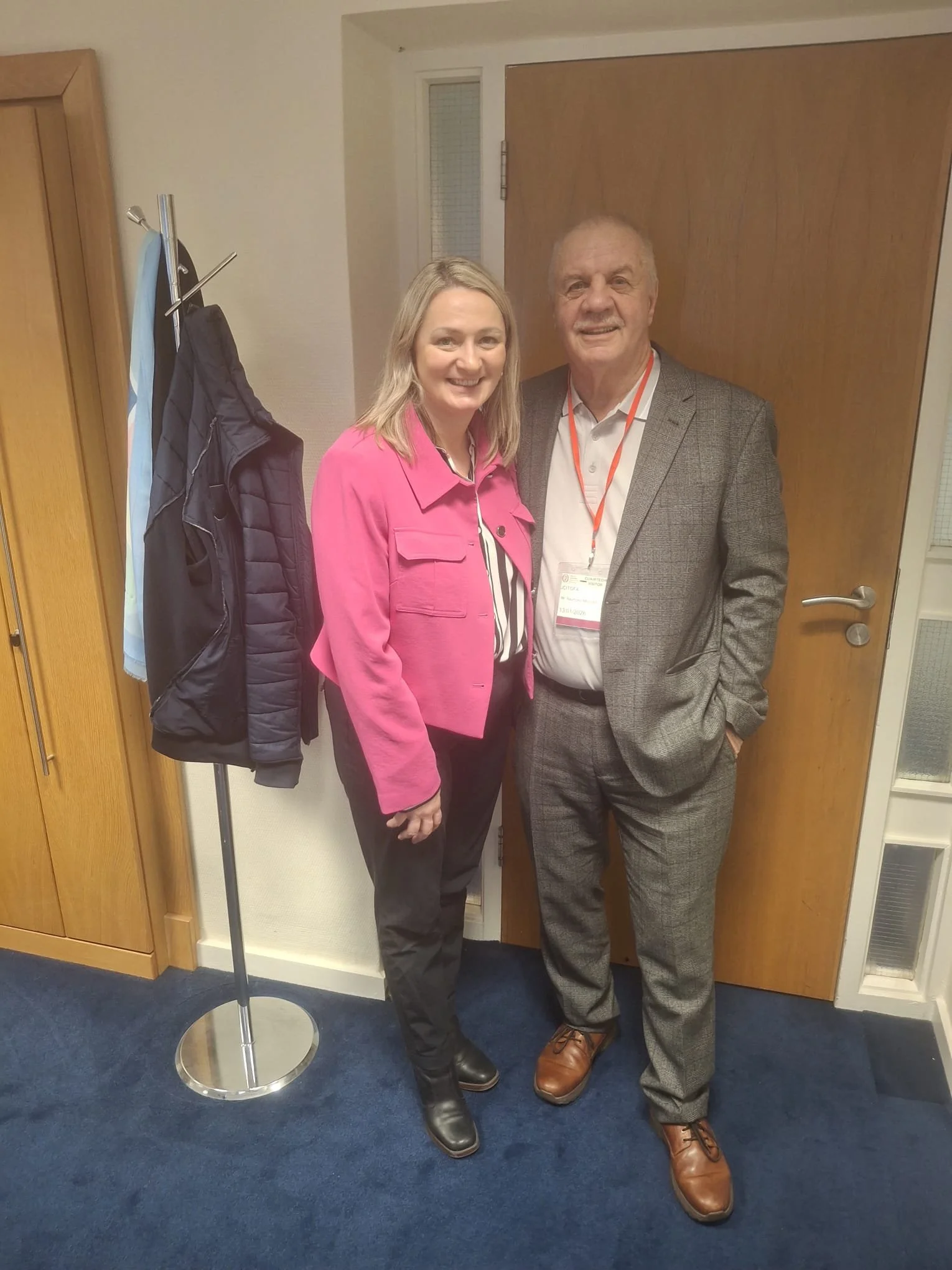
Raymond McCord with Emer Currie TD (Fine Gael) during his visit to Leinster House yesterday to give evidence to the Oireachtas Committee on the Implementation of the Good Friday Agreement
The Good Friday Agreement breakdown.
Raymond McCord
Its failed victims
Its failed both communities. Its failed truth and justice.
It makes a mockery of a way forward for victims. It has benefitted murderers and thugs.
It ignored victims. It promoted sectarianism. It protects agents of the state.
The perpetrators benefitted. It never mentioned pardon or on the run letters.
It doesn't know or explain what reconciliation means. It brought a de facto amnesty for the murderers of my son and many, many other victims.
It has fabricated a false form of government.
It has produced a shambolic form of government.
It has increased division. It was done without consultation with victims.
It was discriminatory of victims. It brought nothing of dealing with the past.
It brought the release of serial murderers.
It brought nothing for my family except more pain.
It never removed sectarianism from Stormont. It doesn't give our young people hope.
Simply. It has failed the people and victims families, but benefitted two parties.
It has failed my son Raymond Jr.
Nominations close today in race to replace Mike Nesbitt as UUP leader
By David Thompson, Belfast News Letter, January 15th, 2026
Nominations close today for those hoping to be the next leader of the Ulster Unionist Party – with Jon Burrows clear favourite to take over from Mike Nesbitt.
At the time of going to print on Wednesday, there was still no indication about whether Robbie Butler would throw his hat in the ring and spark a full contest.
The current deputy leader announced he was considering running for the position last year, but with just hours to go until nominations closed he was remaining tight-lipped about his intentions.
Candidates need to secure 35 signatures from 9 of the Ulster Unionist Party’s constituency associations across Northern Ireland, which must be submitted by 5pm today (Thursday).
In a post on his X social media account at the weekend, Mr Butler said he was back on the “engagement trail” – adding “Not new. Not sudden. Just consistent”.
Jon Burrows launched his bid for the leadership last Thursday, saying that Northern Ireland needs “fresh thinking and strong leadership” to break through the “malaise” at Stormont.
Appearing alongside running mate Diana Armstrong, he said the pair want “straight talking” and to see the party leading politics here once more.
At the weekend, he signalled his intent to shift party policy more in line with its membership – telling the News Letter that the UUP should “go further and be clearer” on changing climate legislation.
The issue had caused friction within the party in recent years, but last October Mr Butler acknowledged that the 2030 target appears unrealistic – and said “revision should be considered”.
However, Mr Burrows backed a much more radical rethink – saying that “simply pushing an unrealistic target further down the road would not be a wise approach”.
There have been rumblings from within the party’s Stormont representatives – who largely back Robbie Butler – about what a Burrows leadership would entail, and briefings to journalists that there could be splits among the MLA team over the direction of the party. However, senior party sources have dismissed these concerns, saying there is little between the pair on major policy areas.
Update January 16th, 2026: I would like to acknowledge the work and support for the victims and their families of the Troubles by Senator Mark Daly and Emer Currie TD. Two Dublin based politicians who engage with and support victims more than our politicians here in Northern Ireland. My meeting in Dublin took place because of Cormac Devlin and support from Mark Daly . They like Emer Currie don't just talk they follow up with action, something our Belfast and Westminster based politicians with the exception of Jim Shannon fail to do. They listen to what we want for truth and justice and actually do something about it.
Loyalty to victims is not a burden to them. Broken promises from our politicians are nothing new. I call upon all politicians from Northern Ireland to make it clear at both Stormont and Westminister to make it clear to Hilary Benn that if victims don't support Labour's Legacy Bill then neither will they. They are there to support the victims instead of supporting a Bill rejected by those who suffered the most: THE VICTIMS AND THEIR FAMILIES.
The silence from them is deafening except for Gavin Robinson wanting protection for veterans. The law does not have an age limit for prosecutions of those being investigated or charged with murders. Selective prosecutions and investigations by the state and politicians. Tell that to the victims families face to face. That's what a two tier justice system also brings to the table.
Raymond McCord Victims campaigner, North Belfast