Coronation for Burrows, but not all UUP members will play role of dutiful courtiers
SUZANNE BREEN, Belfast Telegraph, January 16th, 2026
FORMER POLICE OFFICER NEEDS TO BE CAREFUL ABOUT PULLING RANK WITH DISILLUSIONED PARTY COLLEAGUES
Nobody in Northern Ireland politics has enjoyed as rapid a rise as Jon Burrows. The newest addition to the UUP's Assembly ranks is about to lead the party he's been representing for just six months.
But trouble is brewing at Stormont. Burrows is not set to receive a flurry of warm, congratulatory texts from all his party colleagues on those blue benches.
Diana Armstrong backed his leadership bid, but support wasn't forthcoming from a single other UUP MLA. Outgoing leader Mike Nesbitt remained neutral.
When Edwin Poots became DUP leader five years ago, Sir Jeffrey Donaldson's supporters set out to topple him. Their efforts — combined with his own poor decision-making — succeeded.
Poots was forced out after just three weeks in the job. Burrows has so far shown himself to be a considerably shrewder political operator than Poots, and his internal opponents likely lack both the finesse and ruthlessness of the Donaldson camp.
Robbie Butler
But a clear shot across the bow was fired on Thursday by Robbie Butler. Announcing he wasn't standing for the leadership, the Lagan Valley MLA notably didn't stress the need for party unity or pledge his support for Burrows.
Quite the contrary. He said that he remained “loyal to the cause of modern, positive unionism with a social conscience”. He would seek to “understand the direction and focus” of the new leadership team but it would be “country first, party second”.
Those Friday Zoom calls involving MLAs — ahead of the next week's business at Stormont — and the Monday morning meetings in Parliament Buildings of the Assembly team, will be frosty to say the least.
There are fears that Burrows will attempt to micro-manage his colleagues. On the Stormont Sources podcast, he spoke of laying down “red lines” in health with Mike Nesbitt, and going through the budget “line by line” with the party's finance spokesperson Steve Aiken.
Some MLAs were alarmed at that, and angered when Burrows said they'd have to “get on with it and get over it” if he became leader as they were “paid by the public purse”.
‘Still thinks his in Police’
One said: “Jon seems to think he is still in the police. He is in politics now, and it's a very different business.”
So will MLAs follow Burrow's instructions? A former head of discipline in the PSNI, he may need to avail of the skills he developed in that job.
In the first instance, he is likely to ignore Butler's swipe and his colleagues' chilliness. He will sit down with them, and ask them to set aside their biases and give his leadership a chance: to judge it by results.
When Burrows was co-opted into the North Antrim seat, there was resistance from some in the local association who saw him as a celebrity politician.
He appointed the man he succeeded as MLA — Colin Crawford — as his constituency manager, a key move which won over many local sceptics and has helped him hugely internally.
In the first instance, Burrows will take a similar conciliatory, consensus-building approach as leader. He is likely to be undeterred by dissenting MLAs. He has strong support among grassroots members and councillors.
UUP grandees — along with the party officers — are firmly behind him. There will be anger and resentment at any mischief-making MLAs.
Many are seen as being disconnected from their local associations. It will be pointed out that they had every opportunity to run against Burrows if they didn't like him, but none chose to do so because he would have beaten them.
Some predict that any opposition will be as short-lived as snow on a ditch. Those against Burrows are all at different stages of their political careers. Some want just another term at Stormont, others have greater ambitions.
Burrows seems to have connected with unionist grassroots in his short time in politics. He needs to translate that into support in the polls.
A 'Burrows bounce' in LucidTalk's Spring poll for the Belfast Telegraph in three months' time would put him in a strong position vis-à-vis internal opponents.
In the meantime, what changes will the incoming UUP leader make at Stormont? He hasn't ruled out taking the party into Opposition, but it's hard to see him doing so before the next Assembly election.
If he pulled his party out of the Executive, he could cop the blame for destabilising power-sharing.
Nesbitt wants to stay in Health
Mike Nesbitt has said he wants to stay on as Health Minister, and Burrows is surely set to let him. To remove Nesbitt — who brought him into the party — would smack of disloyalty.
Nobody else in the UUP Assembly team has ministerial experience. Health is arguably the most important Executive portfolio. Nesbitt shadowed Robin Swann for three months before becoming minister. For Burrows to put a newbie in would be a high-risk move.
Burrows' ascendancy has cost Robbie Butler dearly. Not only must he watch a newcomer become leader of a party which he has served for over a decade, but he loses his deputy leader position as well.
Butler is currently the UUP's chief whip. He is expected to resign that position. Given his statement of intent regarding monitoring the new leadership team, it's inconceivable that he would be whipping his Stormont colleagues in line behind Burrows.
If no other MLA is willing to take the position, it will likely fall to Diana Armstrong. The decision not to run for the leadership seems to be a weight off Butler's shoulders. He appears to be lightly mocking his incoming party leader on social media.
Butler is currently chair of Stormont's agriculture committee. He has been criticised by some rural UUP members for being too soft on Alliance minister Andrew Muir. It remains to be seen whether Burrows keeps him in the job or moves him later this year, perhaps in a summer reshuffle.
Of the UUP's nine Stormont representatives, Butler and John Stewart are in the strongest electoral positions in their constituencies. Butler will be Lagan Valley MLA for as long as he wants to.
He previously sought to leave politics — unsuccessfully applying for the job of Children's Commissioner. If Burrows cements his position as leader after the next Assembly election, Butler may be tempted to see his future as outside of Stormont.
There are different stakes at play for John Stewart. He almost doubled the UUP vote in East Antrim in the 2024 Westminster election, coming within 2,000 votes of the DUP's Sammy Wilson.
Next MP for East Antrim?
With Wilson unlikely to run again, Stewart stands a strong chance of becoming the constituency's next MP. In any pact discussions within unionism , East Antrim could be the constituency where the UUP asks the DUP to stand aside in return for Gavin Robinson's party doing the same elsewhere.
And if Jim Allister doesn't run for Westminster again, Burrows may fancy his own chances in North Antrim.
The incoming UUP leader will be keen to secure company for Robin Swann at Westminster because having two MPs results in significantly greater party funding.
There could be turbulence when the UUP selects its candidates over the summer for next year's Assembly election. The Stormont team had been pushing for this to happen much earlier but have met resistance.
A question mark hangs over Doug Beattie in Upper Bann. Some in the local association are keen to deselect him and run Councillor Kyle Savage. A compromise could be to run both men, but that could endanger the party's sole seat.
East Belfast MLA Andy Allen could also face challengers for the nomination. Mike Nesbitt is retiring, and Councillor Richard Smart was regarded as his favoured successor in Strangford. However, the change of leadership alters the odds of that happening.
In North Down, Alan Chambers may also retire. The Strangford and North Down constituencies represent a chance to bring in the new talent that Burrows has said the party desperately needs.
Expect Ards and North Down councillor Pete Wray, and Antrim and Newtownabbey Mayor Leah Kirkpatrick, to play a big role in the party moving forward.
Former UUP chairwoman Jill Macauley is surely set for a return to a prominent position - likely behind-the-scenes initially - as well.
Overtaking DUP
Burrows has spoken of his desire for the UUP to overtake the DUP to become the biggest party in unionism. Trust in the DUP has dwindled over the years, and Sir Jeffrey Donaldson's trial on historical sex offences won't help the party.
However, the size and strength of the DUP Assembly team mean the incoming UUP leader's objective is unlikely to be met in the next Stormont election.
The UUP secured an 11% vote in 2022. A rise to 15% — along with an extra seat or two — would surely be a more realistic target for 2027 than outpolling the DUP.
Energy and drive don't reside naturally in the UUP, and it needs both in abundance if it's to become competitive once again. Expect Burrows to take the party by the scruff of the neck, and attempt to breathe new life into it.
It's unlikely that he will be personally bothered if MLAs cold shoulder him over coming weeks and months. Diana Armstrong may care more if she receives the same treatment.
Burrows' opponents haven't been able to thwart his rise thus far. They still have cards to play.
But he's come so far so fast and, despite the internal challenges ahead, he cannot be under-estimated.
Can UUP’s ‘enthusiastic, articulate’ new leader halt decline?
Irish Times, Freya McClements, Irish Times, January 16th, 2026
Yet again, the selection of the next leader of the Ulster Unionist Party (UUP) was not a contest, but a coronation.
As the sole candidate to put his name forward by the close of nominations on Thursday afternoon, Jon Burrows, the former senior police officer who was selected as an Assembly member (MLA) for North Antrim only months ago, will be the next leader of the UUP.
He will take up the position following his ratification at an extraordinary general meeting of the party on January 31st, with the outgoing leader, Mike Nesbitt – Northern Ireland’s Minister of Health – continuing in the role until then.
Five changes of UUP leader in 14 years
Burrows becomes the fifth person to lead the party since 2012, the last time the leadership was contested, following in the footsteps of Nesbitt, Robin Swann, Steve Aiken, Doug Beattie and, most recently, Nesbitt again.
It is a remarkable rise to the top for the ambitious former senior police officer who was co-opted as an MLA in August, and indeed only became a party member shortly before.
For Brian Kingston, a Ballymena councillor and chairman of the party association in North Antrim who was on the panel which chose Burrows as the constituency’s MLA, the incoming party leader stood out.
Good orator
“As he has proved on the floor of the Assembly, he’s a good orator, he could put across a point very succinctly.
“We have a very articulate person coming in as leader now, and probably in all of unionism we haven’t had somebody like Jon for some time,” he says.
A former senior police officer originally from Bangor, Co Down – though he lived for a number of years in Ballymoney, in the North Antrim constituency – Burrows spent 22 years in the Police Service of Northern Ireland (PSNI).
His roles included area commander in Derry and head of the PSNI’s discipline branch; since leaving policing in 2021 he has become a regular commentator on policing and justice issues in the Northern media.
Announcing his candidacy last week, Burrows described himself as an “unapologetic unionist” and promised to “arrest stagnation” within the once-dominant UUP.
This is the same challenge that long list of predecessors have faced, and failed. How to arrest that slow decline that has taken the Ulster Unionists from the largest party in Northern Ireland at the time of the Belfast Agreement in 1998 to fourth place, with 11 per cent of the vote and nine MLAs?
“He talks a very good talk. He’s bouncy, he’s enthusiastic, he’s articulate,” says Alex Kane, journalist and former UUP head of communications. “He’s somebody who, if he was working the room in some Ulster Unionist meetings – which he has been – he would make them feel better, he would make them feel a win is possible, there’s a comeback from the present doldrums.
“I think if he has a game plan and he was committed to it and could bring enough people with him, the sheer power of his almost Tiggerish quality, that might be enough to make a difference.”
Burrows’ speech on assuming the leadership will be a key moment, his opportunity to demonstrate that he has such a plan and whether, as a largely unknown quantity and an unelected leader, he can command the support necessary to turn the UUP’s fortunes around.
“The party is like an ailing football club which is constantly changing managers,” says writer and former BBC Northern Ireland political correspondent Stephen Walker. “You are judged by results, and any new leader has to reverse the electoral fortunes of the UUP very quickly.
The new leader needs a clear vision and fresh thinking but above all needs to define exactly what the party stands for and how it is relevant to modern-day Northern Ireland.
“Another series of poor election results will simply exacerbate calls for the party to merge with the DUP.”
With the next Assembly election due in May 2027, the new UUP leader has some time, but not much.
Man accused of menacing message to Bloody Sunday family
ALAN ERWIN, Irish News, January 16th, 2026
A BELFAST man appeared in court yesterday accused of sending a menacing message directed at the family of a Bloody Sunday victim.
Dean Portis (41) is facing prosecution over a social media posting seen by the brothers of William McKinney, one of the victims shot dead by the British Army in Derry.
Portis, of Olive Street in the city, has been charged with two counts of improper use of a public communications network to send a message of a menacing character.
He allegedly committed the offences on September 18 and October 22 last year during the high profile Soldier F trial.
The former member of the Parachute Regiment was accused but ultimately found not guilty of murdering 26-year-old William McKinney on Bloody Sunday.
Mr McKinney was among 13 people shot dead when troops opened fire on civil rights demonstrators in Derry’s Bogside on January 30, 1972.
Police were alerted to a Facebook posting allegedly attributed to Portis, who also uses the name Dean Martin, early on in Soldier F’s trial.
‘Yous have been warned’
Above a newspaper report and photograph of Mr McKinney’s three brothers, Joe, Mickey and John, attending the hearing in Belfast a message stated: “If yous continued to target the British Armed Forces including the PSNI the consequences will be swift and deadly.”
The posting added: “Yous have been warned.”
Appearing at Belfast Magistrates’ Court yesterday, Portis confirmed he understood the charges against him.
An investigating police officer connected him to the alleged offences but provided no further details about the case.
District Judge Anne Marshall adjourned proceedings and released Portis on continuing bail until February 26.
Roma family to move from Shankill after attack by UDA thugs
ABDULLAH SABRI, Belfast Telegraph, January 16th, 2026
ANGUISH AS SCOOTER THROWN THROUGH FRONT WINDOW DAYS AFTER CHRISTMAS
The teenage daughter of a Roma family whose home was attacked by paramilitary thugs just days after Christmas has refused to return to school out of fear for her safety.
The attack in the Shankill Road area saw a scooter thrown through the front window of their house by a pair of men.
Those who carried out the attack were members of the UDA, but the attack was not sanctioned by the organisation, a loyalist source told the Belfast Telegraph.
Inside the home, a barricade of household items has now been placed against the wall adjacent to the window as a precautionary measure.
The family of three, who wish to remain anonymous, say they are living in fear after what was the latest of many attacks since race riots erupted across Northern Ireland in 2024.
The father of the household said this most recent attack has forced them to look for somewhere else to live.
“Every day something happens, banging on the door - all the time. We want to go away from here,” he told this newspaper.
Aged in his 50s, he said he saw two young men throw the scooter through the front window and quickly flee before he called the police.
Criminal damage
A PSNI spokesman said: “Police in north Belfast received a report of criminal damage at a house in the Ainsworth Drive area on Monday, 29th December.
“It was reported shortly before 11pm that the front living-room window of the house had been smashed by two males.
“The males, who were both wearing grey track suits, then made off from the scene on foot.”
It's understood the attack was motivated by unfounded allegations levelled against family members, which the strenuously deny.
The area is home to several other foreign nationals, some of whom have experienced similar abuse.
The father said their windows were also put through in the summer of 2024.
“In other streets it's the same - locals [hitting] the windows. I don't know why they do that,” he added.
“I don't know what we can do about this - it's nothing new.”
His daughter has subsequently stayed away from her school since the incident, out of concern for her own wellbeing.
Meanwhile, the mental health issues of the 15-year-old's mum have been “worsened” by the recent events.
A long-time resident of the area, who also requested anonymity, said: “I do think they get the blame for a lot and it's nothing to do with them.
“But they get the blame for everything obviously, because they're not from the area which I think is a wee bit tough.”
DUP Minister sought meeting over asylum seekers’ impact on housing market
CONOR COYLE, Irish News, January 16th, 2026
DUP Communities Minister Gordon Lyons held a meeting with a Home Office contractor which organises accommodation for asylum seekers to “express concerns” about its impact on the local housing market.
The minister responsible for housing met with representatives from Mears Group at his request in September of last year in order to raise his concerns on the “potential impact” of the contracts.
Migrants arriving to the UK seeking asylum are placed into accommodation by the Home Office, with the majority placed in Houses of Multiple Occupation (HMOs), while others are placed in temporary accommodation and hotels.
Mears has the contract to house asylum seekers in the north worth an expected £400 million over 10 years.
In response to an Assembly Question from fellow DUP MLA Jonathan Buckley asking whether his department has made an assessment of the potential impact of asylum accommodation contracts on the private rented housing market, Mr Lyons admitted that no formal assessment had been done, but that he had raised concerns with Mears in any case during a meeting last year.
“In September, I met with the Regional Head of Operations and Chief Strategy Officer of Mears,” the minister said.
“During that meeting I expressed my concerns regarding the impacts their contracts are having on the local housing market.
“My Department has not undertaken a formal assessment, however all available evidence indicates that the private rented sector is already under significant pressure, therefore any additional demand will further exacerbate existing supply challenges.”
Requested meeting with contractor
The Department for Communities confirmed that the minister had requested the meeting with the contractor “to understand how Mears operated locally, particularly the scale of operations”.
Communities Minister Gordon Lyons has expressed concerns that the housing of asylum seekers is having an impact on the local property market
When asked by The Irish News to provide evidence of the impact of asylum seeker accommodation on the local housing market, a spokesperson said: “The Department is aware of the significant demand for social housing and private rented accommodation and recognises any additional demand will further exacerbate existing supply challenges.”
Overall, the number of asylum seekers has dropped from 3,220 in September 2023 to 2,535 in June 2025. Proportionally, the north has among the smallest number among the regions of the UK.
The Home Office has said the expected cost of housing asylum seekers in Northern Ireland has quadrupled to £400m.
A report from the UK’s National Audit Office released the figures in a review of asylum accommodation contracts across the UK.
Accommodation for asylum seekers is funded directly by the Home Office, which has a legal duty to support people as they assess their claim for asylum.
Man arrested after volley of shots at dissident show of strength
GARRETT HARGAN, Belfast Telegraph, January 16th, 2026
DERRY COUNCILLORS SLAM 'DISGRACEFUL' SCENES FROM MEN 'WHO OFFER NOTHING'
A man has been arrested after reports of a masked republican gunman firing shots in Londonderry.
Councillors from the city have condemned the scenes as “disgraceful”.
Images show three armed men wearing black clothing displaying the flag of Óglaigh na hÉireann.
A video shows one man kneeling down before firing a volley of shots into the air.
Police said they are investigating a report that gunshots were fired in the Tullymore Road area of Derry.
As a line of enquiry into the report made shortly before midnight on last Sunday, detectives from the PSNI's Serious Crime Branch made an arrest and seized a vehicle on Tuesday.
“A 31-year-old man was arrested following a search of a property in the Claudy area and subsequently released on bail to allow for further police enquiries to be conducted,” the PSNI said.
“Police continue to conduct reassurance patrols of the area and, as part of the police investigation, enquiries also include vehicle check points, house-to-house enquiries and checking CCTV.
“Today, separately, Thursday January 15, police received a report of a video circulating of shots being fired, and are making enquiries in relation to this to establish if it is linked to the report made on Sunday January 11.”
SDLP Waterside councillor Sean Mooney criticised the incident which he said happened in the Currynierin area.
Mr Mooney said: “These were disgraceful scenes that have no place in our communities.
‘Hark back to our dark past’
“They hark back to our dark past and the people of the Currynierin area do not want to see this kind of incident on their doorsteps.
“Footage of masked gunmen firing shots has understandably caused fear and concern across the area and the wider city. Those involved have nothing to offer our community and will not be allowed to intimidate people who are simply trying to get on with their lives.
“The presence of a firearm is deeply worrying and it is vital it is taken off our streets before anyone is seriously hurt.
“I would urge anyone with information to come forward to the police so those responsible can be held accountable.”
Local Sinn Fen councillor Christopher Jackson said the armed men “are criminals masquerading as republicans”.
He added: “They have nothing to offer the people of this area but fear and intimidation and should get off the backs of the local community.
“I have been inundated with concerns from local residents. These people in no way reflect them or their estate.
“What is even more frustrating is the fact that the council is on the verge of securing significant new investment in Currynierin to improve the lives of the people who live there.
“We won't allow those with a destructive agenda to derail that work but it also underlines the stark contrast between those who want Currynierin to thrive and those who want to drag it back to the past.”
Police urged anyone with information or relevant footage to call them on 101.
Dropping 50:50 recruitment decision must be reviewed
Pro Fide et Patria, Irish News, January 16th, 2026
THE decline in the Catholic membership of the Police Service of Northern Ireland has been an issue of major concern for some time, and alarm about the disturbing pattern can only grow in the coming years.
There will be considerable sympathy for Chief Constable Jon Boutcher, who has acknowledged the “critical importance” of ensuring that the PSNI is fully representative of the community it serves since his appointment to the post in October 2023.
However, on the basis of the evidence he gave to the Northern Ireland Affairs Committee at Westminster earlier this week, it appears that his options in this regard are sharply limited.
“In a society which is essentially evenly divided in religious terms, it cannot be appropriate that less than one third of PSNI members are Catholics
Mr Boutcher pointed out that the PSNI is currently recruiting, and said: “I am desperate for this society to move forward all communities, not just the two traditional communities, all communities.”
He said: “To help society move forward, to help me get Catholic officers into the PSNI, we need to start making some difficult choices. And each secretary of state that I’ve dealt with, and I’ve dealt with a number, now get the same advice. Please listen to other people who have some considerable experience and understanding and more accountability in policing.”
It will be widely concluded that Mr Boucher was implicitly expressing his frustration on a number of fronts, although there will be surprise that one of his specific suggestions was more Catholics could join the PSNI if the British government publicly confirmed the identity of the state agent in the IRA known as Stakeknife.
While there can be no doubt that the decision of the authorities not to formally declare that Stakeknife was the west Belfast man Freddie Scappaticci has been damaging in many ways, the debate has become more than a little academic.
The main details about Scappaticci, who died in 2023 at the age of 77, and his appalling activities have been in the public domain for more than two decades, and it is difficult to believe that officially naming him will make much difference at this stage.
In a society which is essentially evenly divided in religious terms, with Catholics now marginally outnumbering Protestants, it cannot be appropriate that less than one third of PSNI members are Catholics, with firm indications that the figure could drop below 23% within the next decade.
The political intervention which dropped the highly successful 50/50 recruitment policy in 2011 was disastrous in every respect, and needs to be reviewed with the utmost urgency if the enormous progress made since the launch of the PSNI almost a quarter of a century ago is not to be seriously undermined.
Call to honour NI man who printed US Declaration of Independence
GARRETT HARGAN, Belfast Telegraph, January 16th, 2026
STATUE OF STRABANE NATIVE DUNLAP 'CAN BE A FITTING TRIBUTE'
There have been calls for a permanent public statue of John Dunlap — the Strabane-born printer of the Declaration of Independence — as the US celebrates its 250th anniversary this year.
John Dunlap began his working life as an apprentice at Gray's Printing Office before emigrating to Philadelphia, where in 1776 he printed the first copies of the declaration — the founding document of the United States and one of the most influential in world history.
On July 2, 1776, the Continental Congress voted to declare independence from Britain.
The Declaration of Independence explaining the reasons for the separation was approved on July 4 — and is celebrated in the US as Independence Day.
Despite this extraordinary connection, Dunlap's legacy remains largely unrecognised in his home town.
West Tyrone MLA Daniel McCrossan has urged the Communities Minister, Gordon Lyons, and Derry City and Strabane District Council to work together to erect a statue of Dunlap. He said a prominent town centre location, ideally close to Gray's Printers, would underline Dunlap's early connection to the town.
Role in Global history
Mr McCrossan said: “John Dunlap was born in Strabane and played a direct role in one of the most important moments in global history. The fact this is not properly marked in his home town is a glaring omission that must be put right.
“The Declaration of Independence did not just shape the United States, it helped shape the modern world. Strabane has a rightful claim to that story.
“As the United States prepares to mark 250 years of independence, there is no better moment for Strabane to step forward and recognise one of its own who helped give that historic moment a voice.
“This is about more than a statue. It is about recognising Strabane's contribution to democracy, freedom of expression and the written word. It is about telling our story properly, at home and on the international stage.
“Gray's Printing Office is where Dunlap learned his trade. A statue in that setting would provide a tangible link.
“There are cultural and heritage funding streams available, and this meets every test of historical importance.
“What is needed now is political will. Strabane has every reason to be proud of John Dunlap. It is time we said so, clearly and permanently.”
‘Radio silence’ from Stormont on Irish language strategy, court told
Irish News, January 16th, 2026
THE Stormont administration should face a judicial order to end its continued failure to deliver an Irish language strategy, the High Court has heard.
Counsel for a campaign group argued that the Executive Committee must be compelled to implement the long-awaited blueprint.
Conradh na Gaeilge also claimed responsibility for the ongoing delay now lies with Communities Minister Gordon Lyons.
A judge was told there was “radio silence” for months after an action plan had been submitted to him.
Conradh na Gaeilge has been involved in a long-running legal battle over pledges to progress an initiative for the Irish language which dates back to the 2006 St Andrews Agreement.
The High Court has already ruled previously, in 2017 and again in 2022, that the power-sharing government is in breach of an obligation to adopt a blueprint.
The continued failure contravenes the 1998 Northern Ireland Act, successive judges held.
Amid an ongoing alleged violation of the legal duty, the language campaigners issued fresh judicial review proceedings against both the power-sharing cabinet and the communities minister.
No defence
In court yesterday, it was claimed that the Executive Committee has mounted no defence to the challenge against it.
Karen Quinlivan KC, for Conradh na Gaeilge, said: “There is no evidential explanation or justification for their failure.
“The court can only conclude that they continue to be in breach of their statutory duty… and the only proper remedy is a mandatory order.”
She contended that Mr Lyons, as minister with responsibility for putting a strategy in place, has also “manifestly failed in his obligation” to take action.
Mr Justice McAlinden was taken through a chronology of events since the setting up of a working group to devise an action plan for approval by the Department.
According to Conradh na Gaeilge’s case, the paper was received by the minister in May 2024 but not brought to the executive until 12 months later.
“There was radio silence (during this period)… just nothing,” Ms Quinlivan alleged.
Others were said to have become agitated and exasperated at the alleged lack of progress and “ever expanding timescale”.
“The minister sat on the first paper for essentially the best part of a year,” the barrister submitted. “The minister lies at the heart of that delay.”
Urging the judge to compel the Stormont government to deliver on an Irish language strategy, she added: “The court can’t be allowed to be a forum for mild wrist slapping.
“The Executive Committee is happily bumbling along with no sense of urgency despite two judgments against them.”
The case continues.
Falling schools numbers points to 'empty desks' issue in years ahead
MARK BAIN, Belfast Telegraph, January 16th, 2026
PUPIL DECLINE MOST MARKED IN PRIMARY SECTOR AS 20 CLOSE IN PAST FIVE YEARS
The number of schools operating in Northern Ireland is continuing to fall, official figures show.
Pupil numbers are also still declining, particularly in primary schools.
An education expert has warned that “empty desks”, particularly in rural schools, will be an increasing issue in the years ahead.
Dr Matt Milliken said “new thinking” will be needed if some schools are to survive.
Department of Education figures show there are currently 164,717 pupils in primary schools and preparatory departments (years 1-7) — that figure has decreased from the previous year, by over 2,800 pupils.
In total 156,763 pupils are enrolled in post-primary schools, a decrease of nearly 130 pupils from last year. The number had been increasing steadily for a decade, but the rise had slowed considerably in the last three years and has now registered the first decrease since 2015/16.
Pupil numbers in post-primary schools had hit a low of 140,413 in 2016/17 before rising, until this year.
Approximately 90,300 pupils in all schools — including voluntary and private pre-schools - are entitled to free school meals, accounting for a quarter of all pupils here (25.7%).
The biggest fall in the number of schools has been in the primary sector, with 20 fewer primaries operating now than five years ago.
The number of primary school age pupils reached a high of 174,523 in the 2018/19 academic year, but has plummeted by almost 10,000 to its current level of 164.717.
The controlled primary sector now operates with two fewer schools than the Catholic maintained sector. Five years ago both sectors had 355. The number of controlled primaries now stands at 343, with 345 Catholic maintained schools.
Across the same five year period, the only growth has been in the controlled integrated primary sector, with the number of schools up from 24 to 27. Enrolments have decreased again in non-grammar schools, by over 250 pupils.
Meanwhile, enrolments in grammar schools have increased again, by 130 pupils.
The number of pupils enrolled in sixth form has reached 29,959, meaning 410 more pupils have continued in school education than last year.
But the overall decrease is impacted by the number of pupils enrolled in years 8-12, now 530 fewer pupils than last year. This aligns with the number of 11-15-year-olds in Northern Ireland in NISRA's population projections.
There are now two fewer post-primary schools compared to five years ago (190, from 192), with the number of grammar schools consistent at 66.
Three post-primaries have closed — two in the Catholic maintained sector and one in the controlled sector, as well as one more controlled integrated post-primary, meaning six in total.
The biggest rise in any school sector has been in special educational needs.
Rising need for special education
A decade ago (2015/16) there were 5,173 pupils in special education schools here. That number has been increasing year on year, and now stands at 7,729.
In total, Northern Ireland has 345,524 pupils enrolled in school, rising to 351,894 with pre-school education centres.
The overall percentage of free school, meals pupils has fallen in the last five years from 28% to 26%, but there remains a marked difference between post-primary sectors. Pupils in non-grammar schools are almost three times more likely to qualify for free school meals (32%) than those in grammars (11%). The percentage of free meal pupils is highest in special education schools (55%).
Dr Milliken is a lead researcher on Ulster University's Transforming Education series of reports.
He said the number of pupils and schools is likely to continue to drop.
“Trends indicate that the decline in school populations observed in 2025-26 is likely to continue for some years to come in parallel with an increase in the number of pupils with additional educational needs,” he explained.
“This will, in association with the financial limitations being passed down from Stormont, place increasing demands on those charged with balancing the education budget for individual schools and indeed for the whole of education in Northern Ireland.” The age profile of the rural population is of particular concern, Dr Milliken added.
“It is likely that empty desks will prove to be a challenge to the sustainability of small schools, many of which lie at the heart of communities,” he continued.
“In such a scenario, duplication of provision must be seen as a costly luxury in our deeply divided system.
“If schools are to survive, new thinking will be needed.
“The recent report by the Independent Review of Education proposed the creation of cross-sectoral, jointly managed community schools. Such an initiative could perhaps provide for the development of innovative local solutions to address both falling pupil numbers and the excessive costs associated with segregated schooling.”
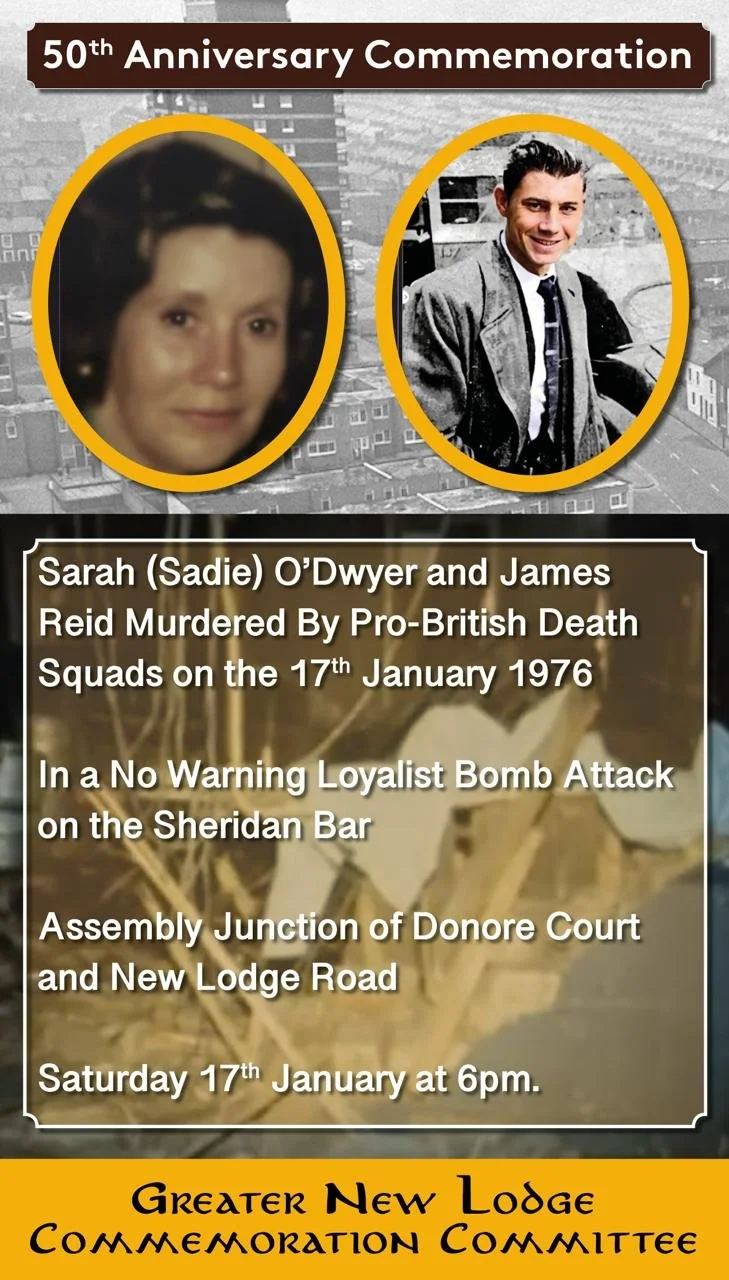
Families prepare to mark 50th anniversary of Sheridan Bar atrocity
Conor McParland, Belfast Media, January 16th, 2026
THE families of two people killed in an attack on a New Lodge bar 50 years ago say the events surrounding the atrocity "feels like yesterday".
Sarah (Sadie) O'Dwyer and James Reid died when a no-warning bomb was thrown into the Sheridan Bar by the UVF on January 17, 1976.
Sadie (46) was married with five children and was from Hillman Street. James (43) was married with ten children and was from Upper Meadow Street.
This Saturday, a commemoration will be held in the New Lodge to mark the 50th anniversary of the atrocity. It will take place at the junction of Donore Court and New Lodge Road at 6pm.
Ahead of the anniversary, James' son, Seamus Reid, and Sadie's daughter, Pat O’Dwyer, spoke with the North Belfast News to recall the tragic events of 50 years ago.
"I remember that Saturday evening. There was ten of us and most of us were in the house eating fish and chips. I was only nine years-old at the time," explained Seamus.
"The next thing we heard the explosion. I remember my mum saying how close it was.
"There was so much activity and commotion outside. I knew there was something wrong.
"I didn’t know my dad was in the bar that night. It wasn’t until the next day we found out he was killed.
"It was hard to take it all in. There was my dad lying in the coffin. It was devastating for the whole family.
"It doesn’t feel like 50 years ago. It is all so raw and fresh still in my head. We will never get justice at this stage."
Pat O’Dwyer recalled that her mummy was working that Saturday. "She worked in a launderette on the New Lodge Road," she said.
"She finished at 5.30pm and would have gone up to the Sheridan Bar to meet her friends.
"Our dog used to sit outside waiting for her to finish work.
"I was 19-years-old at the time and I was in the house and heard the explosion. The next thing people started to come into the house, some were people I didn’t even know. It was chaotic.
"At about 8pm, my uncle took me round to the Sheridan Bar to look for my mummy. Through the smoke and rubble I saw the dog Shane digging through the rubble. I know now that he obviously smelt her scent.
"I went back home and was crying and stuff. It wasn’t until later on we got the news.
"I got her purse. That was all that was left of her. She was sitting in the snug which got the full impact of the bomb.
"It is hard to believe it was 50 years. Some days it seems like yesterday."
Test of new UUP leader Jon Burrows will be stance on Northern Ireland Protocol: TUV
By Iain Gray, Belfast News Letter, January 16th, 2026
One of the UUP’s big political rivals has wished its leader-in-waiting well – though reinforced that the big test will be opposing the Northern Ireland Protocol and sea border.
The TUV’s comments came as MLA Jon Burrows was announced as running unopposed for the top seat in the Ulster Unionist Party, marking the fifth time in a row leadership of the UUP has changed with an effective coronation instead of a contest.
Mr Burrows is to take the reins of the party at the end of this month, but speaking this evening a TUV spokesman said his succession “comes at a moment of profound consequence for unionism”.
“Northern Ireland remains subject to the protocol which continues to place EU law over large swathes of our economy and undermines Northern Ireland’s place within the United Kingdom,” said the spokesman.
“Unionism does not need cosmetic adjustments. It needs clarity, courage and an unambiguous commitment to oppose arrangements that separate Northern Ireland from the rest of the UK. The central test of any unionist leader is whether they are prepared to confront that reality honestly and act accordingly.
“If there is to be any rebuilding of unionist confidence, it will only come through firm opposition to the structures that erode our constitutional position.
“We wish Mr Burrows well personally – but unionism will be judged not by changes of leadership, but by whether its representatives are prepared to stand against the protocol in principle and in practice.”
At the party’s conference in autumn last year, Mr Burrows – then just weeks into his political career, having been appointed as MLA over the summer – said Stormont’s collapse would be a risk to the Union, adding the Ulster Unionist Party is the “greatest bulwark against a united Ireland” due to its unwavering support for the institutions.
He went on to describe proposals to quit the European Convention on Human Rights as a “pitfall” for unionism, stating that to come out of it would create “another battle with Irish republicanism, another battle with our government, and another border in the Irish Sea around rights”.
WE SAY: Flag row – time to call in the optometrists
The Editor, Belfast Media, January 16th, 2026
THE vacuous debate involving the Communities Minister over the flag to be used to represent these benighted six counties in the Commonwealth Games speaks to a wider problem: the nationalist community of the North is simply still not seen by our former masters.
How else can we explain the fact that the BBC spent more money last year on libelling Gerry Adams than on its Irish language TV and radio services?
How else can we explain that the fact that the Butcher's Apron — unfurled once more to fly spy planes over the Gaza wastelands — flies from the Clare house headquarters of the Sinn Féin Finance Minister 17 days a year while the flag he salutes flies nary the once?
How else can we explain the fact that our biggest industrial employer, now known as 'Short Brothers, A Boeing Company', flies the union flag from its headquarters 365 days a year in direct contravention of Fair Employment guidelines?
All the above and more — did we mention God Save the Queen at Windsor Park, home of the 'Football for All' IFA? — can only occur because the normally gimlet-eyed unionists simply don't wish to see the heaving, seething mass of natives at the gate.
Tumultuous changes in the demographic and political landscape are ignored. Typical unionist responses might be summarised pithily thus: Catholic majority in the North – "Sun's in my eyes, can't see that upsurge." Nationalist plurality at Stormont, Westminster and, for a generation now, on Belfast City Council – "My myopia's playing up today." Students from the nationalist community outnumbering their counterparts from the unionist community almost two-to-one: "Where did I leave my bi-focals?"
Acknowledging the past
In Canada, no meeting of government or civic society starts without a 'Land Acknowledgement' recognising the fact that there were 10,000 years of civilisation before the white man arrived. These 'Opening Words' are to remind all Canadians that "each of the 634 different First Nations communities, 53 Inuit communities and eight Métis settlements have a unique historical, cultural, spiritual and environmentally sustainable connection to the land that their people and ancestors have inhabited since time immemorial."
And yet for the BBC, when history doesn't begin with Partition in 1921, it begins with the Plantation in the 1600s.
When's the last time we heard any acknowledgment from the NIO or its unionist surrogates that Ulster was not a tabula rasa when the Plantation began?
Over recent weeks, this failure to see the Gaelic tradition has been brought into stark relief by the Communities Minister's failure to embrace both the Gael and the Planter in his US 250 celebrations.
Missing from the suite of activities planned to mark the birth of the wonderful (if imperilled) experiment in republican democracy that is the USA is any acknowledgement of the radical effect of the American Revolution in the North of Ireland. Events in America 250 years ago inspired Catholics, Protestants and Dissenters to come together in the late 1770s and early 1780s to draw a veil of oblivion over past differences and unite under the common name of Irishmen—a clear precursor to the foundation of the United Irishmen in 1791. Yet that glorious chapter in our past will be confined to the margins – if acknowledged at all — in the Ulster-Scots Agency's official USA-NI 250 programme.
Once again, our history, heritage and heroes go unseen.
Nationalist leaders have all but exhausted the gamut of peace making gestures in their efforts to promote reconciliation with our unionist neighbours — most recently we witnessed Michelle O'Neill's presence at the Cenotaph on Remembrance Sunday. Perhaps the best policy is simply to call in the optometrists.