Back to the Future - Five Belfast high-rise blocks still have ‘Grenfell’ cladding
John Manley, Irish News, May 24th, 2025
HUNDREDS of people in Belfast are still living in high-rise blocks with similar potentially deadly cladding as the ill-fated Grenfell Tower.
It has emerged that five blocks of flats in the city have yet to have their cladding replaced, despite public money being available since 2021 to carry out the work.
In the wake of the 2017 fire in west London that claimed the lives of more than 70 people, the Department for Communities (DfC) identified 11 buildings in Northern Ireland, all in the Belfast area, that had non-aluminium composite material (ACM) or other cladding that may need to be removed on grounds of safety.
The highly flammable ACM cladding on Grenfell Tower played a significant role in the fire’s rapid spread.
Six of the buildings have since had remedial work undertaken to replace their outer coverings.
However, according to DfC, the owners of five buildings have yet to avail of the voluntary cladding safety scheme, which has so far seen more than £2m paid out.
Communities Minister declines to say which are fire risk
But although the names and locations of the 11 high-rise blocks originally identified were recently listed by Communities Minister Gordon Lyons in response to a written assembly question, his department has declined to say which ones still have dangerous cladding, arguing “this information is commercially sensitive”.
The department has also stated that it “holds no information as to why some buildings are not availing of the scheme”.
In Britain, building owners have been warned that they face jail if they fail to replace the dangerous cladding. However, in the coming weeks, DfC officials plan to write letters to the buildings’ owners and launch a media campaign aimed at encouraging participation in the replacement scheme.
A DfC spokesperson said: “Officials have engaged with residents of high-rise residential buildings and a meeting was held with residents in March 2025.
“The department will continue to engage with managing agents, building owners and residents via a range of social media tweets and an advertising media campaign is due to launch at the end of May to encourage any high rise residential building owners/managing agents to avail of the scheme if they have not already done so.”
Hundreds in Belfast still living in blocks with same cladding as ill-fated tower
Councillor demands action
SDLP Belfast councillor Carl Whyte said it was “deeply concerning” that five buildings were still clad in dangerous material.
He said those responsible for their maintenance needed to be “compelled” by the department to carry out the necessary remedial work.
“We know the risks that these materials pose and building owners cannot be allowed to knowingly let people live in these buildings, while doing nothing to address the hazards,” he said.
SDLP Belfast councillor Carl Whyte said it was “deeply concerning”
“Given the seriousness of this situation and the response from some building owners it’s clear a voluntary scheme is not enough to adequately deal with this situation. Residents must also be aware of the presence of cladding in these buildings, the risks and dangers, and what their options are going forward.”
The 11 high-rise buildings originally identified by the Communities Minister are:
Arc Apartments – Queens Road, Titanic Quarter, Belfast. BT3 9DE
James Clow Building – 11 Princes Dock Street, Belfast. BT1 3AA
Quay Gate – 19 Station Street, Belfast. BT3 9DA
Queen’s Square – 17 Queens Square, Belfast. BT1 3FF
St Johns Wharf – 1-3 Laganbank Road, Belfast. BT1 3LT
Ravenhill Reach – Ravenhill Reach, Belfast. BT6 8RA
The Embankment – Annadale Crescent, Belfast. BT7 3NB
Cromwell Court – 110 Cromwell Court, Belfast. BT7 1NE
Stranmillis Wharf – Lockview Road, Belfast. BT9 5FR
The Bakery –311 Ormeau Road, Belfast BT7 3GB
FX Apartments – 14 Montgomery Street, Belfast. BT1 4NX
Lest we forget: Almost 1,000 victims of the Belfast Blitz to be honoured
Mark Bain, Belfast Telegraph, May 24th, 2025
937 NAMES TO BE INCLUDED ON NEW MEMORIAL IN CITY'S CATHEDRAL GARDENS
The names of almost 1,000 people who died during the Belfast Blitz are to be commemorated with a new memorial in the city's Cathedral Quarter.
Plans for the memorial had been discussed in 2019, and will now become part of Belfast City Council's plans for the transformation of Cathedral Gardens, the area between St Anne's Cathedral and Ulster University's Belfast campus.
Northern Ireland War Memorial (NIWM) has been working in partnership with the council to create the memorial, which will include 937 names of the victims who died in four separate raids by the German Air Force during April and May 1941.
Manager at the museum, Keith Beattie, said the expectation is that the monument will be in place by the end of 2026.
“We have had great public support for this,” he said.
“The sculpture will be the final piece in the plan for Cathedral Gardens and the timing of the unveiling will be dependent on how quickly those plans can proceed. But to limit the possibility of any damage from the works in the area, it will be the final installation.
“We're very excited. And what we will have when the work is finished is a wonderful place for people to visit, sit and reflect, and a fitting tribute to all those who died in 1941.
Design - Making sure it’s what people want
“Next year, we will be holding separate events to mark the 85th anniversary of the blitz and while this sculpture will form the centrepiece of the new gardens, we want to make sure it's exactly what the people of Belfast want.
“We have waited some time to be able to bring this plan to fruition and I believe it will all be worth it and a fitting memorial to the Blitz when it's complete.”
The design is being kept under wraps for now, but will take the form of a sculpted monument, inscribed with the names of all those known to have died.
The names to be included on the memorial have been compiled using official sources and government records.
Luftwaffe bombers honed in on strategically selected targets of industrial and military importance across the city.
Over the course of four nights, the German bombers attacked many of these targets but it was working-class residents in the city who paid the highest price.
In particular, neighbourhoods in north Belfast and east Belfast suffered.
Tightly packed, poorly built housing was no match for the high-explosive bombs, parachute mines and incendiary bombs of the Luftwaffe.
The youngest victim was six-week-old William John Wallace who lost his life during the Easter Tuesday Raid at Eastland Street. His father William, aunt Annie and cousin David were also killed.
Belfast, Derry, Bangor and Newtownards were among Luftwaffe’s UK targets
Don Bigger, chair of NIWM, said the Blitz decimated Belfast — one of 17 major UK cities targeted, along with many smaller towns, in 1941.
“This memorial will be a compelling monument to a tragic time in Belfast's history,” he said.
“There were four nights of German bombing and they are remembered as the Dockside Raid (April 7-8), Easter Tuesday Raid (April 15-16), Fire Raid (May 4-5) and the Final Raid (May 5-6).
“The impact was devastating and the new memorial will recognise those who were killed 'as a direct result of enemy action' in the city.
“A total of 937 fatal casualties have already been identified and NIWM is working with Blitz historians Alan Freeburn and Dr Brian Barton to establish a definitive list of people who lost their lives as a result of these raids.
“Elsewhere in Northern Ireland, on the night of Easter Tuesday, a further 32 died due to German bombing in Derry/Londonderry, Bangor and Newtownards. In time, NIWM is also hoping to support memorials to mark these raids.”
Belfast Lord Mayor Micky Murray said the Cathedral Gardens Memorial will provide the perfect location for people to meet and reflect.
“It's right and fitting that we remember all those who lost their lives in these devastating raids on our city,” he said.
Devastating
“Our plan for Cathedral Gardens is that it becomes an easily accessible place, where everyone is welcome to meet up to relax, enjoy entertainment, or simply take in the beauty of a new living landscape and urban forest.
“Hopefully, in creating this Blitz Memorial and siting it in Cathedral Gardens, we will not only honour these Belfast residents, but also provide pause for reflection on the pointless destruction that war brings at a time when conflict sadly continues in many parts of the world.”
Mr Murray said there may be other names of those who died during the Blitz who could still be added to the memorial.
“I urge those who know people whose name may not be on this list to contact NIWM with supporting evidence; and those who may have memories of this time as a child — or who have heard family stories passed down through the generations — to get in touch so that NIWM can document these through interviews,” he added.
If you think a victim of the raids has been omitted, email supporting evidence to NIWM at info@niwarmemorial.org before June 30
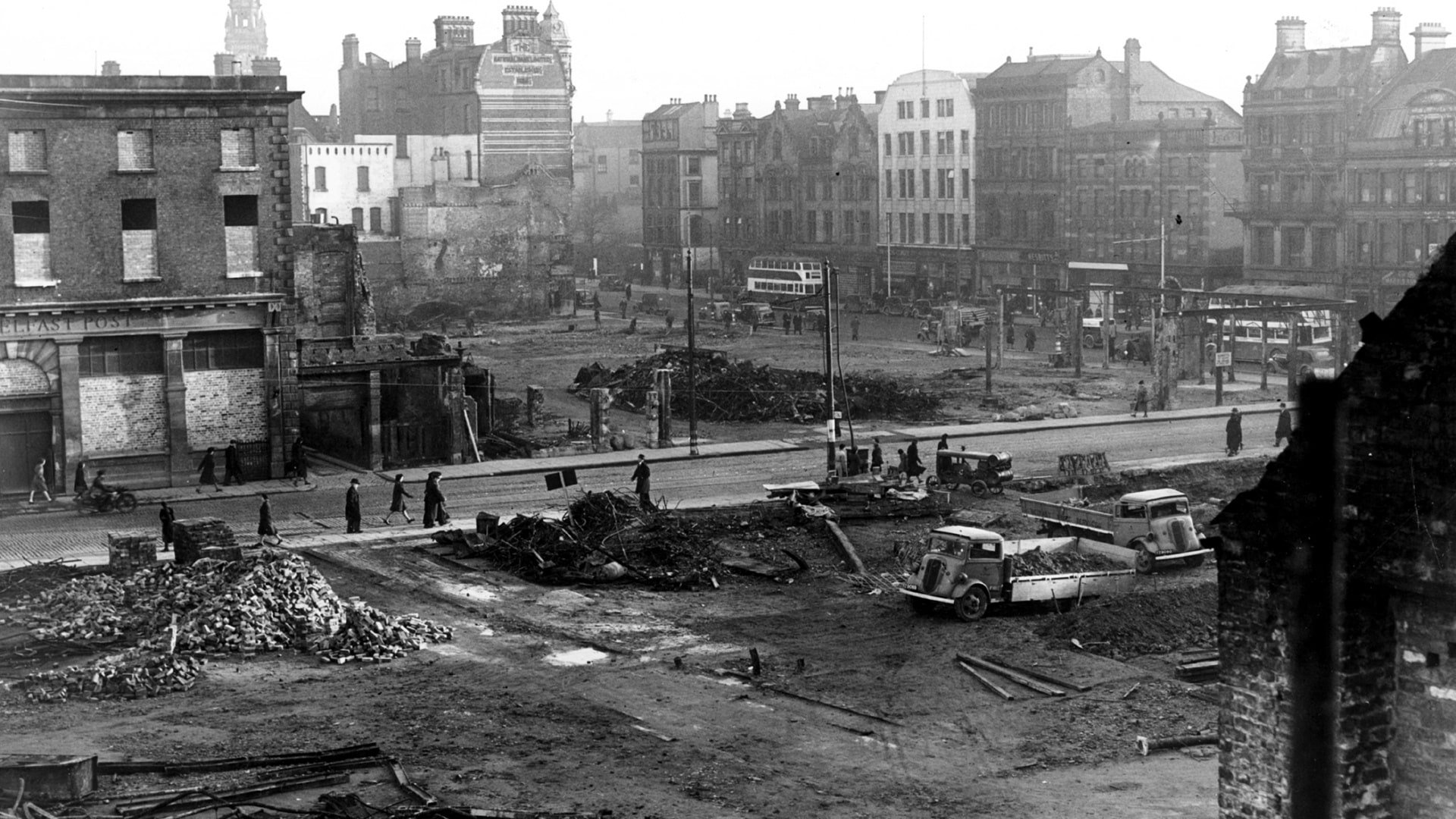
Belfast City Centre 1941
The names to be included on new Belfast Blitz Memorial - Irish News
A dedicated memorial to the people of Belfast who died during the Blitz is to be created. A partnership between Northern Ireland War Memorial (NIWM) and Belfast City Council it will form a key part of the plans to transform the city’s Cathedral Gardens. Today, we publish the full provisional list of names of the people who will be remembered on it…
The list has been compiled using official sources and government records. If you think a victim of the bombing raids has been omitted, please email supporting evidence to NIWM at info@niwarmemorial. org before June 30, 2025.
Addis, Mary Addis, Sarah Aicken, Alexander Aitken, Jane Allister, Martha Anderson, Elizabeth Anderson, Isabella Anderson, Mary Ann Anderson, William John Andrews, David Harold Andrews, Mary Armstrong, Martin Robert Artt, Isabella Ash, Stanley George Atcheson, Eliza Baird, David Baird, Murdugh George Ball, Samuel Ballance, Agnes Ballantine, Ethel Ballantine, William Vincent Balmer, James Barr, James Alexander Barr, Jeannie Barr, William Cathcart Beattie, James Beattie, James Beech, Margaret Eileen Williamson Beggs, Phyllis Irene Bell, Hannah Bell, John Bell, Joseph Bell, Thomas George Belshaw, Robert Bennett, Catherine Bennett, Robert Benton, William Bill, Thomas Bingham, Thomas Black, Annie Black, Eva Black, Evelyn Black, Hazel Black, Hessie Black, James Black, James Black, Mary Blankney, Roland Bleakley, Matilda Violet Bleakley, Thomas William Boal, George Boal, Winifred Bonnell, Hugh Emrys Bothwell, David Edward Bothwell, Ernest Bothwell, Lily Mary Bothwell, Peggy Mary Boyd, Edith Boyd, Elias Jones Boyd, Elizabeth Kate Boyd, Hugh Boyd, Jessie Boyd, Sarah Jane Bradley, Everhilda Bradley, Margaret Bradley, Sydney Bradshaw, Annie Bradshaw, David Kennedy Brady, George Robert Brady, Mary Braniff, William Brennan, Margaret
Briggs, James Briggs, Leonard Briggs, Leonard Briggs, Rowland William Brooker, Herbert Montague Brookes, Wilfrid Mark Hamilton Brothers, Margaret Brown, Elizabeth Jane Brown, Florence Edna Brown, Georgina Brown, Georgina Brown, Henry Brown, James Brown, John Brown, Margaret Jane Brown, Mary Jane Brown, Rachel Brown, Sarah Brown, Stephen Brown, William Alexander Browne, Annie English Browne, William Thomas Bullock, Robert Burbage, Montague James Burdett, Dorothy Kathleen Burleigh, Betty Burton, Sarah Byrne, Eliza Sarah Caldwell, Francis Ernest Cameron, Annie Campbell, Arthur McLean Campbell, Elizabeth May Campbell, Hugh Campbell, Margaret Campbell, Margaret Christina Campbell, Roberta Carleton, Dona Carroll, Thomas William Carson, Edward Carson, Eileen Carson, Martha Carter, Alice Carter, Joseph Carter, Joseph Carter, Kathleen Carter, Mary Carter, Mary Ann Carter, Sarah Cash, Mary Ann Castles, Hugh Christian, Leonard Charles Christy, James Christy, Margaret Christy, Margaret Sylvia Church, Hannah Cinnamond, Arthur Moore Clarke, Cecil Clarke, David Clarke, Desmond Clarke, James Henry Clarke, Jeremiah Clarke, Jeremiah Clarke, John Clarke, Lavina Clarke, Mabel Alexandra Clarke, Robert Clarke, William Close, Albert Close, Mary Jane Close, William Cobain, Elizabeth Maud Cobble, Edward William Cochrane, Gertrude
Cole, Patrick Conlon, James Connelly, Annie Connelly, Charlotte Connelly, James Connolly, John Convery, Jane Cooke, David McKee Cooke, Ernest Victor Cooke, John Cooke, Mary Anne Cooke, Mary Jane Cooke, Thomas Coombs, Frank Mundy Corr, Annie Corr, Frederick Corr, Mary Ann Corry, Elizabeth Corry, Henry Corry, Martha Corry, Samuel Costello, Mary Ann Costello, Stephen Craig, Rebecca Craig, Robert Creighton, John Creighton, Rachel Crossan, David Crothers, Alexander Crothers, Raymond Crotty, Mary Ann Cuffe, Denis Patrick James Curran, Patrick Curran, William Curry, William John Danby, Alice Danby, Arthur Danby, Emily Danby, John Danby, John Robert Danby, Kathleen Danby, Olga Danby, Peter Darragh, Margaret Davey, Henry Davey, Matilda Davidson, Jane Davison, John Deering, Martha Elizabeth Deering, Mary Dempster, Agnes Dempster, Agnes Ruby Dempster, Ellen Dempster, Robert Denby, Dorothy Ethel Denby, Harriette Macredie Denby, Isabella Denby, William Henry Dennant, Eric Doherty, James Doherty, Mary Doherty, Mary Christina Doherty, Sarah Doherty, Susan Dojan, Donald Dojan, John Donnelly, Annie Donnelly, Arthur Donnelly, Bessie Donnelly, Hugh Donnelly, Joseph Michael Donnelly, Maggie Donnelly, Marie Donnelly, Mary Donnelly, Patrick Donnelly, Robert Moorhead Donnelly, Susannah Donnelly, Susannah Hope Donnelly, Thomas Dorman, Annie Dorman, Mary Dornan, Harriet Dornan, Harriett Douglas, Emily Douglas, James Douglas, Margaret Douglas, Samuel Douglas, Sarah Douglas, William Dowds, Anne Dowds, Annie Dowds, Maureen Drummond, Martha Duff, John Murray Duff, Kathleen Duffy, Catherine Duffy, James Duffy, James Michael Collins Duffy, Josephine Duffy, Samuel John Duffy, Sarah Ann Dunlop, Agnes Dunlop, Elizabeth Dunwoody, Edith Dunwoody, Henry Dunwoody, Isabella Dunwoody, William Elkin, Mary Elkin, Alexander McNeill Elkin, Alexander Norman Elkin, William Ronald Elliott, Samuel Stewart McComb Erskine, Cecil Esdale, John Farrelly, Maurice Phillip Faux, Christopher Youraba Fee, Daniel Ferguson, Agnes Ferguson, Andrew Ferguson, Andrew Ferguson, Charles Ferguson, Elizabeth Shaw Ferguson, Mary Jane Ferguson, Richard Ferguson, Thomas Gardener Ferris, Daniel Finlay, Robert Finnegan, John Finnegan, Kathleen Fisher, John Joseph Fisher, Martha Fisher, Rose
Flack, George Flack, Mary Fletcher, James Fletcher, Martha Flood, Thomas Flynn, Agnes Flynn, Ambrose Flynn, Kenneth Flynn, Rosemary Forbes, Elsie Forbes, James Forbes, James Forbes, Martha Forbes, Norman Forbes, Sadie French, John Frizzell, Eric Frizzell, Eveline Frizzell, Eveline Frizzell, Robert John Fullerton, Charles Fullerton, Dennis Fullerton, Elizabeth Gardner, Amelia Garrett, Allen Garrett, Bridget Garrett, John Gass, James Gay, Herbert Geddis, Agnes Geddis, James Gibson, Thomas Heeson Gilmore, John Gordon, Elizabeth Gordon, Georgina Gordon, Hugh Gordon, Kathleen Gordon, Samuel Gordon, Susan Gordon, Thomas Gordon, William Gowan, Samuel Hoy Graham, Francis Graham, Frederick Graham, Jane Graham, Violet Graham, William John Gray, John Gray, John Gray, Sarah Greaney, John Greer, Sylvia June Gribbin, Nancy Simms Grimes, Christopher Grimes, Sarah Guglielmazzi, Leon Guinnis, William Guy, Henry William Guy, Mary Guy, Mary Doreen Guy, Reginald Guy, Sydney Hagans, Alexander McIlwrath Haggan, Robert Hagin, William Halliday, Frances Halliday, Francis Halliday, Harold Cecil Halliday, Isaac V.
Hamilton, Annie Brown Hamilton, John Nelson Hamilton, Kathleen Hamilton, Samuel Hanna, Annie Hanna, Doreen Hanna, Eliza Hanna, Letitia Hanna, Myrtle Hanna, Robert John Hanna, Samuel Hanna, Samuel Hanna, Thomas Harbinson, Robert James Harkness, Brice Harper, Ann Jane Harris, John Thomas Harrison, John Harron, Mary Elizabeth Harvey, Thomas Harvey, Thomas Douglas Harvey, William Thomas Hawkins, Elizabeth Hawkins, Elizabeth Hawkins, John Albert Hawthorne, David Henry Heaney, Edith Heaney, George Heaney, Joseph Andrew Heaney, Vera Hemelryk, Edward Valentine Henderson, Agnes Hendron, William Henry, Mary Henry, Susan Heron, Elizabeth Heron, Martha Higgiston, Mary Matilda Hill, James Stringer Hill, Joseph Hill, Margaret Hillis, David Hillock, Sarah Ann Holden, Charlotte Holden, Jean Holden, William Holmes, Mary Jane Holt, Archibald Joseph Adolphus Holt, Eliza Jane Holton, Arthur Henry Hood, Robert Dalzell Howard, Mary Elizabeth Howe, Maurice William Huddleston, Elizabeth Jane Huddleston, Ellen Huddleston, James Huddleston, Hannah Huddleston, Hans Patrick Huddleston, Mary Hughes, Sarah Hunter, Charlotte Hunter, Henry Hunter, Irene Hunter, Joseph Molyneaux Hunter, Kathleen Hunter, Margaret Hunter, Rose Hutchinson, David Hutchinson, Lily Hutchinson, Martin Hutchinson, May Hutchinson, Rita Hutchinson, Sadie Hutchinson, Sarah Hutchinson, William Hutton, Jesse Taylor Hynes, William Irvine, Agnes McQuoid Irvine, Georgina Irvine, Hamilton Irvine, Margaret Hill McQuoid Irvine, Robert McCullough Irwin, Albert James Irwin, James Jackson, Georgina Jackson, Thomas Jackson, Thomas Jacobson, Maurice Barnett Jamieson, Margaret Jamieson, William Samuel Jamison, Charles Frederick Jamison, Elizabeth Jamison, Mary Jamison, Samuel Jerwood, Albert Johnston, Margaret Jones, Daniel Rees Jones, Peter Jones, Stephen Henry Francis Kane, Robert Alexander Kater, Annie Jardine Kater, James Keane, Thomas Kearney, Elizabeth Keeney, Sarah Kelly, Albert Kelly, Annie Kathleen Kelly, Ernest Kelly, Vera Kennedy, Benjamin Kennedy, Oliver King, Joseph Kinghan, George Stuart Kingston, Ronald Victor Knight, Arthur Knight, Grace Knight, James Knight, Mildred Knox, Agnes Kyle, Stanley Lambert, Joseph Lancaster, William Larkin, William Larmour, Jane Leebody, Margaret Lemon, William James Lennon, John Lilley, Albert William Lilley, Edith Frances Ferguson Lindsay (Steele), Rosina Long, Ivers Long, Margaret Jane Long, Norman Long, Ralph Alonza Lucey, Ernest John Montague Lutton, Ellen Lutton, Robert Lutton, Robert Vincent Lynas, Jean Lynas, Richard Lyttle, Frederick Lyttle, Jane Johnston Macauley, Grace MacDonald, Angus Campbell Magee, Daniel Magee, Jane Magee, Mary Magee, Mary Magee, Thomas Magee, Thomasina Magill, Annie Magill, Hugh Magill, Margaret Magill, May Mahaffey, William John Malcolm, Dorothy Malcolmson, Evelyn Mallon, Anna Mallon, Annie Mallon, Cecil Mallon, John Terence Marasi, Felix Martin, John Andrew Martin, Sarah Mason, Anthony Gerard Mason, John William Oliver Mason, Mary Mason, Richard Mason, Rose Mason, Thomas Mateer, David Mateer, Florence Mawhinney, Charlotte Mawhinney, Elizabeth Maxwell, Joseph Maynard, Geoffrey Hiram Mays, William James McAdams, Andrew McAlea, Catherine McAnespie, John McAtamney, Mary McAteer, Adam McAteer, Kathleen McAteer, Martha McAuley, George McAuley, Joseph McAuley, Margaret McAuley, Walter McAvoy, Isabel McAvoy, James McAvoy, John McAvoy, Thomas McCaffery, Catherine McCallum, Cecil McCann, Annie McCann, Mary McCann, Sarah Baird McCarey, Josias McCartney, Matthew McCleary, William McClelland, Agnes McClelland, David McClelland, Edward McClements, Agnes McClements, Hamilton McClements, Hamilton McClements, Jane McCloskey, Gerard Patrick McCormick, Sarah McCready, John McCreedy, James McCreedy, John McCreedy, Mary Jane McCrickard, Margaret McCrickard, Mary McCrickard, Patrick McCullagh, Eliza Jane McCullagh, James Albert McCullagh, Lily Mary McCullagh, Mary Ann McCullagh, Sarah Jane McCullough, Agnes McCullough, Agnes McCullough, Brian McCullough, Eileen McCullough, Eileen Lovain McCullough, Mary Jane McCullough, Martha Neill McCullough, Ralph McCullough, William McCullough, William John McCunnie, John McDermott, Mary Ann McDermott, Mary Kathleen McDermott, Patrick McDonald, Archibald McDonald, Ellen McDonald, Martha McDonald, Thomas McDonald, Thomas Mahood McDowell, William McDowell, William Henry McElheran, Catherine McErlean, Evelyn McErlean, John McErlean, Pierce McFall, Joseph McFall, Joseph McFall, Martha McFall, Sarah McFall, Violet McFarlane, James McGarry, Georgina McGaughan, Sarah Jane McGee, Anne Jane McGee, Harry McGee, Henry McGee, Margaret McGennity, Bridget McGennity, Margaret McGennity, Robert McGennity, William Henry McGerrigan, Patrick James McGladdery, Samuel McGladdery, Sarah McGookin, Joan McGowan, Bertha McGowan, William Thomas McGrawn, Minnie McGregor, Adam McGroder, John McHugh, Annie McHugh, Sarah McIlveen, Eliza Jane McIlveen, Samuel McIlwaine, Elizabeth McIntyre, William McKay, Daniel McKay, Daniel McKay, Jean McKay, Marcus McKee, David McKenna, Frances McKenna, James McKenna, John McKeown, Margaret McKeown, Margery McKeown, Thomas McKinty, John McKnight, Maggie McLellan, James McLellan, James McLellan, Sarah McMeekan, Jennie McMeekan, Robert James McNair, William McNally, Agnes McNally, Elizabeth McNally, Hugh McNally, Mary McNeill, Hetty McNeill, Hugh Baxter McNeill, Lorna McNiece, Elizabeth
Some of the evacuees crowded into one of Belfast’s railway stations in the aftermath
McPolin, Annie Bernadette McPolin, Bridget McPolin, Hannah McShane, Patrick McSourley, Ann Philomena McSourley, Mary McSourley, Sarah McTernaghan, Eliza Jane McVeigh, Francis McWhinney, Bridget McWhinney, Eileen McWhinney, James McWhinney, Joseph McWhinney, Joseph McWhinney, Mary Meaklim, James Mells, Mary Jane Miley, James Thomas Millar, David Millar, David Millar, Elizabeth Millar, Francis Millar, Henry John Millar, John Alexander Millar, John Forsythe Millar, Margaret Millar, Rebecca Millar, Robert Miller, John Miller, Mary Jane Mills, Robert John Humphries Mills, Walter Charles Edmondbury Montgomery, Andrew Moore, Hugh Hanna Moore, James Simon Moore, Mary Robinson Moore, Thomas Moore, Trevor Moore, William Morgan, William George Morris, William Thomas Alexander Morton, Thomas Muldoon, Katherine Mulholland, Sarah Freeburn Murdock, Ellen Murdock, Margaret Murray, Margaret Murray, Mary Elizabeth Murray, William Neill, Annie Neill, Jane Nesbitt, Alice Nesbitt, Ellen Nesbitt, Jean Nesbitt, Samuel Nixon, James Johnston O’Boyle, James O’Brien, Jeremiah O’Hare, Josephine Patricia O’Hare, Mary Teresa O’Neill, Hugh O’Neill, Margaret Jane O’Neill, Maria Orr, Raymond Osben, James Owens, Frederick Park, John Thomas Park, Martha Patience, John Patience, John Cameron Patience, Robert Patterson, Emma Jane Patterson, Emma Jane Patterson, William Robert Perkins, Herbert Owen Perring, Alfred Frederick Peters, Harold Herbert Phillips, Edward Warburton Phillips, Henry Pickup, Harry Norman Pollock, William Martin Power, Bridget Power, Gerald Power, Patrick Power, Thomas Price, Thomas Pritchard, Joshua Pritchard, Margaret Pritchard, Margaret Pritchard, William John Quigley, William
The Belfast Blitz, when the Luftwaffe carried out bombing raids in April and May 1941, left more than 1,000 dead, 1,500 injured and up to 50,000 homes damaged
Quinn, John Roderick Redman, Myrtle Edwina Freida Rees, Ivor John Reid, Isabella Reid, Martha Reid, Robert Reilly, Mary Renton, Allison McClelland Renton, Elizabeth Renton, Muriel Lowry Renton, William Richardson, Charles Richardson, Ellen Riecken, Ernest William Riecken, Mary Louisa Roberts, Francis Edward Roberts, John Thomas Roberts, Sarah Robinson, Agnes Robinson, James Henry Rodgers, Evelyn Rodgers, James Rodgers, Jane Rodgers, Kathleen Rodgers, Phyllis Rodgers, Robert Rodgers, William Rogers, Daniel Rogers, Daniel Rogers, Mary Rooney, Joseph Ross, John Reynolds Rossborough, Minnie Rowley, Alfred John Rowley, Charles James Rowley, Emily Roy, Samuel John Russell, Sofia Saunders, George James Henry Savage, Thomas Scott, Albert Scullion, Bridget Scullion, James Seaward, Norman Leslie Shaw, Kenneth Lawrence Silverman, Anthony Meyer Simmons, John Thompson Simon, Florence Simon, Geoffrey Ronald Simon, Henry Nathan Simpson, David Cooper Skelly, Samuel
Skelton, Audrey Skelton, Samuel Skinner, Albert Joseph Slavin, Henry Smith, Mary Smyth, Elizabeth Smyth, Elizabeth Smyth, Ellen Smyth, Hugh Smyth, Lawrence Smyth, Margaret Smyth, May Smyth, Sadie Smyth, William John Spence, George Spratt, Jean Spratt, John Stafford, Margery Staunton, Edith Staunton, Frederick Staunton, Herbert Staunton, Letitia Staunton, Robert Steele, Mary Sterrett, William John Stevenson, Ellen Stevenson, James Stevenson, Richard Stevenson, Samuel Stewart, Alice Stewart, Archibald Herbert Sanderson Stewart, Hugh John Stewart, Raymond Stewart, Stella Stewart, William Story, Rachel Anna Story, Susanna Sutcliffe, Richard Douglas Swann, John Swann, Margaret Isabella Swann, Martha Swann, Mary Swann, William Taggart, Elizabeth Taggart, Ellen Taggart, William Henry Tate, Elizabeth Tate, Ellen Ogle Tate, Evelyn Taylor, James Taylor, John
Taylor, Kathleen Taylor, Mary Taylor, Patrick Thompson, Elizabeth Thompson, Hugh Thompson, James Thompson, Joan Thompson, John Thompson, Samuel Alexander Thompson, Sarah Jane Thompson, Una Timoney, Mary Ann Tobin, Joseph Todd, Ella Elizabeth Todd, Vera Todd, Violet Toogood, Margaret Toole, Patricia Anne Torley, Francis Totton, Agnes Totton, Geoffrey Totton, Thomas Turner, Mary Turpin, James Herbert Unsworth, Sarah Elizabeth Unsworth, Thomas Vannan, Ann Elizabeth Vannan, Mary Elizabeth Venn, Trephena A.
Venton, William Anson Vigors, Patrick Forbes Waddington, Thomas Wallace, David Wallace, James Wallace, James Wallace, Jane Wallace, Jane Wallace, Kathleen Wallace, Sheila Wallace, William John Wallace, William John Wallace, William James Walsh, Catherine Ward, Sarah Ward, William Ward, Richard Fowler Warwick, Alice Warwick, Alice Winifred Warwick, Ann Jane Hughena Warwick, Joanna Payne Warwick, Nathaniel Boyd Warwick, Nathaniel James
Warwick, Phyllis Iris Watson, Margaret Watson, William James Watt, John Webb, Minnie Welch, Angela Maureen Welch, Annie Angela Welsh, Phares Hill Wherry, Elizabeth Wherry, John Wherry, Margaret Jane Wherry, Martha Wherry, Mary Wherry, Robert White, Mary Wilson, Alexander Wilson, Annie Wilson, Annie Wilson, David Wilson, Dorothy Wilson, Edith Wilson, Elizabeth Wilson, Ellen Wilson, Ellie Wilson, Euphemia Wilson, James Wilson, James Wilson, Johanna Wilson, Margaret Wilson, Robert Wilson, Robert J.
Wilson, Sarah Wilson, Thomas Wilson, Violet Wilson, Violet Wilson, William Wilson, William John Wiseman, Matthew Wiseman, William Wylie, Annie Wilson Wylie, Francis
The list has been compiled using official sources and government records. If you think a victim of the bombing raids has been omitted, please email supporting evidence to NIWM at info@niwarmemorial. org before June 30, 2025.
Comment
Interesting mix of articles including my own on the Lord Mountbatten allegations on 21 May. The blitz memorial story oddly makes no mention of the fact that I successfully proposed it when a city councillor - in the teeth of opposition from certain parties. It only passed when three SDLP councillors broke ranks and supported the project while the Alliance Party abstained.
Jeff Dusgeon
LucidTalk poll: Over half want Kneecap banned from gig at Belfast Vital
Suzanne Breen, Political Editor, Belfast Telegraph, May 24th, 2025
SURVEY SHOWS PEOPLE DIVIDE ON TRIBAL AND GENERATIONAL LINES GROUNDS
More people think that Kneecap shouldn't be allowed to perform on Belfast City Council-owned land this summer than believe their sold-out gig should be permitted.
Fifty per cent of voters want the rap group banned from appearing at the Belfast Vital festival on the Boucher Road Playing Fields, while 45% back the trio performing there and 5% don't have an opinion.
A LucidTalk poll for the Belfast Telegraph shows greater support for dual Irish and English signs at Belfast's Grand Central station. Fifty per cent of people agree with erecting bilingual signage in the public transport hub, while 43% disagree and 7% don't know.
Northern Ireland is divided on both issues along traditional political lines, with a clear majority of nationalists and Alliance voters supporting dual language signs and Kneecap playing at Boucher Road, and an overwhelming majority of unionists opposing both.
More young people and those in early middle-age back the bilingual signs and Kneecap's Boucher gig than are against them. However, a majority of the over-55s oppose both.
DUP, UUP and TUV councillors are calling for the group not to be allowed to perform on council property.
Some 40,000 people are due to see them play at the outdoor venue in south Belfast on August 29.
The Irish language rappers denounced Israel at the Coachella festival in California last month and led the crowd in pro-Palestine chants.
Kneecap member Liam Óg Ó hAnnaidh, who performs under the stage name Mo Chara, was charged on Wednesday with a terrorism offence following an investigation by the Metropolitan Police in London.
He is denying the charge. It relates to the alleged display last year of a flag in support of Hezbollah, a proscribed organisation, at a gig at the O2 Forum in Kentish Town, north London.
Poll followed arrest
LucidTalk's poll was conducted before Mr Ó hAnnaidh was charged. Some 2,755 people took part in our online survey from May 16 to 19. The sample was scientifically weighted to reflect the Northern Ireland population.
Sinn Fein voters (94%) are strongest in backing Kneecap's gig on the Boucher Road being permitted, followed by SDLP (70%) and Alliance (55%) supporters. A third of Alliance voters believe the group shouldn't be allowed to perform at the venue.
TUV voters (99%) feel most strongly that Kneecap should be banned from playing on council-owned property, followed by DUP (93%) and UUP (90%) supporters.
There is a sharp generational divide on Kneecap. Those aged 18-34 are in favour of the rappers performing at the venue by 49% to 46%. Voters aged 35-44 are even more supportive of the group playing at Boucher Road — 59% to 40%.
Among 45-54-year-olds, 46% believe they should be allowed to appear there while 45% don't.
Troubles generation most opposed
The older generation disagrees, with twice as many of those aged 55-64 opposing Kneecap playing at the venue (66%) as supporting it (32%). Pensioners split 53% to 37% against the group performing at the council-owned property.
More women (49%) believe Kneecap should be permitted to appear at Boucher Road than be prohibited (44%), whereas men are against a ban by 54% to 42%.
In videos posted on social media, Liam Óg Ó hAnnaidh appeared on stage with tape covering his mouth at Kneecap's surprise gig at the 100 Club in London's Oxford Street on Thursday night.
He then joked about being careful what he said, before adding that he wanted to thank his lawyer.
In a statement, the group accused the Government in Westminster of being more “focused on us” and cited the ongoing humanitarian crisis in Gaza as a result of military action by Israel.
The band added: “We deny this 'offence' and will vehemently defend ourselves.
“This is political policing. This is a carnival distraction. We are not the story. Genocide is.”
Kneecap have had some gigs cancelled in the wake of recently publicised controversies.
Language divides
The installation of Irish language signs at Grand Central Station has been delayed following loyalist Jamie Bryson's legal challenge which is backed by the DUP and TUV.
Bilingual signage at the £340m new public transport hub is supported by Sinn Fein (99%), SDLP (75%) and Alliance (59%) voters.
Unionists of all shades oppose the signs, with TUV voters the most against them (97%), followed by DUP (91%) and UUP (71%) supporters.
More women (54%) back the dual signage than men (46%). It is also more popular with younger people.
While 62% of 18-34-year-olds and 58% of those aged 35-44 support the signs, only 36% of 55-64-year-olds and 40% of pensioners do.
Sinn Fein Infrastructure Minister Liz Kimmins announced in March that Irish signage would be installed at Grand Central and on ticket vending machines.
She said she was “committed to the visibility and promotion of Irish language” and the station must be “reflective of all citizens”. The department said the signs would cost about £150,000.
Council set to offer lifeline to historic Assembly Rooms
John Breslin, Irish News, May 24th, 2025
ONE of the most storied buildings in Belfast, the Assembly Rooms, may soon be in public hands as the council is on the cusp of making an offer to buy, with the owners indicating a willingness to sell.
Councillors will vote on Friday on whether to offer to buy the building at the corner of Waring and North streets, one of dozens across the north of the city centre in a derelict condition after years left vacant.
The offer will be to buy the Assembly Rooms and two other buildings from Project Goat Ltd, with sources quoting a price of approximately £2.7 million.
Project Goat is the legal owner of the building and at least 30 derelict properties and parcels within 12 acres of land around Royal Avenue, Donegall Street, North Street and Rosemary Street.
However, the council has mostly had dealings with a company called Castlebrooke and its principals. It is behind Tribeca Belfast, launched in 2018 as a £500m regeneration scheme of the area. No development has happened.
The Assembly Rooms, described by the Cathedral Quarter Trust as the “stark symbol of the neglect” of the area, was the site of many historic moments, including the trials of the United Irishmen in 1798 and the celebrated speech by abolitionist Frederick Douglass in 1845 when he addressed Belfast audiences on the horrors of slavery.
It was recently added to the World Monuments Watch list, which identifies sites that face “major challenges such as climate change, tourism, conflict and natural disaster”.
Councillors have welcomed the “substantial progress” made on plans to purchase the grade B1 listing building, which was discussed in a closed doors meeting yesterday.
Long Campaign
“We have long campaigned for this historic building to be restored and advocated that the council is best placed to achieve this,” said Alliance Councillor Michael Long.
“From a heritage point of view, it’s unacceptable that this building has been allowed to deteriorate to the stage of actually falling down,” Mr Long added.
“This acquisition would be an exciting opportunity to bring one of Belfast’s most important and historically significant buildings back into public use for both residents and tourists alike, as well as aid crucial regeneration of this part of the city centre alongside the upcoming Belfast Stories attraction.”
A special meeting of the Strategic Policy and Resources Committee will be held on Friday to decide whether to offer to buy. If this is agreed, and Castlebrooke agrees to sell, the refurbishment of the building could cost further millions, with one report suggesting in the region of £8m.
Councillor Brian Smyth, of the Green Party, cautioned he did not want to prejudice and committee decision but said he and colleagues “have been fighting for the Assembly Rooms coming into public ownership for some time”.
“This is a vitally important and historic building for the city and is key to the future regeneration of the area,” Mr Smyth said.
“The Assembly Rooms have been left to rot and decay for decades, it’s time to preserve and restore it for future generations. It could play a significant part in the wider economic revitalisation of Belfast City Centre.”
Tyrie's quiet burial far removed from militant past
Allison Morris, Belfast Telegraph, May 24th, 2025
LATE UDA FIGURE WAS LEADER DURING A MURDEROUS AND VOLATILE TIME FOR THE ORGANISATION
As supreme commander of the UDA at a murderous time in the organisation's history, Andy Tyrie was one of militant loyalism's most recognisable figures.
In his later years Tyrie lived a much quieter life. Involved in local community projects, he presented as a normal retired grandfather, but behind the façade was a deadly past.
Narrowly avoiding an attempt on his life on March 6, 1988, within a week he had stood down as UDA leader.
What happened after that changed how the terror group was run - he would be the last overall commander with the leadership being allocated on a revolving basis after his departure.
Despite being involved in hundreds of killings, using the UFF cover name, the UDA was not proscribed until 1992. This allowed Tyrie to give multiple interviews without fear of prosecution.
A recognisable figure with his tinted glasses and moustache, the look was later parodied by the Give My Head Peace character Uncle Andy.
The inside story of the rise and fall of the UDA leader involves alleged informers, treachery, sectarian slaughter and a power play with allegations of collusion with the IRA to target problematic loyalists standing in the way of those with ambitions to lead the organisation.
John McMichael
John McMichael died when a bomb exploded under his car, outside his Lisburn home on December 22, 1987.
While Tyrie was the leader of the UDA on paper, one senior insider said it was McMichael who was the strategist and the person who was really in charge of the UFF operations.
One senior UFF figure from that time said: “Once John McMichael was murdered Tyrie's days were numbered.
“Andy may have been sent out to talk to the media but John was the man. He is who we (the UFF) would have dealt with.
“There was a lot going on at that time and Jim Craig was being accused of colluding with the IRA to set people up.”
Craig was heavily involved in UDA extortion rackets but was suspected of leaking information to both the Provisionals and the INLA. The UVF accused him of setting up the assassination of Shankill Butcher members Lenny Murphy, John Bingham and William “Frenchie” Marchant in the 1980s.
Loyalists Tucker Lyttle and Billy Elliot wanted rid of Tyrie and used his friendship with Craig to launch a coup against him.
“In the paramilitary world paranoia runs rife,” said a former UDA prisoner.
“Craig was being linked to all sorts and anyone close to him was guilty by association”. Craig was shot dead by two gunmen from the UDA in The Castle Inn - later called The Bunch of Grapes - bar in east Belfast in October 1988.
During Tyrie's time as supreme commander of the organisation, sectarian attacks increased. This was despite him saying he wanted to stop targeting civilians and take the war to the IRA or “terrorise the terrorists” as he put it.
In 1974 the UDA/UFF killed 37 people in shootings and bombings, including the battering to death of a Protestant civilian, Ann Ogilby, by a female UDA unit.
Ulster Workers Council
This was also the year of the Ulster Workers' Strike in which Tyrie played a leading role.
By the late 80s new and more hard line figures were coming up the ranks of the UDA.
Figures like Johnny Adair would step into the void, with the political aspirations promoted by McMichael falling by the wayside.
The move to unseat Tyrie was orchestrated by Tucker Lyttle and Billy Elliot with a meeting held in The Farmers Rest, a bar situated at the junction of Templemore Avenue in east Belfast.
A vote was taken with three votes to two to stand down Tyrie. Only Jackie McDonald spoke in Tyrie's favour. UDA boss Cecil McKnight was not present at the meeting.
McKnight was linked to the murder of Sinn Fein member Eddie Fullerton in Donegal in May 1991. A member of the Ulster Democratic Party (UDP), the UDA's political wing, McKnight was shot dead on 29 June, 1991 by the IRA.
One UDA insider said: “The rise of the likes of Adair and the Shoukris with the organisation linked to drugs and criminality every week in the Sunday World, was — in my opinion — intentional.
“Feuds, infighting, the spray jobs (random attacks on bars and bookmakers), they feed into the narrative that all loyalists were thick savages, full of steroids and only interested in lining their own pockets. That slide started with McMichael's murder and Tyrie standing down.”
However, others take a different view. They claim that, without McMichael, Tyrie's leadership was weak and it was only a matter of time before he was pushed out.
Tyrie's final push towards the door came when he survived an undercar bomb attack.
One senior UDA figure said: “He stormed into a room where Tucker Lyttle was and said, 'the RUC told me you planted that'. I doubt they did but there was no doubt who was involved, Lyttle wanted rid of him.”
Five days later Tyrie stood down from the UDA, only being brought back occasionally to talk to the older members during the ceasefire and Good Friday Agreement negotiations to convince them of the path to peace.
Paper Trail
Investigative organisation Paper Trail released documents this week that gave an insight in Tyrie's leadership and relationship with the security forces.
British military intelligence documents from May 1972 uncovered by Paper Trail record that the commander of A Company was involved in a firearms incident.
The 1st Battalion King's Regiment reported at 23:08 hours it arrested a gunman in the Springmartin Road area where an “interfactional” battle was taking place.
“Picked up boy (17) with a weapon. UDA [Ulster Defence Association] Commander is taking boy away, saying they [UDA] will sort him out. Security Forces have the weapon. RUC and Company Commander [1 Kings] agree best [course of] action is to let boy go. If detained by Security Forces, there will be a major incident, and may foul up relations for 12 July.”
A later document states. “Ref [Reference] Protestant Gunman. 17 year old boy Stupid Boy — UDA Company Commander request[ed] to deal with it. Did not have firearms certificate. Being released to the UDA on the advice of the RUC.”
That commander of A Company at the time was Andy Tyrie who the following year would be elevated to the role of overall UDA leader, a role he held for 15 years.
Family and friends of Tyrie who gathered at Dundonald Presbyterian Church for his funeral service on Thursday were told the 85-year-old had “embarked on a journey towards reconciliation”.
There were no paramilitary trappings at the private family service as per his wishes.
It was a long way from the militant Tyrie of the 70s and 80s.
Kneecap charge exposes the legal fudge in terrorism laws
Newton Emerson on the week that was - Irish News, May 24th, 2025
TERRORISM legislation has been the same across the UK for a quarter of a century, yet it is enforced very differently in Britain and Northern Ireland, and to some extent is barely enforced in Northern Ireland at all.
This vast legal fudge has crept up on us and it goes remarkably unnoticed most of the time.
But it has suddenly been brought to widespread attention by the Metropolitan Police charging Kneecap member Liam Óg Ó hAnnaidh with allegedly demonstrating support for a proscribed organisation, in this case by holding up a Hezbollah flag.
If this offence under the Terrorism Act 2000 was enforced consistently, it would criminalise half the population of Northern Ireland – or, perhaps more correctly, two-quarters of the population.
That does not just apply to the obvious examples of flags, parades, commemorations and statements by loyalists and republicans.
Merely meeting with members of a proscribed organisation can be a serious offence, so half the great and the good of peace processing should also be in jail.
Ironically, the Terrorism Act was introduced after the Good Friday Agreement in the belief the law could be standardised across the UK. Instead, it has become a testament to our anarchic pragmatism.
DUP councillor calls for flute band to be 'banned' from Kilkeel after assault incident
Donal McMahon, Local Democracy Reporter, Belfast Telegraph, May 24th, 2025
A DUP councillor has called for a flute band to be “banned” from future parades in Kilkeel, expressing concern about public safety after an “atrocious” assault following an annual Loyal Orders parade.
The incident is reported to have happened in the wake of an annual march on May 17 organised by local outfit the Rising Sons of the Valley, with 30 bands in attendance.
The PSNI is investigating the circumstances when a 50-year-old man was attacked in a public house toilets, with a further reported affray involving 20 males in the early hours of May 18.
The Local Democracy Reporting Service contacted Mournes DUP councillor Henry Reilly, who has called for a flute band from outside the district to be banned from future Kilkeel parades.
He said: “I am absolutely appalled by this sort of behaviour taking place in the village of Kilkeel.
“I know one of the men who was beaten up, who is the biggest, soft and inoffensive of people, and apparently there is an online video of him getting his head kicked in when he was on the ground.
“He has been really badly shaken up by this with bruises all over his body.
“I would sincerely hope that the band involved will never be invited back to Mournes again.
“If the allegations are accurate and true, the PSNI should investigate it and the band should not be allowed back into the area if they are going to behave in that atrocious fashion.”
Men warned about unruly behaviour
The Local Democracy Reporting Service contacted the flute band alleged to have been involved in the incident and the parade organisers for comment.
The PSNI has confirmed the details of the recent Kilkeel incident to the Local Democracy Reporting Service.
A spokesperson said: ”Police received a report of an assault in licensed premises in The Square area of Kilkeel in the early hours of Sunday, May 18.
“It was reported that a member of staff aged in his 50s had warned a number of men regarding unruly behaviour during the course of the night. He stated that he was later followed to the toilet area and assaulted by three of them, sustaining serious facial injuries. The men were removed from the premises by staff, however a short time later it was reported that an upstairs window at the premises had been smashed.
“It was further reported that around 20 men had gathered outside the premises at around 1.15am and an altercation ensued, although they were not present on police arrival.
“Enquiries are ongoing, and police would appeal to anyone who witnessed any of the events or the circumstances leading up to them, to contact them on 101, quoting reference number 118 of 18/05/25.
“We would be particularly keen to hear from anyone who has dashcam, CCTV or mobile phone footage.”
Revealed: Winston Irvine's host of top-level referees
Sam McBride, Northern Ireland Editor, Belfast Telegraph, May 24th, 2025
COURT PAPERS OBTAINED BY THIS NEWSPAPER SHOW LOYALIST HAD MILITARY AMMUNITION AND REPEATEDLY LIED - YET THE UVF COMMANDER WASN'T CHARGED WITH TERRORIST OFFENCES AND RECEIVED A DERISORY SENTENCE
There's a question that has long enraged and dismayed law-abiding citizens: why do the police almost never arrest known paramilitary commanders?
Buried in court bundles obtained by the Belfast Telegraph is a disturbing answer.
On Tuesday, a judge jailed a man who exemplifies the peace process's moral perils.
Winston Irvine was able to talk a good game while operating at the top of the UVF.
Feted by police commanders, unionist and nationalist politicians, and by the British and Irish Governments, he took Irish taxpayers' money but was then arrested by police investigating a hoax bomb attack on the then Irish foreign minister.
He lied and lied. Yet, when caught, he was able to rely on some of Northern Ireland's most respected and respectable figures writing in praise of him.
Irvine's sentence is derisory. He'll be out of jail next year.
After sentencing, this newspaper applied to the judge for court papers. Judge Gordon Kerr KC immediately agreed to release all the material.
It shows what some of Irvine's backers tried to keep hidden. Their names read like a who's who of senior figures from polite society.
Before considering them, it's important to understand what Irvine did.
When stopped by police in July 2022, Irvine claimed not to know what was in a Sainsbury's bag in his boot.
Inside the bag was a Calvin Klein holdall containing two revolvers, an airgun replica of a Heckler & Koch submachinegun, several magazines, 9mm ammunition and assorted blank cartridges.
Some of the weapons were modified and some of the ammunition magazines were found by an expert to be “consistent with British military use and in good condition”.
When Irvine's Ballysillan Road home was searched, police found a UVF pendant on a gold chain, a black balaclava, a UVF framed photo and, intriguingly, digital recording devices.
Workman
On the same day the 49-year-old was arrested, police also lifted Larne man Robin Workman (54) who they had observed handing over the bag.
When Workman's home was searched, police found rifle and pistol publications, a UVF magazine, an air rifle, a cleaning kit for a Glock handgun, two pistol holsters, an armband stamped 'UVF East Antrim', two shotgun cartridge belts, a shotgun and a UVF jumper.
Police interviewed Irvine five times. He refused to speak beyond “denying any knowledge of the items in the bag and that forensic evidence will show this”.
In a prepared statement, he boasted that he'd “developed a reputation as a trusted interlocutor” and was a “trusted peace-building advocate” who'd worked with the PSNI.
He claimed to be working on decommissioning weapons, saying that “as part of this work, I regularly meet with individuals and relay messages or collect messages and bring them to third parties”.
He added: “I clearly had no intention of engaging in criminal activity of any kind… I had no knowledge or insight as to what was in the bag.”
Ciaran Murphy KC for the prosecution said “this now is clearly established as a lying account to mislead the police”.
When charged, Irvine replied “not guilty”.
Workman denied having ever met or phoned Irvine in his life. CCTV and phone evidence proved both men were lying.
When Irvine's phone was examined, it held photos of men in balaclavas with rifles and “images indicating support of the UVF”.
Memory sticks seized from Irvine's home contained images of UVF pins, rings, what appeared to be a bullet, murals supporting the UVF, a handgun and a UVF picture on a wall.
Demonstrably, he was up to his neck in the UVF.
Workman's phone similarly proved him a liar. He had saved Irvine's number into his mobile in 2019 under the name “Winky Irvine” and made a series of calls to him. A second contact was called “winky”, perhaps relating to another Irvine handset.
Workman's lawyer claimed that “on prior occasion he has been requested to act as a messenger in his role as someone who has assisted in making efforts on behalf of his community to prevent or diffuse problematic situations”.
Eradicating terrorism
This sums up the perversity of how Northern Ireland functions. People caught with terrorist guns, ammunition and paraphernalia claim to be involved in eradicating terrorism.
Workman said he guessed the guns were to be decommissioned. But he'd lied so much that he was tying himself up in knots. Just a few sentences later, his barrister said that when Workman saw Irvine, “he was well known to him”, even though his client had told the police he'd never met Irvine.
Workman's lawyer, Michael Borelli KC, said the former UDR member “worked tirelessly” to establish Ace Developments, a building company.
The prosecution argued there were five aggravating factors, including Irvine's extensive criminal record. By 2022, he had 18 criminal convictions, including rioting and assaulting a police officer. His most recent offence was in 2009.
But the prosecution barrister said they “are not in a position to point to evidence of any specific act of terrorism relating to the offences in his case”.
Irvine was represented by Brenda Campbell KC and Joe Brolly. At a hearing in July 2022, Brolly referred to “very sensitive material”. saying “a witness has attended today who had asked to give evidence anonymously to the court”.
He claimed: “There is going to be a publication once Mr Irvine is released — that was delayed — which might have fundamental importance in our society as a whole.”
At a hearing last year, Brolly said there may be “significant disclosure” before the trial. There wasn't. Instead, a few months later, both defendants suddenly pleaded guilty.
Despite Irvine's extensive criminality, his defence team argued that his “character” should be a mitigating factor, along with his “wider positive impact on his local community”.
Unique position
The lawyers told the judge that the references demonstrated he “has a unique position within the loyalist community and is held in very high regard by a wide cross section of our society”.
They went on to state that Irvine “is a trusted interlocutor who has directly engaged with loyalist paramilitaries”, omitting to mention that this is because he is a paramilitary leader.
The submission claimed he was “currently centrally involved in intensive talks whose aim is the permanent disbandment of all of the loyalist paramilitary groups”, describing him as “an exceptional individual”.
They said the criminal was “the sole breadwinner and primary carer for his wife and four children” and went on to claim: “There is no terrorist connection in this case.”
Judge Kerr said he considered Irvine's references when deciding that for “exceptional” reasons he shouldn't get the minimum five-year sentence.
Key to decommissioning
David Campbell of the Loyalist Communities Council (LCC) wrote “in strict confidence” and “privately” to tell the judge that Irvine was key to loyalist decommissioning and resolving the Ardoyne parade dispute.
He said Irvine helped stop violence over the Irish Sea border, putting “his own life and safety on the line”.
Campbell said there was “barely a week” where the LCC wasn't communicating with Downing Street and senior Government advisers, and sometimes Irish ministers, with Irvine “a key figure”.
He added: “I can in no way condone or excuse his serious misjudgement, but I am frankly astonished given the years of genuine work for peace that he has engaged in and that I have witnessed. I do not believe that he had any malicious intent, and I do not believe it is in the public interest to place him in prison.”
Dedicated to peace process
Former Policing Board vice chair Debbie Watters said she had “worked closely” with Irvine for 15 years, finding him “a dedicated supporter of the peace process”. She said Irvine's wife, Roberta, “relies heavily” on him.
Methodist minister the Rev Gary Mason said he'd known Irvine for 15 years and he'd “taken risks for the securing and preservation of peace”.
He said if Irvine was jailed it could be “devastating” for his family.
The judge was given a statement by Rev Harold Good and Jim Roddy who said that “in light of our roles, and because of threats that have been issued in the past, we would ask the court to grant us anonymity”. The judge declined to do so.
The men said they had “worked very closely” with Irvine for the last six years “on problems relating to intercommunal disputes and issues relating to the legacy of the conflict” and “in our work we have always found Winston to be honest [and] trustworthy”.
They added: “Our engagement over the past six years has been continual and we would have cooperated regularly and without break with each other, during this period.”
Several other letters were submitted when Irvine sought bail in 2022.
Paul Crawford, whose father was murdered by the UVF in 1974, said Irvine had worked with the UVF to secure information about the killing.
He came to see Irvine “as a genuine friend” and “a man of integrity” who “will pose no threat to anyone”.
Queen's law professor Kieran McEvoy told the judge then that he'd been involved in “highly sensitive” work linked to the legacy of the Troubles which involved “private and public engagement with a diverse range of stakeholders”.
He said he'd been involved in the process with Crawford who believed Irvine “engaged at all times in good faith”, adding: “ I formed a similar impression.”
He also asked for the letter to be kept from the public. David Porter, then chief of staff to the Archbishop of Canterbury, said he'd witnessed Irvine's “commitment to work for peace and stability” and to “promote a constructive future for loyalist communities”.
Former Church of Ireland primate Alan Harper said he'd known Irvine for seven years and he'd taken “very considerable risks”.
Harper said he wrote for “pastoral and humanitarian grounds”.
In a December 2021 handwritten letter given to the court, the then NIO Minister Conor Burns wrote to Irvine: “Please know that I am available to speak whenever it would be helpful.”
The letter predated Irvine's arrest, but indicates his level of access.
Here was a UVF leader being told by a Government minister to ring him whenever he wanted.
Burns might claim ignorance of Irvine's role, but the NIO knew. In 2013, Irvine had been named by BBC Spotlight as a UVF commander; he was repeatedly named in newspapers as a UVF figure.
Irvine told the court he'd been in talks with Secretary of State Julian Smith, was “informally appointed” to a 'contact group' set up by his successor Brandon Lewis, negotiated with the Irish Government about loyalist ceasefires, and had “a leading role in working with the PSNI, Sinn Fein and the loyalist community” to end rioting over the sea border.
Deputy Chief Constable Bobby Singleton told the court he worked with Irvine “in his role as a community worker” for a decade, but said they never discussed decommissioning.
Irvine “refused to provide any details” of who he claimed to be meeting when caught.
A letter from a local teacher said Irvine helped set up an important school scheme and Irvine's wife's GP confirmed issues relating to her, saying Irvine “has been a stable presence and a strong emotional support”, with the prospect of him being absent representing a “significant challenge for her”.
Conor McNeill, the managing director of CM Fit-Out Ltd, described Workman as a man of “exceptional leadership and management abilities” with “sound decision-making skills” and “an aptitude for resolving conflicts”.
Jonathan Hodge, who as a PUP press officer issued statements for Irvine, said Workman helped ensure a “relative lack of disorder” in Larne over the sea border. He said the man who lied to police was “honest and hardworking”.
Former PSNI officer Eric Bracewell said he'd met Workman while stationed in Larne and he was “a good cross-community worker” who during the Drumcree protests “negotiated with police” to resolve a blockage of the A8.
Although Workman continued to plead not guilty long after being caught, Bracewell said Workman contacted him “soon after” his arrest “expressing remorse and poor judgement on his own behalf”.
This episode is more embarrassing for the authorities than for the UVF. It exposes how they've been openly working with someone known to be a paramilitary commander. A decade ago, I watched a senior police officer negotiating with Irvine amid rioting at Ardoyne.
Already, senior figures are said to be quietly seeking to rehabilitate Irvine's reputation, preparing the way for him to slot back into public life after jail.
By contrast, former UUP leader Doug Beattie is an exception, having written to the PPS requesting an appeal of the “bizarre” sentence for Irvine, who will be out in 15 months.
For all the talk, our society simply isn't serious about eradicating paramilitarism. Even when caught red-handed, these people are so deeply embedded in Northern Ireland's power structures that they can get away with a lighter sentence than postmasters wrongly convicted of fraud.
To treat leaders of paramilitaries who destroy lives through drugs, extortion and violence in this way is morally vomitous — and would never be tolerated if their victims were in middle-class areas.