UK's reset of relations with EU opens up new opportunities for Northern Ireland
NEW AGREEMENT WITH BLOC, INDIA AND US TRADE DEALS, GOOD NEWS FOR LOCAL ECONOMY, WRITES SECRETARY OF STATE HILARY BENN
Belfast Telegraph, May 23rd, 2025
It has been a momentous month — both for Northern Ireland and for the entire United Kingdom. First came the Government's trade deals with India and the USA which will open up new opportunities for Northern Ireland exporters.
Next, on Monday, the UK played host to the first-ever UK-EU summit at Lancaster House in London as we set out to build a new partnership with the European Union.
In recent years our relationship with the EU has — at times — been strained, but in an era in which global instability is rising, it makes sense to build stronger ties with our European friends and neighbours. And then, on Thursday, we marked the anniversary of the referenda on the 1998 Good Friday Agreement held in Northern Ireland and Ireland. By voting 'yes', the people chose and secured a chance for peace in Northern Ireland; a peace which has lasted in the almost three decades since and helped pave the way for Northern Ireland's transformation. It was an agreement which remains to this day proof of the power of courageous political leadership, and people's willingness to compromise in hope of a better future.
The agreement with the European Union will help to create growth and lower household bills across the UK as a whole.
NI has strongest growth in UK
It is a particularly good deal for Northern Ireland. Our economy is already vibrant — think of our aerospace, life sciences, manufacturing, and film and television industries — and this agreement will further help Northern Ireland which experienced stronger growth than the United Kingdom as a whole last year. Peace has delivered real economic benefits.
Of particular significance will be the deal we reached on agrifood and plants, which will smooth flows of trade, ease the frictions for businesses and protect the UK internal market. Applying the same rules across the UK will give businesses greater certainty, and mean we can eliminate paperwork and mandatory identity and physical checks on goods moving under these arrangements.
All of this will save up to £1 million a month for those firms using the 'red lane' and we'll see a real difference in garden centres, with bans on so-called 'high risk' plants being eliminated — a commitment made in Safeguarding the Union — and plants being able to move within the UK without barriers.
This deal will also maintain Northern Ireland's unique access to both the UK and EU markets and the advantages that the Windsor Framework offers to businesses and the economy. So, it's no surprise that businesses have welcomed it.
The Ulster Farmers' Union called it “a major step forward for Northern Ireland's agri-food industry”. The Horticultural Trades Association have said that their sector will save millions. And big name retailers such as Asda and M&S have praised the removal of frictions too. The message is clear from business — this is good news for Northern Ireland and good news for you.
The other outcomes of Monday's summit are also good for Northern Ireland. Our new security and defence partnership with the EU will support our national security and the aerospace, defence and space industry which is already home to more than 9,000 jobs in Northern Ireland. Our closer law enforcement relationship with the EU will help prevent crime. Closer cooperation on decarbonisation and energy will lower prices and make our country greener and more resilient. And it'll become easier to travel to mainland Europe through e-Gates.
Northern Ireland's prosperity is intrinsically linked to its strong relationship with the rest of the UK, and it can only benefit further from our new partnership with the EU. The steps we are taking will bring practical benefits, and Monday's summit makes me even more confident that Northern Ireland's economy will continue to flourish as a thriving and growing part of the UK.
Hilary Benn MP, Secretary of State for Northern Ireland
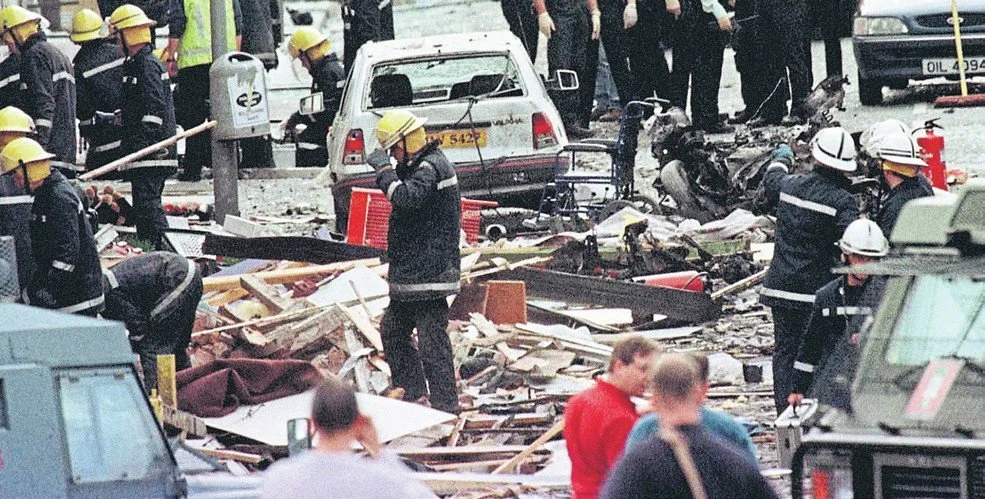
Omagh town centre August 15th, 15.04 1998
Proposal to redact names of civil servants ‘attempt to exclude’ Omagh bomb families
Conor Coyle, Irish News, May 23rd, 2025
A PROPOSED redaction of the names of junior civil servants from hundreds of documents related to the Omagh Bomb inquiry is an attempt by the UK government to “exclude” core participants such as victims’ families’, a legal representative for a number of those who lost loved ones told the inquiry yesterday.
A public inquiry into the Real IRA bomb which killed 29 people and two unborn babies in the Co Tyrone town in August 1998 is taking place.
Ahead of the core proceedings next month to examine whether the atrocity could have been prevented, the UK government has made an application for names of junior civil servants to be excluded on the grounds that they could face attacks from dissident republicans.
If granted, the application would see the unredacted documents provided to the chair of the inquiry, but withheld from “core participants” – largely made up of bereaved families but also including several other individuals and organisations classed as having a significant contribution to make to the inquiry. Core participants must sign a confidentiality agreement.
Legal representatives for the PSNI have also highlighted concerns to the inquiry over the potential naming of suspects in documents provided to the inquiry, however it has not made a formal application to redact them.
Raymond Foster KC, speaking on behalf of the families of 14 victims of the Omagh bomb represented by Fox Law, told the inquiry the UK government application would have an impact on its ability to deliver “full and proper scrutiny”.
‘Excessive Secrecy’
“We submit that it should be remembered that there was an excessive secrecy in the past applied in the context of Northern Ireland, which would imply that justifications relied upon should be reviewed with the utmost care.
“We respectfully submit sir, that by inference, it is proposed to withhold them from the core participants and thereby excluding them.
“We submit introducing at this early stage a level of secrecy into process is contrary to core participants’ expectation of overarching openness and transparency in order to have an investigation to ensure there can be full and proper scrutiny.
“I would highlight to the inquiry sir, that some of the participants that Fox Law represent, have been involved in campaigning for this public inquiry for over 20 years.
“We respectfully submit that a duty of candour is just that, an obligation and responsibility to be open and honest.”
Foster KC went on to tell the inquiry the idea of “blanket anonymity” should not apply in the case of the inquiry.
“When it comes to the relevance of documents and significance of documents, that’s a matter for the inquiry, not to be predetermined, not to be dealt with by blanket anonymity. We submit that the duty of candour goes to the heart of the process of ensuring an effective investigation, because it impacts upon public confidence.”
Counsel for the inquiry Paul Greaney KC went on to tell the hearing in Belfast yesterday that 700 documents, amounting to 8,000 pages, of evidence had been withheld from the inquiry as a result of the deliberations over redacted material.
On Wednesday, Greaney KC had said it was “highly unfortunate” that legal papers from the UK government relating to the redaction of names were received on the evening before the public session.
Council rejection of Armed Forces Covenant 'not procedurally wrong'
Andrew Madden, Belfast Telegraph, May 23rd, 2025
DUP COUNCILLOR WHO PROPOSED MOTION SAYS VETERANS AREN'T BEING TREATED FAIRLY
A decision to reject a motion that would have seen Belfast City Council sign up to the Armed Forces Covenant was not wrong on procedural grounds, a legal review has found.
The DUP 'called-in' the decision to reject the motion, which is aimed at ensuring no former or serving member of the armed services is disadvantaged compared to other citizens when it comes to the provision of public and commercial services.
Dating back to November last year, the saga over the Armed Forces Covenant at City Hall has now seemingly come to an end, after months of being bounced back and forth between committee and full council meetings.
The DUP originally proposed the motion, which was first considered by the council's Standards and Business Committee on November 21. It was then referred to the Strategic Policy and Resources Committee (SPR) for a December meeting, during which a proposal was made to reject the motion, which passed via a vote.
The minutes of this meeting were placed on the agenda for a full council meeting for ratification.
In a dramatic turn of events, the decision to reject the motion was overturned, subject to equality screening, following a knife-edge vote. The deciding vote was cast by Alliance Party Lord Mayor Micky Murray.
An equality screening was then carried out, which found that signing the covenant is “likely to have a minor impact on the basis of religious belief and political opinion on both the promotion of equality of opportunity grounds and good relations grounds.”
Another vote on signing the covenant was taken at an SPR Committee meeting on January 27. It was lost. It was voted on again at a full council meeting on February 3 and was again defeated.
After this, the DUP initiated the council's call-in procedure, which allows for an outside legal opinion to be sought on a decision if it is felt it was made in error.
No financial implications
The DUP felt that the Standards and Business Committee should never have referred the original motion to the SPR Committee, as this is normally only done if a motion has financial implications. Another argument was that the matter was not required to go back to the SPR Committee after the council decision in January 2025.
Barrister Denise Kiley was tasked with giving her legal opinion on the issue. In her written report, Ms Kiley states that it is her view “that no obvious procedural error has occurred”.
“I do consider it important to note that, even if a procedural error did occur, the council still had a full opportunity to consider the matter and no procedural detriment arose,” she added.
Now an Ad-Hoc Committee will sit next week to consider the opinion given in the call-in. DUP councillor James Lawlor, who is Belfast's Veterans' Champion and first proposed the motion back in November 2024, said he is “deeply disappointed” with the legal opinion, adding he, naturally, takes a different view.
“I promised when I took on the role of Veterans' Champion, I would endeavour to provide our veterans and the armed forces with a voice,” he said.
“This call-in clearly has merit and the reasons were checked over by our own City Solicitor.
“When I first brought the Armed Forces Covenant motion to council, BCC Officers advised that it needed to go to Strategic Policy & Resources despite there being no financial implications.
“Everyone forgets that I was actually successful in getting BCC to approve my motion. Due to the threat of call-in this returned to committee and then full council.
“It is ironic that those who preach equality over and over again, cannot bring themselves to afford equality for our veterans in the city of Belfast.”
Mr Lawlor said the DUP will be attending the Ad Hoc Committee next week and proposing that the motion goes back to full council.
Demand for dual language signs cause major backlog in Fermanagh and Omagh
Tanya Fowles, Irish News, May 23rd, 2025
FERMANAGH and Omagh councillors have been told it will take around two-and-a half years to clear the backlog of dual language signage requests due to the heavy volume of applications.
In each application, residents are canvassed on their views as to dual language signage, of which a threshold of 15 per cent in favour must be reached.
Legislation states a street/ road name must be expressed in English; however, it also provides the council with a discretionary power to erect a second nameplate expressing the name of the street in another language.
At the most recent meeting of the Environmental Services Committee, a report was presented by Director of Community and Wellbeing, John Boyle, who noted the Building Control service processed seven requests for dual language signage since the last meeting, canvassing all occupiers as listed on the Electoral Register, residing on the streets/roads by post to seeking their views.
Of the latest applications, three roads – all in the Mid-Tyrone/Omagh area – met the required threshold: Golan Road, Glencam Road and Glenderg Road.
Some areas will require more signage than others, depending on the road and layout, and in this instance will amount to 18 signs, at a combined cost of £9,000.
The report pointed out the council approved a capital budget of £150,000 in February for the 2025/26 financial year as part of the estimates process, for installation of dual language signage.
This budget must also cover the cost of replacement of damaged signs.
It was further highlighted that the work is carried out within existing Building Control staff resources.
Former UDA boss Tyrie sought forgiveness after finding religion
Garrett Hargan, Belfast Telegraph, May 23rd, 2025
EX-TERRORIST LEADER WAS ON A JOURNEY OF RECONCILIATION, SAYS MINISTER AT FUNERAL
The funeral of former UDA leader Andy Tyrie has taken place, with those gathered told he embarked on a journey of reconciliation following the Troubles.
Family and friends were at Dundonald Presbyterian Church yesterday for the service following his death at the weekend aged 85.
Tyrie was one of the most prominent figures from the early years of the UDA.
He led the terror group between 1973 and 1988, when an attempt on his life forced him to quit.
Tyrie stepped away from the public spotlight some time ago.
His tinted glasses and thick moustache made him a recognisable figure during the 1970s and 1980s.
It is understood Tyrie had been ill for some time.
Images from the service showed family walking behind the hearse carrying Tyrie's coffin.
At the funeral service, Rev William McCully said Tyrie was a “family man, and family meant everything to him”.
He spoke of Tyrie donating a kidney to wife Agnes.
Rev McCully added: “But we would be fooling ourselves this morning if our understanding of Andy Tyrie was only just a loving family man.”
‘Always forgive and don’t be bitter’
He said Tyrie's life and history was well documented, but one of the things Rev McCully recently learned was a saying of Tyrie's: “Always forgive and don't be bitter.”
He said: “The topic of forgiveness isn't something much talked about — and sometimes its grossly misunderstood.
“But when it comes to our province, to our community, and to our family, and to us as individuals, it's something that is so desperately needed — but there really is a lot to be forgiven.”
He told mourners “people struggle with forgiveness”, and the rawness of the past still endures for people “on both sides of the divide”.
He posed the question: “If forgiveness isn't found and considered, does that then mean that the cycle of bitterness continues?”
The cleric said Tyrie found the path to reconciliation when “he came to faith sometime around 2002/03”.
He went on: “It was obviously a journey.
“But the journey became clear with the Rev Bobby Allen, who Andy arranged to meet in the park here in Dundonald and where they talked things out.
“It was there that Andy gave his life to Jesus, and the direction of his life changed, all through the Grace of God.
“'Amazing Grace, how sweet the sound that saved a wretch like me. I once was lost, but now am found, was blind but now I see'.
“The past behind him, he became a new creation in the Lord Jesus.
“And when I came to Dundonald, this was the Andy I came to know. And, of course, he knew he needed forgiveness — but so do we all need the Gospel of Jesus's offer of forgiveness, and we also need to take it too.”
A funeral notice for Tyrie said he “passed away peacefully after a long illness surrounded by his loving family”.
“Cherished Husband of Agnes and much loved Dad of Dorothy (Cole), Andrew (Ann) and Linda (John),” it added.
“A very special Granda and Great Granda.
“At home with the Lord.”
OPINION: Focus for unionism must be border poll not framework
Alex Kane, Irish News, May 23rd, 2025
IN a column for this newspaper on January 17 – responding to news that the secretary of state had commissioned a review of the functioning of the Windsor Framework – I noted that most businesses just wanted “life made easier for them… less paperwork, less red tape, less difficulty in moving goods to and from Northern Ireland… as I’ve been banging on about since November 2018, what most people who have everyday contact with Brexit regulations need most is clarity and certainty”.
Well, I think that’s what the proposed UK/EU deal seems to be offering them.
Fair enough, the agreement isn’t proposing the removal of the framework and the sea border; but to be honest, I could count on the fingers of one hand the number of business owners who have talked to me over the past couple of years and prioritised removing the framework over just finding a way of making life easier and less expensive for them.
Those business owners will, of course, have their individual constitutional preferences about the future of Northern Ireland. But for now – indeed, until a border poll is called – those preferences will take a back seat. And it’s that particular reality that our political leaders, particularly within unionism, should focus on.
Jim Allister may have a point when he accuses the secretary of state of talking nonsense about the new agreement; but it’s also an accusation marinated in perpetual whinge. Let’s face it, the secretary of state can talk as much nonsense as he likes. Successive prime ministers can heap false promise upon false promise. Unionists can lodge as many court challenges as they like. And loyalists can organise one rally after another.
But none of this actually prevented the eventual imposition and implementation of the framework.
Even the Command Paper, which the DUP accepted last year as reason enough to reboot the Executive, has been exposed by this agreement as not amounting to a hill of beans.
So maybe the DUP should take with a huge pinch of salt the secretary of state’s assurance – in the House of Commons on Wednesday – that the government has no plans to secure a ceasefire from dissident republicans in exchange for the early release of their prisoners.
I’m not sure how much credit the leadership of unionism has with business owners right now; not least because those leaders failed to prevent Northern Ireland’s transition to a granny flat stuck between Ireland, Great Britain and the EU – making life extraordinarily difficult for those trying to trade between those three entities.
There is now the prospect of life being made a great deal easier for the businesses concerned, so unionism should bank the progress and promote it as a good thing for Northern Ireland. Because it is a good thing.
Don’t trust Tories, or Farage
Unionism now needs to tread carefully. It is likely that Nigel Farage and Reform will, between now and the next general election, commit to a strategy to win an overall parliamentary majority and overturn any agreement reached by Starmer and the EU. Unionism must not get sucked into that battle.
The Conservatives cannot be relied upon and only a fool would seek support from them. Farage doesn’t care about the ‘Celtic fringes’ and will not allow the interests of NI unionism to stand in the way of Brexit in its purist form.
I have no doubt – no doubt whatsoever – that Farage wouldn’t even pause for thought if it came to making a choice between unionism here and the regenerated English-only nationalism upon which his electoral power base is built.
So, what does unionism do? For a start, it mustn’t do what the DUP did from 2017 onwards and close the doors to people and parties who might have proved more dependable as allies than the ERG and the Conservative Party generally.
It must not seek to build links with the hard-Brexit right, because that approach cannot deliver for either Northern Ireland or unionism.
And it must not become obsessed with laying down demands or painting red lines which Starmer must meet or not cross.
Eight unionist MPs from here cannot dictate to a prime minister with a whopping majority.
Nobody knows when a border poll will come. For unionism, a set date is not the key factor. All that matters is being fully prepared for whenever it is called
Also, unionism must abandon the hydra approach to how it presents and manifests itself: which, since the late 1960s, has meant too many parties looking over their shoulders at each other instead of focussing entirely on the existential challenge which unionism, collectively, faces.
Northern Ireland remains in the UK until a border poll decides otherwise. Focus on that.
Nobody knows when a border poll will come. For unionism, a set date is not the key factor. All that matters is being fully prepared for whenever it is called.
Snarling at each other is not an attractive look. An attractive strategy for the future is clearly the better option. Get on with it.
Concern as 4,200 water pollution incidents logged in just five years
Andrew Madden, Belfast Telegraph, May 23rd, 2025
An environmental organisation has voiced concern after new figures revealed that there have been more than 4,000 water pollution incidents recorded across Northern Ireland since 2020.
Water pollution is a significant issue here, brought under the spotlight in recent years by blooms of potentially toxic blue-green algae at Lough Neagh.
One of the causes of blue-green algae is excess nutrients in the water from agricultural and wastewater run off, as well as warm and dry weather.
Figures released this week by Stormont's Department for Agriculture, Environment and Rural Affairs (DAERA) reveal the scale of water pollution incidents since 2020, as well as their source and where they have occurred. Last year there were 887 substantiated water pollution incidents, with more than a quarter of these coming from the farming sector. This compares with 822 incidents in 2023 and 677 in 2022.
From the beginning of 2020 to the end of 2024 there have been 4,205 recorded pollution incidents.
Looking at incidents by local management area, 446 were recorded in the River Blackwater from 2020 to 2024, while 359 were in Lough Neagh and 356 were in the Lagan.
James Orr of the environmental organisation Friends of the Earth said the figures are “not just depressing, but unforgivable”.
“All our rivers and lakes are suffering, wildlife is collapsing yet there appears to be no leadership on this from the Executive and [Agriculture, Environment and Rural Affairs] Minister [Andrew] Muir,” he said.
“The results show a country with chronic and persistent levels of water pollution across the whole of NI.”
Mr Orr added that the sector with the greatest responsibility for polluting lakes and rivers is the agri-food industry.
“Those politicians with responsibility for the pollution need to understand that their job is not to protect the polluters but to protect Lough Neagh,” he said.
Polluters subsidised with Grants
“The polluters are often subsidised by government grants and they know if they ever get to court, which is unlikely, the fines will be derisory and fail to act as a deterrent.
“The one significant change Minister Muir promised was to create an independent Environmental Protection Agency, but they have so far failed to deliver. It's time to get real about the appalling crisis with our water and give us an Independent EPA.”
The Department of Agriculture, Environment and Rural Affairs has been contacted for comment.
A recent Audit Office report into the water quality of our lakes and rivers found that only 31% of rivers and 14% of lakes had 'good' or 'high' ecological status.
The figures on water pollution incidents come after Northern Ireland's Nutrients Action Programme (NAP) for 2026-29 went out for consultation. It is designed to reduce water pollution as a result of agricultural activity.
Among the recommended revisions to the current NAP programme are that restrictions be placed on the use of phosphorus fertiliser and that low-emission slurry spreading equipment be made mandatory.
In response to the proposals, the Ulster Farmers' Union (UFU) voiced its concern, warning they could have “devastating consequences for family farms and the wider agri-food economy”.
UFU deputy president John McLenaghan said: “Lough Neagh is often referenced as justification for more legislation, but agriculture is just one contributor to its nutrients issue.
“Other sectors are part of the problem too, yet, farming is the only sector that has been landed with this type of draconian legislation.”
National Black Police chief ‘vindicated’ over his social media post
Rebecca Black, Irish News, May 23rd, 2025
THE head of the National Black Police Association has been “vindicated” following an investigation into a social media post.
Andy George was placed under investigation following a post on X about a police officer in London who was cleared of murder in 2024, and following his acquittal was promoted.
He made a comment about the “disproportionate number of black officers under investigation for misconduct and being held back in their own careers”.
On Wednesday, PSNI deputy chief constable Bobby Singleton said an investigation was started after an “outside remit” referral from the Office of the Police Ombudsman.
He said an internal misconduct investigation “has now concluded determining there was no misconduct in this case”.
Mr George’s solicitor Kevin Winters, of KRW Law, confirmed he had been informed that PSNI internal misconduct proceedings have concluded there was no misconduct.
“We are pleased to see vindication for our client in this determination,” Mr Winters said.
“However we are disappointed to note that he will be the subject of so called ‘management action’ meaning he will have a conversation with his line manager.
“That discussion will include the issue of the posting allegedly stirring up division.
“We don’t think that is a proportionate out-working to the nature of the complaint made here.
George satisfied he has been exonerated
“He absolutely rejects any such allegation. For now Mr George is satisfied that he has been exonerated.”
“ Cases which require an assessment of the balance between the rights of the individual and the limitations placed on police officers will almost inevitably always require at least some degree of investigation and objective assessment
In a statement, Mr Singleton said police officers, like all citizens, have the right to freedom of speech but it is recognised that for police officers that must be limited “owing to the unique role with which we are entrusted in society and the need to maintain public confidence, impartiality and professional standards”.
“Cases which require an assessment of the balance between the rights of the individual and the limitations placed on police officers will almost inevitably always require at least some degree of investigation and objective assessment,” he said.
“Importantly, commencement of an investigation is not a final determination as to whether there has or hasn’t been misconduct.
“It is simply the start of due process. All referrals from the Office of the Police Ombudsman that originate from a member of the public are required to be reviewed by the Police Service of Northern Ireland – that obligation extends to complaints relating to officers located in Northern Ireland and those officers that are seconded to other police forces under the direction of the chief constable.”
Nesbitt orders pay rise for health workers despite lack of funding
Rebecca Black, Irish News, May 23rd, 2025
STORMONT Health Minister Mike Nesbitt said he has signed a pay increase for workers, despite not having the budget to cover it.
He said the salary increase recommended totalled around £200 million in Northern Ireland, including 3.6% for nurses and staff under Agenda for Change, 4% for doctors, and 4% plus £750 for resident doctors – formerly known as junior doctors.
It comes after recommendations were announced earlier by pay review bodies, including 3.6% for health workers and 4% for doctors.
Mr Nesbitt said he expects to have to issue a ministerial directive, which will go to the Finance Minister, John O’Dowd, and potentially be passed to the Executive for approval.
Speaking to media at the Department of Health headquarters in Belfast yesterday, Mr Nesbitt said he was very unhappy last year when health workers had to wait until the end of the financial year for confirmation that they were going to get their pay parity recommendation implemented.
“I said I wanted it to be the last time and I’m determined it is the last time,” he said.
“I’ve also said on numerous occasions, all things being equal, as soon as this year’s awards are made public, I would want to action them in full and that’s what I’ve been done, I’ve just signed this, and will be taking it to the permanent secretary upstairs as soon as we are finished, and that will start a process, and where that goes I cannot be sure.
“I think inevitably the permanent secretary will have to say to me, ‘you cannot afford to do this, so you will have to give me a ministerial direction’.
“That, to be clear, is not an event, it’s part of a process.
“That ministerial direction is likely to go to a finance minister who may choose to implement it, or pass it on to the Executive for final decision.”
NI arrests under Terrorism Act used by Met to charge singer a rarity
Liam Tunney, Belfast Telegraph, May 23rd, 2025
PSNI SAYS JUST 13 PEOPLE DETAINED USING SECTION 13 OF ACT SINCE 2001
Just 13 people have been arrested in Northern Ireland under the section of the Terrorism Act used to charge Kneecap member Mo Chara since it was introduced in 2001.
The rapper, real name Liam Óg Ó hAnnaidh, was charged on Wednesday with a terrorism offence related to an incident at one of the band's gigs in London last year.
Ó hAnnaidh is alleged to have displayed a flag in support of Hezbollah, an organisation proscribed under UK law, during the concert. Ó hAnnaidh denies the charge.
Footage of the gig had emerged amid controversy after the west Belfast rappers accused Israel of genocide in Gaza while performing at the Coachella festival in the US last month. A second video emerged which appeared to show a member of the group shouting “Kill your local MP” from the stage.
A number of the band's concerts were cancelled in the aftermath. But yesterday the band announced a surprise gig at the 100 Club in London hours after the charges were announced, later claiming tickets had sold out in 90 seconds, with 2,000 people on the waiting list.
Police officers were seen entering the Oxford Street club ahead of the gig.
At least three were seen walking into the venue at around 7.35pm.
Ó hAnnaidh later arrived in a silver Mercedes before striking a few poses for a photographer.
Kneecap are also set to appear at Wide Awake Festival in Brockwell Park, south London, on Friday night.
Ó hAnnaidh has been charged under Section 13 of the Terrorism Act.
Just 13 people have been arrested under the section since 2001.
Section 13 deals with uniforms and the publication of images.
It states that someone in a public place commits an offence if they wear an item of clothing in a way that arouses “reasonable suspicion that he is a member or supporter of a proscribed organisation”.
The same is true of a person carrying or displaying an item — the part of section 13 the Metropolitan Police used to charge Ó hAnnaidh.
A person found guilty of an offence under this section can be imprisoned for up to six months, fined, or both. The fine would be one “not exceeding level 5 on the standard scale”, although level 5 fines can be unlimited. Before 2015, the limit was £5,000.
The most recent PSNI statistics indicate just how seldom the relevant section is deployed here.
Between 2020 and 2023 just one person has been arrested under Section 13 of the Terrorism Act.
That arrest came in 2021, while in the following two years no one was detained under this section.
Between 2001 and 2020, just 12 people were arrested on suspicion of these offences.
Paramilitary flags are regularly erected in public places here.
Recent paramil arrests include Shankill bomber
Flags and emblems are often displayed at loyalist and republican marches and commemorative events every year, some of which have clear paramilitary links.
A number of high-profile cases have also come before the courts.
Shankill bomber Sean Kelly was convicted last month of wearing a proscribed jacket at a commemoration event for a dead IRA man in 2022.
And earlier this month INLA boss Sean 'Carlo' Carlin and co-accused Paul Shaw were convicted of wearing paramilitary-style clothing at a 2021 parade.
The PSNI has been approached for comment.
Ó hAnnaidh is referred to as 'Liam O'Hanna' in a Metropolitan Police statement published on Wednesday evening.
“Liam O'Hanna, 27, (16.10.97) of Belfast has been charged, via postal requisition, with displaying a flag in support of Hezbollah, a proscribed organisation, namely: “On November 21 2024, in a public place, namely the O2 Forum, Kentish Town, London, displayed an article, namely a flag, in such a way or in such circumstances as to arouse reasonable suspicion that he is a supporter of a proscribed organisation, namely Hezbollah, contrary to section 13(1)(b) and (3) of the Terrorism Act 2000.
“Officers from the Met's Counter Terrorism Command were made aware on Tuesday, April 22 of an online video from the event. An investigation was carried out, which led to the Crown Prosecution Service authorising the above charge.
“O'Hanna is due to appear at Westminster Magistrates' Court on Wednesday, June 18.”
The Campaign Against Antisemitism, which reported Kneecap to counter-terrorism police, posted on X: “We are pleased to see the police have acted swiftly. Hamas and Hezbollah are both proscribed terrorist organisations in the UK. The law must be enforced.”
In a statement following news of the charge, Kneecap said Mr Ó hAnnaidh would be “vehemently” contesting the charge.
“14,000 babies are about to die of starvation in Gaza, with food sent by the world sitting on the other side of a wall, and once again the British establishment is focused on us,” read the statement.
“We deny this 'offence' and will vehemently defend ourselves.
“This is political policing. This is a carnival distraction. We are not the story. Genocide is.
“As they profit from genocide, they use an 'anti-terror law' against us for displaying a flag thrown on stage.
“A charge not serious enough to even warrant their 'crown court', instead a court that doesn't even have a jury. What's the objective? To restrict our ability to travel. To prevent us from speaking to young people across the world. To silence voices of compassion. To prosecute artists who dare speak out.”
In their statement the group accused the “powerful in Britain” of enabling violence and famine in Gaza, drawing a parallel with Irish history.
It concluded: “We stand proudly with the people.
“You can stand complicit with the war criminals. “We are on the right side of history. You are not.
“We will fight you in your court. We will win. Free Palestine.”
FULL CIRCLE: For Tony (83), Annalee Street attack brings back bitter memories of August '69
Anthony Neeson, Belfast Media, May 23rd, 2025
FLASHBACK: The attacks in Annalee Street have brought back bitter memories for Tony NeesonFLASHBACK: The attacks in Annalee Street have brought back bitter memories for Tony Neeson
THE sectarian attack on Catholic homes in Annalee Street on Wednesday evening is a case of history repeating itself for one Belfast man.
As Tony Neeson watched news reports of shocked and frightened families standing outside their homes in the newly-built street in the Oldpark area, with windows boarded up after having been smashed by a gang of masked men, he was transported back 56 years to August 1969 when he and his young family fled the original Annalee Street.
In November last year, families were handed the keys to their new homes in the housing development just off Clifton Park Avenue. This morning the street was empty despite the warm summer weather. No-one is out in the bright sunshine. The windows of several homes remain boarded up.
Now living in Lenadoon, Mr Neeson (83) said watching news reports of Catholic homes being attacked brought him back in time to over half a century earlier.
“Annalee Street was a mixed street,” he recalls. “But mostly Catholic. They were big town houses and Catholics had started moving into the street over the previous years, but by 1969 things began to change and the intimidation started.
“That summer bands started coming into the street at night, playing their music and intimidating residents. The tension was starting to rise and then loyalists would drive into the street shouting sectarian insults. Then they started breaking the windows of Catholic homes and people were fearful of what was coming next.”
With riots in Derry and Belfast, Tony said he made the decision one night to take his family out of Annalee Street and stay with his mother in Ballymurphy, believing the move would be for a couple of nights only until the tension eased.
“I went to a taxi firm in Clifton Park Avenue and got a taxi to take me, my wife Ethel and two children – who were one and two at the time – to my mother’s house. We didn’t bring much with us because I thought we’d be back in a couple of days.
“I remember as if it was yesterday the taxi going down Northumberland Street and the place was packed with people, RUC men and B-Specials all shouting over to one another and heading down towards the Falls, and the taximan saying to me ‘The Fenians are gonna get it tonight. They’re going to burn out Divis Flats.’ That was the night Bombay Street was burnt to the ground and other streets around it.
“I’ll never forget it."
By the 1970s as the Troubles raged, Annalee Street lay derelict. It was eventually demolished in the 1980s and given over to waste ground.
"I didn't even know that a new Annalee Street had been built until I saw the news reports," said Tony. "I had happy memories of living there, raising a young family but all that ended in August 1969.
“The images of those new houses being attacked and young families living in fear brought it all back to me. It may be 56 years later, but nothing has changed.”
Comment
Brand new houses. Families sitting in tears and fear. The thugs do not represent the Unionist community I’m from. Funding to groups feeding sectarianism must stop.
Raymond McCord
Political parties defunct over 15 years consulted on council trans guidance - but not TUV pr PBP
By David Thompson, Belfast News Letter, May 23rd, 2025
Parties which haven’t existed for over fifteen years were “consulted” in 2023 on controversial guidance on the use of council facilities by transgender people, a public body has said.
The Local Government Staff Commission recently advised local authorities in Northern Ireland that people can use facilities – such as toilets and changing facilities – which align with their chosen gender.
That prompted the TUV to accuse the body of being “captured” by the trans lobby, and of giving “misleading” legal advice to councils. The LGSC now says it is waiting for guidance from the Equality Commission (ECNI) in light of the Supreme Court sex ruling which said sex is defined by biology not identity under the 2010 Equality Act.
The News Letter submitted a Freedom of Information request seeking a list of the groups that were consulted. LGSC provided what it described as a “full list of organisations that were invited to review the guidance and provide a formal response”.
This list included all of the main political parties at Stormont – with the exception of the TUV and People Before Profit. However, it also included a number of political parties which are now defunct.
These included the NI Unionist Party and UK Unionist Party (both dissolved in 2008) and the UDA-linked Ulster Democratic Party which became defunct in 2001.
The consultation and feedback period for the guidance document commenced in October 2023 and concluded in February 2024. That list – approved by the Equality Commission – has subsequently been reviewed and changed more than once since then.
TUV Party Chairman and Cusher Councillor Keith Ratcliffe has said there are “serious questions” to answer, given that three political parties haven’t even existed for over 15 years.
“This is not a minor oversight. The exclusion of TUV from this process is a disgrace and casts doubt over the entire legitimacy of the so-called consultation. If [LGSC] is claiming to have engaged with phantom parties, what confidence can anyone have in the rest of the process?” Mr Ratcliffe also said that at least one church listed as being consulted has “no record” of being contacted.