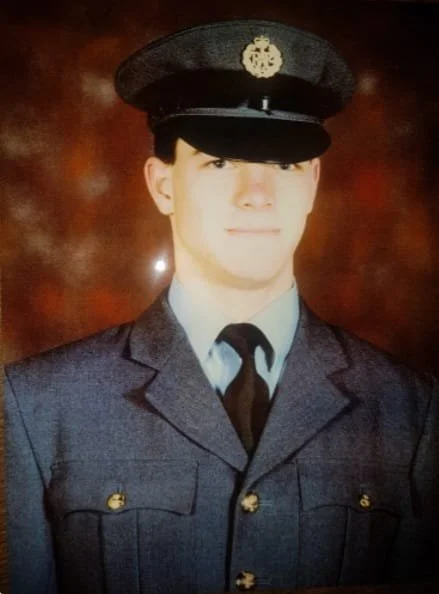
‘Raymond McCord Junior. Murdered by UVF cowards, betrayed by a Judas. Murdered Remembrance Sunday 9th November 1997. Always loved and never forgotten.’
Fresh appeal over the IRA shooting of UDR man 50 years ago today
NIALL McGREEVY, Belfast Telegraph, November 9th, 2026
MECHANIC JIMMY SPEER WAS MURDERED IN HIS GARAGE IN 1976
A fresh witness appeal has been made over a mechanic who was killed at his place of work half a century ago today.
Joseph James Speer, a married father-of-three, was shot dead by the IRA on November 9, 1976 at his garage on Longfield Road in Desertmartin.
The 46-year-old, known as Jimmy, was a part-time member of the UDR.
Shortly before 6pm on the day of the killing, two armed men stole a light blue coloured Ford Cortina bearing the registration number JIA 6492 from a garage on Drumard Road in Draperstown.
At around 6.10pm a man entered the office at Mr Speer's garage and asked for someone to look at his car's radiator.
The man then pulled out a gun and shot Mr Speer. A second gunman also fired at him.
The gunmen escaped in the stolen Ford Cortina, abandoning it on Motalee Road in Magherafelt.
Amanda Logan of the Independent Commission for Reconciliation and Information Recovery (ICRIR) said: “The commission is launching this appeal for information on the 50th anniversary of Jimmy Speer's death. This attack, like many others during the Troubles devastated a family.
“For half a century Jimmy's loved ones have endured the pain of their loss and the commission is working to provide them with the truth about what happened to him.
Five decades
“For five decades the Speer family have sought the truth of what happened to Jimmy. I appeal to anyone with information concerning the attack to come forward to the commission. What you know, no matter how insignificant it may seem, could prove to be key in providing the answers they have waited so long to receive.”
On Friday Mr Speer's children Deirdre, Cheryl and Dermot released a statement.
“In many ways, 50 years is a long period of time, but when it comes to terrorism and losing a loved one as a consequence, time does not have the same meaning,” they said.
“In many ways we, as the children of Jimmy Speer, remain locked in the day the Provisional IRA callously stole away his life.
“We were aged just 16, 14 and 11 years, and in that moment of sheer horror our lives collapsed before us.
“Our mum (Ruby) was given a new identity that she never asked for, nor deserved. She was now a UDR CGC widow, a single mother and she had to somehow find the strength to carry on — for us.
“People outside of those who have a loved one murdered think that the anniversary date of the murder is the day in the year when we would find living particularly difficult, but that doesn't come close to the full story.”
Stolen anniversaries
The statement added: “Our dad was born on Christmas Day (1929), and each Christmas it was a double celebration for us as children. Following father's murder, we never felt able to connect with Christmas in the same way again.
“Our parents' wedding anniversary was on our mother's birthday, so she never had another birthday that held any joy. Nor did Deirdre, whose 17th birthday fell not just on Remembrance Day, but on the day of our father's funeral.
“The Provisional IRA also stole those from us. At graduations, weddings, births of grandchildren, there was always his empty place.”
Victims' campaigner Kenny Donaldson said: “Mr Speer was murdered for reasons of ethnic and sectarian hatred and the impact experienced by his family has been significant, and continues.
“The Speer family are another family who have had next to no focus over the years, and we support the call for anyone living within this community who has information which could lead to belated transparency and accountability around what they have been subjected to search their hearts.
“Don't look at the three adult children now who are all aged over 60 years. Rather, imagine them as the 11 year-old, 14-year-old and 16-year-old children who were robbed of their dad. There must be accountability for the life sentence they have been subjected to.”
Anyone with information can contact the ICRIR on 028 90 362093 or via the email witnessappeals@icrir.independent-inquiry.uk
Voters still back Union over Irish reunification but gap is narrowing
SUZANNE BREEN, Belfast Telegraph, November 9th, 2026
SUPPORT FOR UNITED IRELAND STRONGEST WITH THE YOUNGER GENERATION
The gap between support for Irish unity and Northern Ireland staying in the UK has narrowed in the past year.
In a new LucidTalk poll for the Belfast Telegraph, 46pc of voters would opt to maintain the Union while 42pc would back a united Ireland if a referendum was held now.
There was a seven-point gap between the two sides in our survey last year when 48pc backed staying in the UK and 41pc unity.
The pro-Union camp had an even bigger 10-point lead in 2024.
Some 12pc of people in our latest poll are unsure how they'd vote. Alliance/Green supporters favour a united Ireland over the Union by a margin of two-to-one, although the biggest group among the political 'Others' is undecided.
While almost nine in 10 nationalists and 56pc of Alliance/Green supporters want a border poll within the next decade, seven in 10 unionists say one should never be called.
UUP voters more open to United Ireland
UUP voters are more open to a referendum at some point in the future than other unionists: 52pc say 'never' compared to 74pc of DUP and 79pc of TUV supporters.
The Good Friday Agreement states a border poll should be called by the incumbent Secretary of State when they believe there is evidence that public opinion here has shifted in favour of change.
However, successive UK governments have refused to specify publicly what criteria will be applied when measuring public sentiment on the issue.
The DUP has said Northern Ireland does not need a “divisive” border poll, while Sinn Fein has urged the Irish government to begin planning for a referendum.
Tánaiste Simon Harris unveiled Fine Gael's blueprint for Irish unity at his party conference, An Ireland Alive With Possibilities, at the weekend.
The report estimated the cost of a united Ireland could be up to €25bn (£20.87bn) in year one.
The figure is the highest year-one cost projection. It also sets out a more favourable annual cost of €3.2bn (£2.67bn) in the first year depending on the design of the constitutional change.
Support for a united Ireland is strongest with the younger generation.
It leads staying in the UK 46pc to 45pc among the under-35s; 48pc to 42pc among 35-44 year-olds; and 45pc to 43pc among 45-54 year-olds.
Maintaining the Union is significantly ahead among older voters: 54pc to 37pc with 55-64 year-olds and 47pc to 34pc with the retired.
Despite the SDLP leadership strongly supporting Irish unity, not all its voters are convinced. While 70pc want a united Ireland, 10pc don't, and 20pc are undecided.
More Alliance/Green supporters would vote to end the Union (38pc) than to keep it (19pc), but the biggest group (43pc) is undecided.
The number of Alliance/Greens backing Irish unity is up seven points on last year, while the amount of SDLP voters doing so has fallen nine points.
The desire for constitutional change has grown significantly among non-voters. They now back Irish unity by 42pc to 38pc - a fifth of them remain undecided - compared to last year when 70pc backed the Union and 29pc wanted to end it with just 1pc undecided.
Some 84pc of Protestants support staying in the Union, while 80pc of Catholics want to leave. There are now marginally more pro-Irish unity Protestants (7pc) than Catholic unionists (6pc).
However, more Catholics (14pc) are undecided on our constitutional future than Protestants (9pc). People of no religion lean more towards Irish unity (45pc to 32pc), with 23pc are undecided — a key swing group.
Only 20% of Unionists ‘could live’ with united Ireland
If a border poll resulted in a united Ireland, three quarters of unionists say they'd find it impossible to accept while a fifth could live with it.
The overwhelming majority of TUV (87pc) and DUP (80pc) voters would find a pro-unity result impossible to accept. Some 60pc of UUP supporters say the same, while 30pc wouldn't be happy but could live with it.
Unionists are more likely to be driven purely by their feelings of national identity and to refuse to consider social and economic factors when voting in a border poll.
Four in 10 insist they feel so strongly about being British that they won't consider any other issue when it comes to a referendum on our constitutional future, compared to a third of nationalists and just one in 10 Alliance/Green voters.
The economy is a key issue for 25pc of Alliance/Green voters, 23pc of nationalists, and just 7pc of unionists.
The health service and welfare system is important to 32pc of Alliance/Green voters, 18pc nationalists and 12pc of unionists in a referendum.
One in four unionists says their vote would be influenced by the treatment they would receive as a minority in the new state.
The likelihood of Irish unity resulting in violence would influence 17pc of Alliance, 10pc of unionist, and seven pc of nationalist voters.
Some 55pc of all voters want a united Ireland now or aspire to it. In comparison, 43pc say they support remaining in the UK now and in future.
Just one in 10 Alliance/Green supporters backs maintaining the Union now and in future with eight in 10 aspiring to Irish unity.
Some 3,989 people took part in our online poll from October 29 to 31, the largest ever held in Northern Ireland.
The sample was scientifically weighted to reflect the population.
‘Every opinion under the sun’ offered in party’s unity debate
MARK HENNESSY, Irish Times, November 9th, 2026
Many questions remain unanswered, but unification is now firmly on the radar
The large lecture hall in the Western Gateway building in University College Cork’s campus had been dubbed the Fitzgerald Room for the weekend during the Fine Gael ardfheis.
On Sunday afternoon it was filled to the gills for the meeting held to debate Fine Gael’s unification documents, which had been worked on since last May following the instruction of party leader Simon Harris to draft a blueprint for unity.
The documents do not meet that threshold, though there is little doubt that the party has managed to put the debate about unity, and its opportunities and challenges, into a broader stream of conversation.
Hard answers on a lot of questions are not possible, the party argues, such as the costs that would come with unification each year, or what would happen with the British responsibility for Northern Ireland pensions. However, that is rather the point in the eyes of economist Stephen Kinsella, who put the costs of unification for the Irish exchequer in the first year between €3.5 billion and €20 billion.
The final costs on unification, if it happens, will depend on the work that has been done in advance, and the efforts that can be made now and in the years ahead to boost Northern Ireland’s economy.
Modelled on the New Ireland Forum of the 1980s, a standing committee should be created to be a home for debate and listening for all shades of opinion on the subject of unification.
For months, Fine Gael members had gathered to debate the options, or even the desirability of unification – with every opinion under the sun being offered, said Minister of State Neale Richmond.
Introducing the report, the chair of the working group that piloted the report, Emer Currie, talked of how as a teenager in Tyrone during the 1980s so much of the importance for her that world unity by peaceful means would happen one day.
A first chapter
However, her father Austin, a former leader of the SDLP, then moved to Dublin to become a Fine Gael TD, where Currie said she began to learn that the desires she held so fervently were not necessarily held in the same way south of the border.
The work done is but a first chapter, though a more detailed report will be brought before the Fine Gael parliamentary party late next year in advance of the party’s next ardfheis.
Harris, however, mused that the work could and should begin more quickly, leaving open the possibility for talks with Fianna Fáil next year in advance of the changeover between him and Micheál Martin, or his successor, in the Taoiseach’s office.
If Harris is right and work begins next year, not after the next election, then Harris and Martin will have to agree terms and conditions in a world where Martin has long believed cautious steps are necessary.
However, that line proved not to be holdable, which led him to propose ideas a week in advance of the ardfheis that would see a group set up to look at all options – including a continuing place in the UK union for Northern Ireland.
If many of the questions have not been answered, there is little doubt that the weekend in Cork has put the subject of unity firmly on the radar for that element of the southern vote who are ready to become involved.
Cost of unification a blank cheque
By Cillian Sherlock, Press Association, Irish News, November 9th, 2026
There is no “one figure” for the cost of a united Ireland, the Tánaiste has claimed as he said his party’s policies provided for more “sophisticated” discussion on the proposal.
At the Fine Gael Ard Fheis in Cork on Saturday, the party published a “blueprint” on Irish unity which proposed a new junior minister for North-South relations in a dedicated unit within the Department of An Taoiseach and the establishment of a dedicated sovereign wealth fund to deal with the potential costs of transition.
The publication of the report came shortly after Taoiseach and Fianna Fáil leader Micheál Martin suggested a body, the Future Studies Initiative, should be appointed to oversee research into future scenarios for Irish unification.
Opposition parties had also piled on pressure for the Government to make preparations for a debate on a united Ireland.
The blueprint projected a potential worst-case cost of a united Ireland could be up to 25 billion euro in year one.
The most adverse high-cost scenario also estimates a potential bill of 41.2 billion euro for year 25 after unity.
Both sides of the Irish border as the Newry River flows out to Carlingford Lough
Worst scenario
The cost to the Exchequer in year one ranges from circa 3.2-25 billion euro depending on the design and the deal with the British government, according to the report.
The settlement with the British government on pensions and debt is the largest policy choice in the early years, the report states, from between four billion euro and 24.8 billion euro.
On Sunday, Fine Gael leader Simon Harris said he wanted to see a united Ireland in his lifetime, adding that gathering a sustainable majority for the constitutional change would require political leadership being able to answer questions raised by the blueprint.
Asked if he believed Fine Gael voters would be happy to pay 25 billion euro in the first year of a united Ireland, Mr Harris said: “I don’t think anybody on the island of Ireland would see 25 billion euro as – let’s call it – a settlement amount in relation to a unified island in the first year, and that’s not the purpose of the document today.”
He added: “What we’re basically saying is if you decided on day one – which isn’t how anybody would unify anything, by the way – but if you decided on day one everything would be immediately aligned and there would be, let’s call it, a bad settlement with Britain.
“In other words, Britain wouldn’t play any role around debt or pensions, the cost could be up to 25 (billion).
“If you did this over a more sustained period and there was – let’s say – a better arrangement with the UK in the first instance, the cost could fall to three.”
Mr Harris said the question on the single-figure cost of a united Ireland is “unfair” as “it doesn’t exist”.
“That’s why the conversation does require a proper standalone constitutional forum, ongoing engagement, and a conversation that’s maybe more mature and sophisticated.”
The publication of the document was welcomed by Sinn Féin leader Mary Lou McDonald and SDLP leader Claire Hanna.
However, the DUP dismissed the blueprint as part of a political “race in Dublin to look the greenest” and said it had “nothing to do with the people of Northern Ireland”.
Gareth Wilson, DUP MLA for Newry and Armagh, said: “Northern Ireland’s place in the United Kingdom rests on the consent of the people who live here. Fine Gael signed up to that principle.
“No forum, no secretariat and no five-year talking shop in Dublin changes it.”
No plans to run candidates
Fine Gael deputy leader Helen McEntee previously said the party would have discussions on running candidates in Northern Ireland when asked if it was fair for Fine Gael to use its subtitle “The United Ireland Party”.
Asked for an update on those discussions on Sunday, she said there were “no plans” to run candidates in Northern Ireland’s upcoming elections but added: “At the same time, if that was a decision that we were to take, it would be taken within the party.
“Our focus has been on this particular document, and I think what it shows is, for the first time, certainly since I’ve been involved in politics, is that we are having real conversations around what a unified Ireland might look like.”
Minister Neale Richmond said the issue of running candidates in Northern Ireland did come up during regional engagements in preparation for the blueprint.
He said membership was “realistic” that it would involve a process including “reasserting” Young Fine Gael branches in universities.
Poll slump shows DUP losing its grip on Unionism
SUZANNE BREEN, Belfast Telegraph, November 9th, 2026
For more than two decades, the DUP ruled unionism with an impregnable dominance. It almost wiped out the UUP, inheriting much of its electoral support, effectively becoming the political voice of the unionist community.
The latest polling raises an intriguing possibility: could the DUP now be facing the same challenge from two directions that it once presented to the UUP?
In 1998, David Trimble led the UUP's support for the Belfast Agreement. His party was the largest in unionist politics, but the fallout from entering government with “Sinn Féin/IRA” caused deep divisions internally. Ian Paisley's DUP challenged and undermined Mr Trimble's leadership, presenting itself as an alternative with a clear identity.
The DUP takeover was complete by 2005 when Mr Trimble lost his Upper Bann seat having endured the public embarrassment of defections from two future DUP leaders in Arlene Foster and Jeffrey Donaldson.
Is the political landscape within unionism beginning to turn again, almost 25 years later?
Jon Burrows and the UUP represent a moderate, institutionally minded approach. A more traditional position is led by Jim Allister's TUV, with Carla Lockhart's departure from the DUP bringing this bloc into sharp focus. The irony that Ms Lockhart represents the constituency once held by Mr Trimble underlines the change in fortunes for the DUP.
Gavin Robinson's decision to retain Emma Little-Pengelly as Deputy First Minister, thus keeping Michelle O'Neill in office despite her lawbreaking, is key to understanding the predicament unionism, and particularly the DUP, finds itself in. Unionists narrowly support Ms Little-Pengelly's resigning, according to the Belfast Telegraph's LucidTalk poll. More worryingly for the DUP, 41pc of its voters are 'unconcerned' if Stormont were to collapse.
Falling between the cracks
In short, unionism is almost perfectly split, with the DUP appearing to fall between the crack in the middle.
The DUP stance has exposed a fundamental disagreement about the purpose of unionist participation in power-sharing, which has played a key role in Gavin Robinson being the least popular unionist leader at 47pc compared to Ms Lockhart at 68pc.
Worse still, DUP voters rate Ms Lockhart at 73pc compared to Mr Robinson at 60pc, with Jamie Bryson almost as popular at 59pc.
In normal circumstances, leadership contenders would be sharpening their knives. The fact that there is no threat to Mr Robinson underlines the painful position in which the DUP now exists.
There may be some who regret the haste with which they hysterically worked to unseat Edwin Poots, albeit no one could have predicted the horrendous circumstances thrust upon the DUP at Easter 2024, when Donaldson was arrested and charged with historical sex offences.
Mr Robinson's stance does not automatically win him the moderate unionist vote. Mr Burrows and the UUP can argue that they offer a more consistent version of that institutional politics. The biggest lesson from the polls is that those who have provided clear and concise messaging have performed well in the recent polls.
“There will be no business as usual”, the DUP insisted, while business continues as usual but without photographic evidence.
Mr Robinson's difficulty is that the DUP is being challenged from both sides. Those who want to maintain the institutions have an alternative in the UUP. Those who believe the party has not taken sufficiently decisive action have an alternative in the TUV.
However, it would be premature to write off the DUP ahead of next May's Assembly election.
Political momentum and electoral machinery are two different things. The DUP remains an established party with sitting MLAs, substantial constituency organisation, incumbency and a much larger political infrastructure than either the UUP or TUV.
It also has the advantage of a recognisable brand and a deeper pool of established political representatives, while habitual voting is another factor worth remembering. Those advantages could protect the DUP next May, even if the underlying political direction remains difficult. The UUP and TUV may be attracting attention, but converting that into seats requires credible, well-known candidates in the right constituencies. Neither party can assume polling figures will translate into an equivalent Assembly result.
However, electoral survival should not be confused with having answered the questions now confronting the party.
The DUP spent decades arguing the UUP had lost touch with unionist voters as it changed leader like Chelsea FC changed managers.
Making choices
Moreover, the UUP struggled to give any tangible example of difference with DUP policies and, in reality, why it continued to exist. Ironically, the DUP now needs to explain what distinguishes its approach from the UUP's, while convincing more traditional unionists that it has not abandoned the principles on which it built its success.
The history of the past two decades offers a warning. Political dominance is never guaranteed, and parties that take their support for granted can discover they have an expiry date.
The UUP once struggled to hold together different traditions of unionism. The DUP subsequently brought many of those traditions under one roof. The current tensions suggest history is now repeating itself. Unionism must agree on what it wants to achieve, how it intends to achieve it, and what role it believes it should play in government.
The DUP may well retain most of its seats in 2027, but the political debate about the future of unionism started long ago.
Unionists can no longer bury their heads in the sand or there will be profound consequences for unionism.
David Graham is a former DUP special adviser and councillor