Hundreds attend vigil in memory of murdered pregnant mother
John Breslin, Irish News, July 3rd, 2025
Hundreds attend vigil in memory of murdered pregnant mother ‘who would never pass you without a smile’
HUNDREDS of people gathered last night for a vigil to remember Sarah Montgomery, the pregnant mother of two young girls found murdered inside her north Down home last weekend.
The vigil, organised by the Beechfield Community Wellbeing Centre in Donaghadee, involved a short walk from the local resource centre to the 27-year-old’s home on Elmfield Walk.
Many wore purple, while flowers and soft toys were left outside the house. A minute’s silence was observed.
The vigil took place following the appearance at Newtownards Magistrates’ Court of a man charged with Ms Montgomery’s murder, and also with child destruction.
Organisers of the vigil, including North Down and Ards Women’s Aid, received permission from Ms Montgomery’s family.
The organisers said: “Sarah is not just a statistic, Sarah was a mummy, a sister, a granddaughter and a friend, she deserves to be remembered in a dignified manner.”
North Down MLA Peter Martin said “literally hundreds and hundreds” gathered, with entire streets closed due to the crowd.
“The message was simple – no more,” Mr Martin wrote on social media.
A fundraising page set up in memory of Ms Montgomery, who was approximately over £40,000 as of yesterday evening.
Organisers of the page said: “Donations will not ease the pain that this family will have to live with forever, but, as a close knit community, we are keen to show them that they are so loved and supported at this sad time and in the days, months and years to come.
“Violence against women will not be tolerated in our community. We must stand together to ensure that this will never happen again.”
They said the events of this weekend “have brought the community and indeed a wider circle to its devastated knees”.
Ms Montgomery was described as a “popular girl who would never pass you without a smile or a chat”, and the page added that her two daughters “have now been robbed of the nurture and love to guide them”.
Natalie McNally
Among those who attended the vigil were some members of the family of Natalie McNally, who was pregnant when she was killed in Lurgan, Co Armagh in December 2022.
Earlier in the day, a 28-year-old man appeared in court charged with the murder of Ms Montgomery
Zak Hughes, from Ardglen Place in Belfast, was also charged with child destruction during a brief appearance at Newtownards Magistrates’ Court.
Dressed in a grey tracksuit, he stood in the dock and nodded when asked if he understood the charges.
A PSNI detective chief inspector told the court he could connect Hughes to the offences.
No facts of the case were laid out and there was no application for bail.
The date of the alleged offences given on court papers was June 27.
District Judge Conor Heaney remanded Hughes in custody until July 30.
A 42-year-old woman, who was arrested in Belfast on suspicion of assisting an offender, was released unconditionally on Tuesday.
The death of Ms Montgomery has led to renewed focus on the rate of violence against women and girls in Northern Ireland.
She was the 27th adult woman to be killed in Northern Ireland since 2020.
'She was the best mummy and couldn't wait to add her little boy to the family'
Niamh Campbell, Belfast Telegraph, July 3rd, 2025
TRIBUTES AND TEARS AT VIGIL HELD FOR WOMAN FOUND DEAD IN HER HOME
A vigil held in Co Down last night for mum-of-two Sarah Montgomery has heard she was the “best mummy with the biggest heart”.
The 27-year-old, who was around 34 weeks pregnant with a baby boy, was found dead at her home in the Elmfield Walk area of Donaghadee on Saturday afternoon.
Earlier yesterday, Zak Hughes (28), of Ardglen Place, Belfast, appeared at Newtownards Magistrates Court charged with Ms Montgomery's murder and destroying the life of her unborn child.
Last night the local community held a vigil for Ms Montgomery, in collaboration with the North Down & Ards Women's Aid group.
Beginning at 6.30pm, those who came out to show their respects gathered at the Donaghadee Resource Centre and walked the short distance to her home.
Attendees were encouraged to wear anything with the colour purple.
Women's Aid workers also distributed purple ribbon pins.
Ainslie White, Ms Montgomery's best friend, told the crowd that her two daughters “will be the most protected wee girls ever”.
She also described her pal as having “the biggest heart” and someone who “absolutely loved band season”.
She asked mourners to raise a glass and think of her friend on the Twelfth next week.
“Sarah was the best mummy and she couldn't wait to make her family complete with her little boy,” said Ms White.
“I had been lucky enough to attend her gender scan with her, where her daughters were unsure whether they wanted a baby brother or a baby sister... once they found out it was a boy, they were more than happy because then they wouldn't have to share their stuff with him.
“I hope Sarah knew how much she was loved, and I don't even have the words to begin how to describe Sarah as a friend.
“I was honoured to call her my best friend and my sister at the same time.
“Sarah was the kind of girl to leave you a 10-minute voice note... she never failed to put a smile on your face. She was a girl's girl and she had your back, through and through.
“She was there for absolutely everybody and it had been an honour to have her in all of our lives.”
Ms White shared that Ms Montgomery had joked about how their nearest Twelfth parade celebrations will be in Dundonald this year, because it would be a few weeks before her birth due date.
“She would say: 'I would only be a few minutes away from the hospital, all you have to do is carry me there',” her friend explained.
“Anyone that knew Sarah knew how much band season meant to her.
Band season
“Any band season, that's where you found Sarah Montgomery... so can I ask everyone that for the Twelfth of July this year, can you please raise a glass for our girl? And if you're feeling really rebellious, can you have a tequila rose, because that's what she loved the most.”
Mourners left bouquets of flowers, toys and candles in memory of Sarah at the entrance to her home.
Many also left notes and letters. One friend said: “There are no words for what has gone on. You [Sarah] will always be remembered for being such a kind and down to earth young woman.”
Sarah was also been described as thoughtful and generous. She regularly helped volunteer and fundraise for the RNLI's Donaghadee lifeboat division, and also donated to various other charities and fundraisers, including Dementia UK and the Miscarriage Association.
Whilst many of her loved ones are in shock and grief, some also shared their anger this week.
One woman, who knew Sarah through her charity work, said: “For decades, this country has been on a slippery slope, it's no f***ing wonder. My skin is actually crawling [at what has happened to Sarah].”
A spokesperson for the Beechfield Community Wellbeing Centre, who helped organise the vigil, stated: “Sarah is not just a statistic, Sarah was a mummy, a sister, a granddaughter and a friend, she deserves to be remembered in a dignified manner.”
A fundraiser set up in memory of Ms Montgomery had last night raised £40,000.
Those behind it said that her wider family had been “left bereft of the care and support” that she had always provided.
The statement added: “Donations will not ease the pain that this family will have to live with forever but as a close-knit community, we are keen to show them that they are so loved and supported at this sad time and in the days, months and years to come.
“Violence against women will not be tolerated in our community. We must stand together to ensure that this will never happen again.” Alison Blaney, the chief executive of Kilcooley Women's Centre, called for local politicians to stop paying “lip service” to the issues facing local woman.
“We just need to be doing more... providing more services for women to access, because down here the services available are appalling.
“That is the only way I can describe it; appalling.”
Details for Sarah's funeral have yet to be released.
It’s the most wonderful time of the year (if you love towering infernos)
Leona O’Neill, Irish News, July 3rd, 2025
HAPPY July everyone. It looks like it is shaping up to be a really fabulous one for all of us who love nothing more than expressing ourselves through the medium of raging towering infernos.
Honestly, for those of us who are total strangers to health, safety, healing and normality, it really is the most wonderful time of the year.
Bonfire season kicked off strongly with a sodden Dundonald double mattress bearing the slogan ‘All taigs will be crucified’ appearing alongside other vulgar and racist slurs.
In Belfast, folks were building their pyre beside a large pile of material that was believed to be contaminated with asbestos.
Health and safety boffins – who tend to all go on holiday at this time of year – would tell you that lighting a fire beside asbestos is an extremely bad idea.
They would also say that even without asbestos, bonfires release harmful pollutants into the air, including fine particulate matter and other toxins, which can exacerbate respiratory and cardiovascular conditions and pose risks to lung and brain health.
Presumably some would also say that culture cancels out all this bad stuff and just work away with your fire, lads.
We’re at the start of the process now. We have a good two weeks left to fill with madness – posters and placards daubed with horrible, sickening slogans, effigies of hate figures, and family homes having to be boarded up and hosed down in case the mammoth community fires on their doorsteps set them alight.
Is it any wonder that those looking in on this place think the heat of the Northern Irish summer makes us lose our actual minds?
Nine year old participant
I’ve covered many Eleventh nights in this place over 25 years as a reporter, and I can’t say I felt very comfortable at any of them.
I’m sure others have different emotions when near a bonfire, but I think the most prominent emotions I felt were sadness and despair.
Sadness that the skill of the young men building these feats of engineering was not nurtured into a trade that could help them make a life for themselves.
Sadness that a lot of the bonfire culture seemed to revolve around copious amounts of alcohol.
Despair at the vitriol that seems to revolve around many of them.
I still remember the nine-yearold who pushed his way past me to spray ‘Kill All Taigs’ on the sofa someone had left out to burn, 27 years after the Good Friday Agreement.
A sectarian slogan was sprayed on a mattress left at a bonfire in Dundonald outside east Belfast
“ We are not a healed society and never will be if these towers of division keep burning year on year
One week to go to Eleventh Night and asbestos remains at bonfire site
Conor McParland, Belfast Media, July 3rd, 2025
WITH just over a week to go until the controversial Westlink Eleventh Night bonfire is lit, two statutory agencies are remaining silent on whether dangerous asbestos material nearby will be removed.
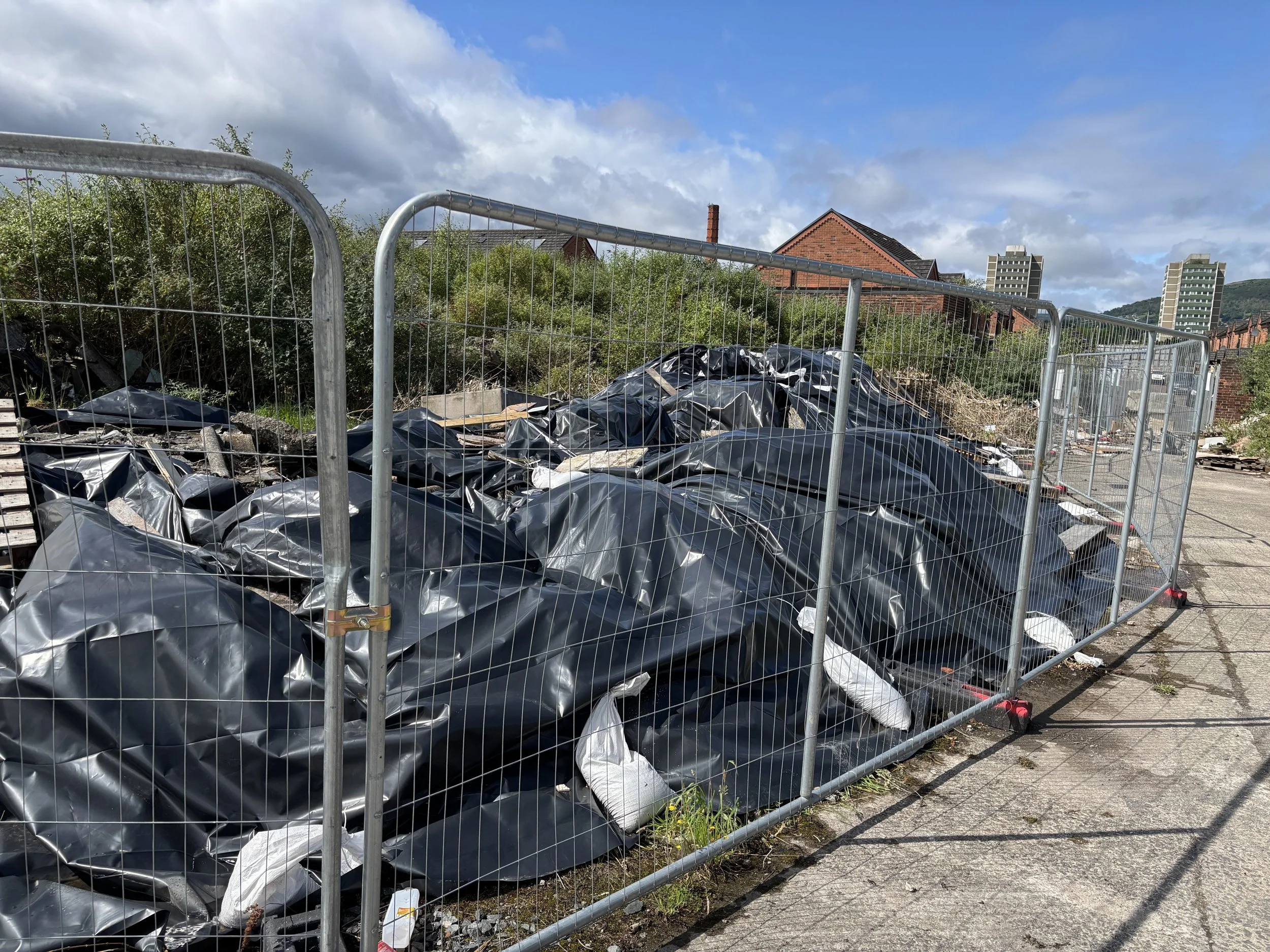
Last week, we visited the sprawling former Ulster Weavers factory site off the Donegall Road where two months ago a large quantity of the lethal fire-retardant material was found dumped on the site of an Eleventh Night bonfire.
We reported that the huge pile of asbestos next to the bonfire has been secured by a plastic sheet held down by bits of scrap wood and sandbags.
A number of six-feet high portable wire fencing panels have been placed around the asbestos. On top of the illegally dumped material a black plastic sheet has been spread, held down by bits of scrap wood and sandbags. Where the sheeting is held to the ground by the sandbags, multiple gaps expose the asbestos underneath.
It's believed the asbestos is from the roof of the now-demolished factory where linen and textile products were once made.
The Northern Ireland Environment Agency (NIEA) and Belfast City Council have been involved in a game of pass-the-parcel over responsibility for dealing with the asbestos, which an NIEA source recently told BBCNI could cost £100,000 to remove.
It’s not known whether the fencing and sheeting were put in place by City Hall, the NIEA or the owner of the site, who both agencies have been in contact with.
Refused to say if asbestos will be removed
When contacted again this week, both the NIEA and Belfast City Council refused to tell us whether the asbestos material will be removed.
The Northern Ireland Environment Agency (NIEA) directed us to a previous statement, which read: "We received a complaint concerning potentially hazardous waste at a site in the vicinity of Meridi Street, Belfast on the afternoon of Friday 16th May.
"Staff from the Environmental Crime Unit within NIEA were in contact with Belfast City Council about the matter on Monday 19th May and enquiries are ongoing."
Meanwhile, a Belfast City Council spokesperson this week said: “Belfast City Council continues to engage with the landowner and NIEA in relation to this site.”
A local builder we spoke to, who has experience of working with and disposing of hazardous materials, examined our pictures and said the asbestos remains a danger to anyone in its vicinity.
“The fencing is portable and easily bypassed or removed,” he said.
“The sheeting has been secured using whatever they seem to have had handy, rather than what’s needed to do the job. It’s just amateur hour.
"There’s nothing effective enough either to keep kids from getting in there, to stop the elements doing their bit, or to stop burning debris from landing on the plastic. Asbestos is dangerous, but when it's burned it becomes much more dangerous. And there’s gaps everywhere in the sheeting – a strong wind would easily blow it off.”
DUP accuses non-unionist parties of ‘carve-up’ at Belfast City Council
Michael Kenwood, Irish News, July 3rd, 2025
THE DUP has accused non-unionist parties in Belfast City Council of an Irish language “carve-up” after it was agreed most of a financial underspend will go to a new Gaelic policy.
At the council’s full meeting on Tuesday, members agreed a Sinn Féin proposal on how to use the £2,940,000 underspend from last year’s net expenditure budget.
Sinn Féin’s Natasha Brennan successfully proposed spending £1.9 million on an incoming Irish language strategy, £500,000 for “resilience” funding for “newcomer” families and communities, £440,000 for the purchase of cleansing equipment, and £100,000 for biodiversity measures.
A vote on the proposal showed 41 in favour – from Sinn Féin, Alliance, SDLP, Greens and People Before Profit – while the DUP, UUP and TUV were against the proposal with 16 votes.
Conflicting priorities
DUP councillor Sarah Bunting said the council should stick to a decision that was made in a behindclosed-doors committee session last month.
In this meeting, on a narrow vote, it was decided £100,000 would be reallocated to HERe NI, a charity for LGBTQIA+ women, and £2m previously allocated for a National Music Award bid would be removed and reallocated to committed and additional funding requests.
It was also agreed in the committee meeting that an update report would be provided in August on the Irish language policy and underspend reallocation would be considered for that after a workshop to be held in September.
This was passed on a vote with 10 members from the unionist parties and Alliance, to nine members against from the remaining parties.
The plan was jettisoned during Tuesday evening’s full council meeting after Alliance sided with the new Sinn Féin proposal.
Alliance councillor Michael Long said: “We believe this is a good opportunity to use an underspend to deal with a number of issues.
“Obviously we are developing an Irish language policy, and it will require funding to allow that to happen.
“But we are looking at other issues that need to be sorted out in our city.
“Given in recent weeks the issues we face in terms of racism in this city, it is important we tackle that, in a really strong way, and send out a message that Belfast City Council is not going to stand for that type of racism.”
Green party Councillor Áine Groogan said: “We have put an awful lot of work into developing an Irish language policy, as we should do, but the worst thing we can do is have a policy or a strategy that is not costed or funded.”
Ms Bunting said: “It is funny that quite often the Alliance Party accuses the DUP of making a bit of a carve-up, it seems there is a bit of carve-up between them and four other parties in this chamber.
“I mentioned at the committee I think it is madness to be putting money into an Irish language policy that we haven’t agreed through this council yet.”
She asked if the proposal to designate the money to the Irish language policy was competent.
The council’s chief executive John Walsh said: “It is competent to allocate money into a budget, and then to develop the proposals that flow from that.”
Sweet music for GAA if they end up with 'NI's premier outdoor concert arena for £15m'
John Laverty, Belfast Telegraph, July 3rd, 2025
If you were asked to name three of the GAA's biggest stars of the last decade and answered “Bruce Springsteen, Garth Brooks and Coldplay”, you wouldn't be wrong.
These are the guys guaranteed to fill Croke Park to the rafters every time, while crossing the association's palms with £854k of silver per night for rental alone.
The Boss clearly loves GAA stadiums. Three of his last four gigs on the Emerald Isle were at Croker, Páirc Uí Chaoimh in Cork and Kilkenny's Nowlan Park.
At a mere 30,000, the hurling kingpins' home was the smallest, yet it could still boast a considerably larger capacity than any enclosed venue in Northern Ireland.
Ah, if only the GAA had agreed to increase their financial pledge for the new £200m Casement Park — at least in line with inflation — three years ago after legal action against the stadium's redevelopment was dismissed.
Instead, what we got were warm smiles and this bold prediction from Antrim County Board chairman Ciaran McCavanagh: “We're hoping to commence in 2023 and have the stadium built and completed by 2025...”
As deluded optimism goes, this was right up there with 20th Century Fox boss Darryl F Zanuck's famous 1946 declaration that: “Television won't be able to hold onto any market; people will soon get tired of staring at it.”
The GAA's £15m commitment to Casement may have sounded a lot in 2012 when it was 20% of the estimated construction budget, but it's less than half that percentage now.
Indeed, there are kids in Antrim shirts playing hurling and football who weren't even born when that £15m pledge was made.
But, as far as GAA president Jarlath Burns is concerned, it's the UK government that needs to come up with the necessary readies.
That's a baffling stance because, as the GAA's history and swelling coffers have shown, it's not hard to rake in shedloads of dough when you've got huge, functioning, multi-purpose stadiums.
Croke Park is now being marketed online not as a GAA venue per se, but as “Ireland's Premier Outdoor Concert Arena”.
It even produces replacement turf — in its own Balbriggan farm — to cater for rapid turnarounds between gigs and sports fixtures; yep, when it comes to Croker the grass is, literally, always greener.
GAA revenue soaring
As a result, GAA revenue is soaring despite falling attendances at its matches; up 19% last year, with the flagship stadium pulling in €41.44m of the overall €132m.
Last year was the most lucrative with six major gigs — Coldplay (4), Springsteen and AC/DC — while HQ's perpetually angry neighbours will 'welcome' the newly-reformed Oasis and Robbie Williams to Drumcondra next month. Springsteen will be in his 80s before Casement Park is finally built, but newbies like Sabrina Carpenter, Benson Boone and Charli xcx will be stadium veterans by then.
Perhaps a middle-aged Taylor Swift will make a welcome return to Belfast, having delighted 10,000 at the Odyssey 14 years ago prior to her career going stratospheric with albums like Red and 1989.
Meanwhile, and with the tumbleweeds still sweeping across an empty Casement, 'The Clearer Twist National Stadium at Windsor Park' hasn't been taking full advantage of its status as Northern Ireland's biggest stadium.
Only one major non-football event has been staged there in the last decade — boxing star Carl Frampton beating Luke Jackson in 2018 — with Lewis Crocker vs Paddy Donovan a possibility for later this year.
You can accuse the Irish FA of treading water, but anything they plan must suit fellow landlords Linfield FC. Perhaps the Blues should have a word with the Croker boys about a deal for some of that replacement turf...
As this year's Belsonic showed, there's no problem attracting big names like Justin Timberlake to this part of the world, but a maximum 25,000 stadium capacity isn't going to tempt, for instance, Beyoncé, whose management would regard somewhere like Windsor as not being worth the bother.
A full-scale Bey gig has 20 dancers, five costume designers, 25 wardrobe assistants, 40 drivers, 15 caterers, three nurses, two physios and 17 security personnel, not to mention the stage construction and lighting teams.
Only Croker could cater for that — as it did in 2016 — but this time 'Cowboy Carter' opted not to include Ireland in her world tour.
Instead, she played six nights at the 63k-capacity Tottenham Hotspur Stadium in north London.
The US superstar had initially requested use of the larger Twickenham, which can house a Croker-esque 82,000 but, much to English rugby chiefs' chagrin, Richmond council's licence restrictions — three non-rugby events per year, with a restricted crowd of 55,000 and only one on a Friday(!) — put the kybosh on that.
The RFU is now threatening to move to Milton Keynes or Birmingham if they're denied permission to stage 15 full-capacity events at Twickers.
By contrast, the £1bn Spurs arena has a licence for no fewer than 30 — yes, 30 — courtesy of Haringey's forward-thinking civic leaders.
With that in mind, maybe it's Belfast City Council that will end up holding the keys to the GAA's lucrative Casement kingdom.
If you build it — and green-light enough high-profile gigs every year — they will come.
There’s nothing stopping Stormont taking control of the benefits budget
Newton Emerson, Irish News, July 3rd, 2025
WELFARE reform is still supposedly going ahead, despite the government’s significant retreat on the issue.
Almost everyone at Westminster accepts the disability benefits bill is growing unsustainably, at horrendous social and economic cost.
Even the Labour rebels who voted against the government on Tuesday opened their motion with the words “this House, whilst noting the need for the reform of the social security system, and agreeing with the government’s principles for providing support to people into work…”
It was the failure to provide support that caused the rebellion.
Labour has a proper reform plan, which it worked out in opposition and adopted on entering office last summer – only for Chancellor Rachel Reeves to steamroller over it with short-sighted Treasury cuts.
All change to disability benefits has now been paused until autumn next year, pending a review. It is possible there will be no fall in the projected spending increase by the end of the decade. Nevertheless, reform will remain on the agenda.
Stormont does not have to be a spectator in this. No doubt it will choose to let Westminster impose reforms, while complaining about them, lamenting it cannot afford to stop them, and possibly tweaking them very slightly around the edges.
However, it is important to understand this is a choice and taking control is not just possible but entirely realistic.
Almost all benefits are devolved to Northern Ireland, a unique arrangement within the UK. The Treasury pays the bill directly where Stormont maintains parity with the system in Britain. If Stormont wants to be more generous, it has to fund the difference from its own budget, as it has done to mitigate the socalled bedroom tax and some lesser aspects of universal credit.
Stormont has never opted to be less generous than Britain and it would have to negotiate a new arrangement with the Treasury on how this would work. But it is clear how this negotiation would proceed, because Scotland has done it already.
Taking charge of benefits
Since 2016, the Scottish executive it has been taking charge of benefits one by one, including all disability benefits. The arrangement negotiated for this has established in law what is called the ‘no detriment principle’, meaning neither Holyrood nor Westminster should ever lose out financially from the initial decision to devolve.
When Scotland acquires control of a benefit, the full cost of paying it is added to its block grant. This is then adjusted every year to reflect changes in England and Wales.
Work and Pensions Secretary Liz Kendall this week laid out concessions on welfare cuts to Labour rebels
“ If there is to be any hope at all of Stormont doing better, the first step is to realise doing better is an option
So when benefit spending goes up in England and Wales, Scotland gets more money to spend as it likes.
It can and invariably does spend this on benefits itself, but it could choose not to and keep the difference. It would also keep the savings if it ever chose to be less generous than England and Wales.
This system is Stormont’s for the asking. If it took control and got a head start on reform, investing in its own policies to get people into work, the potential rewards are extraordinary. Disability benefit spending in Northern Ireland is around £3bn a year and will presumably rise to at least £7bn by the end of the decade, in line with projected growth across the UK. So an executive would have an extra £4bn a year by 2030 to invest in reform, then to spend on anything else as reform paid off.
Of course, Labour wants to reduce the growth in benefit spending in England and Wales, but its internal rows suggest it will make little headway. Stormont could reap enormous savings by doing only slightly better.
£2 a week rise in rates could save Water system
Expectations of Stormont are so low it seems absurd to discuss it doing anything on welfare. An executive that will not put household rates up by £2 a week to save the water system is hardly about to coax people off disability benefits.
All governments struggle with this issue, as Labour’s travails demonstrate. The Republic is experiencing similar problems with its social security system. Scotland only took control to put benefits up, which it has funded by partially devolving and raising income tax.
But there is no legal or practical obstacle in Stormont’s way. Even the much-cited cost of setting up its own benefits computer system would be trivial compared to the disability benefits budget, another lesson that can be drawn from Scotland.
If there is to be any hope of Stormont doing better, the first step is to realise doing better is an option.
President Higgins portrait is removed from city hall at new DUP mayor’s request
Conor Coyle, Irish News, July 3rd, 2025
A PORTRAIT of President Michael D Higgins has been removed from a reception room at Belfast City Hall following a request from DUP lord mayor Tracy Kelly.
The issue was raised at a meeting of Belfast City Council on Tuesday night with Sinn Féin councillor Ryan Murphy pointing out that the portrait had not been seen in “recent weeks”.
Mr Murphy also said that during his party’s tenures when holding the lord mayor position, portraits of both British monarchs and Irish presidents have remained in the reception room at City Hall.
During the meeting, Ms Kelly said that Mr Murphy’s point was “noted” but did not answer the question about where the portrait had gone.
Ms Kelly was installed as the city’s first citizen last month for the year-long term.
In a statement provided to The Irish News yesterday, Belfast City Council confirmed that the portrait had been placed into storage “at the request of the current lord mayor”.
“When our representatives have been in that position of being the mayor, there were certain things that we never took off the walls. There were certain things we felt were off limits
President Higgins safely stored away
“The decoration of the parlour is a matter for each individual lord mayor throughout their term in office,” a council spokesperson said.
“The photographic portrait of President Michael D Higgins has been safely stored at City Hall, at the request of the current lord mayor, while she considers options for this space during her mayoral term.”
A DUP spokesperson said the decoration of the lord mayor’s parlour was “not yet complete”.
“There will be further artefacts to be added in the next few weeks,” they said
Mr Murphy, himself a recent lord mayor, said Sinn Féin representatives held the view in previous mayoral terms that certain things were “off limits”.
“When our representatives have been in that position of being the mayor, there were certain things that we never took off the walls,” he said.
“There were certain things we felt were off limits.
“And so, when we were offered the royal portrait of the British king Charles we accepted it, and we put it up.
“And we put it up alongside Uachtarán na hÉireann Michael D Higgins, and we marked it with a small event in the mayor’s office.”
The issue is the latest controversy to have arrived at Belfast City Hall over portraits, after thousands of pounds worth of damage was caused to a picture of a former DUP lord mayor last year.
A Sinn Féin employee resigned after admitting involvement in the incident last year in which the portrait of Wallace Browne was damaged.
Activists begin third legal bid to activate Irish language policy
John Breslin, Irish News, July 3rd, 2025
ACTIVISTS have lodged legal papers over the executive and Communities Minister Gordon Lyons’ failure to deliver an Irish language strategy, the third such court action over the last decade.
The High Court has ruled twice previously declaring first the executive was in breach of its duties under the law and then that the failure was “unlawful”.
Conradh na Gaeilge’s judicial review application will again ask the court to declare the failure to develop and adopt a strategy since it was made law in 2007 as unlawful and order its publication.
Dr Pádraig Ó Tiarnaigh, of Conradh na Gaeilge, said an “Irish language strategy will set out the executive’s plan to promote and develop the language over the coming 20 years”.
“The original statutory duty was imposed in law in 2007. We have had two very decisive High Court declarations since then calling for the executive to act with urgency,” Dr Ó Tiarnaigh said, adding work should be ongoing on a second strategy rather than still waiting for the draft of a first.
“Irish language organisations have been working tirelessly… since 2021 to develop a strategy that will make a difference, helping families, parents, schools, communities and the state to develop their Irish language support structures.”
No alternative to courts
Dr Ó Tiarnaigh said: “We are incredibly disappointed… to have been left in no position but to seek further remedy from the courts. To have to return to the courts for a third time is simply unacceptable.”
Both the executive and the communities minister “have failed to uphold their legal duties and we have seen nothing to convince us that this is in any way a priority for the minister in charge of its development”.
A Department for Communities spokesperson said: “The department can confirm receipt of proceedings for a judicial review in this matter. No further comment can be made while legal proceedings are ongoing.”
Mr Lyons, due before the communities committee today, is involved in another legal action as he was granted participation status over Irish language signs at Grand Central Station.
He is arguing the decision taken by Sinn Féin infrastructure minister Liz Kimmins to approve the £150,000 scheme was both controversial and cut across his own departmental responsibilities.
Niall Murphy, of KRW Law, acting on behalf of Conradh na Gaeilge, confirmed his firm has lodged proceedings.
The plaintiffs are looking for an order “to immediately publish a comprehensive timetable and delivery of an Irish language strategy within a reasonable period of time”. This will include publication of “concrete steps towards and a concrete date for the adoption of an Irish language strategy”, Mr Murphy added.
Beattie: I was beaten in British army because I’m an Irishman
Irish News, July 3rd, 2025
FORMER UUP leader Doug Beattie says he was “beaten badly” by superiors in the British army because he was an “Irishman”.
The Upper Bann MLA joined the army aged 16 in 1982 and served three tours of Afghanistan with the Royal Irish Regiment.
He stepped down as leader of the Ulster Unionists last year following an internal row over the selection of who was to replace Robin Swann as North Antrim MLA.
Speaking to the BBC Red Lines podcast, Mr Beattie said the bullying he endured in his early years in the army had a huge impact on his life.
He added it was during his military training in Somerset where he experienced the abuse.
“Because I was an Irishman – and I’ve always been an Irishman – I was beaten badly by instructors, by people I was looking up to,” he said.
“I found myself bullied quite badly, it doesn’t matter that I was a unionist or my father was a military man.
“The fact I came from Northern Ireland meant I found myself being bullied and beaten quite a lot and that had an effect on my life as a young man.”
Mr Beattie also told the podcast he was forced to resign by UUP party officers after he had pushed for Mr Swann to be replaced by a female MLA after his election to Westminster, in order to address the party’s lack of female representation at Stormont.
“People who weren’t supporting me made what I was doing really difficult to stay on… the truth was I had no choice,” he said.
“I put in a letter of resignation, I didn’t go to anyone I just went to the party chair. Then I was persuaded by the MLA group to withdraw it, I went back to withdraw and the party chair said no, they put it to party officers who said ‘we’re not letting you withdraw it, the letter stands’.
“The bottom line is I stepped down, I found my place back in the party as an MLA and that’s where I’m working now.”
Presbyterians have made church one fit for 17th century
Alf McCreary, Belfast Telegraph, July 3rd, 2025
NARROW THEOLOGY AND RIGID GOVERNANCE HAVE CREATED A CULTURE OF EXCLUSION
This week, Lord John Alderdice, a former Stormont Speaker and highly-regarded member of the House of Lords, expressed his frustration that the Charity Commission has been so slow in dealing with a dossier of alleged wrongdoings by some people within the Presbyterian Church.
John Alderdice is the son of a Presbyterian minister, who resigned from the Presbyterian Church in Ireland (PCI) in 2018 as a matter of principle.
He has a detailed knowledge of the inner workings and governance of the church, and when he forcefully states his frustration in public, it is time to take notice.
Alderdice has been assisted by Roy Simpson, a former PCI cleric, who has submitted to the commission a lengthy dossier of claims about suffering among a number of individuals who have been disciplined for the alleged breaking of the church's rules and teaching.
He, too, is frustrated by the lack of action by the Charity Commission.
He said: “At the very least, the commission should investigate, and those who are named as abusers be given the opportunity to deny or explain.
“The same names came up repeatedly, and there were similar elements to claims — false accusations of sexual impropriety, for example.”
Will Charity Commission publish its findings?
In a lengthy reply, the Charity Commission claimed its investigation “is taking longer than usual to complete”, but fair-minded observers might conclude that three years is long enough. If not now, when will the Charity Commission make public its findings?
In the meantime, it is important that Alderdice, Simpson and others who have worked hard on the dossier will keep up the pressure on the commission.
In the long silence of the past three years, the alleged victims continue to suffer.
A great deal of this has been known by observers and insiders in the PCI who talk depressingly among themselves about the situation, but so far there has been too little publicity.
However, this newspaper and others have stepped up strongly to the mark.
The spotlight is now firmly on some of the inner workings of the Presbyterian Church, and it won't go away.
Much of this may come as a surprise to many Presbyterians in the pews who pay little attention to what goes on in the higher echelons of the church.
In fact, few enough Presbyterians know or care about the annual election of a Moderator, which sometimes makes the intense Sistine Chapel deliberations for the election of a new Pope seem simple by comparison.
Those pew Presbyterians who do take an interest in such things are divided between a determined coterie of evangelicals, and a dwindling number of liberals who are increasingly unwilling or afraid to speak out in public.
The PCI tries to foster an image of togetherness, but those who differ from the party line say their experiences are very different.
The prevailing mantra is to obey “the settled position” on such controversial matters as same-sex marriage and LGBT issues, but anyone who tries to reach out a caring hand to the “others” is obliged to toe the party line.
Dissent is too often frowned upon, and this is tragic in a church which itself was formed and, until now, thrived on dissent.
In the past few decades, the Presbyterian Church has been taken over by determined conservatives who are on a path of pushing it up narrow cul-de-sac, along which it does not appear to have an open-arms welcome for human beings with all their flaws and shortcomings. The PCI will deny this of course, but many people feel this way.
The church has been travelling long on a path of isolationism, from the time decades ago when it left the World Council of Churches because of that institution's alleged connection with an element of terrorism in the developing world.
Several years ago, it severed the connection with its mother church, the Scottish Presbyterians, because of the Scots' much more liberal attitude to same-sex marriage and allied issues.
No women need apply
I was reporting for this newspaper on that general assembly when the female Scottish Moderator left the hall in tears after her eloquent plea for continued relationships with the PCI had been voted down.
I remember the Scottish general secretary, who made a much more Christian statement than the entire Assembly itself that day when he said: “I am sorry for your decision. We will pray for you, and if you change your minds, our door is always open.”
Unlike the other main Reformed Churches in Ireland, the PCI has never had a female leader, though it was the first in Ireland to ordain a woman, the Reverend Ruth Patterson.
Later on, she bravely put her name forward twice unsuccessfully for election as Moderator. On the second occasion, she did not receive a single vote from any of the church's 19 Presbyteries throughout Ireland which was, and remains, a thundering disgrace.
Not surprisingly, there was no female candidate for the Moderatorship this year. What woman in her right mind would put up with such humiliation in public?
Despite this, there are good people in the church doing great things for their congregations and for society in general.
Sadly, however, there are still too many awkward questions facing the PCI which has been steadily shaping a church for the 17th century, but not necessarily fit for the 21st century where all sorts of needy human beings are still looking for love and compassion, and not just theology and strict judgment.
Ireland’s population grew by nearly a third in 20 years, study finds
Mark Hennessy, Britain and Ireland Editor, Irish Times, July 3rd, 2025
The population of the Republic of Ireland grew by nearly a third in 20 years, while the population of Northern Ireland grew by an eighth, according to a joint study.
In 2022, the population of the island of Ireland stood at 7.1 million. This marked an increase of 26 per cent, or 1.5 million people, over the 20 years since 2002. It was the first time the island’s population exceeded seven million since the Famine of the mid-19th century.
Between 2002 and 2022, the population in the Republic increased by 31 per cent to 5,149,000. In the same period, the population grew by 13 per cent in Northern Ireland to 1.9 million. These figures are from the Central Statistics Office (CSO) and Northern Ireland’s Statistics and Research Agency (NISRA).
Population growth in the Republic, largely fuelled by immigration, was strongest from 2002 to 2006 and from 2006 to 2011, with an increase of 8 per cent recorded over the course of two census counts. Growth slowed noticeably between 2011 and 2016, dropping to 4 per cent.
However, growth rebounded between 2016 and 2022, reaching 8 per cent. In Northern Ireland, meanwhile, the fastest growth took place between 2006 and 2011, rising by 4 per cent, before dropping to 3 per cent from 2011 to 2016 and declining again to 2 per cent from 2016 to 2022.
Ethnicity range increasing
In 2022, 86 per cent of the population living in the Republic identified as white, compared with 97 per cent in Northern Ireland, with Asians now making up 4 per cent of the population south of the border and 2 per cent in Northern Ireland.
The proportion of people identifying as black that year accounted for 1.5 per cent of the population in the Republic of Ireland (76,245), compared with 0.6 per cent in Northern Ireland (11,030).
Fifty-nine per cent of those from an Asian background were aged 20 to 49 in the Republic, while 57 per cent of Asian-background people living in Northern Ireland fell into the same age category.
A quarter of those from a black ethnic background living in the Republic are aged between 10 to 19 years, though Northern Ireland’s black community is significantly older, with the largest cohort 30–39.
Meanwhile, people aged 40–44 are now the Republic’s largest single group, reflecting a spur in births between 1978 and 1982, However, the single most common group in Northern Ireland is significantly older, with people aged 50–54, and 55–59, now the numerically largest.
The number of Travellers was 32,949 (up by 0.6 per cent in 20 years) in the Republic and up by 0.1 per cent in Northern Ireland to 2,610. However, over half of all Travellers in both jurisdictions are younger than 25.
Northern Ireland’s population density is significantly higher than south of the Border, with 141 people living per sq km, which is almost twice that found in the Republic, with 73 people per sq km.
Fingal in north Dublin is the fastest growing part of the island, up by 21 per cent over 20 years, while growth was lowest in Donegal at 4 per cent. In Northern Ireland, Lisburn and Castlereagh grew by 11 per cent, while North Antrim, grew by just 0.3 pert cent.
Half of the population in the Republic are now younger than 38 and half are older, while half in Northern Ireland are younger than 40, compared to a European Union average of 44.
Waste crime flourishing because poor detection and enforcement, says Audit Office
MORE THAN 700 LIVE INVESTIGATIONS AND WATE CRIME BILL OF £34 MILLION A YEAR
By John Manley, Politics Correspondent, Irish News, July 3rd, 2025
Efforts to tackle waste crime are being hampered by a system that has failed to learn lessons from the Mobuoy dump scandal, a new watchdog’s report concludes.
The Audit Office has found shortcomings in the monitoring of the lucrative waste sector, enabling criminals to escape detection and make millions of pounds from illegal dumping.
Sanctions for waste crime are also inadequate, today’s report says, with fines imposed since 2019 amounting to around £1 million, compared to the estimated £17m it cost to legally dispose of the waste that was the subject of the proceedings.
Comptroller and auditor general Dorinnia Carville’s probe into waste crime looks at the approach of the Northern Ireland Environment Agency’s (NIEA) in preventing and tackling illegal waste disposal.
Translink to provide special bus services for Tyrone GAA fans travelling to Croke Park on 12 July
It highlights how, in addition to damaging the environment, waste crime costs the region as much £34m a year, which includes the bill for clean-ups and lost tax revenue.
Mubuoy scandal
The watchdog notes that some 12 years since former director of the Welsh Environment Agency Chris Mills’ report into the north’s largest-ever illegal dump at Mouboy near Derry made a raft of recommendations for tackling waste crime, the same failings are being repeated.
The report concludes that the NIEA’s current inspection arrangements are insufficient to effectively detect and prevent waste crime.
Legislation to modernise the NIEA’s regulation and enforcement capabilities has not been introduced, according to the report.
It notes how the Environmental Better Regulation Act, which came into effect in 2016, was “intended to act as the starting point for the modernisation of waste regulation”, creating a more joined-up regulatory system with greater powers to assist with the prevention and detection of waste crime.
“However, over nine years later, the regulations that would give effect to that legislation and facilitate the streamlining of waste licensing, as well as the move to more effective regulation and enforcement, have not yet been introduced,” the watchdog concludes.
Elsewhere, the report says the number of planned inspection visits to high-risk sites is near half what it was eight years ago and that no inspections matching waste materials arriving and leaving sites, or verifying waste on-site, have been conducted in the last two years.
Likewise, the auditor general found companies transporting waste are not subject to any routine inspection regime or stop and search operations, with only one such operation being carried out last year.
Ms Carville said the current approach to regulating waste “requires significant improvement”.
“The current operation of the inspection regime does not adequately identify or discourage criminality,” she said.
“Legal enforcement activities, even when successful, rarely result in polluters remediating the damage caused. Furthermore, financial penalties through fines and confiscation orders are a fraction of the costs of dealing with the waste legally.”
The upshot, the watchdog said, was that “damage is being caused to the environment and the cost for remediation often falls to taxpayers”.
“A review of existing arrangements and inspection regimes is recommended to help ensure future expenditure on regulating waste delivers better value for money and more effective environmental protections for Northern Ireland,” she said.
Comment: Tired of Sectarian spin doctors of no substance
The subject of a United Ireland has many "political" journalists putting their own spin on it without real substance. Constitutional experts, academics, politicians and former politicians all giving their "expert" opinions, yet it’s the people who will decide, not a tiny faction of those who always know better than the rest of us.
For me personally I want to hear how we all are going to be better off. No one has explained that. I see people as people, not unionists, nationalists, republicans or Protestant and Catholic. Have none of these "experts" learnt anything from the Troubles, 3,700 people murdered? What started off rightly for human rights and equality became a tit for tat
Killing political sectarian war.
Human Rights for everyone that should apply to every citizen was forgotten. I see our country going backwards as discussions on the future of the island of Ireland being dominated by one political aspiration and not by the people. It's the people who will decide, not the politicians or those self-appointed experts.
This is a generational issue being made into an orange and green issue. Like any grandparent I want a peaceful future for my grandchildren decided by agreement, not a take it or leave it approach. I believe certain politicians, academics and "political journalists" are afraid of the voices and opinions of ordinary people who want to look at all options and decide what is best for them and their grandchildren.
Will this be just a sectarian issue or will it be about making it a land for everyone were we have equality, peace, and sectarianism no longer exists? If the unionist community reject it will we have another 3,700 people murdered or will we live in a land where all political opinions matter?
Discussions dominated by the people from both communities not those with their own self serving agendas are what are needed. People first, not power, money and more sectarianism. A land of equality with a future for all our citizens.
Raymond McCord Victims Campaigner, North Belfast