Stormont is broken. The public is paying the price
Paul Gosling, Irish Times, July 2nd, 2025
For many politicians in the North, governing is a zero sum game – our community loses if your community gains anything – with results that are good for no one
When I speak with people in Dublin I’m shocked by the lack of knowledge of the scale of crisis in Northern Ireland’s health service. “But you have a free service in the North, so much better than the HSE.” A free service with inadequate capacity can be no service at all.
Long waits – often for several years – are standard for health treatment in Northern Ireland. Recently published analysis by the Economic and Social Research Institute concluded that while 12 per 1,000 people on waiting lists in Ireland were there for 18 months or longer, in the North the comparable figure was 86 per 1,000.
Sadly, the crisis in healthcare in Northern Ireland is not a unique failure in political delivery. Indeed, health waiting lists cause other problems. Health incapacity is the most common cause of economic inactivity – thousands who want to work are unable to do so because of long waits for surgery and other treatment.
Water infrastructure is another crunch point. Lack of sewage and water supply capacity is constraining housing construction and industrial development. Around £300 million (€350 million) a year is being invested in water infrastructure, compared to the minimum of £500 million that NI Water says it needs and the £640 million a year that the construction industry argues for.
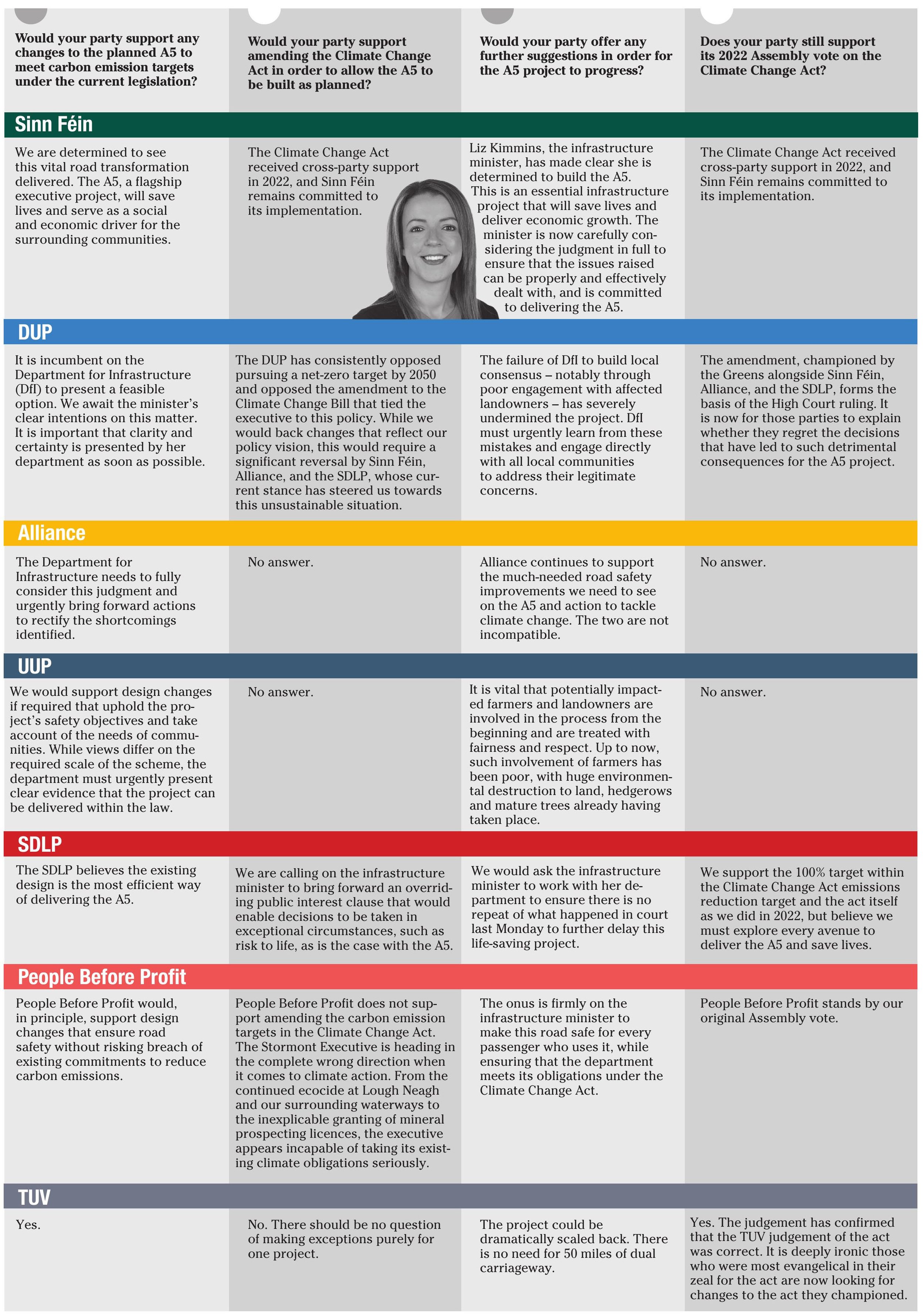
The North’s infrastructure crisis – and yes, it is a crisis – is further illustrated by last week’s court judgment blocking the upgrade of the A5, the most dangerous road on the island, which connects Donegal as well as Derry to Dublin. The court found that the Department for Infrastructure did not explain how the scheme meets the obligations of Stormont’s own climate change legislation.
Another serious failing in Northern Ireland is the education and skills system. The North has too few graduates, with around a third of undergraduates studying away because of lack of capacity within the local universities. Nor are there enough adults with high-level vocational skills. This, in turn, reflects a schools system based around academic selection – with many children from lower-income families not making the grade into the best-performing grammar schools.
Early school leaving
A consequence is that Northern Ireland has lots of teenagers who switch off in school and leave the education system at an early age. Rates of early school leaving are three times higher in the North than in Ireland. One in 10 school pupils in the North becomes disengaged as a teenager. These children are more likely to become economically inactive as adults, less likely to gain well-paid employment, more likely to suffer ill health and more likely to gain criminal records, becoming prisoners at high cost to the state.
All these problems (and many more) can be argued to be results of a political system that is unable to make difficult choices and allocate resources objectively. The Belfast Agreement achieved peace, but failed to provide an effective system of government. Indeed, Stormont has not even been sitting or operational for 40 per cent of the time since the agreement was signed. The Belfast Agreement never evolved beyond “conflict by peaceful means”.
This context raises the question: can Stormont be reformed? After working within the Stormont system as a political adviser, I left convinced that it cannot be made to work effectively. I was astonished at the continued sectarianism I perceived from some politicians, 27 years after the Belfast Agreement and the declaration of peace.
For many politicians in the North, governing is a zero-sum game – our community loses if your community gains anything. The result is that both communities are held back by the failure to govern for the good of all. And, equally important, Northern Ireland is no longer a society of just two communities. While Catholics today outnumber Protestants, these religious groupings contain a wide range of differences and neither forms a majority. The third section – from other and no religions and arriving from elsewhere – is large and in a sense, underrepresented politically.
Mutual Vetoes inconducive to Positive Attitudes
It is difficult to see how the existing structures of mutual veto by the senior representatives of unionism and republicanism can be remoulded to create a functional system. One wag suggested it is like giving joint government to Jeremy Corbyn and Nigel Farage and expecting it to work. (Or, it might be said, to Conor McGregor and Paul Murphy.)
The permanent impasse at Stormont and its inbuilt dysfunctionality causes many to find Irish unity the attractive alternative. But unity is not an easy option. For one thing, there is the cost. Unaffordable, says Prof John FitzGerald, given the scale of the subvention (subsidy) from the UK government. Affordable, argues Prof John Doyle, not least given the potentially transformative impact of unification.
Then there is the timeline, process, destination and lack of preparation. It is perhaps wrong to consider Irish reunification as a potential “big bang” event. As professors Seamus McGuinness and Adele Bergin have pointed out, the handover of Hong Kong to China took 13 years. The transition of East Germany is an ongoing process that has so far taken 35 years.
What concerns me most is the suggestion that Irish unity should lead to a federalised arrangement in which Stormont continues. When I argued to an Oireachtas committee a couple of years ago that the Northern Ireland Assembly is so dysfunctional that it cannot be retained within a new Irish State, the reaction from some senators seemed like suppressed horror. Why an institution that does not work and apparently cannot work should be retained within a new island-wide constitution is completely beyond me. For many close observers, abolition of Stormont is the single most attractive element of Irish unity.
For all their faults, the Irish Government and the Irish State work and are effective. Difficult decisions are taken, with mostly good outcomes. If the Irish Government comprises adults, their equivalents in the North often seem like rowdy teenagers – more focused on arguing and scoring points than on reaching compromise, consensus and the best solutions.
It would be understandable if people in the Republic read this and think, “why do we want them?” Despite the challenges, the emotional desire for Irish unity remains stable across the Republic’s population. The work of the Shared Island Unit has illustrated the challenges involved – it is the practical path to be navigated that remains to be agreed.
Paul Gosling is author of A New Ireland – A Five Year Review of Progress, published by Colmcille Press
The A5, Climate Change and where party’s stand
A case study of power sharing Stormont style - where rhetoric is a substitute for reality
‘Photo-ops’ are not enough O’Neill told as SDLP attacks executive’s record of delivery
Jonathan McCambridge, Irish News, July 2nd, 2025
MICHELLE O’Neill has been told that “staged photo-ops and platitudes” are no longer enough as the SDLP criticised the “woeful” record of delivery of the Stormont Executive.
Opposition leader Matthew O’Toole clashed with the first minister at the assembly, telling her that if the Dublin government had her record of delivery, it would have been “roasted” by Sinn Féin.
He also told Ms O’Neill that she was an “elected leader, not a royal”.
But the first minister hit back, insisting the powersharing executive has laid “strong foundations” to build upon in the future, as she answered questions in the assembly for the final time before summer recess.
Michelle O’Neill clashed with Opposition leader Matthew O’Toole
The SDLP Stormont leader said the executive had so far failed to deliver on upgrading the A5 or rebuilding Casement Park and said Sinn Féin and the DUP had voted to block action needed to deal with the environmental emergency at Lough Neagh.
Mr O’Toole added: “I could give lots of other examples of, I am afraid, woeful failure of delivery, but in the spirit of the end of term, first minister, can I ask you how do you think it is going?”
Ms O’Neill said: “There is no doubt that the executive and every minister in the executive faces enormous challenges as the result of years of under-funding, austerity budgets, crushed public services.
“I think every minister around that executive table is there to do their best… Will you do everything immediately? No, you won’t.
“Can you lay strong foundations to build upon? Yes, you can and that is what I believe we have done in this first year.”
Mr O’Toole responded: “Staged photo-ops and platitudes aren’t enough any more. You are an elected leader, not a royal. Blaming others when your own ministers have failed to do the basics.
Ms O’Neill said she had heard nothing but negativity from the SDLP, adding: “While the rest of us are getting on, no solutions, no credible proposals, no ideas from the funded and resourced opposition.”
Poots to investigate why O'Neill and Little-Pengelly not answering MLAs' questions
Adrian Rutherford, Belfast Telegraph, July 2nd, 2025
Stormont's Speaker has pledged to investigate why the First Minister and Deputy First Minister are dodging MLAs' questions.
Edwin Poots conceded it was not acceptable that it was taking up to a year to answer queries.
In a handful of cases, questions — which should be answered within 10 working days — remain outstanding more than 15 months after they were tabled.
TUV MLA Timothy Gaston raised the matter in the Assembly yesterday.
He cited a report by this newspaper on Monday, which detailed how Michelle O'Neill and Emma Little-Pengelly blocked the release of details about a St Patrick's trip to Washington that cost taxpayers almost £54,000.
While draft replies were provided to the ministers' private office, they were not released until months later — and only after the Information Commissioner's Office had forced their disclosure after a Freedom of Information (FoI) request.
A separate FoI request by Mr Gaston revealed that hundreds of prepared answers were held up for weeks, and often months, by Ms O'Neill and Ms Little-Pengelly.
Speaking in the Assembly, the TUV MLA accused the First Minister and Deputy First Minister of lacking respect for members.
“When ministers dodge questions, they are not just being evasive; they are breaking the rules of the House,” he said.
“The Speaker has rightly said that not answering a question for written answer for a year is clearly not acceptable.
Ministers answerable to Assembly
“Ministers are not above the Assembly. They do not get to choose which questions they answer or when. It is not a private office; it is a public government.
“If the Executive Office will not respect the Assembly's procedures, then we turn to you, Mr Speaker, to assess it.
“Scrutiny is not optional. Transparency is not up for negotiation. The public, who foot the bill, have the right to know how their money is being spent.”
In many cases, the answers — when eventually provided — amount to just a handful of words, indicating there is no agreed position.
According to insiders, the lack of consensus between the DUP and Sinn Fein on many issues, and the practical operation of the joint office, is to blame.
Any answer, whether to a press query or Assembly question, can only be released when agreed and signed off by both parties.
Mr Gaston asked what action the Speaker will take to compel ministers to fulfil their obligations by answering MLAs' questions.
Mr Poots, a former health and agriculture minister, responded: “We will look at that over the summer and see what more we can do to address the issue.
“As a minister, I was constantly aware of trying to answer questions on time. I am also aware, having done the health job at one stage, of how many questions you have to answer and the pressure that you are under. That does not mean that you cannot do it — you can do it.
“The Executive Office is different, because you have to have the agreement of the two ministers before something can be moved off.
“One might give them a bit of latitude. Nonetheless, up to 283 days is a tad extreme. We will look at that and see how we can address it in the next session.”
'We have a real problem here in NI with violence against women'
Niamh Campbell, Belfast Telegraph, July 2nd, 2025
COACH WHO TAUGHT SARAH MONTGOMERY SELF-DEFENCE CALLS FOR 'SEVERE' ACTION
A kickboxing coach who trained Sarah Montgomery in self-defence last year has called on more men in Northern Ireland to speak out against violence against women and girls.
Aaron Mouser coached ladies' self-defence classes at the community centre in Donaghadee from September 2023 to July 2024, under his franchise Savage Martial Arts.
He said that Ms Montgomery attended his classes soon after they started, adding that she was his best client and that she became a friend.
“She loved it. She absolutely loved it,” he explained.
“She was my most loyal customer, for want of a better word. She really enjoyed it and she would bring her daughters to the class sometimes. There were days where it was only her turning up and we had quite a few one-to-one training sessions.
“My partner went to school with Sarah — Glastry College. She was in the same year. So my partner came down and trained with Sarah as well, at least once or twice, and they caught up and everything.”
Mouser's reflections came as the First Minister warned that violence against women and girls was “embedded” in Northern Ireland.
Ms Montgomery (27) a pregnant mother-of-two, was found dead in her home on Elmfield Walk in Donaghadee on Saturday afternoon.
A 28-year-old man, who was known to Sarah, has been charged with murder and child destruction. He is due to appear before Newtownards Magistrates Court today.
A 42‑year‑old woman, also known to the victim, was arrested on suspicion of assisting an offender but was later released unconditionally by the PSNI.
Aaron and his partner heard the news at the weekend that a woman had been killed in Donaghadee, but wanted to believe that it wasn't Ms Montgomery, despite early reports.
“I was just absolutely horrified,” he said.
Showing text messages that Ms Montgomery had sent him last year, asking if she could bring her kids to Saturday classes, Aaron said: “She was just so lovely, warm, gentle, always really up for a laugh as well, every single time. She was a warm and wonderful mum.”
Aaron, who lives in Millisle, was born in England but moved to NI when he was young. Having witnessed his mother being domestically abused in front of him, he said it has spurred him on from a young age to advocate for stronger measures in deterring violence against women and girls.
“When I had the opportunity to start a ladies' self-defence course through the franchise, I was absolutely buzzing about it. And I've always been quite vocal about that anyway.”
He added that he wishes self-defence classes specifically aimed at women weren't needed, saying that they aren't a direct solution to the epidemic of gender-based violence in Northern Ireland.
“[Sarah] shouldn't have needed to defend herself in the first place.
Worst rate of demestic violence in UK
“We live in a country with the worst rate of domestic violence in the UK. We have a problem here on home ground and it's time that more severe punishment is discussed.
“Sarah obviously was close to me, and I was really fond of her, but those other 26 women since 2020... they're like a Sarah to someone else, you know?
“I would just hope that this is dealt with extremely severely. And I hope this is a turning point, because I think we do have a real problem.”
First Minister Michelle O'Neill also said yesterday that the problem of violence against women and girls is “embedded” in Northern Ireland.
She said she does not accept that the situation cannot be turned around and she called for a “whole of society” approach to dealing with it.
Ms O'Neill said: “I can't even imagine what her family are going through.
“A young mummy expecting her next child, her whole life ahead of her, and taken from her family in the most devastating way.”
Ms O'Neill further said the Executive Office had committed £3.2m until next March to support the strategy.
Ulster Unionist councillor for the area Mark Brooks said the community and development association are meeting to discuss initiatives targeted at preventing violence against women and girls.
A vigil for Sarah will also be held in Donaghadee tonight, with the community coming together with the local Women's Aid branch to facilitate it.
Cllr Brooks and Sarah's friend Joanne Courtney have set up an online fundraiser to help support Sarah's young daughters; within just two hours of the GoFundMe page being created, it received £12,000 in donations.
At The Blackbird crafts shop and Bow Bells Coffee Shop in Donaghadee, books of condolences were opened to the public yesterday, with donation boxes also set up for Sarah's family.
In one book, someone wrote: “Always a smile on her face any time you saw her.”
In addition, flowers can be purchased from the Green Room and white ribbons from The Blackbird, with all monies being given to Sarah's family.
Donaghadee Parish Church said its clergy and congregation were “deeply saddened” by Ms Montgomery's death.
“She was a familiar and friendly part of our local community, a young mum who would stand with other mums at the gate of Donaghadee Primary School at pick-up time, a school which she herself had attended,” it said.
“The tragic nature of Sarah's death, compounded with the loss of her unborn child, can only add to the immense sense of grief that her family and friends will be feeling.”
'We were Sinn Fein's friends in America until they wanted to change their image'
Suzanne Breen, Belfast Telegraph, July 2nd, 2025
AHEAD OF A NEW RTE DOCUMENTARY, SUZANNE BREEN LOOKS AT THE ROLE PLAYED BY IRISH AMERICANS DURING THE TROUBLES
For almost two decades, he was the public face of the IRA in the US. New York lawyer Martin Galvin was regarded as so dangerous by the authorities here that he was prohibited from entering the UK.
In August 1984 he defied the ban to appear at an anti-internment rally in west Belfast.
“I was brought across the Donegal-Derry border by republicans,” he says. “We walked miles through woodland. It was summer, but it was a cold, rainy night.”
Galvin never got to address the thousands gathered outside Connolly House in Andersonstown.
Gerry Adams introduced him on stage. As the lawyer took the microphone, the RUC moved forward, firing plastic bullets, in an attempt to arrest him. Twenty-two-year-old Sean Downes was killed. Galvin jumped off the platform.
As the RUC entered Connolly House, he was able to escape. “I'd a black coat on underneath the white one I was wearing. I put on a cap and glasses that were in my pockets,” he recalls.
“A young woman grabbed my hand and took me to a nearby house. It was only when in the attic there that I'd time to be afraid.”
Raised millions and suspected Donaldson
Galvin is speaking to the Belfast Telegraph ahead of a two-part RTE documentary, Noraid: Irish America and the IRA. It tells the story of the US citizens who raised millions of dollars for the republican movement.
The lawyer, who was Noraid's publicity director, knew he'd have to escape after addressing the rally, but nobody had anticipated the RUC would forcefully storm the crowd, he says.
He claims that just one republican present didn't seem surprised at the turn of events. “The only person who didn't look stunned was Denis Donaldson,” Galvin says. “He was chief steward at the rally. He was present for discussions leading up to my appearance. I'm convinced he'd told his handlers everything.”
In 2005 Donaldson admitted to being a British agent since the 1980s. A few years after the anti-internment rally the republican movement sent him to work in New York. He hated Galvin. “I'd clear evidence he was a traitor,” the lawyer says.
“I presented it, and expected him to be investigated. However, I was told that his credentials were impeccable, that he was beyond reproach and had the full confidence of the Sinn Fein leadership.”
The RTE documentary interviews Noraid members in their homes and workplaces. They give their account of involvement in an organisation which was loathed by the British and Irish governments, and the White House.
In his yellow cab, taxi driver John McDonagh says: “New York City has always been the cockpit of Irish republicanism, and it was a great honour when they read the Proclamation at the GPO. It said 'the exiled children in America' — and you're looking at them.
“Irish Americans have been part of the conflict from the 1800s. With the split of 1969, New York went with the Provisionals.”
Galvin says Sinn Fein knew Noraid members were “their friends in America — the people they could count on”.
Every US visitor entitled to bring $10,000 to Ireland
Millions of dollars went to Ireland. Every American visitor could legally take over up to $10,000. The money would be brought to the Dublin office of IRA prisoners' support group An Cumann Cabrach.
Noraid held fundraisers across the US. Limerick-born priest Fr Patrick Moloney, who worked with underprivileged youth in New York, sold raffle tickets at dinner dances.
In the documentary he jokes about wearing a big sleeved robe. If someone bought two tickets and handed him $50, he'd say “I won't insult you by giving change”. A painting of the Last Supper by republican prisoners in Portlaoise hangs in his home.
During the 1981 hunger strike Noraid held daily protests in New York. Children banged bin lids on the streets, and effigies of Margaret Thatcher were burned.
Michael Shanley grew up at protests: “There was never a card-carrying membership. You showed up, you went to meetings, you participated.”
He sold pro-IRA bumper stickers, posters and badges. “We couldn't sell that stuff fast enough,” he explains.
Noraid's Irish People newspaper, which Galvin edited, had subscriptions “in every state of the Union with the exception of Hawaii”, Shanley recalls. Brigid Brannigan says activists “changed careers to be sure they'd enough time to give to the cause”.
Galvin, whose grandfather came from Co Offaly, visited Ireland as a law student. He joined Noraid in 1976.
“Queen Elizabeth visited as the US celebrated 200 years of independence. I saw the hypocrisy of that as Ireland was denied freedom,” he says.
“I was an assistant district attorney. I was doing really well. I won a lot of cases. At some point I was hoping to become a criminal court judge. Becoming involved in Irish Northern Aid put a halt to that.”
Galvin flew to Ireland regularly to discuss political and media strategies with Adams and other senior republicans.
Playboy and Sinn Fein
Former Sinn Fein national publicity director Danny Morrison tells the documentary that Galvin once sent over a journalist from Playboy to interview republicans. “A lot of women in the movement weren't pleased, but it got massive publicity,” he explains.
Galvin defends his decision. “It got the Irish republican message to people far beyond the traditional audience. Playboy had a huge reach,” he says.
“It wasn't regarded as badly then as it is now. It did VIP interviews including ones with President Carter, Yasser Arafat and Lech Walesa.”
In 1983 McDonagh rented illuminated billboards in Times Square to send Christmas messages to IRA prisoners, which flashed across the screens every 12 minutes.
He tells the documentary he'd said he was a member of an Irish Catholic charity when booking the advertising. “They never asked me what type of charity,” he recalls. “I said I wanted to send season's greetings to the Irish people. They never asked what type of Irish people. I didn't offer what type.”
The messages ended with UTP — Up The Provos. The company had thought it meant Up The Pope.
Hours after Bobby Sands died on hunger strike in 1981, Noraid had organised a march with demonstrators carrying a coffin from the British consulate to UN headquarters. Weeks later a protest was held at the Metropolitan Opera House as Prince Charles attended a gala performance of the Royal Ballet's Sleeping Beauty.
Four hunger strikers' families addressed the rally. New York Mayor Ed Koch batted off complaints about the protest.
NYPD Pipe band at Hunger Strike commemoration
Complaints about NYPD officers' support for republicans similarly fell on deaf ears. Chris Byrne joined the force in 1983 and played in its pipe band, which visited Ireland the following year.
When playing at the Rose of Tralee contest in Kerry, the band decided to also join a Sinn Fein hunger strike commemoration in Bundoran. Byrne recalls his bosses and Mayor Koch paying no heed to gardai complaints.
The band's participation challenged the negative stereotype of US-born Irish republican supporters, he argues. “Next thing you have a contingent of Kojaks coming down the road, it was very hard to write that off,” he says.
The Rev Ian Paisley's claim that there was “an active service unit in the NYPD” was “preposterous”, the former policeman says. He views the band's Bundoran visit as “a great moment altogether” and perhaps its “proudest”.
Noraid always rejected claims the money it raised really went to the IRA. Former Provisionals interviewed in the documentary support that denial. Gabriel Megahey was jailed for arms smuggling. “The FBI said I was the officer commanding US and Canada,” he says.
“We didn't need Irish Northern Aid money. There were people here, contractors. If I needed money I'd go to them and get it.”
Megahey discloses how IRA members took weapons over on the QE2. “You'd be walking out the dock gate and the next thing the seams of your trousers would be busted (with) the barrels sticking out. How we got away with it,” he adds.
John Crawley, a US Marine from Chicago who joined the IRA, says going near Noraid would have been “suicide” as its open membership meant undercover FBI agents could join.
Yet some members of the organisation were involved in gun smuggling. Its founder, 79-year-old Michael Flannery, was charged with arms offences with four other men in 1982. They were found not guilty.
Nobody wanted to convict geriatrics
Bernadette Devlin, who appeared as a defence witness, tells the documentary “nobody in the courtroom wanted to convict this geriatric mob sitting in front of them”.
Byrne recalls the acquittal celebrations that night at a Woodside ballroom. “A couple of jurors came up on the stage and were saluted by the crowd. They were pumping their fists in the air, and we were all together,” he says.
From 1983 Noraid organised “fact-finding” tours to Northern Ireland. People were “billeted” with local families. Kathleen Savage was on one trip. She was delighted to have her picture taken with Adams.
The documentary shows footage of Sinn Fein's Tom Hartley warning the visitors the RUC could arrest and hold them for up to seven days.
“If they ask you for the name of a solicitor, you must ask for Pat Finucane,” he says. “Having suitably frightened you all, I'll tell you about the torture too!” Hartley quips.
A masked IRA man can be seen boarding one of the Noraid buses to cheers. Savage recalls that at Derry's Rossville Flats “the lads were in full gear. I asked them could I take a photo. They said: 'Oh sure, snap away'”.
Morrison describes the Noraid visitors as “more principled about what was happening (here) than successive Irish governments”.
He argues that Irish America generally played a significant role. “They were the sons and daughters, or grandsons and granddaughters, of people who had suffered as a result of British policy in Ireland,” he says.
“Those people send money back, some of those people sent weapons back. It was a case of chickens coming home to roost.”
US Visa for Adams
Before the 1992 New York Democratic presidential primary, Galvin quizzed Bill Clinton about a visa for Adams. Clinton pledged to support granting one — which he did when president — and Adams flew over in 1994.
The party's direct access to the US spelt the beginning of the end for Noraid. Friends of Sinn Fein was set up in Washington with “business people and human rights lawyers” brought in who had no connection with the past struggle.
The party could reach into “a whole new set of money” with $10,000-a-head dinner tables in corporate America.
Galvin says: “I was told I had the wrong image. They saw me as too closely associated with support for the IRA. They wanted to change their image. They wanted to leave Irish Northern Aid behind. I had to just accept it and stand aside.”
Megahey tells the documentary: “I always stayed friends with Martin. Martin defended me many times. He was always there. He was always at my back. I think he was treated disgracefully.”
Morrison believes Noraid had “a fundamentalist point of view”, and Sinn Fein was moving into a “pragmatic phase” which “not everybody was suited to… not everybody agreed with”. He adds: “It can't be a position of the tail wagging the dog.”
McDonagh says there was “no big bang moment”, the organisation “just fizzled out... we moved on with our lives”.
Galvin remains active in Irish American politics. He is now Freedom for All-Ireland chair in the Ancient Order of Hibernians.
But how does he feel about his Noraid past and the group's decommissioning? He says: “I'm an Irish republican hardliner, I'm proud of that. I've no regrets, except that we haven't achieved a united Ireland.”
Noraid: Irish America and the IRA, RTE One, July 9 and 16 at 9.35pm
‘Two-thirds of Glenanne Gang were members of the RUC, UDR or TA’
Connla Young, Irish News, July 2nd, 2025
A LIST of Glenanne Gang suspects published in a new book by the brother of three of its victims suggests that more than two-thirds were members of the RUC, UDR or Territorial Army.
The loyalist gang, which is believed to have killed around 120 people, included members of the RUC, UDR and UVF.
Its activities are currently being examined by the Kenova investigation team and Police Ombudsman.
The gang was responsible for some of the worst atrocities of the Troubles, and has been linked to the 1974 Dublin and Monaghan bombings, which killed 33 people.
In the book ‘The Killing of the Reavey Brothers: British Murder and Cover Up in Northern Ireland’, south Armagh man Eugene Reavey has published a detailed list of those alleged to have been involved in the gang.
Mr Reavey’s brothers John Martin (24) and Brian (22) were shot dead by members of the gang on January 4 1976 at their Whitecross home in south Armagh.
A third brother, Anthony (17), died several weeks later from his injuries.
Mr Reavey, who has campaigned on behalf of his murdered brothers for almost five decades, has now revealed details of those he believes were involved with the killer gang.
While many of the members were already known, Mr Reavey finds that 23 of the 35 people listed were members of the RUC, UDR and Territorial Army – more than twothirds.
The information was contained in a document submitted to a coroner’s court in 2015 by the family of Elizabeth McDonald (38).
The mother-of-three died in a car bomb explosion at the Step Inn Bar in Keady, Co Armagh, in August 1976, which was carried out by the gang.
The book, which was co-authored by journalist Ken Murray, does not identify all the suspects “for legal reasons”.
Among those listed is Robin ‘The Jackal’ Jackson, a suspected British agent, believed to have been involved in multiple sectarian killings.
The list also includes UDR member Bertie Frazer, who was shot dead by the IRA in August 1975.
A week before he was shot dead, the Glenanne Gang killed Catholic men Sean Farmer (32) and Colm McCartney (22) near Newtownhamilton as they made their way home from a GAA match in Croke Park.
The book claims Mr Frazer’s son, Willie Frazer, claimed to have driven a getaway car during the attack that claimed the lives of the Reavey brothers. Mr Reavey writes that his family later received information from “Protestant locals” that Willie Frazer had boasted he was “a getaway driver in the Reavey murders”.
Mr Reavey claims Frazer had “a grudge” against his family after the IRA killed his father adding “we had no connection to Bertie’s, or anyone else’s death, but unfortunately, Willie blamed us”.
The Frazer family have previously denied that Bertie or Willie Frazer had any connection to paramilitary organisations or activity, saying a Historical Inquiries Team document stated that it found no evidence of Bertie Frazer’s involvement.
The Killing of the Reavey Brothers: British Murder and Cover Up in Northern Ireland, by Eugene Reavey with Ken Murray and published by Mercier Press, is available now.
Legislation ‘forthcoming’ to stop Adams type internment compensation
Gráinne Ní Aodha and Jonathan McCambridge, Irish News, July 2nd, 2025
A Supreme Court judgment in 2020 paved the way for former Sinn Féin president Gerry Adams to secure compensation over his internment without trial in the early 1970s
“ The main issue here is the application of the Carltona principle in the context of ICOs. The previous government’s attempt to address this following the 2020 Supreme Court judgment in Adams has been found by the Northern Ireland courts to be unlawful and we need to find a better way of reaffirming this principle
LEGISLATION is to be brought forward to stop Gerry Adams receiving compensation over being interred in the 1970s, the secretary of state has confirmed.
Hilary Benn said that draft laws to address issues highlighted by the Adams case was “forthcoming”.
A Supreme Court judgment in 2020 paved the way for the former Sinn Féin president to secure compensation over his internment without trial in the early 1970s.
Mr Adams won his appeal to overturn historical convictions for two attempted prison breaks, after he was interned without trial in 1973 at Long Kesh internment camp, also known the Maze Prison, near Lisburn.
The Supreme Court ruled that his detention was unlawful because the interim custody order (ICO) used to initially detain him had not been “considered personally” by then secretary of state Willie Whitelaw.
At the time of the case, the previous government contended that the ICOs were lawful because of a long-standing convention, known as the Carltona principle, where officials and junior ministers routinely act in the name of the secretary of state.
Mr Adams subsequently successfully challenged a decision to deny an application for compensation for his detention.
However, the Legacy Act stopped such payouts to Mr Adams and other former internees.
The Act retrospectively validated the ICOs to make them lawful and halted civil claims related to the orders.
However, in February last year, the High Court in Belfast ruled that the provisions of the act related to the ICOs were incompatible with the European Convention on Human Rights.
The Labour government has not appealed that judgment and has tabled a remedial order in Parliament that will repeal various parts of the legacy act.
The draft laws to be introduced by Mr Benn will aim to give effect the block on payouts to former detainees in a lawful manner.
In a question to Mr Benn, Labour MP Chris McDonald asked “what steps he is taking to address the issue of interim custody orders that were not signed by his predecessor” in relation to Mr Adams’s case.
Responding in a written answer on June 26, the secretary of state said: “The main issue here is the application of the Carltona principle in the context of ICOs.
“The previous government’s attempt to address this following the 2020 Supreme Court judgment in Adams has been found by the Northern Ireland courts to be unlawful and we need to find a better way of reaffirming this principle.
“The government will therefore legislate to address this issue in forthcoming primary legislation.”
Archibald downplays economic support for Ballymena businesses hit by recent race riots
David Young, Belfast Telegraph, July 2nd, 2025
Providing direct financial support to businesses hit by the recent race-related violence in Ballymena is not the most appropriate way Stormont can respond to the disorder, the Economy Minister has said.
Caoimhe Archibald made clear she was not planning to channel funding to the businesses caught up in the rioting as she was asked about the issue during Assembly Question Time.
DUP North Antrim MLA Paul Frew had questioned the minister about the Executive's response to the violence as he outlined the impact on businesses.
Mr Frew said some restaurants were now unable to find chefs willing to work in the town as he highlighted that a number of workers had fled Ballymena.
Several businesses and homes were vandalised and set alight during last month's race-linked violence.
The disorder flared in response to an alleged sex attack on a teenage girl in the town. Two teenage boys were subsequently charged. They used a Romanian interpreter when before a court.
There were several days of unrest in Ballymena while sporadic rioting also erupted in other parts of Northern Ireland.
During Assembly questions, Mr Frew asked Ms Archibald to outline the engagement she has had with Stormont Executive colleagues on supporting the affected businesses in his constituency.
“Given the fact that we have seen Ballymena in particular in North Antrim in the press for all the wrong reasons given the violence, given that the footfall is down, given that some eateries can't get chefs now, given that the workers have had to flee and go home, what specific support can the minister give businesses in Ballymena affected?” he asked.
The minister branded the violence as “disgraceful and unacceptable”.
She also highlighted that businesses affected by criminal damage may be eligible to claim under the Criminal Damage Compensation Scheme run by the Department of Justice.
Combatting racism
But Ms Archibald downplayed the prospect of economic support from her department as she insisted the most appropriate response was a cross-departmental approach to tackling racism.
“In order to prevent a repeat of the hatred and intolerance that we saw, we need to see political and civic leadership standing united for inclusion and respect,” she said.
“And I think that we also need to see that civic leadership coming through. The idea of support coming through to support businesses, I don't think, is the most appropriate vehicle at this point in time. I think we need to see a cohesive and collective approach across departments as to how we address these challenges.
“I'm also aware that the Department for Communities has provided a small amount of funding to Mid and East Antrim Council to take forward work with the Ballymena Business Improvement District to positively promote Ballymena town centre. And I think that is something that will be useful.
“But, again, I would revert to the idea that we do need to have that very strong and clear leadership about the type of society that we want, that is inclusive for all.”
Anti-immigration petition is delivered to Belfast businesses
Conor Coyle, Irish News, July 2nd, 2025
ADDRESS TO KING CHARLES
A PETITION started by anti-immigration protesters calling on King Charles to stop both legal and illegal immigration into Northern Ireland has appeared within the premises of several businesses.
The petition has been introduced to a number of bars, shops and salons in recent days in areas such as east Belfast and the Shankill.
It comes weeks after violent unrest following anti-immigration protests in Ballymena. A week of violent clashes saw houses damaged and police officers injured.
In parts of Ballymena almost every house now has a symbol of Britishness in their windows to ward off attack. The letter has been delivered to local businesses by a prominent anti-immigration protest organiser who was previously convicted of breaching Covid regulations for organising an anti-lockdown protest.
The petition asks that “all immigration to Northern Ireland, whether by legal means or unlawful entry, be wholly ceased, to preserve the peace, stability, and good order of this realm”.
It goes on to call for the monarch to direct ministers of the UK government to “remigrate” those who have arrived to the UK both “lawfully” and “unlawfully”.
Among the local businesses which have signed up to host a petition on their premises are east Belfast bars.
Local shops bearing the Eurospar and Vivo brands have also featured the petition for customers to sign.
The individual organising and handing out the document to businesses posted on social media that the stores had “volunteered” to host the petition.
The website of the Henderson Group, which owns both the Eurospar and Vivo brands, highlights company values which include “treating everyone with dignity and respect” and being “inclusive and championing diversity”.
In a statement the retail group, which posted more than €60million in pre-tax profits last year, said it “strongly condemns” all forms of discrimination.”
“Henderson Group is committed to running stores that provide hubs for local communities and we strongly condemn any form of discrimination or exclusion,” a spokesperson said.
The anti-immigration petition that has been delivered to Belfast businesses
Asked whether any action would be taken against the businesses which have hosted the petition in store, the company did not respond to further requests for comment.
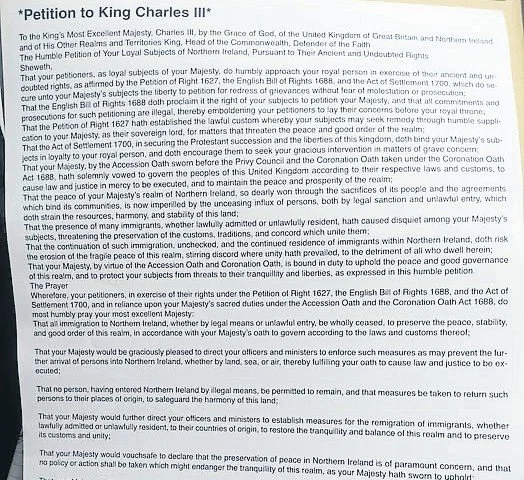
Petitioners invoke the 1688 Bill of Rights to lay their concerns before the Monarch